Cannabis Hyperemesis Syndrome: The Vomiting Disorder Linked to Long-Term Marijuana Use

Updated: 2 days ago
Medically reviewed by Dr. Baraa Alnahhal, MD · Last reviewed: October 2026
Quick answer
Cannabis hyperemesis syndrome is a condition causing cycles of severe nausea, vomiting and abdominal pain in long-term cannabis users, typically after about 10–12 years of at least weekly use [1]. Hot baths and showers temporarily relieve symptoms [1] [2]. Diagnosis involves ruling out other causes [1] [3]. The only cure is stopping cannabis completely [1] [4]; most people feel relief within 10 days [1].
What the research says
According to PubMed:
Hot-shower relief was common among frequent cannabis users in an emergency department. Among 155 patients aged 18–49 who smoked marijuana at least 20 days a month, 32.9% (95% CI 25.5–40.3%) met the study's criteria for CHS, which was based on rating hot showers as a strong relief method for nausea and vomiting. If that figure held across the general population, the authors estimated roughly 2.75 million Americans a year might have a CHS-like condition (Habboushe et al., Basic & Clinical Pharmacology & Toxicology, 2018) [5].
Suspected CHS visits rose sharply over 11 years. In Kaiser Permanente Northern California records, 57,227 patients had at least one suspected-CHS emergency visit under the narrower case definition. Annual prevalence rose by 134–175% between 2009 and 2019, depending on the definition used (Costales et al., Drug and Alcohol Dependence, 2024) [7].
Heavy daily use and unsuccessful quit attempts were typical. In a prospective cohort of emergency department patients with suspected CHS, 84% used cannabis more than once a day, and 79% had previously tried to stop — but only 13% of those had sought treatment (Wightman et al., Annals of Emergency Medicine, 2023) [8].
Study details are from PubMed abstracts.
What is cannabis hyperemesis syndrome?
Cannabis hyperemesis syndrome (CHS) happens when you have cycles of nausea, vomiting, and abdominal pain after using cannabis (marijuana) for a long time [1]. People with CHS often find temporary relief from these symptoms by taking hot baths and showers [1] [2].
"Hyperemesis" means severe vomiting [1]. Cannabinoids are compounds in the Cannabis sativa plant that bind to cannabinoid receptors in your brain, spinal cord, gastrointestinal tract, and other body tissues [1]. Examples of cannabinoids include tetrahydrocannabinol (THC) and cannabidiol (CBD).
CHS is more than just a side effect of marijuana use. It's a condition that can lead to serious health complications if you don't get treatment for it [1].

How common is it?
It's difficult for researchers to know how common CHS is. Not everyone with the condition seeks medical help or tells their provider that they use marijuana [1].
One study found that 32.9% of self-reported frequent marijuana users who came to an emergency department for care met the criteria for CHS [1] [5]. With the widespread use, increased potency, and legalization of marijuana in multiple states in the U.S., CHS may be becoming increasingly common [1].
What are the symptoms?
Symptoms of CHS typically come on several years after the start of chronic marijuana use [1]. But not everyone who uses marijuana long-term experiences CHS.
Hot baths and showers tend to help reduce or curb the symptoms. Many people with CHS will compulsively shower or bathe — often for hours every day — to relieve their symptoms [1] [2].
What is "scromiting"?
Some people call certain symptoms of CHS "scromiting." The term combines "vomiting" and "screaming." You may have intense pain, which causes you to scream while you vomit [1].
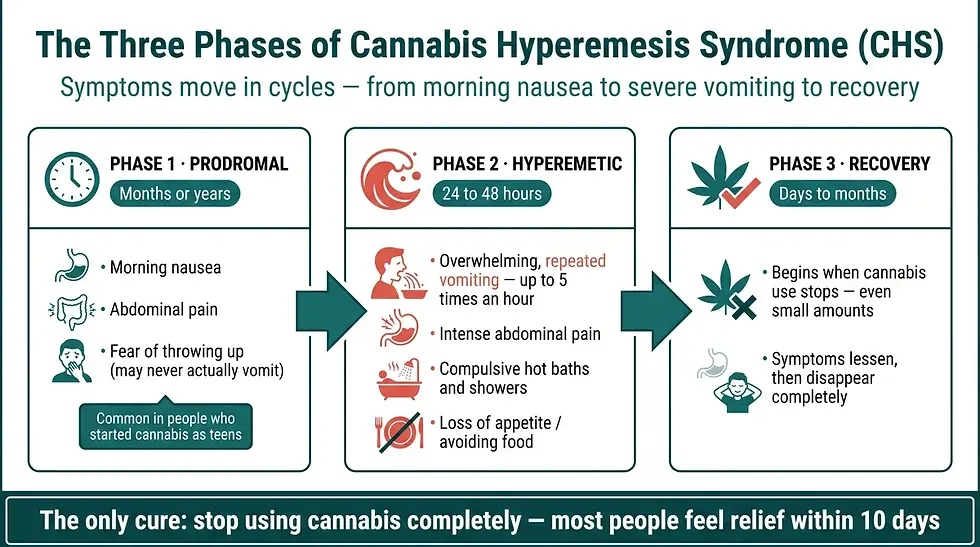
What are the three phases of CHS?
Cannabis hyperemesis syndrome (CHS) has three phases, and the symptoms and their severity depend on which phase you are in.
Phase | What happens | How long it lasts |
Prodromal phase | Most common in adults who have used cannabis since their teenage years; abdominal pain or morning nausea; may fear throwing up but never actually vomit | Months or years [1] |
Hyperemetic phase | The characteristic phase of CHS; overwhelming, recurrent vomiting and nausea; compulsive bathing; avoiding certain foods or purposefully restricting food intake | Usually 24 to 48 hours [1] |
Recovery phase | Begins when you stop using cannabis (even in small amounts); symptoms lessen and eventually disappear completely | A few days or months [1] |
What causes CHS?
Scientists don't yet know the exact cause of CHS. But the main theory is that it may happen due to long-term overstimulation of receptors in your endocannabinoid system (ECS) [1]. This may lead to issues with your body's natural control of nausea and vomiting [1].
Who is at higher risk?
People who use marijuana long-term — typically for about 10 to 12 years [1] — are at risk of developing CHS. But not every person who uses marijuana, even with long-term use, develops CHS.
It tends to affect people who use cannabis at least once a week and happens more often in adults who've been using cannabis since their adolescent years [1].
How is CHS diagnosed?
Healthcare providers mainly diagnose CHS based on your symptoms, medical history, and history of substance use [1]. Your provider will do a physical exam and may ask you how often and how long you've used cannabis, when you vomit or feel nauseated, whether certain foods trigger vomiting, whether you've lost weight for no known reason, and whether you take hot baths or showers to relieve symptoms [1].
It's important to be honest about your marijuana use if you have symptoms of CHS. Without knowing this background, providers often misdiagnose CHS as other conditions, like cyclic vomiting syndrome (CVS) [1].
Diagnostic criterion | What it means |
Long-term, frequent marijuana use | More than one year of use [1] |
Severe cyclic vomiting episodes | Repeated cycles of intense vomiting |
Abdominal pain | One of the core symptoms |
Symptoms stop with sustained abstinence | |
Compulsive bathing in hot water | A signature clue of CHS |
Your provider may also recommend tests to rule out other causes of nausea and vomiting, like blood tests, urinalysis, and imaging tests such as a CT scan or MRI [1].
How is it treated?
The only known treatment to permanently get rid of CHS is to stop cannabis use completely [1] [4]. You may have symptoms and side effects of CHS for a few weeks after quitting cannabis [1]. Over time, symptoms will disappear.
If you have cannabis use disorder and need help quitting, professional treatment is available. Talk to your healthcare provider or an addiction counselor.
Researchers are currently studying several treatment options to manage the hyperemetic phase of CHS. But there are currently no therapies approved by the U.S. Food and Drug Administration (FDA) for CHS [1].
You may need to go to the hospital for severe CHS. There, healthcare providers may give you IV fluids and electrolytes if you become dehydrated from vomiting; antiemetics (anti-vomiting medications), though these often aren't effective at relieving vomiting in CHS [1] [4]; and other alternative therapies for symptom relief, like capsaicin cream to relieve pain [1].
Hot baths may relieve the nausea for a while, but they don't cure CHS. Taking too many hot baths can increase dehydration due to sweating [1].
You may use home treatments to relieve CHS symptoms immediately after quitting cannabis. Your healthcare provider may recommend antihistamines like diphenhydramine (Benadryl), capsaicin cream to relieve pain, pain relievers like ibuprofen (Advil, Motrin) or acetaminophen (Tylenol), or prescription medications including benzodiazepines (like lorazepam), antipsychotic medications (like haloperidol), or tricyclic antidepressants [1].

How soon will I feel better?
Most people with CHS who stop using cannabis have relief from symptoms within 10 days [1]. But it may take a few months to feel fully recovered [1].
What are the possible complications?
Cannabis hyperemesis syndrome (CHS) can cause complications including dehydration, electrolyte imbalance, malnutrition, weight loss, tooth decay, choking, aspiration pneumonia, injury to the esophagus and scald burns from very hot water [1] [4].
When should I go to the ER?
Emergency: CHS can increase your risk for severe dehydration. Call 911 or go to your nearest emergency room if you have any dehydration symptoms, including:
Dark or very little pee
Delirium (sudden confusion)
Dizziness
Fatigue or unexplained sleepiness
Quickened heart rate
Rapid breathing
Syncope (fainting)
Can it be prevented?
The only proven way to prevent cannabis hyperemesis syndrome is to avoid cannabis (marijuana) [1].
Quitting marijuana use can be hard. If you need help quitting, speak to a healthcare provider or connect with your local addiction treatment services. You can also call the Substance Abuse and Mental Health Services Administration (SAMHSA) National Helpline at 1.800.662.4357. It's a free, confidential service that is open 24/7, 365 days a year [1]. They provide treatment referrals and information in English and Spanish.
Conclusion
Cannabis hyperemesis syndrome is a painful and potentially dangerous complication of long-term marijuana use — but it has one clear answer: stopping cannabis completely. If you've been using marijuana for a decade or more, especially since your teen years, and you're dealing with cycles of severe morning nausea and vomiting that hot showers seem to ease, CHS could be the cause. Being honest with your healthcare provider about your cannabis use is the fastest path to the right diagnosis, because without that information CHS is often mistaken for other conditions. With complete abstinence, most people feel relief within 10 days, and the symptom cycles eventually stop for good.
Looking for clear answers on tough health questions? Browse hundreds of plain-language guides at Rinnit.com.
Frequently asked questions
What is cannabis hyperemesis syndrome (CHS)?
CHS is a condition that causes cycles of severe nausea, vomiting, and abdominal pain in people who have used cannabis (marijuana) long-term. The only cure is stopping cannabis use completely.
Why do hot showers seem to help?
Many people with CHS find temporary relief from symptoms through hot baths and showers, and some compulsively bathe for hours every day. Hot water relieves symptoms but does not cure CHS — and too many hot baths can worsen dehydration.
What does "scromiting" mean?
"Scromiting" combines "vomiting" and "screaming." It describes the intense pain that causes some people with CHS to scream while they vomit.
Who is at risk for CHS?
People who have used marijuana long-term — typically about 10 to 12 years — especially those who use it at least once a week and started in their adolescent years. Not every long-term user develops CHS.
What are the three phases of CHS?
The prodromal phase (months to years of morning nausea and abdominal pain, sometimes without actual vomiting), the hyperemetic phase (24 to 48 hours of overwhelming vomiting and nausea with compulsive bathing), and the recovery phase (symptoms fade and disappear after stopping cannabis).
What causes CHS?
The exact cause is unknown. The main theory is long-term overstimulation of receptors in the endocannabinoid system (ECS), which disrupts the body's natural control of nausea and vomiting.
How is CHS diagnosed?
Providers diagnose CHS based on long-term frequent marijuana use (more than one year), severe cyclic vomiting episodes, abdominal pain, symptoms that stop with sustained abstinence, and compulsive hot-water bathing — with blood tests, urinalysis, or imaging (CT or MRI) to rule out other causes.
Why is honesty about marijuana use so important?
Without knowing about cannabis use, providers often misdiagnose CHS as other conditions, such as cyclic vomiting syndrome (CVS).
Is there a cure for CHS?
Yes — the only known treatment to permanently get rid of CHS is to stop using cannabis completely. No therapies are currently approved by the FDA for CHS.
Can anti-vomiting medications help?
Antiemetics are often not effective at relieving vomiting in CHS. Hospital care may instead include IV fluids and electrolytes, capsaicin cream, and, after quitting, antihistamines, pain relievers, or certain prescription medications recommended by your provider.
How soon will I feel better after quitting?
Most people who stop using cannabis have relief from symptoms within 10 days, though full recovery may take a few months. Some symptoms can linger for a few weeks after quitting.
What are the complications of untreated CHS?
Dehydration, electrolyte imbalance, malnutrition, weight loss, tooth decay, choking, pneumonitis, aspiration pneumonia, esophageal injury (Boerhaave's syndrome or Mallory-Weiss tear), and scald burns from very hot water.
When should I go to the emergency room?
Call 911 or go to the ER for signs of severe dehydration: dark or very little urine, sudden confusion (delirium), dizziness, fatigue or unexplained sleepiness, quickened heart rate, rapid breathing, or fainting (syncope).
Can CHS be prevented?
The only proven prevention is avoiding cannabis (marijuana) altogether.
Where can I get help quitting cannabis?
Talk to a healthcare provider or local addiction treatment services. You can also call the SAMHSA National Helpline at 1.800.662.4357 — free, confidential, 24/7, with information in English and Spanish.
Related reading
This article is for general informational purposes only and is not a substitute for professional medical advice, diagnosis, or treatment. Always seek the advice of your physician or other qualified health provider with any questions about a medical condition. Never disregard professional medical advice or delay seeking care because of something you have read here.
References
Cleveland Clinic. Cannabis Hyperemesis Syndrome (CHS). Cleveland Clinic. Medically reviewed; last updated January 16, 2024. https://my.clevelandclinic.org/health/diseases/21665-cannabis-hyperemesis-syndrome
Buesing S. Cannabinoid Hyperemesis Syndrome (CHS): Symptoms and Treatment. American Addiction Centers. Updated October 22, 2024. https://americanaddictioncenters.org/marijuana-rehab/cannabinoid-hyperemesis-syndrome
Hoff RT, Faulkner CS. Cannabinoid Hyperemesis Syndrome (CHS) and the Cyclic Vomiting Syndrome (CVS) in Adults. American College of Gastroenterology. Updated August 2026. https://gi.org/topics/cannabinoid-hyperemesis-and-the-cyclic-vomiting-syndrome-in-adults/
Cue L, Chu F, Cascella M. Cannabinoid Hyperemesis Syndrome. Updated July 3, 2023. In: StatPearls [Internet]. Treasure Island (FL): StatPearls Publishing; 2023 Jan-. PMID 31751105. https://www.ncbi.nlm.nih.gov/books/NBK549915/
Habboushe J, Rubin A, Liu H, et al. The prevalence of cannabinoid hyperemesis syndrome among regular marijuana smokers in an urban public hospital. Basic Clin Pharmacol Toxicol. 2018;122(6):660-662. PMID 29327809. https://doi.org/10.1111/bcpt.12962
Khattar N, Routsolias JC. Emergency department treatment of cannabinoid hyperemesis syndrome: a review. Am J Ther. 2018;25(3):e357-e361. PMID 28953512. https://doi.org/10.1097/MJT.0000000000000655
Costales B, Lu Y, Young-Wolff KC, et al. Prevalence and trends of suspected cannabinoid hyperemesis syndrome over an 11-year period in Northern California: an electronic health record study. Drug Alcohol Depend. 2024;263:112418. PMID 39216202. https://doi.org/10.1016/j.drugalcdep.2024.112418
Wightman RS, Metrik J, Lin TR, et al. Cannabis use patterns and whole-blood cannabinoid profiles of emergency department patients with suspected cannabinoid hyperemesis syndrome. Ann Emerg Med. 2023;82(2):121-130. PMID 37479395. https://doi.org/10.1016/j.annemergmed.2023.03.005



Comments