Caffeine Sensitivity: Why a Small Coffee Can Wreck Your Day and What to Do About It

Updated: 3 days ago
Medically reviewed by Dr. Baraa Alnahhal, MD · Last reviewed: October 2026
Quick answer
Caffeine sensitivity is how quickly or strongly you feel caffeine's stimulating effects, which varies widely between people [1] [2]. Up to 400 milligrams a day is generally safe for most adults [1] [2]. Symptoms include racing heart, jitters, anxiety, insomnia and headache [1]. Causes include genetics, medications and habits [1]. Cut back slowly to avoid withdrawal and read labels for hidden caffeine [1].
What the research says
According to PubMed:
Your CYP1A2 genotype changed how people responded to caffeine. In a systematic review of 19 randomized trials with 732 participants, caffeine improved exercise performance in people with the AA genotype, helped people with the AC genotype less, and had no effect or a negative effect in people with the CC genotype. (Messenburger et al., Nutrition Research, 2025 [6]).
Sensitivity genes may also change how the gut reacts to caffeine. In a small randomized trial of 18 adults, people with the ADORA2A TT ("high sensitivity") genotype had a rise of about 109% in a gut-cell damage marker after exercising with caffeine, compared with 48% in "low sensitivity" participants, whose increase was not statistically significant. The authors called the study preliminary. (Davison et al., Physiological Reports, 2025 [7]).
What is caffeine sensitivity?
Caffeine sensitivity is how quickly (or slowly) you feel the stimulating effects of caffeine [1], or how much it affects you. Levels of caffeine sensitivity vary widely [1]. Some people don't feel anything after having a shot of espresso. Others are wide awake after eating a small piece of chocolate. Your sensitivity to caffeine can also change based on factors like the medications you're taking.
Most adults can safely have up to 400 milligrams of caffeine a day without experiencing any negative effects [1] [2]. Caffeine has many benefits, like boosting your energy and fighting inflammation [1]. But some people have a higher sensitivity to it, and others have a lower sensitivity.
Caffeine sensitivity is different from a caffeine allergy or caffeine intolerance. A caffeine allergy is when your immune system mistakenly thinks caffeine is a harmful invader and reacts to try to get rid of it [1]. Caffeine sensitivity is also a different condition from caffeine overdose or caffeine toxicity. That occurs when you consume more caffeine than your body can handle [1].
What are the symptoms of caffeine sensitivity?
Caffeine sensitivity impacts your central nervous system. It can cause your heart to race, increase your blood pressure, and give you heart palpitations [1].
Other symptoms include rapid, shallow breathing, anxiety, jitters, insomnia, nausea and vomiting, headache, and irritability [1].
Symptom | What it feels like |
|---|---|
Rapid heart rate | Heart beats faster than usual |
Heart palpitations | Fluttering or pounding in the chest |
Increased blood pressure | Higher-than-normal blood pressure readings |
Rapid, shallow breathing | Breathing that is faster and lighter |
Anxiety | Feeling nervous or on edge |
Jitters | Shaky, restless feeling |
Insomnia | Trouble falling or staying asleep |
Nausea and vomiting | Upset stomach, sometimes throwing up |
Headache | Pain in the head |
Irritability | Easily annoyed or upset |
Rapid heart rate, heart palpitations, and increased blood pressure all point to too much caffeine.

How is caffeine sensitivity different from an allergy?
You can tell the difference between caffeine sensitivity and caffeine allergy by the symptoms. A caffeine allergy involves the immune system and can look like other allergic reactions.
Caffeine sensitivity | Caffeine allergy |
|---|---|
Impacts the central nervous system | Involves the immune system |
Racing heart, jitters, anxiety, insomnia | Hives, itchy skin |
Comes from caffeine's stimulating effects | Swelling of lips, tongue, or throat |
Not dangerous on its own | Trouble breathing; can cause anaphylaxis [1] |
What causes caffeine sensitivity?
Caffeine sensitivity can happen for different reasons.
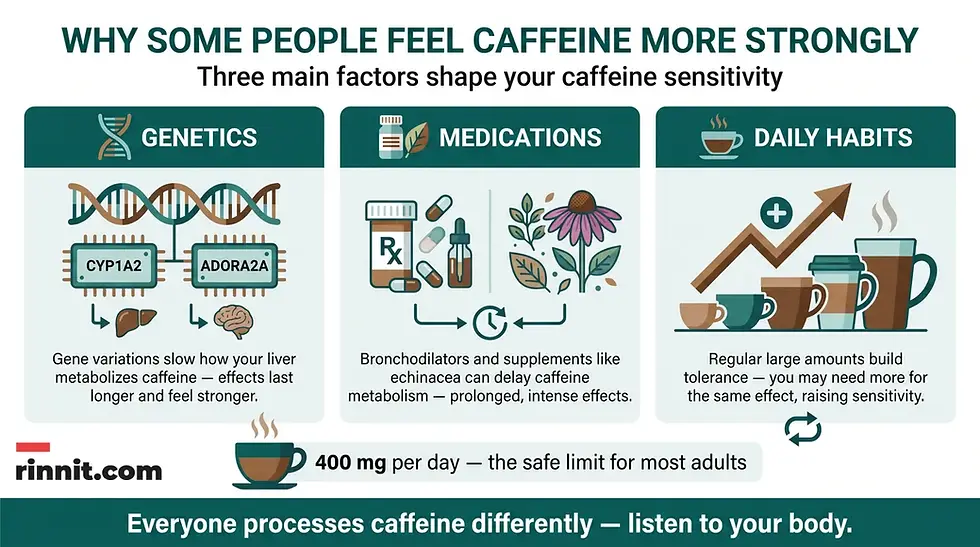
Genetics. Certain genetic changes, called variations, may affect the speed at which your body absorbs and uses caffeine. Research suggests that variations in the CYP1A2 gene can influence how fast your liver breaks down caffeine, while variations in the ADORA2A gene can change how strongly your brain responds to it [1]. Metabolizing is the process of breaking down a substance your body doesn't need. People with these genetic variations take longer to process caffeine and may feel its effects more strongly.
Medications. Certain medications and herbal supplements can increase caffeine's effects on your body. Medications like bronchodilators and supplements like echinacea can delay caffeine from metabolizing [1]. So, your body may experience prolonged, intense effects.
Daily habits. If you regularly consume large amounts of caffeine, your body may build up a tolerance to it [1]. So, you may need higher amounts to get the same effects. This means you may become less sensitive to its effects over time.
How do I know if I have caffeine sensitivity?
If you notice your heart racing or you feel jittery after your morning coffee, you might be sensitive to caffeine. If so, you might want to reduce the amount of caffeine you consume.
It's important to read product labels. Many foods, drinks, and medications contain caffeine [2]. So, you may be consuming more than you realize.
Try keeping a food diary to track your caffeine intake [1]. You may wish to cut out all forms of caffeine. Then, you can slowly add it back in to figure out when your symptoms start.
Providers don't have a specific test to diagnose caffeine sensitivity [1]. But they may recommend genetic testing [1]. Genetic testing can tell you if you have a gene variation that affects your body's ability to metabolize caffeine. If your sensitivity continues to cause problems, discuss your symptoms with your healthcare provider.
How do you treat caffeine sensitivity?
Treatment for caffeine sensitivity involves watching how much caffeine you consume. You may want to cut back on the amount you take in. See if limiting caffeine reduces your symptoms.
But make sure you reduce your caffeine intake slowly [1] [2]. If you're physically dependent on the stimulant, you may have withdrawal symptoms. These include headache, nausea, and anxiety [1].
After you've reduced your consumption, you may wish to cut it out of your life altogether. Continue to check product labels. And try new beverage choices, like decaffeinated coffee or even water.
You can also speak with your healthcare provider about your symptoms and concerns. They can help you figure out other ways to reduce your caffeine intake and manage your sensitivity.
Step | What to do | Why it matters |
|---|---|---|
1. Track | Keep a food diary of everything with caffeine | Hidden caffeine is easy to miss |
2. Cut back slowly | Reduce intake gradually, not cold turkey | Avoids withdrawal headache, nausea, anxiety |
3. Check labels | Read labels on foods, drinks, and medicines | Caffeine hides in chocolate, soda, ice cream, and OTC products |
4. Try alternatives | Decaf coffee, half-caff, or water | Keeps the routine without the caffeine |
5. Talk to your provider | Discuss ongoing symptoms | They can help you manage sensitivity |

What is the outlook?
Caffeine sensitivity isn't usually life-threatening [1]. It can cause some uncomfortable symptoms. But you should be able to manage them by cutting back or eliminating your intake of caffeine.
Make sure to read product labels for hidden sources of caffeine. It can be found in more than just coffee and tea. Foods and beverages like chocolate, soda, and even some ice creams contain caffeine [1]. Over-the-counter products like herbal supplements and some headache medicines contain it, too [1]. If cutting back doesn't help, talk to your healthcare provider for guidance.
Can caffeine sensitivity be prevented?
If you find that you're highly sensitive to caffeine, it's helpful to know that you can prevent the condition's effects. Cutting back or eliminating caffeine altogether can reduce symptoms. Reduce your intake slowly. You may be able to tolerate a lower amount. Or you may have to stop consuming it.
Either way, there are alternatives to caffeine. You can try decaffeinated coffee or tea. "Half-caff" — a 50/50 blend of regular and decaffeinated coffee [1] — is an option. Or you may just want to stick with water.
How do I know when I've had too much?
How much caffeine is too much? Your body will let you know. Caffeine sensitivity depends on several factors. Some people can take in more than others before feeling its effects [2].
Listen to your body. If you're experiencing symptoms like a racing heartbeat or rapid breathing, you may want to cut back on caffeine. Cut back slowly and keep track of your symptoms. If your symptoms decrease, you may have caffeine sensitivity. If your symptoms don't go away, see your healthcare provider for additional guidance.
Conclusion
Caffeine sensitivity comes down to one simple idea: everyone processes caffeine differently. For most adults, up to 400 milligrams a day is safe, but your genes, medications, and habits can change that number for you. The good news is that caffeine sensitivity is uncomfortable but not dangerous, and it is highly manageable. Track what you consume, cut back slowly, read labels for hidden caffeine, and lean on decaf, half-caff, or water. If your symptoms stick around even after cutting back, a healthcare provider can help you figure out what's going on.
Curious about everyday health questions? Explore more plain-language health guides at Rinnit.com.
Frequently Asked Questions
What is caffeine sensitivity?
Caffeine sensitivity is how quickly or strongly you feel caffeine's stimulating effects. Sensitivity varies widely — some people feel nothing after an espresso shot, while others stay awake after a small piece of chocolate.
How much caffeine is safe for most adults?
Most adults can safely have up to 400 milligrams of caffeine a day without experiencing negative effects. If you are pregnant, experts advise keeping caffeine under 200 milligrams a day.
Is caffeine sensitivity the same as a caffeine allergy?
No. A caffeine allergy involves the immune system reacting to caffeine as a harmful invader, causing hives, itchy skin, swelling of the lips, tongue, or throat, trouble breathing, or anaphylaxis. Sensitivity affects the central nervous system instead.
Is caffeine sensitivity the same as a caffeine overdose?
No. Overdose (or toxicity) happens when you consume more caffeine than your body can handle. Sensitivity is about how strongly you react to normal amounts.
What are the symptoms of caffeine sensitivity?
A racing heart, heart palpitations, increased blood pressure, rapid shallow breathing, anxiety, jitters, insomnia, nausea and vomiting, headache, and irritability.
Why do some people feel caffeine more strongly than others?
Genetics play a big role. Variations in the CYP1A2 gene affect how fast your liver breaks down caffeine, and ADORA2A variations affect how strongly your brain responds to it, so some people process it more slowly and feel it more strongly.
Can medications make caffeine sensitivity worse?
Yes. Certain medications and herbal supplements, such as bronchodilators and echinacea, can delay caffeine from metabolizing, leading to prolonged, intense effects.
Can daily habits change caffeine sensitivity?
Yes. Regularly consuming large amounts of caffeine builds tolerance, so you may need higher amounts for the same effects — which means you become less sensitive to it.
Is there a test for caffeine sensitivity?
Providers don't have a specific test to diagnose it. They may recommend genetic testing to check for gene variations that affect how your body metabolizes caffeine.
How do I figure out if caffeine is my problem?
Keep a food diary to track your intake, cut out all caffeine, then slowly add it back in to see when symptoms start.
How should I cut back on caffeine?
Reduce your intake slowly. If you're physically dependent on caffeine, quitting cold turkey can cause withdrawal symptoms like headache, nausea, and anxiety.
Where is caffeine hiding besides coffee and tea?
In chocolate, soda, some ice creams, over-the-counter herbal supplements, and some headache medicines. Reading product labels helps.
Can caffeine sensitivity go away?
Yes. Cutting back or eliminating caffeine can reduce symptoms. You may be able to tolerate a lower amount, or you may have to stop consuming it entirely.
What can I drink instead of regular coffee?
Decaffeinated coffee or tea, "half-caff" (a 50/50 blend of regular and decaf coffee), or simply water.
When should I see a healthcare provider?
If your symptoms don't go away after cutting back on caffeine, see your provider for additional guidance. Also seek care right away for signs of an allergic reaction, such as throat swelling or trouble breathing.
This article is for general informational purposes only and is not a substitute for professional medical advice, diagnosis, or treatment. Always seek the advice of your physician or other qualified health provider with any questions about a medical condition. Never disregard professional medical advice or delay seeking care because of something you have read here.
Related Reading
What Is a Caffeine Overdose? Symptoms, Safe Limits, and Treatment explains the warning signs of too much caffeine and when to get help.
Heart Palpitations: Causes, Symptoms & Treatment Guide describes racing or pounding heartbeats and when they need a checkup.
Anxiety Disorders: Symptoms, Types, Causes, Treatment & Complete Guide explains anxiety symptoms that caffeine can make worse.
Cognitive Behavioral Therapy for Insomnia (CBT-I): How It Works, How Long It Takes, and Results describes a proven, drug-free treatment for trouble sleeping.
References
Cleveland Clinic. Caffeine Sensitivity. Cleveland Clinic. Medically reviewed; last updated December 1, 2025. https://my.clevelandclinic.org/health/diseases/caffeine-sensitivity
U.S. Food and Drug Administration. Spilling the Beans: How Much Caffeine is Too Much? U.S. Food and Drug Administration. Content current as of 08/28/2024. https://www.fda.gov/consumers/consumer-updates/spilling-beans-how-much-caffeine-too-much
Evans J, Richards JR, Battisti AS. Caffeine. Updated May 29, 2024. In: StatPearls [Internet]. Treasure Island (FL): StatPearls Publishing; 2024 Jan-. PMID 30137774. https://www.ncbi.nlm.nih.gov/books/NBK519490/
Murray A, Traylor J. Caffeine Toxicity. Updated February 6, 2025. In: StatPearls [Internet]. Treasure Island (FL): StatPearls Publishing; 2025 Jan-. PMID 30422505. https://www.ncbi.nlm.nih.gov/books/NBK532910/
Saimaiti A, Zhou DD, Li J, et al. Dietary sources, health benefits, and risks of caffeine. Crit Rev Food Sci Nutr. 2023;63(29):9648-9666. PMID 35574653. https://doi.org/10.1080/10408398.2022.2074362
Messenburger GP, Nuñez FF, Porepp O, et al. Influence of the CYP1A2 genotype on the exercise performance of physically active individuals under caffeine supplementation: a systematic review. Nutr Res. 2025;144:16-31. PMID 41207073. https://doi.org/10.1016/j.nutres.2025.10.005
Davison G, Carswell AT, Baron P, et al. Caffeine exacerbates exercise-induced gut cell damage and is influenced by ADORA2A genotype but not CYP1A2 genotype: a preliminary study. Physiol Rep. 2025;13(22):e70673. PMID 41261949. https://doi.org/10.14814/phy2.70673



Comments