Boxer's Fracture: Symptoms, Treatment, and Recovery Time Explained

Updated: 2 days ago
Medically reviewed by Dr. Baraa Alnahhal, MD · Last reviewed: October 2026
Quick answer
A boxer's fracture is a break in the neck of the fifth metacarpal, the hand bone connecting the pinkie to the wrist [1], usually from punching something hard with a closed fist [1]. Symptoms include pain, swelling and the pinkie crossing the ring finger [1]. Mild cases need a splint or cast for three to six weeks; severe cases may need surgery [1].
What the research says
According to PubMed:
Buddy strapping performed comparably to a hand-based orthosis. In a randomized noninferiority trial of 62 adults with a fifth metacarpal neck fracture, mean QuickDASH scores at 6 weeks were 10.7 in the orthosis group and 9.6 in the buddy strapping group, with no significant difference and no device-related adverse events. The authors note the trial was underpowered. (Clark et al., J Hand Ther, 2026) [3].
Closed reduction with casting maintained improved angulation. In a retrospective review of 115 patients treated with closed reduction and a 4-week below-elbow cast, mean volar angulation was 49.9° at presentation, 40.9° after reduction, and 42.4° after cast removal. (Hoppe et al., Wien Klin Wochenschr, 2026) [4].
Surgery and conservative care gave similar grip strength. A meta-analysis of 5 studies and 311 patients found no significant difference in grip strength or shortening between surgical and conservative treatment, though palmar angulation was significantly reduced in the surgical group. (Mohabey et al., Ann Chir Plast Esthet, 2026) [5].
Study details are from PubMed abstracts.
What is a boxer's fracture?
A boxer's fracture is a bone fracture (broken bone) in your hand. It's a type of metacarpal fracture.
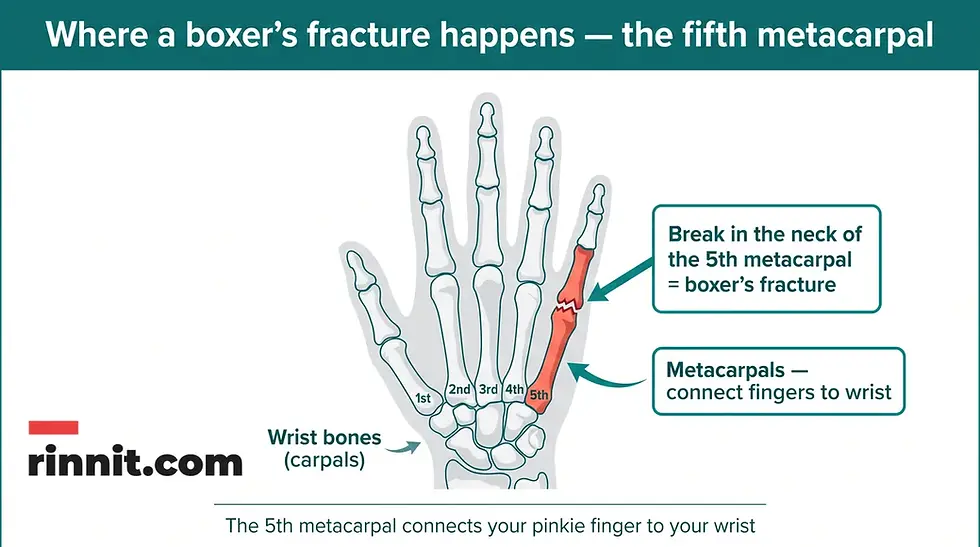
Your metacarpals are the bones in your hand that connect your thumb and finger bones (your phalanges) to your wrist [1]. You can feel your metacarpals by pressing on the back of your hand.
A boxer's fracture is a fifth metacarpal fracture — the bone that connects your pinkie finger to your wrist. It happens when you break the neck of the metacarpal, which is the end that joins your finger bones [1].
You'll probably only need to wear a splint or cast while your bone heals after a boxer's fracture. More severe fractures require surgery to repair — especially if you have other injuries.
What do open and closed mean?
A healthcare provider will classify your fracture as either open or closed. If you have an open fracture, your bone breaks through your skin. Open fractures usually take longer to heal and have an increased risk of infections and other complications [1]. Closed fractures are still serious, but your bone doesn't push through your skin.
What do displaced and nondisplaced mean?
"Displaced" or "nondisplaced" are more words your provider will use to describe your fracture. A displaced fracture means the pieces of your bone moved so much that a gap formed around the fracture when your bone broke — the bone is crooked and not lined up correctly.
Nondisplaced fractures are still broken bones, but the pieces weren't moved far enough during the break to be out of alignment. Displaced fractures are much more likely to require surgery to repair [1].
How common are boxer's fractures?
Boxer's fractures are the most common metacarpal fracture [1]. They're around one-quarter of all broken metacarpals [1].
What are the symptoms?
Boxer's fracture symptoms include pain, swelling, and tenderness. Your pinkie finger may cross over or behind your ring finger — a rotational deformity [1]. You may also have difficulty moving or using your hand, and bruising or discoloration.

What causes a boxer's fracture?
Punching or hitting something hard with a closed fist (like punching a wall in frustration) is the most common cause of boxer's fractures [1]. They get their name from being a common sports injury that boxers experience.
Getting hit on the back of your hand can also cause a boxer's fracture [1]. If you punched someone in the mouth and the skin over your knuckle is cut, get medical care the same day, because tooth cuts over the knuckle ("fight bites") can cause serious hand infections.
Who is at risk?
Anyone can break their fifth metacarpal bone. Some groups of people are more likely to experience boxer's fractures:
Risk group | Why they're at higher risk |
People ages 10 to 40 | The most common age range for this injury |
Athletes in physical sports | Especially combat sports like boxing or martial arts |
People with osteoporosis | Weakened bones break more easily |
How is a boxer's fracture diagnosed?
A healthcare provider will diagnose a boxer's fracture with a physical exam and X-rays [1]. They'll probably be able to feel or see a boxer's fracture in your hand. Tell your provider what you were doing before you hurt your hand or when you first noticed symptoms.
Your provider will use X-rays to take pictures of your bones to confirm where your fifth metacarpal is broken and what the fracture looks like.
They may also use a computed tomography (CT) scan to take 3D pictures of your bones and the surrounding tissue — especially if you need surgery [1].
How are boxer's fractures treated?
Your provider will suggest treatments to help your bone heal. Which treatments you'll need depends on which type of boxer's fracture you have and any other injuries you experienced.
Treatment | When it's used | How it works |
Immobilization | Mild, nondisplaced fractures | A splint or cast for three to six weeks; follow-up X-rays confirm the bones are healing correctly |
Closed reduction | More severe fractures | The provider physically pushes the outside of your hand to realign the broken bones, using a local anesthetic, sedatives, or general anesthesia; afterward, the hand goes in a splint or cast |
Surgery | Open, displaced, or comminuted fractures (broken in more than two places), tissue damage, or malrotation | The surgeon realigns the bones and performs internal fixation — inserting metal pins, screws, or a plate to hold the bone in place; fasteners may need to be removed after healing |
Most people don't need surgery for a boxer's fracture. But your provider may suggest it if you have an open fracture, a displaced fracture, or a comminuted fracture (if the bone is broken in more than two places) [1]. You might also need surgery if the injury damaged tissue other than just your bone. You'll be more likely to need surgery if the fracture causes malrotation — your pinkie finger crosses over your ring finger when you try to bend it.

What are the surgery complications?
Complication | What happens |
Malunion | The broken bones don't line up correctly while they heal |
Nonunion | The bones don't grow back together fully or at all |
Bone infection (osteomyelitis) | Open fractures carry an increased risk of bacterial infection |
Stiffness | People usually feel stiffness around the fractured bone; home exercises and occupational therapy can help reduce it |
Acute compartment syndrome (ACS) | A pressure buildup in the muscles may stop blood from reaching tissue, which can cause permanent muscle and nerve damage |
How soon after treatment will you feel better?
It might take a few weeks for your symptoms to improve. Pain should start getting better in a few days, but it'll take around six weeks for your bone to regain its full strength [1].
Depending on which type of immobilization or surgery you need, you should be able to start moving your hand again in a few weeks. Contact your healthcare provider right away if you experience intense pain that doesn't get better.
When should you go to the emergency room?
Emergency: You need to see a healthcare provider as soon as possible if you think you have a boxer's fracture (or any other type of broken bone). Go to the emergency room if you experience any of the following: intense pain; you can't move your hand or fingers like you usually can; your hand looks noticeably different; you can see your bone through your skin; swelling; or new bruising that appears at the same time as any of these other symptoms [1].
A boxer's fracture won't heal on its own. A healthcare provider needs to diagnose and treat all bone fractures. If you have an untreated boxer's fracture, you have a much higher risk of complications like malunion [1].
Malunion happens when a broken bone heals back together, but not in the correct position or alignment. It can make it hard to use your pinkie finger in the future and increases the chances you break that bone again in the future [1].
Go to the emergency room as soon as you injure your hand and notice any boxer's fracture symptoms — even if your bone isn't broken, a healthcare provider needs to examine and diagnose your injury.
How long does a boxer's fracture take to heal?
Most people need a month or two to recover from a boxer's fracture [1]. How long it takes you to heal depends on the severity of the fracture and which treatments you need. There are lots of factors that can affect how long it takes your body to heal — talk to your healthcare provider or surgeon about a timeline that fits your specific situation.
You should make a full recovery if you have a boxer's fracture. You'll need occupational therapy to regain strength and range of motion in your hand [1].
Will you need to miss work or school?
You might have to miss work or school while your hand heals, especially if the boxer's fracture is in your dominant hand (the hand you use most often to write or do other tasks).
Most people can resume physical activities (like playing sports) after eight weeks [1]. Talk to your surgeon or healthcare provider before resuming any physical activities — especially if you broke your bone doing a specific activity or sport.
How can you prevent a boxer's fracture?
General safety tips can help reduce your risk of a boxer's fracture.
Prevention step | Why it helps |
Never punch or hit walls, the floor, or other hard surfaces when mad or frustrated | Removes the most common cause of this injury |
Always wear your seatbelt | Reduces hand and wrist injuries in crashes |
Wear the right protective equipment for all activities and sports | Shields the hands during physical sports |
Follow a diet and exercise plan for good bone health | Stronger bones break less easily |
Ask about a bone density test if you're older than 50 or have a family history of osteoporosis | Catches weak bones before a break happens |
What questions should you ask your provider?
Consider asking: Which type of fracture do I have? Will I need surgery? How long will I need to wear a splint or cast? When is it safe to resume physical activities like playing sports?
What is the outlook?
A boxer's fracture is a broken bone in your hand. Boxer's fractures get their name for how they usually happen — punching something hard with a closed fist. They're a common sports injury, but can also happen when you punch a wall or other hard surface when you're angry or frustrated.
It's annoying to miss several weeks of practices, meets, or other activities, but you should make a full recovery after a boxer's fracture. Don't ignore symptoms like pain and swelling in your hand — especially after an injury. Visit a healthcare provider right away to get a diagnosis. The sooner they diagnose a boxer's fracture, the quicker your broken metacarpal bone can start healing.
Conclusion
A boxer's fracture is one of the most common hand injuries, and it's also one of the easiest to misunderstand: it doesn't require a boxing ring, just a closed fist meeting something hard — most often a wall or a person. The break happens in the neck of the fifth metacarpal, the bone that connects your pinkie to your wrist [1]. If your hand hurts, swells, or your pinkie rotates over your ring finger after a punch, don't brush it off — a boxer's fracture will not heal on its own, and an untreated break raises the risk of permanent problems like malunion. Mild cases heal with three to six weeks in a splint or cast, while severe cases may need a closed reduction or surgery [1]. With proper treatment, a full recovery is the norm — pain eases within days, the bone regains strength in about six weeks, and most people return to sports after eight weeks [1].
Dealing with a hand injury? Get clear, plain-language answers. Explore more trusted health guides at Rinnit.com — your everyday companion for understanding conditions, treatments, and staying healthy.
Frequently asked questions
What is a boxer's fracture?
A boxer's fracture is a broken bone in the hand — specifically a break in the neck of the fifth metacarpal, the bone that connects the pinkie finger to the wrist. It's a type of metacarpal fracture.
Why is it called a boxer's fracture?
It gets its name from being a common sports injury that boxers experience, though it most often happens when anyone punches or hits something hard with a closed fist, like a wall.
How common are boxer's fractures?
They're the most common metacarpal fracture — around one-quarter of all broken metacarpals.
What does a boxer's fracture feel like?
Pain, swelling, tenderness, bruising or discoloration, difficulty moving or using your hand, and sometimes the pinkie finger crossing over or behind the ring finger (a rotational deformity).
How does a boxer's fracture happen?
Most often from punching or hitting something hard with a closed fist. Getting hit on the back of the hand can also cause it. People ages 10 to 40, athletes in combat sports, and people with osteoporosis are at higher risk.
Can a boxer's fracture heal on its own?
No. A healthcare provider needs to diagnose and treat all bone fractures. An untreated boxer's fracture carries a much higher risk of complications like malunion, where the bone heals out of alignment.
How is it diagnosed?
With a physical exam and X-rays. A CT scan may also be used for 3D pictures of the bones and surrounding tissue, especially if surgery is needed.
What's the difference between an open and closed fracture?
In an open fracture, the bone breaks through the skin — these take longer to heal and have a higher infection risk. In a closed fracture, the bone doesn't push through the skin, though it's still serious.
What does a displaced fracture mean?
The broken pieces moved far enough to form a gap — the bone is crooked and not lined up correctly. Displaced fractures are much more likely to require surgery. Nondisplaced means the pieces stayed roughly aligned.
How is a boxer's fracture treated?
Mild, nondisplaced cases usually need a splint or cast for three to six weeks. More severe cases may need a closed reduction (the provider pushes the hand to realign the bones, then applies a splint or cast). Surgery is reserved for open, displaced, or comminuted fractures, tissue damage, or malrotation.
What happens in boxer's fracture surgery?
The surgeon realigns the bones and performs internal fixation — inserting metal pins, screws, or a plate to hold the bone in place while it heals. Fasteners may be removed after healing.
What are the surgery complications?
Malunion, nonunion, bone infection (osteomyelitis) with open fractures, stiffness, and acute compartment syndrome — a pressure buildup that can cut off blood flow and cause permanent muscle and nerve damage.
How long until I feel better?
Pain should improve within a few days, and the bone regains full strength in about six weeks. Most people need a month or two to recover overall.
When can I play sports again?
Most people can resume physical activities after eight weeks — but talk to your surgeon or provider first, especially if you broke the bone doing a specific sport.
What should I ask my healthcare provider?
Which type of fracture do I have? Will I need surgery? How long will I need a splint or cast? When is it safe to resume physical activities like playing sports?
Related reading
This article is for general informational purposes only and is not a substitute for professional medical advice, diagnosis, or treatment. Always consult a qualified healthcare provider about any medical concern, and go to the emergency room right away if you suspect a broken bone.
Hand X-Ray: What It Shows, How It's Done and What Results Mean explains the imaging test used to check hand bones for fractures, arthritis and other problems.
References
Cleveland Clinic. Boxer's Fracture: Symptoms, Causes & Treatment. Cleveland Clinic. Updated October 16, 2023. https://my.clevelandclinic.org/health/diseases/boxers-fracture
MedlinePlus. Hand fracture - aftercare. MedlinePlus Medical Encyclopedia. Reviewed June 27, 2026. https://medlineplus.gov/ency/patientinstructions/000552.htm
Clark T, et al. Buddy strapping is not inferior to a hand-based orthosis for boxer's fracture in the early weeks of hand therapy: a randomized controlled trial. Journal of Hand Therapy. 2026. PMID 42772996. https://doi.org/10.1016/j.jht.2026.06.018
Hoppe PL, et al. Effectiveness of reduction in conservative treatment of boxer fractures: a retrospective study of 115 patients. Wiener Klinische Wochenschrift. 2026;138(17-18):568-574. PMID 41703335. https://doi.org/10.1007/s00508-026-02711-1
Mohabey A, et al. Comparative outcomes in fifth metacarpal neck fractures: meta-analysis and GRADE evaluation of the evidence. Annales de Chirurgie Plastique et Esthetique. 2026. PMID 42595633. https://doi.org/10.1016/j.anplas.2026.04.003



Comments