Balint Syndrome: The Rare Brain Condition That Makes the Things You See Feel Out of Reach — and How Treatment Helps You Adapt

Updated: 2 days ago
Medically reviewed by *Dr. Baraa Alnahhal, MD*. Last reviewed October 13, 2026. This content is for educational purposes and is not medical advice.

Quick Answer
Balint syndrome is a rare neurological condition affecting visual perception, spatial cognition and motor coordination, caused by parietal lobe damage from stroke, tumor, brain injury or other causes [1]. Its three core symptoms involve trouble moving the eyes on purpose, guiding the hand to objects and seeing a whole scene [3]. There is no cure, but rehabilitation reduces symptoms [1].
What the research says
The three signs come from the brain's “where” pathway. A clinical review describes simultanagnosia, optic ataxia and oculomotor apraxia, together known as Balint's syndrome, as disorders of the dorsal visual stream, the pathway that carries visual information from the visual cortex to the parietal lobe (Cooper and O'Sullivan, Practical Neurology, 2016) [6].
Recovery is possible after a head injury. A 61-year-old man with a right parieto-occipital contusion after traumatic brain injury was followed for 12 months; after 4 months of outpatient rehabilitation, his Balint's syndrome improved 8 months after symptoms began (Moscote-Salazar et al., Bull Emerg Trauma, 2016) [7].
A stroke outside the parietal lobes can cause it too. In one reported case, a stroke limited to both sides of the corpus callosum produced optic ataxia, simultanagnosia and optic apraxia without direct damage to the parietal lobes, which shows why doctors look at the whole brain network (Changlai and Liang, Cureus, 2025) [8].
Because Balint syndrome is rare, most of the evidence comes from case reports and reviews rather than large trials.
What Is Balint Syndrome?
Balint syndrome is a rare neurological condition that affects how your brain processes the things you see (visual perception), where objects are located (spatial cognition), and your physical movements in relation to what you see (motor coordination) [1].
The result is symptoms that interfere with your daily routine and make tasks like grabbing a fork or reading extremely difficult. The name describes it almost literally: your eyes see things, but your brain can't connect what you see to where those things are or how to reach them.
It's a rare condition. You may also hear your healthcare provider call it Balint's syndrome or Balint-Holmes syndrome [1].
What part of the brain is responsible?
Damage to the parietal lobe causes Balint syndrome. The parietal lobe helps your brain process visual and spatial information, such as interpreting your senses and coordinating your movements. It also helps you understand the position of your body within your environment [1]. Some people have damage to the occipital lobe in addition to damage to the parietal lobe [1].
What Does Balint Syndrome Look and Feel Like?
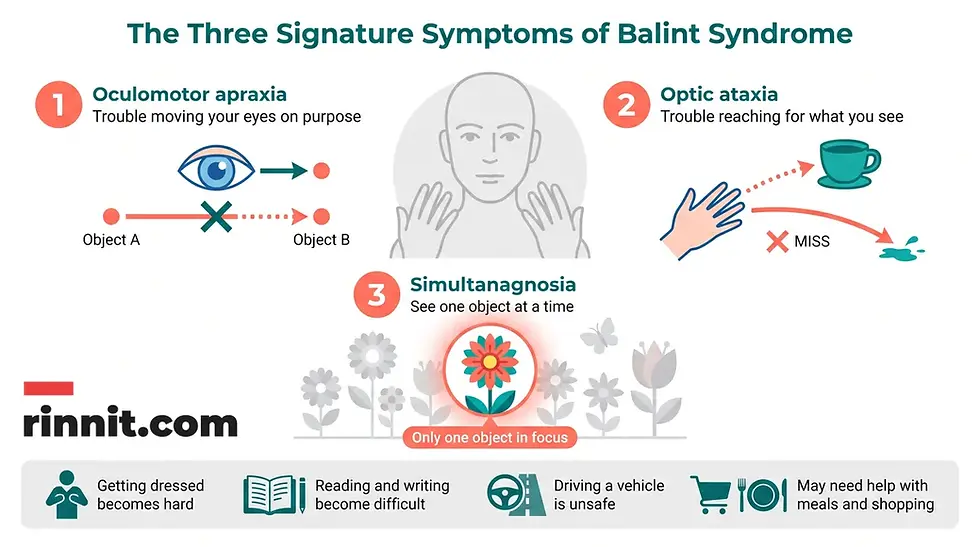
Balint syndrome has three main symptoms, and each one breaks a link in the chain between seeing, thinking and moving.
Symptom | What it means | Real-world example |
|---|---|---|
Oculomotor apraxia | It's difficult to voluntarily move your eyes to focus on an object in your line of sight | Trouble moving your eyes away from one object to look at another |
Optic ataxia | You have trouble guiding your hand to an object that you see | You reach for an object, but your hand doesn't land near it; trouble walking around an obstacle |
Simultanagnosia | You see individual objects rather than multiple objects in the same field of vision | Looking at a flower garden but only identifying one flower at a time; trouble detecting the movement of objects in front of you |
How does it affect daily life?
Balint syndrome symptoms can have a significant impact on how you interact with your environment. While symptoms aren't life-threatening, they can make it extremely difficult to complete your routine and may put you at risk of harm [1].
You might have trouble getting dressed and combing your hair. Symptoms make it difficult to read and write. Activities like driving a motor vehicle will be unsafe. You may need assistance grocery shopping or preparing your meals, which may progress to full-time care to help you eat and navigate safely [1].
What Causes Balint Syndrome?
Damage to the parietal lobe in your brain causes Balint syndrome. Your parietal lobe helps your brain process visual and spatial information, like interpreting your senses and coordinating your movements. It also helps you understand the position of your body within your environment.
Cause | How it leads to Balint syndrome |
|---|---|
Stroke | Damages the parietal lobe |
Tumor | Presses on or damages the parietal lobe |
Traumatic brain injury | Head injury damages the parietal lobe |
Oxygen deprivation | Starves the parietal lobe of oxygen |
Infection | Inflammatory damage in the brain |
Toxin exposure | Such as carbon monoxide poisoning |
What other conditions is it linked to?
Balint syndrome may happen alongside other neurological disorders, including Alzheimer's disease, cerebral toxoplasmosis, corticobasal degeneration, Creutzfeldt-Jakob disease, HIV-related encephalitis, metastatic brain tumors, posterior cortical atrophy, posterior reversible encephalopathy syndrome, and progressive multifocal leukoencephalopathy [1].
How Is Balint Syndrome Diagnosed?
A healthcare provider will diagnose Balint syndrome after an exam and testing. An optometrist or ophthalmologist will perform an eye exam first. If they suspect Balint syndrome, they'll refer you to a neurologist to perform a neurological exam and additional testing [1].
Imaging tests, like an MRI or a CT scan of your brain, show damage to your parietal lobe and lead to an accurate diagnosis [1].
Step | Who does it | What it checks |
|---|---|---|
Eye exam | Optometrist or ophthalmologist | How your eyes and vision work |
Neurological exam | Neurologist | Reflexes, coordination, and brain function |
Brain imaging (MRI or CT scan) | Radiology team | Damage to the parietal lobe that leads to an accurate diagnosis |
How Is Balint Syndrome Treated?
Balint syndrome has no cure, but treatment aimed at the underlying cause, along with rehabilitation, can reduce symptoms in some cases. Treatment can reduce symptoms in some cases. Symptoms that happen with neurological conditions may progressively get worse over time [1].
Treatment varies based on the cause and may include medications to manage an underlying neurological condition or antibiotics for an infection; surgery for tumor removal or to reduce swelling caused by oxygen deprivation; and radiation therapy for tumors that surgery [1] can't easily reach.
Treatment | Used for |
|---|---|
Medications | Manage an underlying neurological condition |
Antibiotics | An infection as the underlying cause |
Surgery | Tumor removal, or to reduce swelling caused by oxygen deprivation |
Radiation therapy | Tumors that surgery can't easily reach |
Physical therapy | Recovery and rehabilitation after a stroke |
Occupational therapy | Recovery and rehabilitation after a stroke |
Neuropsychological rehabilitation | Retrain your brain to complete certain tasks and adapt to symptoms by learning new skills |
Can rehabilitation help?
Rehabilitation therapy can help you recover after a stroke. Your care team may recommend physical therapy and occupational therapy to get you back to your routine [1].
In addition, neuropsychological rehabilitation can help retrain your brain to complete certain tasks and adapt to your symptoms by learning new skills. It focuses on improving your emotional well-being, environmental and social task performance, and cognitive function [1].
What's the Outlook?
Your healthcare provider will consider many factors when evaluating your outlook, and it can vary widely based on the cause.
If diagnosed and treated early, Balint syndrome associated with a stroke or infection may have a good outlook. Certain neurological conditions that cause Balint syndrome, like corticobasal degeneration or posterior cortical atrophy, may have a poor outlook [1] [3]. Your provider is the best resource to give you this information specific to your situation.
Can Balint Syndrome Be Prevented?
You can't prevent all causes of Balint syndrome. But you may reduce your risk by taking steps to prevent stroke [1].
Prevention step | What it involves |
|---|---|
Manage underlying conditions | High blood pressure, high cholesterol, and diabetes |
Eat healthy meals | A balanced, nutritious diet |
Get regular physical activity | Participate in physical activities on a regular basis |
Stop smoking | Quitting smoking lowers stroke risk |
Wear protective equipment | Like a helmet during activities that may cause physical injury |

When Should You See a Healthcare Provider?
Visit a healthcare provider if you notice changes to your vision and spatial awareness, especially after a head injury or stroke [1]. If vision or spatial problems start suddenly, call 911 right away, because they can be a sign of stroke.
What questions should you ask?
During your appointment, consider asking: What caused these symptoms? What type of treatment do you recommend? Are there side effects of the treatment? How do I safely complete my daily routine?
What's the Bottom Line?
Balint syndrome is rare but real, and it changes how you experience the world: one object at a time, one reach that misses, one eye movement that won't cooperate. It isn't life-threatening on its own, but it can take away the small things that make daily life easy, like getting dressed, reading, or driving. There is no cure, but treatment can reduce symptoms, and rehabilitation can help you retrain your brain and rebuild your routine. If you notice changes in your vision or spatial awareness, especially after a head injury or stroke, see a healthcare provider promptly, because early diagnosis and treatment give you the best chance at a good outlook.
Explore Rinnit.com's library of clear, practical health guides on brain health, stroke recovery, vision care, and more.
Frequently Asked Questions
What is Balint syndrome?
Balint syndrome is a rare neurological condition that affects how your brain processes the things you see, where objects are located, and your physical movements in relation to what you see. It's also called Balint's syndrome or Balint-Holmes syndrome.
What causes Balint syndrome?
Damage to the parietal lobe of the brain. This damage can happen after a stroke, tumor, traumatic brain injury, oxygen deprivation, infection, or toxin exposure like carbon monoxide.
What are the three main symptoms?
Oculomotor apraxia (trouble voluntarily moving your eyes to focus on objects), optic ataxia (trouble guiding your hand to an object you see), and simultanagnosia (seeing only one object at a time rather than a whole scene).
Is Balint syndrome curable?
No. There isn't a cure available. Treatment can reduce symptoms in some cases.
Is Balint syndrome life-threatening?
The symptoms themselves aren't life-threatening, but they can make it extremely difficult to complete your routine, may put you at risk of harm, and may eventually require full-time care.
Can Balint syndrome get worse over time?
Yes. Symptoms that happen with neurological conditions may progressively get worse over time.
What other conditions is it linked to?
Balint syndrome may occur alongside Alzheimer's disease, cerebral toxoplasmosis, corticobasal degeneration, Creutzfeldt-Jakob disease, HIV-related encephalitis, metastatic brain tumors, posterior cortical atrophy, posterior reversible encephalopathy syndrome, and progressive multifocal leukoencephalopathy.
How is it diagnosed?
An optometrist or ophthalmologist performs an eye exam first; if Balint syndrome is suspected, a neurologist performs a neurological exam, and brain imaging (MRI or CT scan) shows damage to the parietal lobe, leading to an accurate diagnosis.
How is it treated?
Treatment depends on the cause: medications for underlying neurological conditions, antibiotics for infections, surgery for tumors or swelling from oxygen deprivation, radiation therapy for hard-to-reach tumors, and rehabilitation therapies.
Can rehabilitation help me recover?
Yes. Physical therapy and occupational therapy can help you recover after a stroke, and neuropsychological rehabilitation can retrain your brain to complete certain tasks and adapt by learning new skills.
What's the outlook for someone with Balint syndrome?
The outlook varies widely based on the cause. Early-diagnosed and treated stroke- or infection-related cases may have a good outlook, while cases linked to corticobasal degeneration or posterior cortical atrophy may have a poor outlook.
Can Balint syndrome be prevented?
Not all causes can be prevented. You may reduce your risk by preventing stroke: managing blood pressure, cholesterol, and diabetes; eating healthy meals; staying physically active; quitting smoking; and wearing protective equipment like a helmet.
Can I still drive?
Activities like driving a motor vehicle will be unsafe for you to do.
When should I see a healthcare provider?
Visit a healthcare provider if you notice changes to your vision and spatial awareness, especially after a head injury or stroke.
What questions should I ask my doctor?
Ask: What caused these symptoms? What type of treatment do you recommend? Are there side effects of the treatment? How do I safely complete my daily routine?
Related Reading
Stroke: Symptoms, Causes, Diagnosis, and Treatment: A Complete Guide: the leading cause behind many Balint syndrome cases
Posterior Cortical Atrophy Guide: Symptoms, Causes, Diagnosis, and Treatment: a progressive condition linked to Balint syndrome
Sources
Cleveland Clinic. Balint Syndrome. Cleveland Clinic. Updated August 26, 2024. https://my.clevelandclinic.org/health/diseases/balint-syndrome
Amalnath SD, et al. Balint syndrome. Ann Indian Acad Neurol. 2014;17(1):10-1. PMID 24753652. https://doi.org/10.4103/0972-2327.128526
American Academy of Ophthalmology. Balint Syndrome. EyeWiki. Updated July 21, 2026. https://eyewiki.aao.org/Balint_Syndrome
Parvathaneni A, et al. Balint Syndrome. StatPearls. Updated June 26, 2023. https://www.ncbi.nlm.nih.gov/books/NBK544347/
United Brain Association. Balint's Syndrome Fast Facts. United Brain Association. Accessed October 14, 2026. https://unitedbrainassociation.org/brain-resources/balints-syndrome/
Cooper SA, et al. Here, there and everywhere: higher visual function and the dorsal visual stream. Pract Neurol. 2016;16(3):176-83. PMID 26786007. https://doi.org/10.1136/practneurol-2015-001168
Moscote-Salazar LR, et al. Post-Traumatic Balint's Syndrome: A Case Report and Review of the Literature. Bull Emerg Trauma. 2016;4(2):113-5. PMID 27331070. https://pubmed.ncbi.nlm.nih.gov/27331070/
Changlai T, et al. Balint Syndrome in a Patient With Isolated Corpus Callosum Stroke: A Case Study With Narrative Review. Cureus. 2025;17(6):e85402. PMID 40621301. https://doi.org/10.7759/cureus.85402
Medical Disclaimer
The information in this article is for general informational purposes only and is not intended as professional medical advice, diagnosis, or treatment. Always seek the advice of your physician or other qualified health provider with any questions you may have regarding a medical condition. Never disregard professional medical advice or delay in seeking it because of something you have read here.



Comments