Posterior Cortical Atrophy Guide: Symptoms, Causes, Diagnosis, and Treatment

Updated: 2 days ago
Medically reviewed by Dr. Baraa Alnahhal, MD · Last reviewed: September 2026
TL;DR
Posterior cortical atrophy (PCA) is a brain and nervous system syndrome in which brain cells die over time in the back of the brain, the region responsible for visual processing and spatial reasoning. In more than 80% of cases it is caused by an atypical form of Alzheimer's disease. The first symptoms are visual — trouble reading, judging distances, driving, and recognizing objects or faces — which is why it is sometimes mistaken for an eye problem. There is no cure or treatment that slows its progression, but medicines and therapies can help manage symptoms.
Quick Answer
What it is: A syndrome in which brain cells are lost in the back of the brain, causing problems with eyesight and processing visual information.
Main cause: In more than 80% of cases, an atypical (not typical) form of Alzheimer's disease; less common causes include Lewy body dementia, corticobasal degeneration, and Creutzfeldt-Jakob disease.
First symptoms: Visual — trouble reading, spelling or doing math, driving, judging distances, recognizing objects and familiar faces.
How it is diagnosed: By a neurologist or neuro-ophthalmologist using cognitive tests, blood tests, an eye exam, MRI, PET or SPECT brain imaging, and sometimes a spinal fluid test.
How it is treated: There is no cure or treatment that slows progression; medicines and physical, occupational, or cognitive therapy help manage symptoms.
What This Guide Is Based On
All facts in this article come from peer-reviewed neurology research published between 2019 and 2022, including meta-analytic reviews in the journal Cortex and longitudinal profile studies in Current Neurology and Neuroscience Reports, together with specialist-reviewed hospital clinical guidance from 2023, each linked directly below. This content is for education only; consult a qualified healthcare professional for diagnosis and treatment of your own condition.
What Is Posterior Cortical Atrophy?
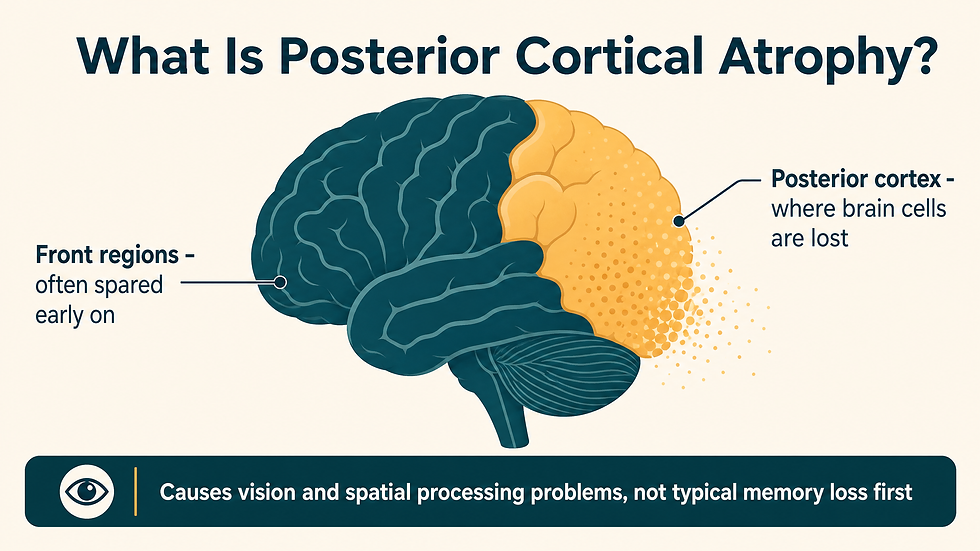
Posterior cortical atrophy is a brain and nervous system syndrome that causes brain cells to die over time. It causes problems with eyesight and with processing visual information.
The condition causes the loss of brain cells in the back of the brain. This is the region responsible for visual processing and spatial reasoning, so the disease changes a person's ability to process visual and spatial information.
In more than 80% of cases, posterior cortical atrophy is due to Alzheimer's disease. However, it can also be due to other neurological conditions such as Lewy body dementia or corticobasal degeneration.
The name describes the anatomy: "posterior" means the back, and "cortical atrophy" refers to the shrinking (atrophy) of the cortex, the brain's outer layer. Unlike typical Alzheimer's disease, where memory problems come first, posterior cortical atrophy starts with the eyes and visual perception.
What Are the Symptoms of Posterior Cortical Atrophy?
Posterior cortical atrophy symptoms vary among people and can also vary over time. They tend to gradually get worse.
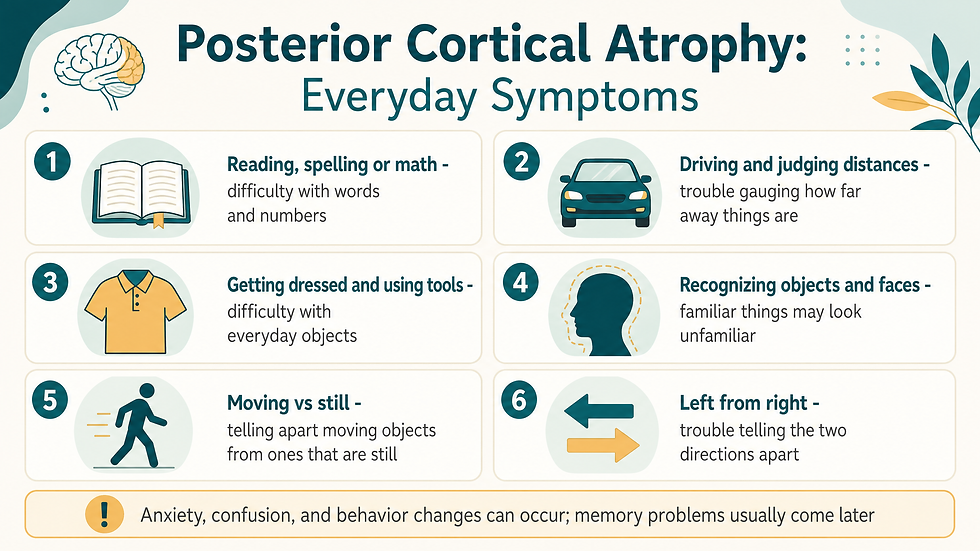
Common symptoms include having trouble with the following.
Everyday task | What goes wrong |
|---|---|
Reading, spelling, or math | Difficulty processing words and numbers |
Driving | Trouble operating safely as visual processing declines |
Getting dressed | Difficulty with the visual sequencing of clothing |
Judging distances | Difficulty gauging how far away objects are |
Moving vs. still objects | Trouble telling the difference between objects that are moving and those that are still |
Using everyday objects or tools | Difficulty using familiar items despite intact vision in the eyes |
Left from right | Trouble identifying the two directions |
People with the syndrome may also not be able to recognize objects and familiar faces, and they may have trouble making calculations.
Other common symptoms include anxiety, confusion, and changes in behavior and personality. Memory problems may occur later in the disease.
What Causes Posterior Cortical Atrophy?
The most common cause of posterior cortical atrophy is a form of Alzheimer's disease that is not typical. This atypical form affects the back of the brain.
Other, less common causes include corticobasal degeneration, Lewy body dementia, and Creutzfeldt-Jakob disease.
Researchers are looking at potential gene variations that may be related to the condition, though no single gene has been established as the cause.
What Are the Underlying Conditions?
The table below summarizes the conditions behind posterior cortical atrophy.
Underlying condition | Role in PCA | Frequency |
|---|---|---|
Atypical Alzheimer's disease | The leading cause; brain changes affect the visual processing areas at the back of the brain | More than 80% of cases |
Lewy body dementia | A neurological condition that can present as PCA | Less common |
Corticobasal degeneration | A progressive brain disorder that can present as PCA | Less common |
Creutzfeldt-Jakob disease | A rare degenerative brain disease that can present as PCA | Less common |
What Increases the Risk of Posterior Cortical Atrophy?
Further study is needed to determine whether the risk factors for Alzheimer's disease may play a role in posterior cortical atrophy.
Why Is It Often Misdiagnosed?
Because the first symptoms are often visual, posterior cortical atrophy can be misdiagnosed as a vision disorder. It is important to see a neurologist or a neuro-ophthalmologist, who can correctly diagnose the condition. A neurologist is trained in brain and nervous system conditions, and a neuro-ophthalmologist specializes in neurology and conditions related to vision.
This is one of the most practical points in this guide: persistent visual problems with a normal eye exam deserve a brain-focused evaluation.
How Is Posterior Cortical Atrophy Diagnosed?
To diagnose posterior cortical atrophy, a specialist reviews the medical history and symptoms, including vision problems, and conducts a physical exam and a neurological exam.
Several tests may help with the diagnosis. The tests also might rule out other conditions that cause similar symptoms.
Test | What it checks |
|---|---|
Mental status and neuropsychological tests | Questions and tests that assess cognitive skills; the person may also be assessed for depression or other mental disorders |
Blood tests | Checks for vitamin deficiency, thyroid disorders, and other conditions that may be causing the symptoms |
Ophthalmology exam | A vision test to determine whether a problem within the eyes, rather than the brain, is causing the vision symptoms |
Magnetic resonance imaging (MRI) | Uses powerful radio waves and a magnetic field to create a 3D view of the brain, showing changes that may be causing symptoms |
FDG PET or SPECT imaging | A small amount of radioactive material is injected into a vein and images are taken with a large machine; PET provides visual images of brain activity, while SPECT measures blood flow to regions of the brain |
Spinal fluid test | Removes a small amount of the fluid that cushions the brain and spinal cord to measure amyloid and tau proteins, the hallmark of Alzheimer's disease |

How Is Posterior Cortical Atrophy Treated?
There are no treatments to cure or slow the progression of posterior cortical atrophy. Some research suggests that medicines used to slow the progression of Alzheimer's disease may help manage symptoms of posterior cortical atrophy. However, this has not been proved, and more research is needed.
What Can Help Manage the Condition?
Some therapies and medicines can help manage the condition.
Medicines. A healthcare provider may prescribe medicines to treat symptoms such as depression or anxiety.
Physical, occupational, or cognitive therapy. These therapies may help a person regain or retain skills that are affected by posterior cortical atrophy.
Is There a Cure?
No treatment currently cures or slows the progression of the condition. Research is ongoing into whether Alzheimer's disease medicines can help manage symptoms, but this has not yet been proved.
Conclusion: What to Do if You Suspect Posterior Cortical Atrophy
Posterior cortical atrophy is a rare but important syndrome in which brain cells are gradually lost in the visual processing regions at the back of the brain. In more than 80% of cases it is driven by an atypical form of Alzheimer's disease. Its earliest signs are visual and spatial — difficulty reading, judging distances, driving, and recognizing familiar faces and objects — rather than the memory loss typical of most Alzheimer's cases. Because these symptoms resemble an eye problem, the condition is often misdiagnosed as a vision disorder.
If you or a loved one are experiencing these kinds of visual and spatial difficulties, especially with a normal eye exam, see a neurologist or a neuro-ophthalmologist for a proper evaluation. Diagnosis involves cognitive testing, brain imaging such as MRI and PET or SPECT scans, and sometimes a spinal fluid test. While there is no cure and no treatment that slows progression, medicines and physical, occupational, or cognitive therapy can meaningfully help manage daily life with the condition.
*This article is for educational purposes only and is not a substitute for professional medical advice. Consult a qualified healthcare professional for diagnosis and treatment of your own condition.*
Frequently Asked Questions
What is posterior cortical atrophy?
Posterior cortical atrophy is a brain and nervous system syndrome in which brain cells die over time in the back of the brain, the region responsible for visual processing and spatial reasoning. It causes problems with eyesight and processing visual information.
Is posterior cortical atrophy a form of Alzheimer's disease?
In more than 80% of cases, yes — it is caused by an atypical (not typical) form of Alzheimer's disease. Less common causes include Lewy body dementia, corticobasal degeneration, and Creutzfeldt-Jakob disease.
How is it different from typical Alzheimer's disease?
Typical Alzheimer's disease usually begins with memory problems. Posterior cortical atrophy begins with visual symptoms, such as trouble reading, judging distances, and recognizing objects and faces, because it affects the visual processing areas at the back of the brain.
Can posterior cortical atrophy be misdiagnosed?
Yes. Because the first symptoms are often visual, it can be mistaken for a vision disorder. A correct diagnosis usually requires a neurologist or a neuro-ophthalmologist.
When do memory problems appear?
Memory problems may occur later in the disease, after the visual and spatial symptoms.
What tests confirm the diagnosis?
Diagnosis may include mental status and neuropsychological tests, blood tests, an ophthalmology exam, an MRI, FDG PET or SPECT brain imaging, and a spinal fluid test that measures amyloid and tau proteins.
Is there a cure or a treatment that slows it down?
No. There are no treatments to cure or slow the progression of posterior cortical atrophy. Medicines and physical, occupational, or cognitive therapy can help manage symptoms.
What medicines are used?
Medicines may be given to treat symptoms such as depression or anxiety. Some research suggests Alzheimer's disease medicines may help manage symptoms, but this has not been proved and more research is needed.
References
Posterior cortical atrophy — Symptoms and causes — Mayo Clinic, published February 17, 2023.
Posterior cortical atrophy — Diagnosis and treatment — Mayo Clinic, published February 17, 2023.
Comments