Avoiding Healthcare-Associated Infections: Essential Steps for Patients and Families

Updated: 3 days ago
Medically reviewed by Dr. Baraa Alnahhal, MD. Last reviewed October 13, 2026. This content is for educational purposes and is not medical advice.
Quick Answer
Healthcare-associated infections are infections acquired in a healthcare setting while being treated for something else, such as C. diff, MRSA and surgical site infections. Catheters, surgery and weakened immunity raise risk. Prevention includes frequent handwashing, asking daily whether tubes can be removed and staying current on vaccines. They cause approximately 99,000 deaths annually in the U.S.
Feature | Details |
What it is | Infections acquired in a healthcare setting (hospital, clinic, etc.) while being treated for something else. |
Common types | C. diff, MRSA, surgical site infections, and infections related to catheters or ventilators. |
Primary risk factors | Invasive devices (catheters, central lines), surgery, and weakened immune systems. |
Key symptoms | Fever, chills, shortness of breath, redness at incision sites, and mental confusion. |
Prevention | Frequent handwashing, asking daily if tubes can be removed, and staying current on vaccines. |
Impact | Can cause longer hospital stays, sepsis, and approximately 99,000 deaths annually in the U.S. [1] |
What the research says
Hospital infections have been falling, but they have not gone away. In a CDC point-prevalence survey of 12,299 patients in 199 U.S. hospitals in 2015, 3.2% had a health care-associated infection, down from 4.0% of 11,282 patients in 2011. The risk was 16% lower (RR 0.84; 95% CI 0.74 to 0.95), largely because of fewer surgical-site and urinary tract infections. Pneumonia, gastrointestinal infections (mostly C. difficile), and surgical-site infections were the most common types in 2015 (Magill et al., New England Journal of Medicine, 2018).
A large share of these infections is preventable with proven steps. A systematic review estimated that as many as 65% to 70% of catheter-associated bloodstream and urinary tract infections, and about 55% of ventilator-associated pneumonia and surgical site infections, may be preventable with current evidence-based strategies. The authors noted that preventing 100% of HAIs is not attainable (Umscheid et al., Infection Control & Hospital Epidemiology, 2011).
What Are Healthcare-Associated Infections (HAIs)?
Healthcare-associated infections, traditionally called nosocomial infections, are illnesses that patients develop while they are receiving medical or surgical care in a facility such as a hospital, dialysis clinic, or long-term care center [1]. These infections are not present at the time of admission but emerge as a result of the healthcare environment or specific medical procedures. By clinical definition, an infection is classified as an HAI if it appears 48 hours or more after hospital arrival, within three days of discharge, or within 30 days of a surgical procedure [1].
These infections represent a significant public health challenge, with more than half a million patients and healthcare providers affected each year in the United States alone [1]. While many HAIs are mild, they can also be life-threatening, contributing to roughly 99,000 deaths annually in American hospitals [1]. Understanding the types and causes of these infections is the first step in effective prevention.
What Are the Most Common Types of HAIs?
Medical facilities are complex environments where various pathogens can spread. The most common types of healthcare-associated infections are often linked to specific medical devices or procedures.
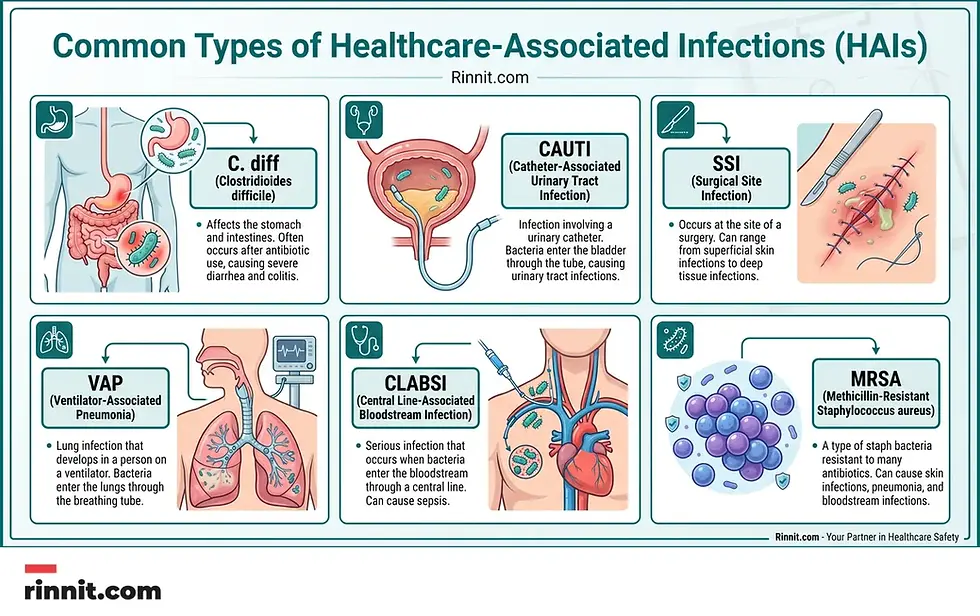
Infection type | Abbreviation | Description and impact |
C. diff infection | C. diff | Inflammation of the colon causing severe diarrhea. Affects nearly 500,000 people annually [1]. |
Catheter-associated UTI | CAUTI | Urinary tract infections caused by long-term drainage tube use. Accounts for 32% of all HAIs [1]. |
Surgical site infection | SSI | Infections at incision sites or deeper tissues and organs following surgery. Makes up 22% of HAIs [1]. |
Ventilator-associated pneumonia | VAP | Lung infections occurring in patients on mechanical breathing support. Accounts for 15% of HAIs [1]. |
Central line-associated infection | CLABSI | Bloodstream infections linked to central venous catheters. Represents 14% of all HAIs [1]. |
MRSA infection | MRSA | A staph infection resistant to common antibiotics like penicillin and amoxicillin [1]. |
What Are the Symptoms of a Healthcare-Associated Infection?
Symptoms of an HAI vary significantly depending on the location and type of the infection. However, there are several general warning signs that patients and caregivers should monitor closely during and after a hospital stay. Common physical symptoms include fever, chills, a persistent cough, or shortness of breath [1].
Patients may also experience localized issues such as abdominal pain, diarrhea, or changes in urination, including pain or increased frequency [1]. For those recovering from surgery, redness, rash, or unusual discharge around an incision site are early indicators of a surgical site infection. In some cases, especially among older adults, the most prominent sign may be a sudden change in mental state, such as confusion or irritability [1].

How Do These Infections Spread and Who Is at Risk?
Pathogens such as bacteria, viruses, and fungi cause HAIs. These germs can spread through respiratory droplets when someone coughs or sneezes, or through direct contact when healthcare providers do not follow strict sterilization and infection control protocols [1].
While anyone receiving medical care can develop an HAI, certain factors significantly increase the risk. Patients with compromised immune systems are particularly vulnerable. Additionally, the use of invasive medical equipment, such as catheters for drainage, mechanical ventilators for breathing, or central lines for medication, provides a direct pathway for germs to enter the body [1]. Surgeries and frequent injections also increase the likelihood of infection.
How Can You Prevent Healthcare-Associated Infections?
While medical teams follow rigorous safety protocols, patients and their families play a vital role in the prevention process. Active participation and advocacy can significantly reduce the risk of acquiring a nosocomial infection.
The Power of Hand Hygiene
Keeping hands clean is the single most effective way to prevent the spread of germs. Patients should wash their hands frequently and use alcohol-based sanitizers. If C. diff is a concern, wash with soap and water, because alcohol sanitizer does not kill C. diff spores. Crucially, patients should never feel hesitant to ask their healthcare providers if they have washed their hands or changed their gloves before providing care [1].
Managing Medical Devices
Invasive tubes like catheters and central lines are high-risk areas for infection. Families should ask the medical team every day if these devices are still necessary and if they can be removed as soon as possible [1]. Keeping the skin around these sites clean and dry is also essential.
General Safety Measures
Maintaining overall health can provide an extra layer of protection. This includes staying up-to-date on vaccinations, such as the annual flu shot, and practicing antibiotic stewardship by taking medications exactly as prescribed by a doctor [1].

What Is the Outlook for Patients with HAIs?
The prognosis for healthcare-associated infections depends heavily on early diagnosis and the effectiveness of treatment. Many patients make a full recovery when the infection is caught early and treated with appropriate antibiotics, antivirals, or antifungals [1]. However, HAIs often lead to longer hospital stays and can result in severe complications like sepsis, respiratory failure, or the rejection of surgical implants [1].
A growing challenge in treating HAIs is drug resistance, where pathogens evolve so that standard medications no longer work [1]. This makes prevention the most critical strategy in the fight against healthcare-associated infections.
Conclusion and next steps
Avoiding healthcare-associated infections is a shared responsibility. By staying informed about the risks, practicing diligent hygiene, and advocating for the timely removal of medical devices, patients can significantly enhance their safety during medical treatment.
Take action: If you or a loved one are preparing for a hospital stay, discuss infection prevention strategies with your healthcare provider to ensure the best possible outcome.
Frequently asked questions
What is the most common healthcare-associated infection? According to Cleveland Clinic, catheter-associated urinary tract infections (CAUTIs) are the most frequent, accounting for approximately 32% of all HAIs [1]. Note that a 2015 U.S. hospital survey found pneumonia, gastrointestinal infections, and surgical-site infections to be the most common types [2], so the ranking depends on how and when infections are counted.
How soon after leaving the hospital can an HAI appear? An infection is considered an HAI if it develops within three days of discharge or within 30 days of a surgical procedure [1].
Can I get an HAI from a simple injection? Yes. Any procedure that breaks the skin, including injections, carries a risk if proper sterilization protocols are not followed [1].
Is MRSA only found in hospitals? While MRSA is a common HAI, it can also spread in the community. However, hospital-acquired MRSA is often more difficult to treat due to antibiotic resistance [1].
Why is C. diff so dangerous in hospitals? C. diff is highly contagious, causes severe colon inflammation, and has a high recurrence rate, with 16% of patients getting it again shortly after recovery [1].
Does every patient with a ventilator get pneumonia? No, but mechanical ventilation increases the risk significantly, as germs can enter the lungs through the breathing tube (VAP) [1].
Should I bring my own hand sanitizer to the hospital? While hospitals provide sanitizer, having your own can serve as a helpful reminder to practice frequent hand hygiene [1].
What should I do if I see a provider not washing their hands? You should politely ask them to wash their hands or change their gloves before they touch you or your medical equipment [1].
Can a central line infection spread to the heart? Yes. A central line-associated bloodstream infection (CLABSI) can lead to serious complications like endocarditis, which is an infection of the heart lining [1].
Are HAIs covered by insurance? Coverage varies, but many healthcare systems are focused on reducing HAIs because they lead to longer, more expensive hospital stays.
Can children get HAIs? Yes. Anyone receiving care in a medical facility can acquire an HAI, though those with weaker immune systems are at higher risk [1].
Is a fever always a sign of an HAI? A fever is a common symptom of infection, but it can also be a normal response to surgery. Your doctor will use tests to confirm the cause [1].
How do doctors test for an HAI? Providers typically use blood tests, urinalysis, or wound cultures to identify the specific germ causing the infection [1].
Can HAIs be treated without antibiotics? If the infection is caused by a virus or fungus, doctors will use antivirals or antifungals instead of antibiotics [1].
What is sepsis? Sepsis is a life-threatening complication where the body's extreme response to an infection causes widespread tissue damage and organ failure [1].
Related Reading
Sepsis: Complete Guide to Symptoms, Causes, Risks, and Treatment: the life-threatening complication an untreated HAI can cause, and how to recognize it.
Trusted External Resources
References
Cleveland Clinic. Nosocomial Infections (Healthcare-Associated Infections). Cleveland Clinic. Last updated May 7, 2024. https://my.clevelandclinic.org/health/diseases/16397-avoiding-healthcare-associated-infections-hais
Magill SS, et al. Changes in Prevalence of Health Care-Associated Infections in U.S. Hospitals. N Engl J Med. 2018;379(18):1732-1744. PMID 30380384. https://doi.org/10.1056/NEJMoa1801550
Umscheid CA, et al. Estimating the proportion of healthcare-associated infections that are reasonably preventable and the related mortality and costs. Infect Control Hosp Epidemiol. 2011;32(2):101-14. PMID 21460463. https://doi.org/10.1086/657912
Medical disclaimer
This article is for informational purposes only and does not constitute medical advice. Always seek the advice of your physician or other qualified health provider with any questions you may have regarding a medical condition or infection prevention.



Comments