Asteroid Hyalosis: A Plain-Language Guide to the Sparkling Particles in the Eye

Updated: 2 days ago
Medically reviewed by Dr. Baraa Alnahhal, MD. Last reviewed October 13, 2026. This content is for educational purposes and is not medical advice.
Quick Answer
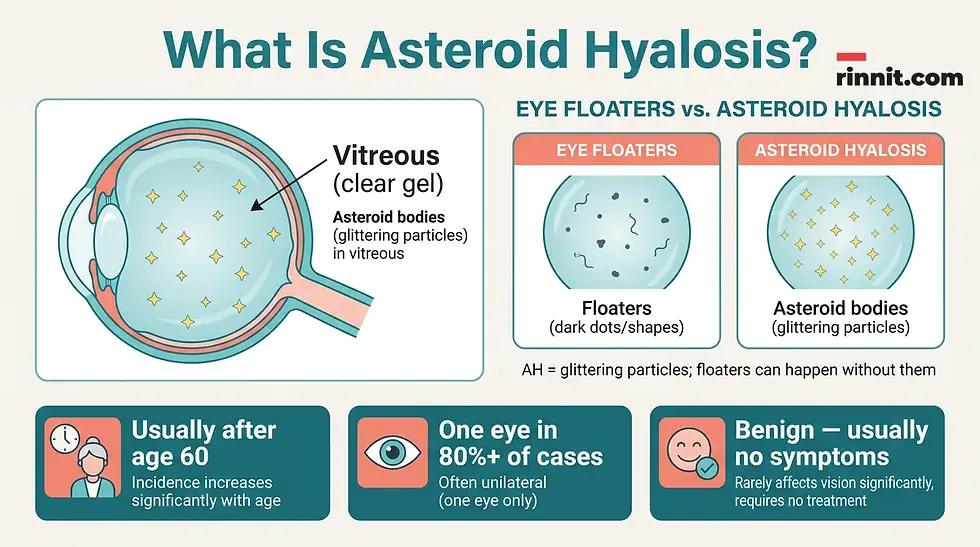
Asteroid hyalosis is a benign condition in which tiny, glittering yellow particles called asteroid bodies form in the vitreous, the clear gel inside the eye. It usually appears after age 60 and affects only one eye in more than 80% of cases. It rarely causes symptoms, most cases need no treatment, and severe cases are treated with vitrectomy surgery.
What the research says
Asteroid hyalosis affects roughly 1 in 100 people, and the risk climbs with age. In the Beijing Eye Study of 3,468 adults aged 50 to 93, asteroid hyalosis was found in 63 eyes (0.9%) of 53 participants (1.6%), and it affected both eyes in 18.9% of those cases. It was linked to older age (OR 1.057), a thicker lens, and a higher spherical equivalent, but not to diabetes or other systemic indicators (Zhang et al., BMC Ophthalmology, 2022).
Vision is rarely affected, so treatment is rarely needed. A clinical review estimates the global prevalence at around 1% and notes a strong association with older age. Because vision is rarely affected, management focuses on telling asteroid hyalosis apart from look-alike conditions, checking the retina behind it for other disease, and considering vitrectomy only in rare cases of visual impairment (Duong et al., Clinical Ophthalmology, 2023).
It may be more common in people with a rare retinal condition. In a retrospective review of 178 patients with bilateral macular telangiectasia type II (MacTel), 16 also had asteroid hyalosis, a rate of 9.88%. That is well above the roughly 0.5% to 2% found in four population-based studies the authors compared against (Dabbs et al., Retina, 2025).
What Is Asteroid Hyalosis, Exactly?
Asteroid hyalosis (AH) is an eye condition that causes you to develop tiny, glittering yellow particles or flecks inside your eyes. It's usually harmless, and most cases don't need any treatment. The particles that develop with AH form inside the vitreous, the clear, gel-like substance inside your eyes. AH affects only one eye at a time in more than 80% of cases.
Despite its classification as a permanent and degenerative condition, most people don't know they have it. That's because it doesn't usually affect your vision or cause symptoms. The glittering effect inside the eye is hard to spot unless you shine a light directly at the affected eye and look closely.
How Is Asteroid Hyalosis Different From Eye Floaters?
Eye floaters (myodesopsias) sometimes appear in your vision due to AH crystals. Floaters are common after you turn 50, and they're usually a normal effect of the aging process. The key difference is that AH involves glittering particles in your eyes, while eye floaters can happen without those particles.
How Common Is Asteroid Hyalosis?
Experts consider AH common overall. It's most common in people over age 60, and people are more likely to develop it as they get older.
What Are the Symptoms of Asteroid Hyalosis?
AH rarely causes symptoms. Most people only learn they have it when a healthcare provider notices the reflection of the particles while looking into their eyes. That's most likely to happen during a routine physical exam or when seeing an eye care specialist for an eye exam. When symptoms do happen, they're usually mild. Most people experience slightly clouded vision or greater numbers of eye floaters.
Symptom | What it looks or feels like |
No symptoms (most common) | Condition discovered by chance during an eye exam |
Slightly clouded vision | Mild haziness, usually not dangerous |
More eye floaters | Greater numbers of spots drifting in vision |
What Causes Asteroid Hyalosis?
Experts aren't sure why AH happens. They know a bit about what exactly is happening, though. Asteroid bodies contain minerals like calcium and phosphorus, plus fatty compounds called lipids. The crystals that make up asteroid bodies have similarities to gallstones and kidney stones. Some researchers suspect that there's a link between AH and the conditions or circumstances that cause kidney stones or gallstones to form, but more research is necessary to confirm this.
Asteroid bodies are extremely small. On average, they're about 180 micrometers in diameter, but they can be as little as 3 micrometers wide or as large as 280 micrometers wide. For context, 1,000 micrometers can fit in 1 millimeter, and the average human hair is about 100 micrometers in diameter.
Asteroid bodies don't sink to the bottom of your eye because the vitreous is gel-like. Much like pieces of fruit suspended in a gelatin dessert, the asteroid bodies linger in roughly the same place. Moving your eyes may cause them to wobble or flutter around, but they generally stay where they are.
Why Does the Condition Have Such a Strange Name?
"Asteroid hyalosis" might sound like an astronomical problem, but that's because of an ancient language quirk. "Asteroid" is from ancient Greek and it means "starlike." When viewed with a light up close, the particles in your eye look like stars in the night sky.
Who Is at Higher Risk for Asteroid Hyalosis?
There are two main contributing factors that researchers can identify. You're more likely to develop AH if you're over 60. Men account for about 60% or more of those with AH. There's also evidence that people with AH are more likely to have certain conditions or circumstances. Experts aren't sure if these conditions cause AH, but studies have found that people with these conditions seem more likely to have AH.
Risk factor | Why it matters |
Age over 60 | Most common in people over 60. Risk rises with age. |
Male sex | Men account for about 60% or more of AH cases |
Type 2 diabetes | More likely in people with this condition. Link not proven. |
High cholesterol (hyperlipidemia) | More likely in people with this condition. Link not proven. |
High blood pressure (hypertension) | More likely in people with this condition. Link not proven. |
How Is Asteroid Hyalosis Diagnosed?
The glittering reflection of asteroid bodies is often visible with the naked eye alone. A healthcare provider may also notice AH during a standard exam with a simple hand-held device called an ophthalmoscope. These devices have a small light immediately underneath a magnifying window your provider looks through. An eye care specialist, such as an optometrist or ophthalmologist, can also diagnose AH during a routine eye exam.
What Tests Will Be Done?
A simple look into your eyes is usually all it takes to diagnose AH. An eye care specialist may also use a slit lamp exam, but asteroid bodies might be harder to see this way. A slit lamp uses brighter light than an ophthalmoscope, and the additional light just means there's more light to reflect off the asteroid bodies (similar to how high-beam headlights in thick fog make it harder to see). While those tests are often enough to diagnose AH, your provider may recommend additional tests to rule out other conditions that can have similar effects to AH.
Test | What it checks |
Naked-eye look or ophthalmoscope | Glittering particle reflection. Usually all that's needed. |
Slit lamp exam | Detailed magnified view (particles can be harder to see due to bright light) |
Fluorescein angiography | Rules out issues like new blood vessel growth from diabetes-related retinopathy |
Optical coherence tomography | Spots diabetes-related retinopathy, glaucoma, eye tumors, or macular conditions |

How Is Asteroid Hyalosis Treated?
In most cases, AH doesn't need treatment. Usually, treatment is only necessary when AH is severe enough to cloud your vision. If that happens, an eye surgery known as vitrectomy is the treatment. This procedure involves removing the cloudy vitreous contents from your eye and replacing it with something else that can do the job in the meantime.
Some of the likely replacements are saline fluid, silicone oil, or a gas bubble. All of these help your eye maintain its shape. Silicone oil may need a follow-up procedure to remove that oil. Saline or a gas bubble don't need a follow-up procedure because your body will gradually replace them with new vitreous fluid.
Treatment | How it works | Follow-up needed? |
No treatment (most cases) | AH usually causes no symptoms | None. Just routine eye exams. |
Vitrectomy (severe cases) | Removes cloudy vitreous, replaces it | Depends on what's used to replace the vitreous |
Replacement with saline | Helps eye keep its shape | No. Body replaces it with new vitreous fluid. |
Replacement with gas bubble | Helps eye keep its shape | No. Body replaces it with new vitreous fluid. |
Replacement with silicone oil | Helps eye keep its shape | Yes. May need a procedure to remove the oil. |
What Are the Complications of Vitrectomy?
Vitrectomy is a surgery, so complications are possible. Some of the possible complications include infection, bleeding, eye pain, torn or detached retina, cataracts (new or worsening), needing follow-up eye surgery, and blindness or vision loss (these are rare).
How Soon After Treatment Will I Feel Better?
The recovery time for a vitrectomy is usually two to four weeks, but some effects may take longer. For example, if you have a gas bubble placed in your eye, it can take several weeks for your body to replace it with new vitreous fluid.

How Long Will Asteroid Hyalosis Last?
AH usually develops after age 60. Once it happens, it's permanent unless you undergo a vitrectomy to replace the vitreous in your eye. While AH is technically a degenerative condition, meaning it gets worse over time, it still doesn't cause symptoms for most people. Because of that, experts consider AH a benign (harmless) condition.
Can Asteroid Hyalosis Be Prevented?
AH happens unpredictably and for reasons experts don't yet understand. That means there's no way to prevent or reduce your risk of developing it.
Can I Live Normally With Asteroid Hyalosis?
Most people with AH don't have symptoms and don't need treatment. For them, their life after diagnosis has little or no difference from life before. Your eye care specialist can tell you more about what you can do to care for your eyes and minimize or prevent further issues. If you have gradual vision changes, especially clouding or decreased vision, you should see an eye care specialist. They can determine what's causing the change and how to treat it (if necessary). If you have AH, you'll need regular follow-up appointments with your eye care specialist. They'll tell you how often you should have your eyes checked.
When Should I Seek Care?
If you have AH, see an eye care specialist if you notice any of the following vision symptoms, issues, or changes: sudden vision loss, sudden flashes of light (photopsia), black spots or floaters (especially when you notice a sudden appearance of them or an increase in their numbers), and darkening vision (either affecting part or all of your vision).
If you notice a gradual increase of floaters in your eyes or a gradual clouding of your vision, you should see an eye care specialist. They'll examine your eyes for any signs of what's causing the change. If they find that you have asteroid hyalosis, your provider will likely check for other eye conditions that can happen with it.
Conclusion and next steps
Asteroid hyalosis typically happens to people older than 60, and fortunately, the glittering effect is usually the only way you know you have it. Most people don't have symptoms and don't need treatment. The condition is permanent but benign, and for most, the only thing that changes is they become starry-eyed.
Take action: If you have AH, keep your regular eye exams, and see a specialist promptly if you notice sudden vision changes, flashes of light, or a jump in floaters. If you've noticed unusual floaters or clouding in your vision, or if a recent eye exam mentioned sparkling particles, talk to an eye care specialist. A simple exam can confirm whether asteroid hyalosis is the cause and rule out other conditions that can look similar.
Frequently asked questions
What causes the sparkles in my eye? Tiny glittering particles called asteroid bodies form inside the vitreous, the clear gel inside your eye. They contain minerals like calcium and phosphorus, plus fatty compounds called lipids [1].
What is asteroid hyalosis? Asteroid hyalosis is an eye condition that causes tiny, glittering yellow particles to form inside your eyes. It's usually harmless, and most cases don't need any treatment [1].
Does asteroid hyalosis cause symptoms? Rarely. Most people only learn they have it when a healthcare provider notices the particle reflection during a routine physical exam or eye exam. When symptoms do happen, they're usually mild: slightly clouded vision or more eye floaters [1].
Is asteroid hyalosis the same as eye floaters? No. Eye floaters sometimes appear due to AH crystals, but floaters are common after age 50 and usually a normal aging effect. AH involves glittering particles in the eyes, while eye floaters can happen without those particles [1].
How common is asteroid hyalosis? Experts consider AH common overall. It's most common in people over age 60, and people are more likely to develop it as they get older [1] [6] [7].
Does asteroid hyalosis affect one eye or both? It affects only one eye at a time in more than 80% of cases [1].
Can asteroid hyalosis be prevented? No. AH happens unpredictably and for reasons experts don't yet understand, so there's no way to prevent or reduce your risk of developing it [1].
How is asteroid hyalosis diagnosed? The glittering reflection of asteroid bodies is often visible with the naked eye alone. A simple look into your eyes with an ophthalmoscope is usually all it takes [1].
Why might a slit lamp exam make asteroid bodies harder to see? A slit lamp uses brighter light than an ophthalmoscope. The additional light just means there's more light to reflect off the asteroid bodies, similar to how high-beam headlights in thick fog make it harder to see [1].
When does asteroid hyalosis need treatment? Only when it is severe enough to cloud your vision. The treatment is an eye surgery called vitrectomy, which removes the cloudy vitreous and replaces it with saline fluid, silicone oil, or a gas bubble [1].
How long does vitrectomy recovery take? Recovery is usually two to four weeks, but some effects may take longer. A gas bubble, for example, can take several weeks for your body to replace with new vitreous fluid [1].
Is asteroid hyalosis dangerous? No. Experts consider AH a benign (harmless) condition. Even though it's technically degenerative (it gets worse over time), it doesn't cause symptoms for most people [1].
Can asteroid hyalosis cause blindness? The condition itself doesn't cause symptoms in most people. Blindness or vision loss is listed only as a rare complication of vitrectomy surgery, not of the condition itself [1].
How long does asteroid hyalosis last? Once it happens, it's permanent unless you undergo a vitrectomy to replace the vitreous in your eye [1].
Related Reading
Presbyopia: Complete Guide to Age-Related Near Vision Loss, Symptoms, and Treatment Options: another eye change that arrives with age.
Vitrectomy: Restoring Vision Through Specialized Eye Surgery: the surgery used when asteroid hyalosis clouds vision, and why people need it.
Diabetic Retinopathy: Symptoms, Causes, Diagnosis & Treatment — Complete Guide: how diabetes can change vision.
Cataracts: Symptoms, Causes, Diagnosis and Treatment — What You Need to Know: why vitrectomy can bring them on.
Trusted External Resources
References
Cleveland Clinic. Asteroid Hyalosis. Cleveland Clinic. Last updated September 5, 2023. https://my.clevelandclinic.org/health/diseases/25231-asteroid-hyalosis
Elbaz H, et al. Epidemiologic Analysis of Asteroid Hyalosis and Associations: The Gutenberg Health Study. Ophthalmology. 2021;128(2):328-330. PMID 32652202. https://doi.org/10.1016/j.ophtha.2020.07.008
Khoshnevis M, et al. Asteroid hyalosis-a comprehensive review. Surv Ophthalmol. 2019;64(4):452-462. PMID 30707924. https://doi.org/10.1016/j.survophthal.2019.01.008
Mishra C, et al. Asteroid Hyalosis. In: StatPearls [Internet]. StatPearls Publishing. Last updated February 15, 2026. PMID 32119262. https://www.ncbi.nlm.nih.gov/books/NBK554375/
Scott DAR, et al. Spotlight on Asteroid Hyalosis: A Clinical Perspective. Clin Ophthalmol. 2021;15:2537-2544. PMID 34168427. https://doi.org/10.2147/OPTH.S272333
Zhang C, et al. Prevalence and associations of asteroid hyalosis: the Beijing Eye Study. BMC Ophthalmol. 2022;22(1):360. PMID 36068511. https://doi.org/10.1186/s12886-022-02586-6
Duong R, et al. Asteroid Hyalosis: An Update on Prevalence, Risk Factors, Emerging Clinical Impact and Management Strategies. Clin Ophthalmol. 2023;17:1739-1754. PMID 37361691. https://doi.org/10.2147/OPTH.S389111
Dabbs SG, et al. Increased Incidence of Asteroid Hyalosis in Bilaterial Macular Telangiectasia Type II Patients. Retina. 2025;45(7):1368-1374. PMID 40106717. https://doi.org/10.1097/IAE.0000000000004467
Medical disclaimer
This article is for general educational purposes and is not a substitute for professional medical advice, diagnosis, or treatment. Always seek the advice of a qualified healthcare provider with any questions you may have regarding a medical condition. Never disregard professional medical advice or delay in seeking it because of something you have read here. Individual care decisions should be made with your own healthcare team.



Comments