What Is Arthus Reaction? Symptoms, Causes, and Treatment

Updated: 2 days ago
Medically reviewed by Dr. Baraa Alnahhal, MD · Last reviewed: October 2026
Quick Answer: What is Arthus reaction?
Arthus reaction is a hard, painful, swollen lump that forms under the skin at the injection site after a booster vaccination, usually within four to 12 hours. Antibodies from the original vaccination activate immune cells at the new site. It is extremely rare, most often follows diphtheria or tetanus boosters, and usually resolves within a few days without treatment. [1]
Key Takeaways
Arthus reaction is a hard, painful, swollen area at the injection site after a booster vaccination — a type III hypersensitivity response. [1]
It is extremely rare, affecting about 1 in 10 million people who receive vaccines. [1]
Symptoms appear within four to 12 hours: a hard, very painful lump, swelling, redness or discoloration, and sometimes an open sore. [1]
It most often follows diphtheria and tetanus (Tdap) boosters, but any repeated vaccination can trigger it. [1]
It usually resolves on its own in a few days; see a provider if swelling is severe or lasts more than a few days. [1]
What the research says
According to PubMed:
Arthus reaction after Tdap is extremely rare. Reviewing U.S. Vaccine Adverse Event Reporting System (VAERS) reports from 1990 to 2018, researchers found 192 Arthus reports after any vaccine, 36 of them after Tdap, for an estimated reporting rate of 0.1 per million Tdap doses distributed; none were reported during pregnancy, and eight published studies of Tdap given within five years of an earlier tetanus-containing dose reported no Arthus cases (Pool et al., Vaccines (Basel), 2020). [4]
Most cases are mild and clear up without treatment. A review of published reports identified only 30 vaccine-associated Arthus cases, of which one died, and noted that most mild cases can be cured without treatment while only severe cases need anti-allergy treatment; 17 of the 30 cases were in children younger than 6 years (Peng et al., Hum Vaccin Immunother, 2019). [5]
Study details are from PubMed abstracts.

What Is Arthus Reaction?
An Arthus reaction is a hard, painful, swollen area that can form under your skin where you have received a booster vaccination — an additional dose of a vaccine you received previously. It is most common with diphtheria and tetanus vaccinations (combined in the Tdap shot), but it can happen with any shot that you have received multiple doses of. [1]
Arthus reaction is a type III hypersensitivity response. Hypersensitivity responses happen when your immune system overreacts or responds incorrectly to something foreign — like pollen or germs — entering your body. While booster shots are the most familiar trigger, some experts also consider farmer's lung (a type of hypersensitivity pneumonitis) and other localized type III hypersensitivities to be Arthus reactions, and bug bites could also potentially cause one. [1]
How Rare Is Arthus Reaction?
Arthus reaction to vaccines is extremely rare. Only about 1 in 10 million people report having this kind of reaction. If you are preparing for a booster and have not experienced this before, the odds of it happening are very low — and most often it clears up on its own without lasting effects. [1]
What Are the Symptoms of Arthus Reaction?
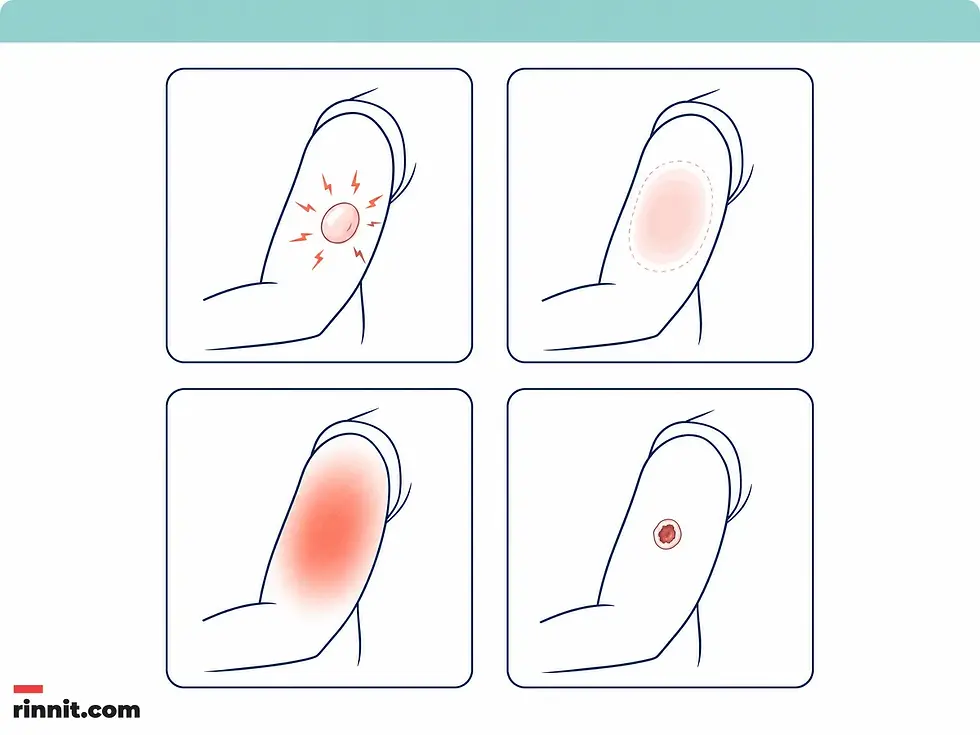
Arthus reaction symptoms appear around the area where the injection was given, within four to 12 hours of vaccination. They include:
Symptom | What It Looks or Feels Like |
Hard, very painful lump | A firm, tender bump under the skin at the injection site |
Swelling | Puffiness spreading around the injection area |
Redness or discoloration | The skin changes color over and around the site |
Open sore or ulcer | In some cases, the skin breaks open at the reaction site |
What Causes Arthus Reaction?
Arthus reaction happens when your body reacts to an additional dose of a vaccine by sending cells and fluid to the injection site. Understanding why requires a quick look at how immunity works. [1]
Your immune system recognizes things it encounters in your body as "self" or "non-self" by attaching to markers called antigens. When your immune system first sees an antigen it does not recognize, it can create antibodies designed to bind to the antigen and alert other immune cells to attack it. Your immune system then remembers that antigen so it can respond more quickly the next time it sees it.
Vaccines use different methods to get your body to recognize an antigen without making you sick. The next time your body sees that antigen after you have been vaccinated against it, it can fight it off quickly. When you get a booster shot, the IgG antibodies you made during the original vaccination can activate immune cells at the injection site. This causes your blood vessels to open up, filling the area with fluid and immune cells. [1]
That buildup of fluid and cells is what creates the hard lump and swelling under your skin — the Arthus reaction itself. In some cases, immune complexes (antibodies bound to antigens) cause vasculitis by sticking to the insides of your blood vessels. When this happens, blood may not be able to flow through, and tissue can die from lack of oxygen. [1]
What Are the Complications of Arthus Reaction?
Rarely, Arthus reaction can cause your tissue to die (necrosis). If left untreated, this can lead to wound infection. This is one reason why swelling that persists, deepens, or looks increasingly dark or blistered deserves prompt medical attention rather than waiting it out at home. [1]
How Is Arthus Reaction Diagnosed?
Healthcare providers diagnose Arthus reaction by learning about your symptoms and examining the injection site. They may test tissue or fluid around the reaction, or order blood tests to help confirm the diagnosis. [1]
How Is Arthus Reaction Treated?
Arthus reaction usually needs no treatment, because most reactions go away on their own. If the reaction is severe or lasts more than a few days, your provider might treat you with:
Treatment | How It Helps |
Corticosteroids | Reduce inflammation at the reaction site. |
Pain relievers | Keep you comfortable while the reaction runs its course. |
Antihistamines | Block some of the chemicals causing the reaction. |
Icing the area | Decreases swelling. |
If you develop complications like necrosis, a provider may surgically remove dead tissue (debridement) or prescribe antibiotics to treat or prevent infections. [1]

How Long Does Arthus Reaction Last?
Arthus reaction usually goes away on its own in a few days. If your reaction is severe or lasts a long time, you may need treatment to recover or to prevent complications. [1]
When Should I See a Healthcare Provider?
See a healthcare provider if you develop a hard, painful lump after getting a vaccine or being bitten by a bug, or if you have a wound that is not healing. They can diagnose the issue and determine what kind of treatment, if any, is best for you. [1]
Warning Sign | Why It Matters |
Swelling or a wound that is very painful | Pain out of proportion can signal deeper tissue involvement. |
Blistering | Skin breakdown raises infection risk. |
Foul-smelling wound | A classic sign of infection. |
Black tissue | May indicate necrosis (tissue death). |
Warm to the touch | Suggests active inflammation or infection. |
Oozing gray or white fluid | Signs of a wound infection that needs treatment. |
If any of these warning signs appear, go to the nearest emergency room or seek emergency medical care rather than waiting for a scheduled appointment.
Can Arthus Reaction Be Prevented?
You can prevent Arthus reaction by avoiding the cause. If you have been diagnosed with Arthus reaction to a diphtheria or tetanus vaccine, your provider might suggest spacing your boosters further apart than is typically recommended. It is important not to skip scheduled vaccinations without consulting a healthcare provider — the goal is to keep you protected while lowering your personal reaction risk. [1]
Arthus Reaction vs. Serum Sickness: What's the Difference?
Arthus reaction and serum sickness affect the body differently and occur under different circumstances.
Feature | Arthus Reaction | Serum Sickness |
Where it occurs | Only at the site of a vaccine injection (localized) | Inflammation throughout the entire body (systemic) |
Typical triggers | Repeated doses of a vaccine, some bug bites | Treatments such as monoclonal antibodies, when the immune system mistakenly attacks the serum |
Underlying mechanism | Type III hypersensitivity with local fluid and cell buildup | Immune system attacks the infused serum proteins |
What Questions Should I Ask My Doctor?
If you visit a provider about a possible Arthus reaction, consider asking: Is this an Arthus reaction or an expected vaccine side effect? When can I expect it to get better? How can I take care of myself at home? Is there any way to prevent this in the future? When should I follow up with you? [1]
Conclusion: Rare, Painful, and Usually Self-Limiting
Arthus reaction is a rare and painful condition you can develop after receiving certain vaccinations — but most often, it goes away on its own without causing any lasting effects. The hard, swollen lump typically arrives within hours of a booster shot, peaks, and then fades over a few days.
The key is knowing when it is more than a passing reaction. If the swelling is severe, persists beyond a few days, or shows any of the warning signs — blistering, warmth, black tissue, foul odor, or oozing — seek medical care promptly. A healthcare provider can confirm what is happening, relieve your symptoms, and help you plan future vaccinations more safely.
Ready to get a clear answer? If you develop a hard, painful lump after a vaccine or a bug bite, talk with a healthcare provider about diagnosis and care. For more clear, verified health information, explore the rest of Rinnit.com — start with our guide to the immune system.
Want to share this information visually? Rinnit.com's health infographic templates make it easy to turn articles like this one into shareable visuals for your website, newsletter, or social channels.
FAQ
What is Arthus reaction?
Arthus reaction is a hard, painful, swollen area that forms under the skin at the site of a booster vaccination — an additional dose of a vaccine you received previously. It is a type III hypersensitivity response, in which the immune system sends fluid and cells to the injection site. [1]
What causes Arthus reaction?
When you receive a booster shot, the IgG antibodies you made during the original vaccination activate immune cells at the injection site. This causes blood vessels to open up and the area to fill with fluid and immune cells, creating a hard, swollen lump under the skin. [1]
How common is Arthus reaction?
Arthus reaction is extremely rare. Only about 1 in 10 million people report this kind of reaction to vaccines. [1]
What are the symptoms of Arthus reaction?
Symptoms appear around the injection site within four to 12 hours of vaccination and include a hard, very painful lump; swelling; redness or discoloration; and sometimes an open sore or ulcer. [1]
How long does Arthus reaction last?
Arthus reaction usually goes away on its own within a few days without treatment. Severe or prolonged cases may need treatment to recover or prevent complications. [1]
How is Arthus reaction treated?
Most cases need no treatment. Severe or persistent cases may be treated with corticosteroids to reduce inflammation, pain relievers for comfort, antihistamines to block the chemicals causing the reaction, and ice to decrease swelling. Complications like tissue death may require surgical debridement or antibiotics. [1]
Can Arthus reaction be prevented?
You can reduce risk by avoiding the trigger. If you have had an Arthus reaction to a diphtheria or tetanus vaccine, your provider may suggest spacing boosters further apart than usual. Never skip scheduled vaccinations without consulting a healthcare provider.
What's the difference between Arthus reaction and serum sickness?
Arthus reaction happens only at the site of a vaccine injection, while serum sickness causes inflammation throughout the entire body. Serum sickness can occur with treatments such as monoclonal antibodies when the immune system mistakenly attacks the infused serum. [1]
When should I go to the ER for a vaccine reaction?
Seek emergency care if the swelling or wound is very painful, blistering, foul-smelling, black, warm to the touch, or oozing gray or white fluid. [1]
Can a bug bite cause an Arthus reaction?
Bug bites could potentially cause an Arthus reaction, since they can introduce foreign material that triggers a localized type III hypersensitivity response. See a provider if you develop a hard, painful lump after a bite. [1]
References
Cleveland Clinic. Arthus Reaction. Cleveland Clinic. February 19, 2024. https://my.clevelandclinic.org/health/diseases/arthus-reaction
Cleveland Clinic. Vaccines. Cleveland Clinic. September 7, 2022. https://my.clevelandclinic.org/health/treatments/24135-vaccines
Cleveland Clinic. Hypersensitivity Pneumonitis. Cleveland Clinic. April 30, 2026. https://my.clevelandclinic.org/health/diseases/17898-hypersensitivity-pneumonitis
Pool V, Mege L, Abou-Ali A. Arthus reaction as an adverse event following Tdap vaccination. Vaccines (Basel). 2020;8(3):385. PMID 32674495. https://doi.org/10.3390/vaccines8030385
Peng B, Wei M, Zhu FC, et al. The vaccines-associated Arthus reaction. Hum Vaccin Immunother. 2019;15(11):2769-2777. PMID 30945978. https://doi.org/10.1080/21645515.2019.1602435
Related Reading
Disclaimer: This article is for informational purposes only and is not medical advice. Always consult a qualified healthcare provider for diagnosis and treatment decisions.



Comments