Zellweger Syndrome: A Comprehensive Guide for Families

Updated: 2 days ago
Medically reviewed by Dr. Baraa Alnahhal, MD · Last reviewed: October 2026
Quick Answer
Zellweger syndrome is a genetic disorder caused by mutations in PEX genes, most commonly PEX1, that mainly affects the brain, liver and kidneys. [1] It is autosomal recessive, so both parents must be carriers. [1] Zellweger spectrum disorders together affect about 1 in 50,000 to 1 in 75,000 newborns, and life expectancy is usually less than 12 months. [1]
What the research says
Clinical findings can help sort Zellweger spectrum disorder by severity. A scoping review and meta-analysis of 107 studies (307 patients), combined with a chart review of 136 people from a natural history study, found that seizures, low muscle tone, reduced mobility, feeding difficulties, kidney cysts, adrenal insufficiency, hearing and vision loss, and a shortened lifespan differed significantly across severity categories. The number of findings present among seizures, an abnormal EEG, kidney cysts, and heart abnormalities, together with blood levels of a very long-chain fatty acid (C26:0), could tell the severity categories apart. (Bose et al., Cells, 2022) [2]
Vision loss is a near-universal feature across the spectrum. A study of 66 patients with Zellweger spectrum disorder, plus 119 patients reported in the literature, found that almost all have retinal degeneration leading to blindness. In the group analyzed, which spanned mild to severe forms, vision slowly worsened over time and legal blindness began at an average age of 7.8 years. Electroretinography (a test of the retina's electrical response) was reduced in 91% of patients. (Yergeau et al., Ophthalmology, 2023) [3]
Hearing loss is usually moderately severe to severe, and hearing aids can help. A retrospective natural history study of 42 patients with Zellweger spectrum disorders or a related condition (D-bifunctional protein deficiency), using 300 hearing tests, found that most had moderately severe to severe hearing loss that changed slowly over time. Hearing thresholds improved with hearing aids, and the authors noted that mixed hearing loss may be more common than previously recognized. (Lee et al., Ear Hear, 2022) [4]
What is Zellweger Syndrome?
Zellweger syndrome (ZS) is a rare genetic condition that is typically diagnosed shortly after a baby is born. [1] It represents the most severe form of a group of four diseases known as Zellweger spectrum disorders (ZSDs). [1] These conditions are also referred to as peroxisomal biogenesis disorders [1] because they interfere with the creation and function of peroxisomes, which are small parts of cells responsible for breaking down fats and toxins.
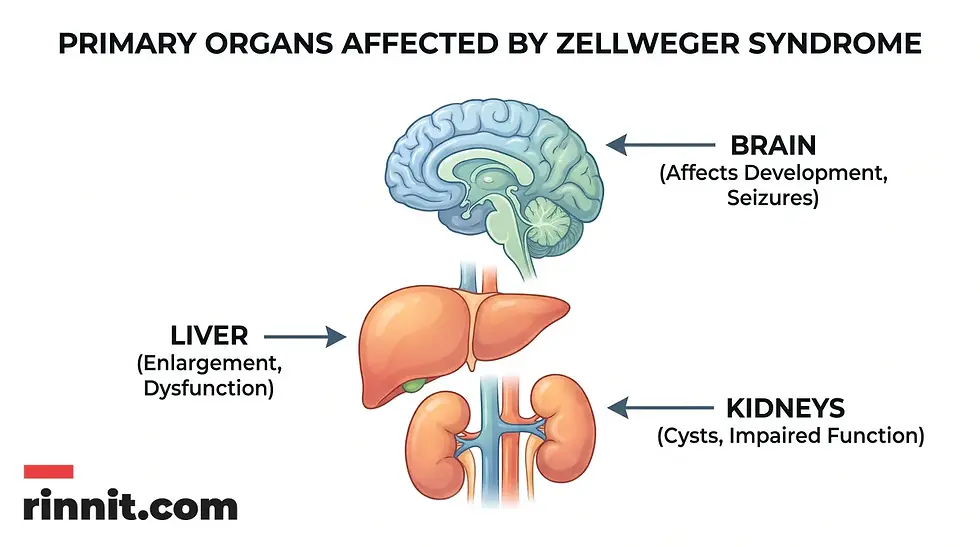
Because the disorder impacts the brain, liver, and kidneys, it is sometimes called cerebrohepatorenal syndrome. [1] The disruption of cellular metabolism leads to serious developmental problems and organ dysfunction almost immediately after birth. While other disorders on the Zellweger spectrum, such as Heimler syndrome or infantile Refsum disease, may allow individuals to live into adulthood [1], Zellweger syndrome is unfortunately fatal in early infancy.
What is the Zellweger spectrum?
Zellweger syndrome is part of a broader spectrum of disorders that vary in severity and the age at which symptoms first appear.
Disorder | Primary Impact | Typical Onset |
Zellweger Syndrome | Severe brain, liver, and kidney dysfunction [1] | At birth [1] |
Neonatal Adrenoleukodystrophy | Hearing/vision loss, brain and spine issues [1] | Infancy |
Infantile Refsum Disease | Movement problems and developmental delays [1] | Infancy |
Heimler Syndrome | Hearing loss and dental problems [1] | Late infancy or childhood [1] |
What Causes Zellweger Syndrome?
The condition is caused by a mutation in any one of 12 specific genes known as PEX genes. [1] The most frequent cause is a mutation in the PEX1 gene. [1] These genes provide the instructions for building peroxisomes, which are essential for normal cell function. Without healthy peroxisomes, the body cannot properly develop the bones, brain, eyes, heart, kidneys, liver, and nerves. [1]
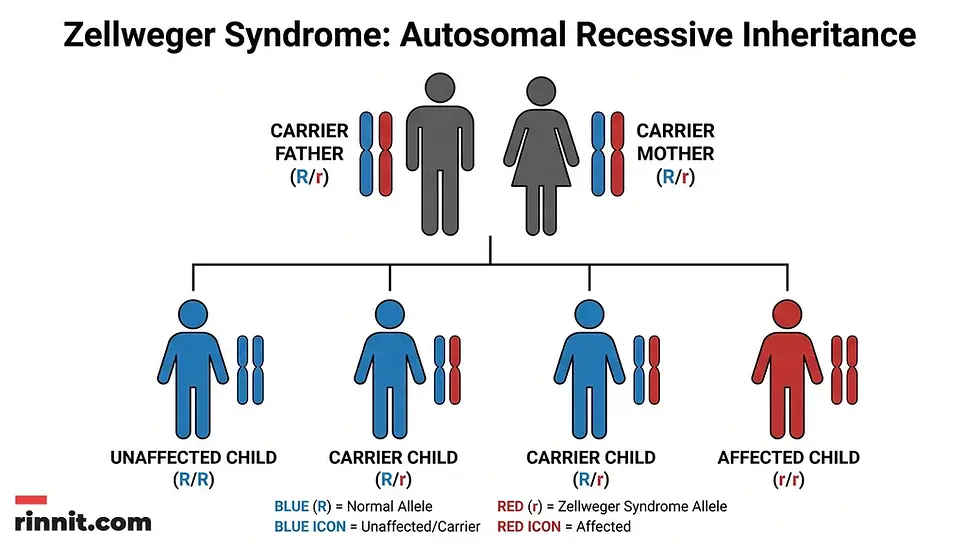
Zellweger syndrome is inherited in an autosomal recessive pattern. [1] [4] This means that a child only develops the disease if they inherit a mutated gene from both parents. [1] If both parents are carriers of the mutation, there is a 25% chance their child will have the syndrome, a 50% chance the child will be a carrier [1], and a 25% chance the child will not inherit the mutation at all.
What are the symptoms of Zellweger syndrome?
Symptoms of Zellweger syndrome are usually apparent immediately after birth. Healthcare providers often first notice distinct facial features associated with the condition. [1]
Facial Characteristics
Infants with Zellweger syndrome often have a high forehead, wide-set eyes, and a broad bridge of the nose. [1] Other common facial features include a flattened face, skin folds at the inner corners of the eyes (epicanthal folds), and eyebrow ridges that are not fully developed. [1]

Physical and Internal Symptoms
Beyond facial features, the disorder causes a range of serious health issues:
Muscle and movement: Newborns often have very weak muscles (hypotonia) and significant difficulty moving.
Organ enlargement: The liver and spleen may be enlarged [1], and jaundice (yellowing of the skin and eyes) is common due to liver dysfunction.
Neurological issues: Seizures are a frequent symptom, along with significant hearing and vision loss.
Digestive problems: Babies may have severe difficulty feeding and may experience bleeding in the digestive tract. [1]
How is Zellweger Syndrome Diagnosed?
Zellweger syndrome is diagnosed with a physical exam at birth, then confirmed with blood and urine tests, imaging and genetic testing. [1] To confirm the diagnosis, doctors use several types of tests:
Blood and urine analysis: These tests look for high levels of specific fat molecules [1], known as very long-chain fatty acids, which accumulate when peroxisomes aren't working correctly.
Imaging studies: Ultrasounds are used to check the size and health of the liver and kidneys [1], while brain MRIs can identify neurological abnormalities.
Genetic testing: A blood test can definitively confirm the presence of mutated PEX genes. [1]
For parents who know they are carriers, prenatal testing is also an option. [1] This can involve blood or imaging tests performed while the fetus is still developing in the uterus. [1]
How is Zellweger syndrome treated with supportive care?
Currently, there is no cure for Zellweger syndrome, and there are no treatments that can fix the underlying genetic cause. [1] Medical care is focused on supportive therapy to manage complications and ensure the infant is as comfortable as possible. [1] For example, if a baby cannot eat safely, a feeding tube may be used to provide necessary nutrition. [1]
Why is genetic counseling important for Zellweger syndrome?
Because Zellweger syndrome is a genetic disorder with no way to prevent it once a child is conceived, families with a history of the condition are encouraged to seek genetic counseling. [1] A counselor can help parents understand their risks [1] and evaluate their options for future pregnancies.
Conclusion
Zellweger syndrome is a devastating diagnosis for any family. While the outlook is challenging, a dedicated team of specialists, including neonatologists, can help parents navigate the care plan that best supports their child's comfort and quality of life. [1]
What actions can families take after a Zellweger syndrome diagnosis?
If you have a family history of Zellweger spectrum disorders, consider speaking with a genetic counselor. For more resources on rare genetic conditions and family support, visit Rinnit.com.
Frequently Asked Questions
What is the main cause of Zellweger syndrome?
Zellweger syndrome is caused by mutations in PEX genes that prevent cells from forming peroxisomes correctly. [1] [4]
How common is this condition?
Zellweger syndrome is very rare. When all Zellweger spectrum disorders are counted together, they affect roughly 1 in 50,000 to 1 in 75,000 newborns. [1]
Can Zellweger syndrome be cured?
No, there is currently no cure or treatment for the underlying cause. [1]
What is the life expectancy for a baby with ZS?
Most infants with the syndrome do not live past their first year. [1]
Is Zellweger syndrome the same as Refsum disease?
Zellweger syndrome and Refsum disease are both on the same spectrum, but Zellweger syndrome is much more severe and appears at birth. [1]
What organs does it affect most?
Zellweger syndrome primarily impacts the brain, liver, and kidneys. [1]
How do doctors test for it?
Diagnosis involves blood tests for fat levels, genetic testing, and imaging like MRIs or ultrasounds. [1]
Are there specific facial features?
Yes, including a high forehead, wide-set eyes, and a flattened face. [1]
Can it be detected before birth?
Yes, if the parents are known carriers, prenatal genetic and imaging tests can be done.
What are peroxisomes?
Peroxisomes are parts of cells that break down fats and toxins in the body. [1]
Why does it cause jaundice?
Jaundice occurs because the syndrome causes significant liver dysfunction. [1]
Is it always fatal?
Zellweger syndrome itself is almost always fatal in infancy, though other disorders on the spectrum have better outlooks. [1]
Can I prevent my child from having it?
There is no way to prevent it, but genetic counseling can help you understand your risks. [1]
What kind of doctor treats Zellweger syndrome?
Neonatologists and genetic specialists typically lead the care team.
Does it affect a baby's hearing?
References
Cleveland Clinic. Zellweger syndrome. Cleveland Clinic. Last updated April 20, 2021. Accessed October 15, 2026. https://my.clevelandclinic.org/health/diseases/6116-zellweger-syndrome
Bose M, Yergeau C, D'Souza Y, et al. Characterization of severity in Zellweger spectrum disorder by clinical findings: a scoping review, meta-analysis and medical chart review. Cells. 2022;11(12):1891. PMID: 35741019. https://doi.org/10.3390/cells11121891
Yergeau C, Coussa RG, Antaki F, et al. Zellweger spectrum disorder: ophthalmic findings from a new natural history study cohort and scoping literature review. Ophthalmology. 2023;130(12):1313-1326. PMID: 37541626. https://doi.org/10.1016/j.ophtha.2023.07.026
Lee J, Yergeau C, Kawai K, et al. A retrospective study of hearing loss in patients diagnosed with peroxisome biogenesis disorders in the Zellweger spectrum. Ear Hear. 2022;43(2):582-591. PMID: 34534157. https://doi.org/10.1097/AUD.0000000000001126
Medical disclaimer
The information provided in this article is for educational purposes only and should not be used as a substitute for professional medical advice, diagnosis, or treatment. Always seek the advice of your physician or other qualified health provider with any questions you may have regarding a medical condition.



Comments