Yellow Jacket Stings: Symptoms, Treatment, and Prevention

Updated: 2 days ago
Medically reviewed by Dr. Baraa Alnahhal, MD · Last reviewed: October 2026
Quick Answer: Key Facts About Yellow Jacket Stings
A yellow jacket sting causes immediate pain, redness, swelling and intense itching, with pain typically lasting 1 to 2 hours and swelling sometimes persisting for a week. Yellow jackets can sting repeatedly. First aid includes washing with soap, applying ice and using antihistamines. Difficulty breathing, throat tightness, dizziness or vomiting are emergency signs.
Feature | Details |
Common Symptoms | Immediate pain, redness, swelling, and intense itching. |
Duration of Pain | Typically lasts 1 to 2 hours, though swelling may persist for a week. |
Sting Capability | Yellow jackets can sting repeatedly without losing their stinger. |
Emergency Signs | Difficulty breathing, throat tightness, dizziness, or vomiting. |
First Aid | Remove stinger, wash with soap, apply ice, and use antihistamines. |
What the research says
Most people with only a large local reaction have a low risk of anaphylaxis next time. A clinical review reports that after a large local reaction (swelling over 10 cm lasting more than 24 hours), the chance of anaphylaxis from a future sting is about 5%. By contrast, at least 60% of adults and 20–32% of children who have had anaphylaxis from a sting and have a positive venom skin test will develop anaphylaxis with a future sting (Ochfeld & Greenberger, Allergy Asthma Proc, 2019).
Venom immunotherapy can prevent most severe reactions. A 2026 clinical review states that people with sting anaphylaxis should be prescribed epinephrine and venom immunotherapy, which prevents allergic reactions in up to 98% of patients. Most patients can safely stop after 5 years, although high-risk patients may need to continue indefinitely (McMurray et al., Immunol Allergy Clin North Am, 2026).
Research summaries are based on article abstracts retrieved from PubMed.
What Is a Yellow Jacket Sting?
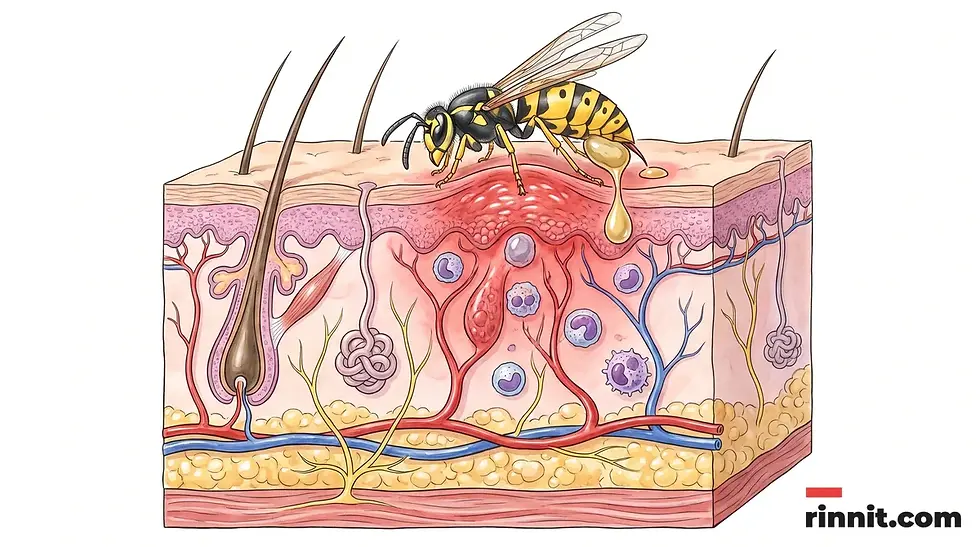
A yellow jacket sting occurs when a yellow-and-black-striped wasp pierces the skin to inject venom. These insects are the most common source of stings in the United States and are often found in underground nests, tree stumps, or hollow logs. The venom contains specific toxins and enzymes, such as mastoparan and phospholipase A1, which trigger an immediate inflammatory response in the body. Because their stingers are not barbed like those of honeybees, yellow jackets are capable of stinging a person multiple times in a single encounter. [1]
What Are the Symptoms of a Yellow Jacket Sting?
Most individuals experience a localized reaction that involves a sharp, burning sensation followed by physical changes at the site of the sting. The severity of symptoms can range from mild irritation to severe systemic reactions depending on the individual’s sensitivity to the venom.
Reaction Type | Common Symptoms |
Localized (Normal) | Pain, redness, swelling, burning, and persistent itchiness. |
Systemic (Allergic) | Wheezing, coughing, throat tightness, hives, and dizziness. |
Gastrointestinal | Nausea, vomiting, diarrhea, and difficulty swallowing. |
Normal Localized Reactions
For those without an allergy, the primary symptoms are confined to the area surrounding the sting. The pain usually peaks quickly and subsides within a few hours, although the resulting swelling and redness may take several days to fully resolve. [1]
Severe Allergic Reactions (Anaphylaxis)
Anaphylaxis is a life-threatening emergency that requires immediate medical intervention. Symptoms often appear rapidly and can include respiratory distress, a significant drop in blood pressure, and loss of consciousness. Individuals known to have such allergies should always carry an epinephrine auto-injector (EpiPen®) when outdoors. [1]
What Causes the Reaction to Yellow Jacket Venom?
The body’s reaction is driven by the chemical composition of the yellow jacket’s venom, which differs significantly from bee venom. The presence of mastoparan and phospholipase A1 triggers the body’s inflammatory response, leading to the characteristic swelling and pain. Interestingly, being allergic to yellow jacket stings does not necessarily mean an individual will be allergic to bee stings, as the specific allergens are distinct. [1]
How Are Yellow Jacket Stings Diagnosed?
Diagnosis is typically straightforward and based on the visual evidence of the sting and the patient’s report of the event. In cases where a severe reaction occurs but the insect was not identified, healthcare providers may use blood tests to confirm the specific allergen responsible for the reaction. [1]
How Do You Treat a Yellow Jacket Sting?
Treatment strategies depend entirely on whether the person is experiencing a normal localized reaction or a severe allergic response.
Home Care for Mild Stings
If there are no signs of an allergic reaction, the following steps can provide relief:
Remove the Stinger: If the stinger remains, it should be plucked or scraped away using a blunt straightedge, such as a credit card or the back of a knife. [1]
Clean the Area: Thoroughly wash the site with antibacterial soap and water to prevent infection.
Apply Ice: Use a cold compress or ice pack to reduce pain and minimize swelling.
Use Medications: Over-the-counter antihistamines can help with itching, while hydrocortisone cream or calamine lotion can soothe the skin. Pain relievers like acetaminophen or ibuprofen may also be used. [1]

Emergency Care for Allergic Reactions
If anaphylaxis is suspected, call 911 immediately. If an epinephrine auto-injector is available, it should be used in the outer thigh without delay. Medical professionals will provide further treatment, which may include epinephrine, intravenous antihistamines, corticosteroids, and breathing support. [1]
What Are the Potential Complications?
Multiple yellow jacket stings can rarely cause serious health problems, even in people who are not allergic, because of the large amount of venom injected. These complications arise from the high volume of venom injected into the system. [1]
Complication | Description |
Hypotension | A dangerous drop in blood pressure levels. |
Rhabdomyolysis | Life-threatening breakdown of muscle tissue. |
Kidney Failure | Reduced kidney function due to systemic toxins. |
Hemolysis | The destruction of red blood cells. |
How Can You Prevent Yellow Jacket Stings?
Prevention focuses on minimizing exposure to yellow jackets and avoiding behaviors that trigger their defensive instincts.
Avoid Nesting Sites: Stay away from garbage cans, hollow logs, and tree stumps where nests are common. [1]
Dress Appropriately: Avoid wearing bright clothing that may attract insects and always wear shoes when walking in grassy areas.
Manage Scents: Refrain from using perfumes, colognes, or heavily scented beauty products before going outdoors.
Handle Food Carefully: Properly dispose of trash and keep food covered during outdoor meals.
Stay Calm: If a yellow jacket approaches, remain still and avoid swatting, as aggressive movements often lead to stings. [1]

Conclusion
Yellow jacket stings are a common but manageable part of outdoor life for most people. By understanding the symptoms and having the right supplies on hand, you can effectively treat mild stings at home. However, the potential for severe allergic reactions means that vigilance and quick action are essential.
Frequently Asked Questions
How many times can a yellow jacket sting you?
Unlike honeybees, yellow jackets can sting repeatedly because their stinger is not lost during the process.
How long does the pain from a sting last?
The intense burning pain usually lasts between one and two hours, though the area may remain tender for days.
Can a single yellow jacket sting be fatal?
Yes, for individuals with a severe allergy to the venom, a single sting can cause fatal anaphylaxis.
What should I do if I am stung multiple times?
You should seek medical attention immediately, as a large number of stings can cause systemic complications even if you are not allergic.
Does insect repellent work against yellow jackets?
Yes, applying insect repellent can help reduce the risk of being targeted by yellow jackets while outdoors.
Should I pull the stinger out with my fingers?
You can pluck it out or use a blunt straightedge to scrape it away; the goal is to remove it as quickly as possible.
Why do yellow jackets sting more in the late summer?
As their food sources become scarcer in late summer and fall, yellow jackets become more aggressive in their search for food.
Is a yellow jacket a bee or a wasp?
A yellow jacket is a type of wasp, not a bee.
What is the best way to reduce swelling?
Applying an ice pack to the sting site helps reduce immediate pain and swelling.
Can I take Benadryl for a yellow jacket sting?
Yes, over-the-counter antihistamines like Benadryl can help reduce itching and localized swelling.
What does a yellow jacket nest look like?
Yellow jackets often build nests underground or in protected areas like tree stumps and wall voids.
Do yellow jackets only sting if provoked?
Yellow jackets are highly defensive of their nests; swatting at them or disturbing a nest will likely result in stings.
Can I be allergic to yellow jackets but not bees?
Yes, the venom components are different, so an allergy to one does not guarantee an allergy to the other.
How long should I monitor someone after a sting?
Watch for signs of an allergic reaction for at least 30 to 60 minutes after the sting occurs.
External Sources
Mayo Clinic. Insect bites and stings: First aid. Mayo Clinic Health Library. Accessed October 15, 2026. https://www.mayoclinic.org/first-aid/first-aid-insect-bites/basics/art-20056593
Centers for Disease Control and Prevention, NIOSH. Insects and Scorpions. NIOSH Workplace Safety & Health Topics. Accessed October 15, 2026. https://www.cdc.gov/niosh/topics/insects/default.html
American Academy of Allergy, Asthma & Immunology. Stinging Insect Allergy. AAAAI Conditions & Treatments. Last updated July 9, 2026. Accessed October 15, 2026. https://www.aaaai.org/conditions-treatments/allergies/stinging-insect-allergy
References
Cleveland Clinic. Yellow Jacket Sting. Cleveland Clinic Health Library. Last updated February 19, 2024. Accessed October 15, 2026. https://my.clevelandclinic.org/health/diseases/yellow-jacket-sting
Ochfeld EN, Greenberger PA. Stinging insect allergy and venom immunotherapy. Allergy Asthma Proc. 2019;40(6):372-375. PMID 31690373. https://doi.org/10.2500/aap.2019.40.4250
McMurray JC, Bingemann TA, Golden DBK. Venom anaphylaxis. Immunol Allergy Clin North Am. 2026;46(2):325-345. PMID 41932750. https://doi.org/10.1016/j.iac.2026.01.006
Medical disclaimer
This information is for educational purposes only and does not constitute medical advice. Always seek the advice of a qualified healthcare provider for any questions regarding a medical condition or emergency.



Comments