Wolfram Syndrome: Symptoms, Causes, and Management

Updated: 2 days ago
Medically reviewed by Dr. Baraa Alnahhal, MD · Last reviewed: October 2026
Quick Answer
Wolfram syndrome is a rare neurodegenerative condition caused by mutations in the WFS1 or WFS2 genes [1] [5]. Its four main features are diabetes mellitus, optic atrophy, sensorineural hearing loss and diabetes insipidus, usually appearing before age 15. Genetic testing confirms it, and multi-specialist care treats symptoms [1]. Life expectancy is currently shortened [3], and clinical trials are exploring ways to slow it.
What the research says
The classic symptom sequence is well documented, and the outlook is serious. In a UK nationwide study of 45 patients (a prevalence of 1 in 770,000), non-autoimmune, insulin-deficient diabetes mellitus presented at a median age of 6 years, followed by optic atrophy at 11 years. Cranial diabetes insipidus occurred in 33 patients (73%) and sensorineural deafness in 28 (62%). Median age at death was 30 years (range 25 to 49), commonly from central respiratory failure with brain-stem atrophy (Barrett et al., Lancet, 1995) [3].
Vision loss is usually severe. In the same UK cohort, optic atrophy presented in 38 patients (median age 11 years) and progressed to visual acuity of 6/60 or worse in 35 patients, a median of 8 years later (range 1 to 25 years). Only 3 patients had background diabetic retinopathy despite a median diabetes duration of 24 years (Barrett et al., Eye, 1997) [4].
Not every patient follows the classic order. An analysis of clinical and genetic data from 412 published patients found that 15% did not fulfill the then-current inclusion criterion, that diabetes mellitus and optic atrophy might not be the first two features in some patients, and that age at onset of diabetes, hearing defects, and diabetes insipidus, as well as the rate of progression, may depend on the patient's genotype (de Heredia et al., Genet Med, 2013) [5].
What is Wolfram Syndrome?
Wolfram syndrome is a rare, inherited neurodegenerative disorder that damages the brain and other tissues throughout the body. It is often referred to by the acronym DIDMOAD, which stands for its most common clinical features: Diabetes Insipidus, Diabetes Mellitus, Optic Atrophy, and Deafness [1] [2] [3].
The condition is classified into two types based on the specific genetic mutation involved:

What are the symptoms and progression of Wolfram syndrome?
Symptoms of Wolfram syndrome typically follow a predictable sequence during childhood and adolescence, though they can vary between individuals.
The DIDMOAD Sequence (Type 1)
Diabetes Mellitus (Average Age 6): The first sign is often high blood sugar, similar to Type 1 diabetes but without the autoimmune component [3].
Optic Atrophy (Average Age 11): Degeneration of the optic nerve leads to blurred vision and reduced peripheral sight [2] [4].
Sensorineural Hearing Loss (Average Age 13): Damage to the inner ear causes progressive hearing loss, which may lead to deafness.
Diabetes Insipidus (Average Age 14): A hormone imbalance results in excessive thirst and the production of large amounts of watery urine.
Other Potential Symptoms
As the condition progresses into adulthood, other neurological, psychiatric, and physical issues may arise:
What causes Wolfram syndrome, and how is it inherited?
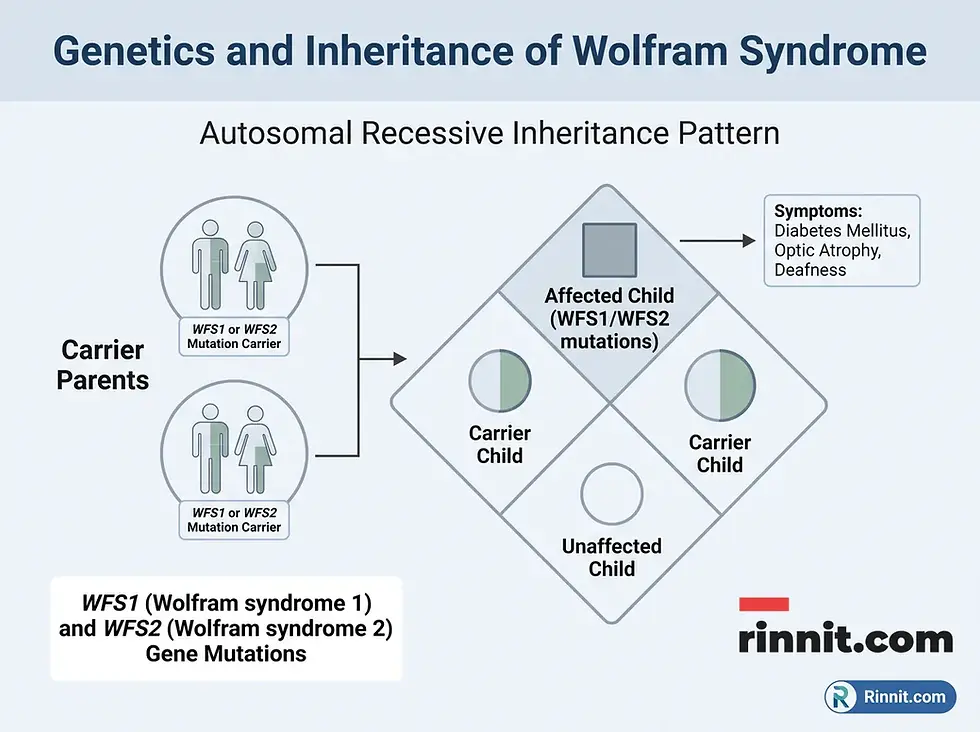
Wolfram syndrome is primarily an autosomal recessive condition [1] [2] [3]. This means a child usually inherits one mutated gene from each biological parent to develop the disorder. In rare cases of Type 1, inheriting a mutation from only one parent may be sufficient.
The mutations affect the production of proteins essential for cell health, particularly in the brain and pancreas. While the condition is extremely rare worldwide (estimated at 1 in 770,000 in the UK) [3], it may be more prevalent in regions where marriage between close relatives is common.
How is Wolfram syndrome diagnosed and managed?
Early diagnosis is critical but often difficult because healthcare providers may treat individual symptoms without connecting them to a single underlying syndrome [1].
Confirming the Diagnosis
If a combination of diabetes and vision loss is present before age 15, providers typically recommend genetic testing. A blood or saliva test can detect mutations in the WFS1 and WFS2 genes, providing a definitive diagnosis.
Current Treatment Strategies
There is no standard treatment to stop the progression of Wolfram syndrome. Care is focused on symptom management [1]:
Diabetes: Insulin therapy for blood sugar control [1].
Vision/Hearing: Regular monitoring, corrective lenses, and hearing aids.
Urinary Issues: Medications or catheters to manage bladder function.
Neurological Care: Physical therapy and monitoring for sleep apnea or seizures.

What is the outlook for Wolfram syndrome, and what research is underway?
The long-term outlook for Wolfram syndrome is currently poor, with a shortened life expectancy (averaging 30 years in some studies) [3]. The most common cause of death is brainstem deterioration [3], which affects heart rate and breathing.
However, research is rapidly advancing. Hope for the future lies in three main areas:
Gene Therapy: Repairing or replacing the mutated genes.
Regenerative Therapy: Healing damaged tissues in the brain and pancreas.
New Medications: Drugs designed to reduce the cellular stress caused by protein disruption.
Frequently Asked Questions
1. What does DIDMOAD stand for?
DIDMOAD is an acronym for the four main symptoms: Diabetes Insipidus, Diabetes Mellitus, Optic Atrophy, and Deafness.
2. Is Wolfram syndrome the same as Type 1 diabetes?
No. While both cause high blood sugar requiring insulin, Wolfram syndrome-related diabetes is not an autoimmune disease; it is caused by genetic mutations.
3. How rare is Wolfram syndrome?
Wolfram syndrome is very rare, affecting approximately 1 in 770,000 people, though it may be more common in specific populations.
4. Can Wolfram syndrome be prevented?
As a genetic condition, it cannot be prevented. However, genetic counseling can help families understand their risks.
5. What is the life expectancy?
Historically, life expectancy has ranged from 25 to 49 years, but improved management and new therapies are beginning to change this outlook.
6. Does it affect intelligence?
In the later stages, neurological symptoms like dementia can occur, but early symptoms are primarily physical and sensory.
7. Is there a cure?
Currently, there is no cure, but clinical trials for gene and regenerative therapies are ongoing.
8. How is it diagnosed?
Genetic testing is the only way to confirm a diagnosis by identifying mutations in the WFS1 or WFS2 genes.
9. Can only one parent pass it on?
Usually, both parents must be carriers, but rare cases of Type 1 have been linked to a mutation from just one parent.
10. Are there different types?
Yes, Type 1 (WFS1 mutation) and Type 2 (WFS2 mutation). Type 2 is much rarer and includes symptoms like GI ulcers and bleeding.
11. Does it cause blindness?
Wolfram syndrome causes optic atrophy, which significantly impairs vision and can lead to legal blindness over time.
12. Why does it cause excessive thirst?
The excessive thirst is due to diabetes insipidus, which affects the hormone that controls how much water the kidneys retain.
13. Should I participate in clinical trials?
Participation can provide access to emerging treatments and help advance research. Consult your healthcare provider for guidance.
14. Are there support groups?
Yes. Because it is a rare disease, connecting with specialized support organizations can be very beneficial for families.
15. Can it be detected during pregnancy?
Genetic testing can determine if parents are carriers, and prenatal testing may be possible if the specific family mutations are known.
Related Reading
Trusted External Resources
References
Hershey T, Marshall B, May J. Wolfram syndrome. National Organization for Rare Disorders (NORD). Published September 23, 2020. https://rarediseases.org/rare-diseases/wolfram-syndrome/
National Library of Medicine. Wolfram syndrome. MedlinePlus Genetics. Accessed October 8, 2026. https://medlineplus.gov/genetics/condition/wolfram-syndrome/
Barrett TG, Bundey SE, Macleod AF. Neurodegeneration and diabetes: UK nationwide study of Wolfram (DIDMOAD) syndrome. Lancet. 1995;346(8988):1458-1463. PMID 7490992. https://doi.org/10.1016/s0140-6736(95)92473-6
Barrett TG, Bundey SE, Fielder AR, et al. Optic atrophy in Wolfram (DIDMOAD) syndrome. Eye (Lond). 1997;11(Pt 6):882-888. PMID 9537152. https://doi.org/10.1038/eye.1997.226
de Heredia ML, Clèries R, Nunes V. Genotypic classification of patients with Wolfram syndrome: insights into the natural history of the disease and correlation with phenotype. Genet Med. 2013;15(7):497-506. PMID 23429432. https://doi.org/10.1038/gim.2012.180
Medical Disclaimer
This content is for informational purposes only and does not constitute medical advice. Always seek the advice of a physician or other qualified health provider with any questions regarding a medical condition.



Comments