What Is Rett Syndrome? A Plain-Language Guide to the Rare Brain Development Disorder

Updated: 3 days ago
Medically reviewed by Dr. Baraa Alnahhal, MD · Last reviewed: October 2026
Quick Answer
Rett syndrome is a rare genetic brain development disorder, mostly in girls, that causes loss of motor skills and spoken language over time [1]. Most children develop normally for six months, then lose skills between 6 and 18 months [1]. It is caused by a random change in the MECP2 gene [1] [3]. There is no cure; lifelong team-based care manages symptoms [2].
What the research says
A drug for Rett syndrome has passed a phase 3 trial. In a 12-week randomized trial of 187 females with Rett syndrome (93 on trofinetide, 94 on placebo), scores on the Rett Syndrome Behaviour Questionnaire (lower is better) improved by 4.9 points with trofinetide versus 1.7 with placebo (P = 0.0175). Diarrhea was the most common side effect (80.6% with trofinetide versus 19.1% with placebo). (Neul et al., Nat Med, 2023) [6]
Communication was one of the areas that improved. On the caregiver-rated social communication score, trofinetide beat placebo by 1.0 point (95% CI 0.3 to 1.7; P = 0.0064), though there was no difference in verbal communication. The US Food and Drug Administration approved trofinetide for Rett syndrome in March 2023; it eases symptoms rather than curing the condition. (Neul et al., Pediatr Neurol, 2024) [7]
Benefits and side effects have been followed for more than two years. In a 32-month open-label extension of 77 participants, the Rett Syndrome Behaviour Questionnaire score improved by an average of 11.8 points from the original trial's baseline, 96% of caregivers interviewed (24 of 25) were satisfied or very satisfied with the benefits, and diarrhea (53.2%) remained the most common side effect. (Percy et al., Med, 2024) [8]
What Is Rett Syndrome, in Plain Language?
Rett syndrome is a rare genetic neurological and developmental disorder that affects the way the brain develops. It causes a progressive loss of motor skills and language [1]. The condition primarily affects females [1] [3].
Here is what makes Rett syndrome unusual. Most babies with the condition seem to develop exactly as expected for the first six months of life [1]. Then, they begin to lose skills they previously had — the ability to crawl, walk, communicate, or use their hands. Over time, children have increasing problems with the muscles that control movement, coordination, and communication [1].
Rett syndrome can cause seizures and intellectual disabilities [1]. Unusual hand movements, such as repetitive rubbing or clapping, replace purposeful use of the hands [1].
There is currently no cure [1] [3], though potential treatments are being studied. Current treatment focuses on improving movement and communication, treating seizures, and providing care and support for children and adults with the condition and their families.
Is Rett Syndrome the Same as Autism or Cerebral Palsy?
Rett syndrome is a distinct condition, but it is often confused with other disorders that affect children's development. Diagnosing it requires ruling out other conditions with similar symptoms, including autism spectrum disorder, cerebral palsy, certain genetic disorders, hearing or vision problems, metabolic disorders such as phenylketonuria (PKU), brain damage before birth, and disorders that cause the brain or body to break down (degenerative disorders) [2].

What Are the Signs and Symptoms of Rett Syndrome?
Babies with Rett syndrome are usually born after an uncomplicated pregnancy and delivery. Most infants seem to grow and behave as expected for the first six months. After that, signs and symptoms start to appear. The most pronounced changes generally occur at 12 to 18 months of age, over a period of weeks or months [1].
Symptoms and severity vary greatly from child to child [4].
The Four Main Signs
Sign | What It Looks Like |
Slowed growth | Brain growth slows after birth. A smaller-than-usual head size (microcephaly) is sometimes the first sign. As children get older, growth in other parts of the body is also delayed [1]. |
Loss of movement and coordination | First signs often include reduced hand control and decreasing ability to crawl or walk. The loss is rapid at first, then continues more gradually. Eventually muscles become weak or stiff, with unusual movement and positioning [1]. |
Loss of communication abilities | Children typically lose the ability to speak, make eye contact, and communicate in other ways. Some become disinterested in other people, toys, and their surroundings. Over time, some may gradually regain eye contact and develop nonverbal communication skills [1]. |
Unusual hand movements | Repetitive, purposeless hand movements that differ from child to child, such as hand-wringing, squeezing, clapping, tapping, or rubbing [1]. |
Other Signs and Symptoms
Beyond the four main signs, Rett syndrome can bring a long list of other symptoms:
Symptom | Description |
Unusual eye movements | Intense staring, blinking, crossed eyes, or closing one eye at a time [1]. |
Breathing problems | |
Irritability and crying | Increasing agitation and irritability with age; sudden crying or screaming for no apparent reason, sometimes lasting for hours [1]. |
Other unusual behaviors | Sudden odd facial expressions, long bouts of laughter, hand licking, or grasping of hair or clothing [1]. |
Intellectual disabilities | Loss of skills may be connected to losing the ability to think, understand, and learn [1]. |
Seizures | |
Scoliosis | Sideways curvature of the spine, usually beginning between 8 and 11 years of age and progressing with age [1]. Surgery may be required if the curvature is severe. |
Irregular heartbeat | Life-threatening for many children and adults with Rett syndrome; can result in sudden death [1]. |
Sleep disturbances | Irregular sleep times, falling asleep during the day and being awake at night, or waking in the night with crying or screaming [1]. |
Other symptoms |
When Should a Parent See a Doctor?
Parents should see a doctor about Rett syndrome right away if a child shows physical problems or behavior changes after seemingly typical development. You should see your child's health care provider right away if you notice physical problems or changes in behavior after what appears to be typical development [1]. Watch for these specific signs:
Watch For | What It Means |
Slowed growth of the head or other body parts | Can be the earliest clue, often noticed at checkups. |
Decreased coordination or mobility | Losing the ability to crawl, sit, or walk. |
Repetitive hand movements | Hand-wringing, clapping, tapping, or rubbing. |
Decreasing eye contact or loss of interest in play | Pulling away from people and toys. |
Delayed or lost language | Slower speech or losing words once spoken. |
Loss of any milestone | Any clear loss of previously gained skills [1]. |
What Causes Rett Syndrome?
Rett syndrome is a rare genetic disorder. Both classic Rett syndrome and several variants — called atypical Rett syndrome, which can have milder or more severe symptoms — occur based on specific genetic changes (mutations) [1].
These genetic changes occur randomly, usually in the MECP2 gene [1] [3]. Very few cases are inherited [1] [3] [5]. The genetic changes appear to result in problems with the production of a protein that is critical for brain development [1] [3]. The exact cause is not fully understood and is still being studied [1].
What About Boys?
Males have a different chromosome combination from females, and males with the genetic changes are affected in devastating ways. Most die before birth or in early infancy [1] [5]. A very small number of males have a different genetic change that results in a less destructive form. They are likely to live to adulthood, but they remain at risk of intellectual and developmental problems [1].
What Are the Four Stages of Rett Syndrome?
Rett syndrome is often described in four stages. Knowing the stages helps parents understand what may come next, though every child's path is different.

Stage | Age Range | What Happens |
Stage 1: Early onset | 6 to 18 months; lasts a few months to a year | Signs are subtle and easily overlooked: less eye contact, loss of interest in toys, delays in sitting or crawling [1]. |
Stage 2: Rapid deterioration | 1 to 4 years | Children lose abilities they once had — sometimes rapidly, sometimes gradually over weeks or months. Slowed head growth, abnormal hand movements, hyperventilating, crying for no reason, and problems with movement and communication [1]. |
Stage 3: Plateau | Usually begins between ages 2 and 10; can last many years | |
Stage 4: Late motor deterioration | Usually begins after age 10; lasts years or decades |
What Are the Risk Factors?
Rett syndrome is rare, and the known genetic changes occur randomly. No risk factors have been identified [1]. In a very small number of cases, inherited factors — such as close family members with Rett syndrome — may play a role [1].
What Complications Can Develop?
Rett syndrome affects the whole person, and complications can touch nearly every part of daily life.
Complication | Description |
Sleep problems | Significant sleep disruption for the person and for family members [1]. |
Difficulty eating | Leads to poor nutrition and delayed growth [1]. |
Bowel and bladder problems | Constipation, GERD (gastroesophageal reflux disease), bowel or urinary incontinence, and gallbladder disease [1]. |
Pain | Can accompany problems such as digestive issues or bone fractures [1]. |
Muscle, bone, and joint problems | Weakness, contractures, and scoliosis [1]. |
Anxiety and problem behaviors | May hinder social functioning [1]. |
Lifelong care needs | Requiring lifelong care and assistance with activities of daily living [1]. |
Shortened life span | Most people live into adulthood, but may not live as long as the average person because of heart problems and other health complications [1]. |
Can Rett Syndrome Be Prevented?
Rett syndrome has no known way to be prevented, because its genetic changes usually occur spontaneously. In most cases, the genetic changes occur spontaneously. If you have a child or family member with Rett syndrome, ask your health care provider about genetic testing and genetic counseling [1].
How Is Rett Syndrome Diagnosed?
Diagnosing Rett syndrome involves careful observation of the child's growth and development, along with questions about medical and family history. Diagnosis is usually considered when slowing of head growth is noticed or when loss of skills and developmental milestones occurs [2].
The Core Symptoms Doctors Look For
A diagnosis of classic Rett syndrome includes the following signs, which may start to show up anytime from 6 to 18 months of age [2]:
Core Symptom | Description |
Loss of purposeful hand skills | Partial or complete loss of the ability to use hands with intent. |
Loss of spoken language | Partial or complete loss of the ability to speak. |
Walking problems | Difficulty walking or not being able to walk at all. |
Repetitive purposeless hand movements | Hand-wringing, squeezing, clapping, tapping, putting hands in the mouth, or washing and rubbing movements [2]. |
Additional symptoms that typically occur with Rett syndrome can support the diagnosis. Guidelines for diagnosing atypical Rett syndrome may vary slightly, with the same symptoms appearing in varying degrees of severity.
Ruling Out Other Conditions
Because other conditions mimic Rett syndrome, doctors may order a range of tests to rule them out. The specific tests depend on the child's signs and symptoms:
Test | What It Checks |
Blood tests | Looks for metabolic and genetic clues. |
Urine tests | Checks for metabolic disorders. |
MRI or CT scans | Imaging of the brain to look for structural causes. |
Hearing tests | Rules out hearing problems as the cause of communication loss. |
Eye and vision exams | Rules out vision problems. |
EEG | Tests brain electrical activity [2], often showing changes in people with Rett syndrome. |
Genetic Testing Confirms the Diagnosis
If your provider suspects Rett syndrome after the evaluation, genetic testing (DNA analysis) may be needed to confirm the diagnosis. The test requires drawing a small amount of blood from a vein in the child's arm. The blood is sent to a lab, where the DNA is examined for clues about the cause and severity of the condition. Testing for changes in the MECP2 gene confirms the diagnosis [2] [3]. Genetic counseling can help families understand these gene changes and their effects.
How Is Rett Syndrome Treated?
Rett syndrome has no cure, but lifelong treatments address symptoms and may improve movement, communication and social participation. Treatments address symptoms and provide support, and they may improve the potential for movement, communication, and social participation [2]. Importantly, the need for treatment and support does not end as children become older — care is usually necessary throughout life and requires a team approach [2].
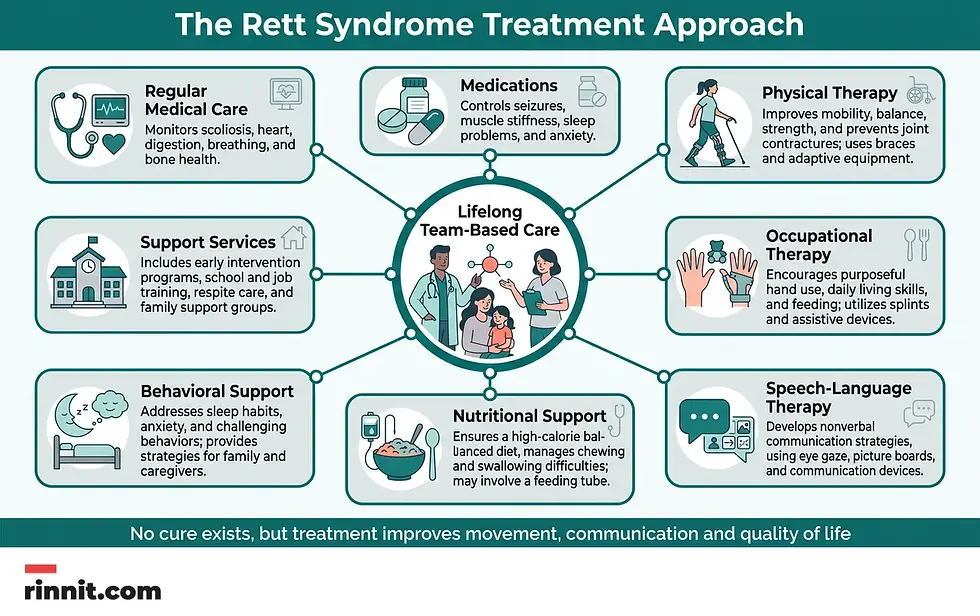
What Does the Treatment Team Do?
Treatment Pillar | What It Involves |
Regular medical care | |
Medications | Medications can't cure Rett syndrome but may help control seizures, muscle stiffness, breathing problems, sleep problems, digestive or heart problems [2]. |
Physical therapy | Therapy, plus braces or casts, can help with scoliosis or support the hands and joints [2]. It may help maintain movement, create a proper sitting position, and improve walking skills, balance, and flexibility. Walkers or wheelchairs may help. |
Occupational therapy | Helps improve purposeful use of the hands for activities such as dressing and feeding [2]. Splints that restrict elbow or wrist motion may help if repetitive arm and hand movements are a problem. |
Speech-language therapy | Teaches nonverbal ways of communicating and helps with social interaction [2]. |
Nutritional support | Proper nutrition is extremely important for healthy growth and improved mental, physical, and social abilities. A high-calorie, well-balanced diet may be recommended, along with feeding strategies to prevent choking or vomiting. Some children and adults may need a feeding tube placed directly into the stomach (gastrostomy) [2]. |
Behavioral intervention | Practicing and developing good sleep habits may help sleep disturbances. Therapies may help improve problem behaviors [2]. |
Support services | Early intervention programs and school, social, and job-training services may help with integration into school, work, and social activities. Special adaptations may make participation possible [2]. |
What About Complementary Therapies?
Families sometimes try additional approaches, including music therapy, massage therapy, hydrotherapy (swimming or moving in water), animal-assisted therapy such as therapeutic horseback riding, and adapted sports and recreational activities. There is little evidence these approaches are effective [2], though they may offer opportunities for increased movement and social or recreational enrichment. Discuss the benefits, risks, and fit with the treatment plan with your health care provider or therapist.
How Do Families Cope With Rett Syndrome?
Children and adults with Rett syndrome need help with most daily tasks, including eating, walking, and using the bathroom. Constant care and disturbed sleep can be exhausting and stressful for families, and can affect the health and well-being of family members [2].
Coping Strategy | What It Looks Like |
Find ways to relieve stress | Talk with a trusted friend or family member [2]. Take time for yourself and do something enjoyable to relax. |
Arrange for outside help | Seek outside caregivers who can give you breaks [2]. Consider residential care at some point, especially when the child becomes an adult. |
Connect with others | Knowing other families helps you feel less alone. Online support and information are available from organizations such as the International Rett Syndrome Foundation [2]. |
How Should Parents Prepare for an Appointment?
A health care provider looks for developmental problems at regular checkups. You may be referred to a pediatric neurologist (a doctor who specializes in children's brain and nervous system conditions) or a developmental pediatrician for testing and diagnosis. Bring a family member or friend if possible, both for memory and emotional support [2].
What to Bring
Make a list of any unusual behavior or other signs you have noticed — daily observations are very important. Include any medications your child takes: vitamins, supplements, herbs, nonprescription medicines, and dosages. Write down the questions you want to ask [2].
Questions to Ask Your Doctor
Why do you think my child does (or doesn't) have Rett syndrome?
Is there a way to confirm the diagnosis?
What are other possible causes of my child's symptoms?
If my child does have Rett syndrome, is there a way to tell how severe it is?
What changes can I expect to see in my child over time?
Can I take care of my child at home, or will I need outside care or additional in-home support?
What kind of special therapies do children with Rett syndrome need?
How much and what kinds of regular medical care will my child need?
What kind of support is available to families of children with Rett syndrome?
How can I learn more about this disorder?
What are my chances of having other children with Rett syndrome?
Questions Your Doctor Will Ask
Doctor's Question | Why It Matters |
When did you first notice your child's unusual behavior or other signs? | Helps date the onset of symptoms. |
What could your child do before that your child can no longer do? | Identifies lost milestones. |
How severe are your child's signs and symptoms? Are they getting progressively worse? | Gauges the stage and pace. |
What, if anything, seems to improve your child's symptoms? | Points toward helpful interventions. |
What, if anything, appears to worsen your child's symptoms? | Helps avoid triggers. |
What is the bottom line on Rett syndrome?
Rett syndrome is a challenging, lifelong condition, but families are not alone. Early recognition of the signs — slowed head growth, lost milestones, repetitive hand movements, and reduced eye contact — is the key to an earlier diagnosis. With a dedicated care team, targeted therapies, and strong family support, children and adults with Rett syndrome can reach their best possible quality of life.
If your child developed normally and then began losing skills, do not wait. Talk to your child's health care provider as soon as you have concerns.
Need more help? Rinnit.com's plain-language health library covers hundreds of conditions like this one. Browse the site for more guides written in clear, simple English.
Frequently Asked Questions
Is Rett syndrome inherited from parents?
In very few cases. Most genetic changes occur randomly in the MECP2 gene [1] [3], so there is usually no family history. If you have a family member with Rett syndrome, ask your provider about genetic testing and counseling [1].
Can boys get Rett syndrome?
Yes, but rarely and usually with devastating effects. Most boys with the genetic change die before birth or in early infancy [1]. A very small number have a different genetic change with a less destructive form and can live to adulthood with intellectual and developmental challenges [1].
What is the first sign of Rett syndrome?
Often a smaller-than-usual head size (slowed brain growth after birth) [1]. Parents may also notice less eye contact, loss of interest in toys, or delays in sitting or crawling between 6 and 18 months of age [1].
Does Rett syndrome get worse over time?
Rett syndrome has distinct stages. After an early-onset stage and a period of rapid loss of skills, children often reach a long plateau where symptoms stabilize or even improve slightly, followed by a late stage of reduced mobility that usually begins after age 10 [1].
Are seizures common in Rett syndrome?
Yes. Most people with Rett syndrome experience seizures at some point in their lives [1] [3], and medications are available to help control them [2].
Is there a cure for Rett syndrome?
No cure exists today [2] [3]. Treatment focuses on managing symptoms and providing lifelong support through a team of specialists. Trofinetide, approved by the US FDA in March 2023 [7], can ease symptoms in some people but does not cure the condition.
How long do people with Rett syndrome live?
Most people with Rett syndrome live into adulthood [1]. However, they may not live as long as the average person because of heart problems and other health complications [1], including an irregular heartbeat that can be life-threatening.
What can parents do to help their child?
Keep up with therapies (physical, occupational, and speech-language), ensure proper nutrition, practice good sleep habits, work closely with the care team, and connect with support organizations and other families.
Related Reading
References
Mayo Clinic Staff. Rett syndrome: Symptoms and causes. Mayo Clinic. Last updated May 3, 2022. Accessed October 14, 2026. https://www.mayoclinic.org/diseases-conditions/rett-syndrome/symptoms-causes/syc-20377227
Mayo Clinic Staff. Rett syndrome: Diagnosis and treatment. Mayo Clinic. Last updated May 3, 2022. Accessed October 14, 2026. https://www.mayoclinic.org/diseases-conditions/rett-syndrome/diagnosis-treatment/drc-20377233
National Institute of Neurological Disorders and Stroke. Rett syndrome. National Institute of Neurological Disorders and Stroke. Last reviewed March 13, 2026. https://www.ninds.nih.gov/health-information/disorders/rett-syndrome
International Rett Syndrome Foundation. Research. Family support. Advocacy. International Rett Syndrome Foundation. Accessed October 15, 2026. https://www.rettsyndrome.org/
MedlinePlus Genetics. Rett syndrome. MedlinePlus. Last updated October 1, 2018. https://medlineplus.gov/genetics/condition/rett-syndrome/
Neul JL, Percy AK, Benke TA, et al. Trofinetide for the treatment of Rett syndrome: a randomized phase 3 study. Nat Med. 2023;29(6):1468-1475. PMID: 37291210. https://doi.org/10.1038/s41591-023-02398-1
Neul JL, Percy AK, Benke TA, et al. Trofinetide treatment demonstrates a benefit over placebo for the ability to communicate in Rett syndrome. Pediatr Neurol. 2024;152:63-72. PMID: 38232652. https://doi.org/10.1016/j.pediatrneurol.2023.11.005
Percy AK, Neul JL, Benke TA, et al. Trofinetide for the treatment of Rett syndrome: long-term safety and efficacy results of the 32-month, open-label LILAC-2 study. Med. 2024;5(10):1275-1281.e2. PMID: 39025065. https://doi.org/10.1016/j.medj.2024.06.007
Disclaimer: This article is for general educational purposes only and is not a substitute for professional medical advice, diagnosis, or treatment. It summarizes information from public medical sources in plain language. Always consult a qualified health care professional for diagnosis and treatment decisions regarding any medical condition.



Comments