What Is Rabies? A Plain-Language Guide to the Bite You Can't Ignore, and the Shots That Stop It

Updated: 3 days ago
Medically reviewed by Dr. Baraa Alnahhal, MD · Last reviewed: October 2026
Quick Answer
Rabies is a deadly virus spread to people through the saliva of infected animals, usually by a bite [1] [3]. Early symptoms look like the flu, followed by agitation, confusion, trouble swallowing and paralysis [1]. After a possible exposure, wash the wound with soap and water and see a doctor immediately [1] [2]; an immune globulin shot plus a vaccine series stops it [2].
What the research says
Rabies is almost always fatal once symptoms appear, but it is becoming less common. Using Global Burden of Disease 2021 data, researchers found that the worldwide age-standardized rabies incidence fell by 69.4% between 1990 and 2021, and annual cases fell by 54%, from 22,035 to 10,181. The authors note that most deaths still occur in parts of Asia and Africa where access to post-exposure prophylaxis and dog vaccination is limited. (Yang et al., PLoS Negl Trop Dis, 2025) [4]
Finishing the full vaccine series matters. In a nationwide community survey across 15 Indian states (337,808 people), the estimated annual animal-bite incidence was 6.6 per 1,000 people, or about 9.1 million bites. Among people bitten by dogs, 20.5% received no anti-rabies vaccine, and nearly half (49.1%) of the 1,253 people who received one dose did not complete the full course. (Thangaraj et al., Lancet Infect Dis, 2025) [5]
Vaccinating dogs is what stops rabies from spreading. On Pemba Island, Tanzania, annual island-wide dog vaccination combined with free post-exposure vaccines for bite victims eliminated rabies. The authors found that post-exposure vaccines were highly cost-effective ($256 per death averted) but that only dog vaccination interrupts transmission, and rabies re-emerged after dog vaccination lapsed. (Lushasi et al., eLife, 2023) [6]
What Is Rabies, in Plain Language?
Rabies is a deadly virus spread to people from the saliva of infected animals [1]. The rabies virus is usually transmitted through a bite [1] [3].
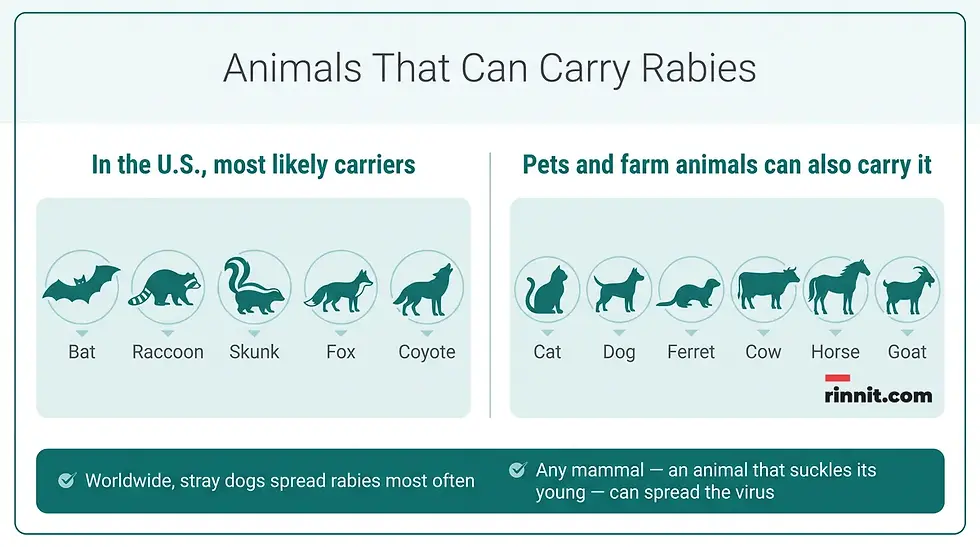
Animals most likely to transmit rabies in the United States include bats, coyotes, foxes, raccoons, and skunks [1]. In developing countries, stray dogs are the most likely to spread rabies to people [1].
Here is the part that makes rabies unlike most illnesses: once a person begins showing signs and symptoms of rabies, the disease nearly always causes death [1]. There is no cure and no treatment for rabies itself. For this reason, anyone who may have a risk of contracting rabies should receive rabies vaccinations for protection [1].

What Do the Symptoms of Rabies Feel Like?
The first symptoms of rabies may be very similar to those of the flu and may last for days [1]. That deceptive start is part of why the disease is so dangerous: by the time the flu-like feeling turns into something clearly wrong, it may already be too late.
Later signs and symptoms may include:
Symptom | What it looks like |
Flu-like start | Early symptoms that resemble the flu and may last for days [1]. |
Fever [1] | Elevated body temperature. |
Headache [1] | Ongoing head pain. |
Nausea and vomiting [1] | Upset stomach. |
Agitation and anxiety [1] | Feeling restless, on edge, or fearful. |
Confusion [1] | Trouble thinking clearly. |
Hyperactivity [1] | Unusually high activity. |
Difficulty swallowing [1] | Struggling to swallow food or water. |
Excessive salivation [1] | Producing much more saliva than normal. |
Fear of drinking fluids | Fear brought on by attempts to drink water, because of difficulty swallowing [1]. |
Fear of air on the face | Fear brought on by air blown on the face [1]. |
Hallucinations [1] | Seeing or hearing things that are not there. |
Insomnia [1] | Inability to sleep. |
Partial paralysis [1] | Loss of movement in parts of the body. |
When Should I See a Doctor?
Seek immediate medical care if you are bitten by any animal, or exposed to an animal suspected of having rabies [1]. Based on your injuries and the situation in which the exposure happened, you and your doctor can decide whether you should receive treatment to prevent rabies.
Even if you are not sure whether you have been bitten, seek medical attention. For instance, a bat that flies into your room while you are sleeping may bite you without waking you. If you wake to find a bat in your room, assume you have been bitten [1]. Also, if you find a bat near a person who cannot report a bite, such as a small child or a person with a disability, assume that person has been bitten [1].
How Does Rabies Spread?
The rabies virus causes a rabies infection. The virus spreads through the saliva of infected animals [1]. Infected animals can spread the virus by biting another animal or a person.
In rare cases, rabies can be spread when infected saliva gets into an open wound or the mucous membranes, such as the mouth or eyes [1]. This could happen if an infected animal licked an open cut on your skin [1].
Which Animals Carry Rabies?
Any mammal, meaning an animal that suckles its young, can carry and spread the rabies virus to people [1]. The animals most likely to spread it to people include:
In very rare cases, the virus has been spread to tissue and organ transplant recipients from an infected organ [1].
Who Is at Higher Risk?
Risk factor | How it raises the risk |
Traveling or living in developing countries | Rabies is more common there [1]. |
Contact with wild animals | Exploring caves where bats live, or camping without taking precautions to keep wild animals away from your campsite [1]. |
Working as a veterinarian [1] | Regular exposure to animals. |
Working in a rabies laboratory [1] | Direct exposure to the virus. |
Wounds to the head or neck | These may help the rabies virus travel to your brain more quickly [1]. |
How Do I Lower My Risk of Rabies?
Prevention comes down to keeping the virus away from you and your household. Several everyday steps make a real difference.
Vaccinate your pets. Cats, dogs, and ferrets can be vaccinated against rabies [1]. Ask your veterinarian how often your pets should be vaccinated [1].
Keep your pets confined. Keep your pets inside and supervise them when outside [1]. This helps keep your pets from coming in contact with wild animals.
Protect small pets from predators. Keep rabbits and other small pets, such as guinea pigs, inside or in protected cages so they are safe from wild animals. These small pets cannot be vaccinated against rabies [1].
Report stray animals to local authorities. Call your local animal control officials or other local law enforcement to report stray dogs and cats [1].
Do not approach wild animals. Wild animals with rabies may seem unafraid of people. It is not normal for a wild animal to be friendly with people, so stay away from any animal that seems unafraid [1].
Keep bats out of your home. Seal any cracks and gaps where bats can enter [1]. If you know you have bats in your home, work with a local expert to find ways to keep bats out [1].
Consider the rabies vaccine before travel or high-risk work. If you are traveling to a country where rabies is common and you will be there for an extended period of time, ask your doctor whether you should receive the rabies vaccine. This includes traveling to remote areas where medical care is difficult to find [1]. If you work as a veterinarian or work in a lab with the rabies virus, get the rabies vaccine [1].

How Is Rabies Diagnosed After a Bite?
At the time a potentially rabid animal bites you, there is no way to know whether the animal has transmitted the rabies virus to you [2]. It is common not to find bite marks, too [2]. Your doctor may order many tests to detect the rabies virus, but they may need to be repeated later to confirm whether you are carrying the virus [2].
Because time matters so much, your doctor will likely recommend treatment as soon as possible to prevent the rabies virus from infecting your body if there is a chance you may have been exposed to it [2].
How Is Rabies Treated?
Rabies has no effective treatment once an infection is established [2], so anyone who may have been exposed needs a series of shots to prevent it. Though a small number of people have survived rabies, the disease usually causes death [2]. For that reason, if you think you have been exposed to rabies, you must get a series of shots to prevent the infection from taking hold [2].
What Are the Rabies Shots?
If you have been bitten by an animal that is known to have rabies, you will receive a series of shots to prevent the rabies virus from infecting you. If the animal that bit you cannot be found, it may be safest to assume that the animal has rabies, but this depends on several factors, such as the type of animal and the situation in which the bite occurred [2].
The rabies shots include two parts:
Shot | What it does |
Rabies immune globulin | A fast-acting shot that prevents the virus from infecting you. Given if you have not had the rabies vaccine. It is injected near the area where the animal bit you, if possible, as soon as possible after the bite [2]. |
Rabies vaccinations | A series of injections in the arm that help your body learn to identify and fight the rabies virus. If you have not previously had the rabies vaccines, you will receive four injections over 14 days [2]. If you have had the rabies vaccine before, you will have two injections over the first three days [2]. |
Can the Animal Be Tested First?
In some cases, it is possible to determine whether the animal that bit you has rabies before beginning the series of rabies shots. If it is determined the animal is healthy, you will not need the shots [2].
Situation | What happens |
Pets and farm animals | Cats, dogs, and ferrets that bite can be observed for 10 days to see if they show signs and symptoms of rabies. If the animal remains healthy during the observation period, it does not have rabies and you will not need rabies shots [2]. Other pets and farm animals are considered case by case, so talk to your doctor and local public health officials [2]. |
Wild animals that can be caught | |
Animals that cannot be found | If the animal cannot be found, discuss the situation with your doctor and the local health department [2]. In some cases, it may be safest to assume the animal had rabies and proceed with the shots. In others, it may be unlikely the animal had rabies, and the shots may not be necessary. |
What Should I Do Right After an Animal Bite?
If an animal bites you, seek medical attention for the wound. Also tell the doctor about the circumstances of your injury.
What Will the Doctor Ask?
Question | Why it matters |
What animal bit you [2]? | Identifies the likely risk level. |
Was it a wild animal or a pet [2]? | Wild animals pose a higher risk. |
If it was a pet, who owns it, and was it vaccinated [2]? | A vaccinated pet lowers the risk. |
What was the animal's behavior before it bit you, and was it provoked [2]? | Unprovoked attacks are more suspicious. |
Were you able to capture or kill the animal after it bit you [2]? | Determines whether testing or observation is possible. |
What Can You Do in the Meantime?
Wash your wound gently and thoroughly with soap and generous amounts of water [2]. This may help wash away the virus.
If the animal that bit you can be contained or captured without causing more injury, do so [2]. Do not kill the animal with a blow or a shot to the head, as the resulting injuries may make it difficult to perform laboratory tests to determine whether the animal has rabies [2].
Tell your doctor that you have captured the animal [2]. Your doctor may then contact the local health department to determine what to do with it [2].
What is the bottom line on rabies?
Rabies is a deadly virus with no cure once symptoms begin [2], but it is also preventable [3]. The virus travels through the saliva of infected mammals, usually via a bite [1] [3], and any animal bite deserves immediate medical attention, even one you are not sure happened [1]. The two-part treatment, a fast-acting immune globulin shot plus a short series of vaccinations, stops the infection from taking hold when given quickly [2]. If the animal can be watched for 10 days or tested, and it proves healthy, the shots may not be needed at all [2]. Between bites, prevention is in your hands: vaccinate your pets, keep bats sealed out of your home, give wild animals plenty of space [1], and wash any wound thoroughly with soap and water [2]. Speed saves lives with rabies. If in doubt, see a doctor right away.
Bitten or exposed to a bat? Do not wait. Wash the wound with soap and lots of water [2], try to safely contain the animal without damaging its head [2], and head to medical care immediately. If the animal cannot be found or tested, ask your doctor and the local health department whether to start the shots [2]. Once symptoms appear, it is nearly always too late [1]. For more plain-language health guides, visit Rinnit.com.
Frequently Asked Questions
What is rabies in simple terms?
Rabies is a deadly virus spread to people from the saliva of infected animals. The virus is usually transmitted through a bite [1] [3]. Once a person begins showing symptoms, the disease nearly always causes death [1], so treatment must happen before symptoms start.
Which animals are most likely to give you rabies?
In the United States, the most likely transmitters are bats, coyotes, foxes, raccoons, and skunks [1]. In developing countries, stray dogs are the most likely to spread rabies to people [1]. Any mammal, including pets like cats, dogs, and ferrets and farm animals, can carry the virus [1].
What do the early symptoms look like?
The first symptoms of rabies may be very similar to those of the flu and may last for days [1]. Later symptoms include fever, headache, nausea, vomiting, agitation, anxiety, confusion, hyperactivity, difficulty swallowing, excessive salivation, fear of drinking fluids or of air blown on the face, hallucinations, insomnia, and partial paralysis [1].
What should I do if a bat is in my bedroom overnight?
Assume you have been bitten and seek medical attention, even if you are not sure. Bats may bite without waking you. The same rule applies if you find a bat near a small child or a person with a disability who cannot report a bite [1].
What are the rabies shots, and how many do I need?
There are two parts: a fast-acting rabies immune globulin shot given near the bite area as soon as possible [2], and a series of rabies vaccinations in the arm. If you have never been vaccinated, you get four injections over 14 days [2]. If you have had the rabies vaccine before, you get two injections over the first three days [2].
Do I always need shots after an animal bite?
Not always. Cats, dogs, and ferrets can be observed for 10 days, and if they stay healthy you will not need shots [2]. Wild animals that can be caught can be tested for the virus [2]. Shots are advised when the animal is known to have rabies, or when it cannot be found or tested and the risk is real. Your doctor and local health officials help decide [2].
Is there a cure once symptoms start?
Once a rabies infection is established, there is no effective treatment [2]. Though a small number of people have survived rabies, the disease usually causes death [2]. That is why the shots must be given before symptoms appear.
Can rabies spread without a bite?
Rarely. Rabies can spread when infected saliva gets into an open wound or the mucous membranes, such as the mouth or eyes [1]. This could happen if an infected animal licked an open cut on your skin [1].
How can I prevent rabies?
Vaccinate your cats, dogs, and ferrets; keep pets inside or supervised; keep small pets that cannot be vaccinated in protected cages; report stray animals; stay away from wild animals that seem unafraid of people; seal cracks and gaps to keep bats out of your home; and ask your doctor about the rabies vaccine before travel to countries where rabies is common or before working as a veterinarian or in a rabies lab [1].
References
Mayo Clinic Staff. Rabies - Symptoms & causes. Mayo Clinic. Updated December 24, 2025. https://www.mayoclinic.org/diseases-conditions/rabies/symptoms-causes/syc-20351821
Mayo Clinic Staff. Rabies - Diagnosis & treatment. Mayo Clinic. Updated December 24, 2025. https://www.mayoclinic.org/diseases-conditions/rabies/diagnosis-treatment/drc-20351826
Centers for Disease Control and Prevention. Rabies. CDC. Updated September 4, 2026. https://www.cdc.gov/rabies/
Yang C, et al. Disparities in Global Rabies Burden from GBD 2021: Children, older adults, and low-SDI countries at continued risk. PLoS Negl Trop Dis. 2025;19(10):e0013630. PMID 41105717. https://doi.org/10.1371/journal.pntd.0013630
Thangaraj JWV, et al. Estimates of the burden of human rabies deaths and animal bites in India, 2022-23: a community-based cross-sectional survey and probability decision-tree modelling study. Lancet Infect Dis. 2025;25(1):126-134. PMID 39362224. https://doi.org/10.1016/S1473-3099(24)00490-0
Lushasi K, et al. Integrating contact tracing and whole-genome sequencing to track the elimination of dog-mediated rabies: An observational and genomic study. Elife. 2023;12:e85262. PMID 37227428. https://doi.org/10.7554/eLife.85262
Medical disclaimer
This article is for general informational purposes only and does not constitute medical advice. Always consult a qualified healthcare professional for diagnosis and treatment decisions. If you have been bitten by, or exposed to, an animal that might have rabies, seek medical care immediately.



Comments