What Is Cedar Fever? The Winter Allergy That Strikes When No One Else Is Sneezing

Updated: 2 days ago
Medically reviewed by Dr. Baraa Alnahhal, MD · Last reviewed: October 2026
Quick Answer
Cedar fever is a winter seasonal allergy caused by breathing pollen from male mountain cedar (juniper) trees, concentrated in areas such as central Texas. [4] It causes a stuffy nose, sneezing, itchy watery eyes, cough, fatigue and occasionally a mild fever. [6] It is treated with antihistamines, decongestants, nasal steroid sprays and allergy immunotherapy [1] [4], and symptoms ease once spring arrives.
Key takeaways
Cedar fever is an allergy to pollen from mountain cedar trees, which belong to the juniper genus and pollinate in winter instead of spring. [4]
Most people do not actually get a fever; symptoms include stuffy nose, itchy watery eyes, cough, sore throat, sneezing, fatigue, and a partially reduced sense of smell or taste. [6]
Symptoms are frequently mistaken for a cold or the flu because they occur during the same winter season. [6]
Only male cedar trees produce pollen, from small orange-brown cones, while female juniper trees bear blueberry-like cones. [6]
Cedar fever is worst in areas with high Ashe juniper concentrations, such as central Texas [4], and typically peaks in mid-January. [6]
OTC antihistamines, decongestants, combination pills, nasal corticosteroid sprays, and prescription leukotriene inhibitors all treat symptoms, while allergy shots and sublingual pills build long-term tolerance. [6]
The allergy itself cannot be prevented, but keeping windows closed, washing clothes after being outdoors, and checking pollen levels significantly reduce exposure. [6]
What the research says
Mountain cedar remains a major winter allergy trigger, and treatment is layered. A review of 61 articles on mountain cedar concluded that it remains a major cause of allergic rhinoconjunctivitis in the south central United States during the winter months. The authors describe key treatment strategies as a combination of allergen avoidance, pharmacologic therapy, and subcutaneous immunotherapy. This is a literature review, so it summarizes existing evidence rather than testing treatments directly (Mendoza and Quinn, Ann Allergy Asthma Immunol, 2022) [1].
Cedar pollen can travel well beyond the trees that make it. Using PCR-based molecular analysis and air-trajectory modeling, researchers traced unusual cedar-family pollen collected in January air samples in London, Ontario, Canada back to mountain cedar populations in Texas or Oklahoma. This is an environmental study of one pollen episode, not a clinical trial, but it shows why exposure can occur away from areas with heavy tree growth (Mohanty et al., PLoS One, 2017) [2].
Immune reactions to cedar-family pollen differ by region. In serum samples from 609 patients across 4 countries, Japanese samples showed Japanese cedar-specific IgE levels nearly 10-fold higher than those against other allergens, while samples from China, Spain, and the United States showed lower levels of that antibody along with reactivity to other Cupressaceae species, including mountain cedar. The authors conclude that diagnosis and treatment should be tailored to region-specific allergen exposure. This is a laboratory study, not a treatment trial (Sugawara et al., J Allergy Clin Immunol Glob, 2025) [3].
What Is Cedar Fever?
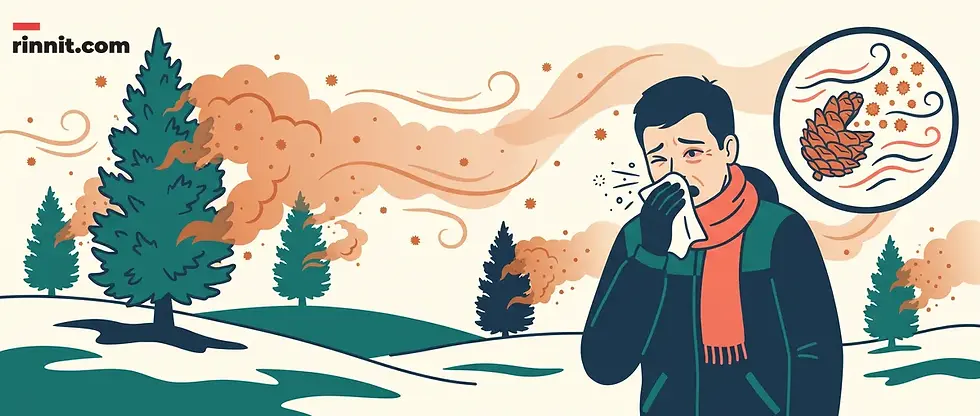
Cedar fever is an allergic reaction to pollen from mountain cedar trees, which are also known as juniper trees. [4] Even though the name includes the word "fever," most people with cedar fever do not actually have a fever. [4] Instead, the condition produces familiar allergy symptoms, a stuffy nose, cough, and sneezing, whenever you breathe in pollen released by this species of tree. [6]
The reaction happens because your body mistakenly treats cedar pollen as an invader. Your immune system releases chemicals to fight off this perceived threat, and that chemical response triggers an allergic reaction that produces your symptoms. [6]
Mountain cedar trees are members of the juniper genus. Only male cedar trees produce pollen, and that pollen comes from a small, orange-brown cone. [6] Female juniper trees, by contrast, carry a blueberry-like cone that does not release pollen. [6]
How Common Is Cedar Fever?
Cedar fever is most common in the winter months, from about December to February. [4] However, people can experience symptoms beginning as early as November and continuing through March. [6]
The condition is worse where Ashe juniper trees grow in high concentrations, particularly in central Texas. [4] Pollen levels there can become so intense that juniper trees can appear to be smoking. [6]
Most people think of allergy season as a spring event, but cedar fever is an exception to that rule because junipers pollinate during the winter. [4]
Cedar Fever Symptoms
Cedar fever produces a recognizable pattern of allergy symptoms whenever pollen is in the air.

Symptom | What you may experience |
Stuffy nose | Congestion and blocked nasal passages |
Itchy and watery eyes | Redness, itching, and tearing |
Coughing or sore throat | Throat irritation and a persistent cough |
Runny nose | Excess drainage from the nose |
Sneezing | Repeated sneeze fits, especially outdoors |
Low or mild fever | An occasional mild fever, despite the name |
Partial loss of smell or taste | Reduced ability to smell and taste food |
Fatigue | Tiredness from the allergic response and poor rest |
People commonly dismiss cedar fever symptoms as the common cold or the flu. That confusion happens because cedar fever arrives during cold and flu season, and all three conditions share similar symptoms. [6]
People with asthma or other respiratory conditions may experience worse symptoms [5], including shortness of breath, wheezing, and chest tightness. [6]
Cedar Fever vs. Common Cold vs. Flu
Because cedar fever overlaps with winter illness season, it helps to understand how the conditions compare.
Feature | Cedar fever | Common cold | Flu |
Cause | Allergic reaction to cedar pollen | Viral infection | Influenza virus |
Season | November through March, peaking mid-January | Fall and winter | Fall and winter |
Fever | Low or mild fever occasionally; most people have none | Occasional low fever | High fever is common |
Itchy, watery eyes | Yes | Sometimes | Sometimes |
Sneezing and stuffy nose | Yes | Yes | Sometimes |
Body aches and fatigue | Mild fatigue | Mild fatigue | Prominent aches and deep fatigue |
Shortness of breath, wheezing | Possible in people with asthma | Less common | Possible with complications |
If your symptoms line up with cedar pollen season and you do not have a cold or the flu, seasonal allergies may be the explanation.
Cedar Fever vs. Hay Fever
Hay fever, also called allergic rhinitis, is an allergic reaction that causes sneezing, congestion, an itchy nose, and a sore throat. Pollen, pet dander, and mold can all trigger hay fever symptoms. [6]
Cedar fever is not the same as hay fever, but cedar fever can lead to symptoms of hay fever. [6] Cedar fever is specifically tied to one trigger, mountain cedar pollen in winter, while hay fever describes the broader allergic response pattern that many different allergens can produce.
What Causes Cedar Fever?
An allergic reaction to cedar trees begins when your body decides that cedar pollen is dangerous. It reacts by producing chemicals to fight the pollen off. Those chemicals trigger the allergic reaction, and your symptoms begin. [6]
Experts are not exactly sure why some people develop allergies and others do not. Genetics and your environment both play a role. [6]
You are more likely to have cedar fever when cedar pollen counts are high. Juniper trees pollinate in colder weather, usually right after a cold front moves through. [6] The weather conditions are dry and the air pressure is shifting, creating an ideal environment for juniper trees to pollinate. Wind gusts pick the pollen up and carry it, creating something close to a pollen dust storm. [6] Cedar fever typically peaks in mid-January. [6]
Certain parts of the United States carry high concentrations of juniper trees. Central Texas, for example, is known for very high cedar pollen levels. [6] Cedar trees also grow in Arkansas, Arizona, New Mexico, Oklahoma, and Missouri, as well as parts of Mexico and Japan. [4]
How Is Cedar Fever Diagnosed?
A healthcare provider can diagnose a pollen allergy using allergy tests. [5]
Test | What happens |
Skin scratch/prick test | The provider scratches an allergen into your skin and watches how your skin reacts to it. This is the most common way to diagnose allergies. |
Blood test | A blood sample is analyzed for allergy markers. This is another common diagnostic method. |
Symptom timing evaluation | The provider matches when your symptoms start and how long they last to cedar pollen season, ruling out flu or infection. |
Your provider can also make a diagnosis based on when your symptoms start and how long they last. If your symptoms line up with cedar pollen season and you do not have the flu or an infection, seasonal allergies may be assumed as the cause. [6]
How Is Cedar Fever Treated?
You can treat cedar fever using either over-the-counter (OTC) allergy medications or prescription medications such as allergy shots. [6] Lifestyle changes help you avoid cedar pollen day to day.

Allergy Medications
Several OTC and prescription allergy medications improve cedar fever symptoms. [6]
Medication class | Examples | How it works | Available forms |
Antihistamines | Cetirizine (Zyrtec), loratadine (Claritin), azelastine (Astelin) | Block histamine, the chemical your body produces in response to an allergen | Pill, liquid, nasal spray |
Decongestants | Pseudoephedrine (Sudafed), phenylephrine (Sudafed PE) | Clear your nose by shrinking nasal passages | Pill, liquid, nasal spray |
Combination antihistamine/decongestants | Loratadine/pseudoephedrine (Claritin-D), fexofenadine/pseudoephedrine (Allegra-D) | Combine both actions in one dose | Pill |
Nasal corticosteroid sprays | Fluticasone (Flonase) | Reduce inflammation in nasal passages | Nasal spray |
Leukotriene inhibitors | Montelukast (Singulair) | Block leukotriene, the chemical that causes inflammation during an allergic reaction; prescription only | Pill |
Asthma Medications
If you have asthma, your provider may prescribe an asthma control medicine and a quick-relief asthma medicine. These can be separate medicines or combined into one medication. Inhalers deliver medication directly to your lungs, and some people use a different device, called a nebulizer, to treat their asthma. [6]
Allergy Shots (Immunotherapy)
Allergy shots work by changing your immune system's response to an allergen over time. Your body builds up a tolerance to cedar pollen so it reacts less severely. [5] Your provider may also recommend a pill you place under your tongue. [6]
It takes time to desensitize yourself, so do not delay in seeing an allergist if medications are not working. [6]
Lifestyle Changes
While avoiding the outdoors entirely may not be possible, you can change daily habits to minimize your time outside, particularly when conditions are dry and windy, since that is when cedar pollen is at its worst. [6]
Habit | How it helps |
Keep house and car windows closed | Keeps pollen out of indoor spaces |
Wash clothes after coming inside | Removes pollen; dry clothes in the dryer |
Bathe pets more frequently | Pollen sticks to fur and travels indoors |
Clean home and outdoor surfaces regularly | Removes pollen particles |
Check pollen levels before going out | Weather websites and apps report daily pollen counts |
Wear a dust mask, hat, and sunglasses outside | Minimizes pollen entering your mouth, nose, and eyes |
Change air conditioning filters in car and home | Keeps recirculated air cleaner |
Avoid being outside when dry and windy | Reduces exposure during peak pollen dispersal |
What Is the Best Thing to Take for Cedar Fever?
Treatment for allergies is unique to you. What works for one person may not work for you, and vice versa. Many people find relief from medications they can purchase at the grocery store, while others need prescription allergy medication or allergy shots. [6]
When Will Cedar Fever Go Away?
Cedar fever is seasonal, which means it eventually goes away. If you have allergy symptoms in the winter months and do not have a cold or the flu, it could be cedar fever. Keep in mind that cedar fever only occurs in regions with an abundance of juniper trees. [6]
Outlook and Prognosis
Cedar fever is seasonal, so it should not affect you all year long. In most cases, symptoms are most intense from December to February, though some people have symptoms as early as November and as late as March. How severe and how long-lasting your season is depends on how your immune system responds to the allergy and what treatments you use to manage it. [6]
Can Cedar Fever Be Prevented?
No. You cannot prevent an allergy itself; you can only manage your symptoms. [6]
Living With Cedar Fever
Medications offer relief for many people with cedar fever, though it might take time to find the medication that works best for you. Work with your healthcare provider to find the right treatment for your symptoms.
While avoiding the outdoors completely for weeks or months can be difficult, taking steps to limit your time outside is often the best way to avoid pollen. [6]
When Should You See a Healthcare Provider?
Contact a healthcare provider if you have symptoms of cedar fever. Many people find relief from over-the-counter allergy medication. But if those do not work for you, a healthcare provider can recommend more effective treatment. You do not have to suffer from allergy symptoms, because treatments are available that can help. [6]
Conclusion
Cedar fever proves that allergy season does not belong exclusively to spring. Mountain cedar and juniper trees release dense clouds of pollen through the winter months, and anyone with this allergy can spend December through March managing a stuffy nose, sneezing, itchy eyes, and fatigue that others mistake for a cold. The good news is that the condition is manageable. Over-the-counter antihistamines, decongestants, and nasal sprays relieve symptoms for many people, while prescription leukotriene inhibitors, asthma medications, and allergy shots provide stronger or longer-lasting relief. Pollen-avoidance habits like keeping windows closed and checking daily pollen counts reduce your daily exposure, and because cedar fever is seasonal, your symptoms should improve once spring arrives.
Want to explain health topics like this one visually? Understanding how your body responds to cedar pollen is the first step toward a comfortable winter. Visual tools and clear health infographics can help you track pollen seasons, compare medication options, and share symptom patterns with your care team. Rinnit's infographic templates make it easy to create exactly those kinds of visual health guides.
Frequently Asked Questions
What is cedar fever?
Cedar fever is an allergic reaction to pollen from mountain cedar trees, which are also known as juniper trees. [4] Breathing in the pollen triggers symptoms such as a stuffy nose, cough, and sneezing. [6]
Why is it called cedar fever if most people don't have a fever?
Despite the name, most people with cedar fever never develop an actual fever. [4] The name refers to the allergy syndrome as a whole; a low or mild fever is only one of several possible symptoms. [6]
What kind of tree causes cedar fever?
Mountain cedar trees, which belong to the juniper genus, cause cedar fever. [4] These trees grow in states such as Arkansas, Arizona, New Mexico, Texas, Oklahoma, and Missouri, and in parts of Mexico and Japan. [4]
Do all cedar trees produce pollen?
No. Only male cedar trees produce pollen, and the pollen comes from a small, orange-brown cone. Female juniper trees have a blueberry-like cone instead. [6]
When does cedar fever season occur?
Cedar fever is most common in the winter months from about December to February, [4] though symptoms can begin in November and last through March. [6]
When does cedar fever peak?
Cedar fever typically peaks in mid-January. [6]
Why do cedar trees pollinate in winter instead of spring?
Juniper trees pollinate in colder weather, usually right after a cold front moves through. Dry weather and shifting air pressure create ideal conditions for juniper pollination during the winter. [6]
Where is cedar fever worst?
Cedar fever is worst where Ashe juniper trees grow in high concentrations, particularly in central Texas, [4] where pollen levels can become so dense that juniper trees look like they are smoking. [6]
What are the main symptoms of cedar fever?
Symptoms include a stuffy nose, itchy and watery eyes, coughing or sore throat, runny nose, sneezing, a low or mild fever, partial loss of smell or taste, and fatigue. [6]
Can cedar fever cause a fever?
A low or mild fever is listed among possible cedar fever symptoms, but most people with the condition do not actually have a fever. [4]
Why do people mistake cedar fever for a cold or the flu?
Cedar fever happens during cold and flu season, and all three conditions share similar symptoms, so people commonly dismiss cedar fever as a cold or the flu. [6]
Can cedar fever make asthma worse?
Yes. People with asthma or other respiratory conditions may experience worse symptoms, including shortness of breath, wheezing, and chest tightness. [6]
What triggers the allergic reaction?
Your body mistakenly believes cedar pollen is an invader. It releases chemicals to fight the pollen off, and that response triggers the allergic reaction and your symptoms. [6]
Why do some people get cedar fever and others don't?
Experts are not exactly sure why some people develop allergies and others do not, but genetics and your environment both play a role. [6]
What weather makes cedar pollen worse?
Dry, windy conditions with shifting air pressure make cedar pollen worse. Wind gusts carry pollen through the air, creating something close to a pollen dust storm. [6]
Is cedar fever contagious?
No. Cedar fever is an allergic reaction to pollen, not an infection, so it cannot spread from person to person.
Is cedar fever the same as hay fever?
No. Hay fever (allergic rhinitis) is the broader allergic response that pollen, pet dander, and mold can trigger. Cedar fever is a specific winter allergy to mountain cedar pollen, though it can produce symptoms of hay fever. [6]
How is cedar fever diagnosed?
Providers use allergy tests such as a skin scratch or prick test, in which an allergen is scratched into the skin and the reaction is observed, or a blood test. [6]
Can cedar fever be diagnosed without testing?
Yes. A provider can make a diagnosis based on when symptoms start and how long they last. If symptoms line up with cedar pollen season and there is no flu or infection, seasonal allergies may be assumed. [6]
Which over-the-counter medications help cedar fever?
Antihistamines like cetirizine (Zyrtec), loratadine (Claritin), and azelastine (Astelin), and decongestants like pseudoephedrine (Sudafed) and phenylephrine (Sudafed PE) all help. They come as pills, liquids, or nasal sprays. [6]
How do antihistamines work?
Antihistamines block histamine, the chemical your body produces in response to an allergen. [6]
How do decongestants work?
Decongestants help clear your nose by shrinking your nasal passages. [6]
What are combination allergy medications?
Some medications combine an antihistamine and a decongestant in one dose, such as loratadine/pseudoephedrine (Claritin-D) and fexofenadine/pseudoephedrine (Allegra-D). [6]
Do nasal sprays treat cedar fever?
Yes. Nasal sprays containing corticosteroids, such as fluticasone (Flonase), reduce inflammation in your nasal passages. [6]
What is montelukast and when is it used?
Montelukast (Singulair) is a leukotriene inhibitor available only with a prescription. It blocks leukotriene, the chemical that causes inflammation during an allergic reaction. [6]
What asthma medications are used for cedar fever?
Providers may prescribe an asthma control medicine and a quick-relief asthma medicine, either as separate drugs or as a combined medication. [6]
What is the difference between an inhaler and a nebulizer?
An inhaler delivers medication directly to your lungs, while a nebulizer is a different device some people use to deliver asthma medication. [6]
How do allergy shots treat cedar fever?
Allergy shots change your immune system's response to an allergen over time. Your body builds up a tolerance to cedar pollen so it reacts less severely. [5]
Is there a pill alternative to allergy shots?
Yes. Your provider may recommend a sublingual pill that you place under your tongue [6] to build tolerance to cedar pollen.
How long does immunotherapy take to work?
Desensitization takes time, which is why experts advise not delaying in seeing an allergist if your medications are not working. [6]
What is the best thing to take for cedar fever?
Treatment is unique to you. Many people find relief from over-the-counter allergy medications, while others need prescription medications or allergy shots. [6] Work with your provider to find what works for your symptoms.
How long does cedar fever last?
Cedar fever is seasonal and eventually goes away. Symptoms are most intense from December to February, depending on your immune response and the treatments you use. [6]
Can cedar fever be prevented?
No. You cannot prevent an allergy; you can only manage your symptoms. [6]
How do I take care of myself during cedar season?
Limit your time outside when conditions are dry and windy, keep windows closed, wash your clothes after being outdoors, bathe pets frequently, clean surfaces regularly, check pollen levels, wear a dust mask, hat, and sunglasses outside, and change air conditioning filters in your car and home. [6]
When should I contact a healthcare provider?
Contact a provider if you have cedar fever symptoms that over-the-counter medication does not relieve. A provider can recommend more effective treatment. You do not have to suffer from allergy symptoms. [6]
References
Mendoza JC, Quinn J. Mountain cedar allergy: a review of current available literature. Ann Allergy Asthma Immunol. 2022;128(6):645-651. PMID: 34582944. https://doi.org/10.1016/j.anai.2021.09.019
Mohanty RP, Buchheim MA, Anderson J, Levetin E. Molecular analysis confirms the long-distance transport of Juniperus ashei pollen. PLoS One. 2017;12(3):e0173465. PMID: 28273170. https://doi.org/10.1371/journal.pone.0173465
Sugawara T, Ma T, Wang X, et al. Global variations of IgE cross-reactivity in Cupressus allergy. J Allergy Clin Immunol Glob. 2025 (published online November 13, 2025);5(1):100602. PMID: 41459440. https://doi.org/10.1016/j.jacig.2025.100602
Allergy & Asthma Network. In the Southwest, cedar fever soars in winter. Allergy & Asthma Network. Published October 2, 2021; revised July 1, 2026. https://allergyasthmanetwork.org/news/the-southwest-cedar-fever-soars-winter/
American College of Allergy, Asthma and Immunology. Pollen allergies. ACAAI Patient Website. Page reviewed April 23, 2018. https://acaai.org/allergies/allergic-conditions/pollen-allergies/
Cleveland Clinic. Cedar Fever. Cleveland Clinic. Last updated July 6, 2023. https://my.clevelandclinic.org/health/diseases/25120-cedar-fever
Medical disclaimer
This article is for general informational purposes only and is not medical advice. Always consult a qualified healthcare provider for diagnosis and treatment decisions.



Comments