What Is Cauliflower Ear? Why Prompt Treatment Matters After Ear Trauma

Updated: 2 days ago
Medically reviewed by Dr. Baraa Alnahhal, MD · Last reviewed: October 17, 2026
Quick Answer
Cauliflower ear is a treatable but time-sensitive condition in which an injured ear bleeds internally, forms a pocket of blood and its cartilage dies without nutrients. [4] Prompt incision and draining, ideally within six hours, greatly reduces the risk of permanent deformity. [4] Untreated, the ear typically becomes permanently misshapen within seven to 10 days. [4] Protective headgear helps prevent it. [4]
What the research says
Cauliflower ear is common in grapplers, and treatment is often informal. In a Finnish survey of 63 national- and international-level wrestlers and judokas, cauliflower ear was present in 84% of male athletes (46 of 55). Most had sought treatment for an auricular hematoma, usually needle aspiration, but 76% were treated by someone outside the healthcare profession and only one athlete reported successful treatment (Manninen et al., Scand J Med Sci Sports, 2019) [1].
Timing and compression matter. A 2025 emergency medicine narrative review advised that a fluctuant hematoma present within 7 days of injury should be evacuated by needle aspiration or incision and drainage, followed by a bolster compression dressing to stop blood from reaccumulating. It also recommended re-evaluation at 24 to 48 hours and avoiding contact sports for at least 2 weeks (Long et al., J Emerg Med, 2025) [2].
The deformity can affect hearing. In a study of 28 male wrestlers with bilateral cauliflower ears and 27 non-wrestling controls, the wrestlers had significantly higher hearing thresholds, particularly at frequencies above 4000 Hz (Özal et al., Am J Audiol, 2024) [3].
Key takeaways
Cauliflower ear follows blunt force trauma: the ear's blood supply is cut off and cartilage dies. [4]
The skin covering the ear normally carries blood to the cartilage beneath; injury separates the two. [4]
Experts prefer treatment within the first six hours of injury. [4]
Untreated, permanent deformity usually develops in about seven to 10 days. [4]
Draining it yourself is a bad idea: it carries an infection risk, and the pocket simply refills. [4]
It is extremely common among combat athletes but can happen to anyone with an ear injury. [4]
Properly fitted headgear can prevent it in contact sports. [4]
What Is Cauliflower Ear?

Cauliflower ear, also known as wrestler's ear or an auricular hematoma, is a condition that can happen after blunt force trauma to the ear. It causes the ear to look lumpy and deformed, resembling the bumpy surface of a cauliflower. [4]
The skin covering your ear carries blood to the cartilage underneath. The cartilage is what gives your ear its shape. When you sustain an ear injury, that skin can separate from the cartilage. When this happens, the blood supply is disrupted, and a hematoma, a pocket of blood, forms. As the injury heals, the ear folds in on itself, producing a shriveled, cauliflower-like appearance. [4]
Beyond the deformity, the condition can also lead to infections or hearing loss, [4] which is why a seemingly small ear injury deserves real attention.
Is Anyone Trying to Get One On Purpose?
Despite the possible health complications, many combat athletes consider cauliflower ear a badge of honor in their sport. [4] Only you can make decisions for your body, but if you are thinking about seeking a cauliflower ear deliberately, it is important to understand the risks, including recurrent infections and hearing loss.
Who Can Get It?
Even though cauliflower ear is most common among athletes, anyone can get it after an injury to the outer ear. [4] The best rule of thumb is to seek immediate treatment any time you have an ear injury, no matter how harmless it seems.
How Common Is It?
Experts are not sure how common cauliflower ear is in the general population. They do know it is extremely common among combat athletes: boxers, wrestlers, martial artists, and anyone who participates in contact sports. [4] One Finnish study reported that 96% of national-champion-level martial artists experienced at least one symptom of cauliflower ear. [4]
How Does It Affect Your Body?
Cauliflower ear primarily affects the outer ear, the visible part built from flexible cartilage covered by skin. Because the cartilage depends entirely on the skin's blood supply for nutrients, any separation between the two sets off a chain reaction: blood collects, nutrients stop flowing, the cartilage dies (necrosis), and new tissue grows back lumpy and deformed. [4]
Symptoms

If you have cauliflower ear, you might experience a range of symptoms:
Symptom | What You May Notice |
Ear shape change | The outer ear takes on a lumpy, deformed, or folded appearance |
Blurred vision | Vision may become blurry after the head or ear trauma |
Discoloration, swelling, or bruising | The outer ear turns purple, blue, or swollen |
Ear pain | Soreness and aching at the injury site |
Ear bleeding | Blood from the injured ear |
Headaches | Pain in the head after the injury |
Tinnitus | Ringing in the ears |
The initial blow to the ear can be quite painful. For many people, discomfort and swelling subside over the next few days. [4] But pain may continue, especially if the ear becomes infected. [4]
Causes
The main cause of cauliflower ear is blunt force trauma. When an ear injury occurs, the blood vessels that supply nutrients to your cartilage can tear. This causes blood to accumulate between your cartilage and your perichondrium, the connective tissue that surrounds your cartilage. [4]
Here is how the process unfolds step by step:
Step | What Happens |
1. Impact | Blunt force strikes the outer ear |
2. Vessel tear | Blood vessels supplying the cartilage rupture |
3. Hematoma forms | Blood pools between the cartilage and the perichondrium |
4. Nutrient cutoff | The cartilage loses its blood supply and starves |
5. Necrosis | Cartilage tissue dies without nutrients |
6. Regrowth | New cartilage and scar tissue form: lumpy, deformed, and asymmetrical |
Experts are not exactly sure why the new cartilage grows back lumpy and deformed, but the end result is the classic cauliflower-like appearance. [4]
How Serious Is It?
Cauliflower ear itself is not life-threatening, but it will not go away on its own. [4] The complications (permanent deformity, infections, and hearing loss) are the real stakes, and they are largely avoidable with fast treatment.
Who Does It Affect?
It most often affects boxers, wrestlers, martial artists, and contact-sport athletes, but anyone who sustains an outer-ear injury, in sports, accidents, or fights, can develop it.
Is It Contagious or Hereditary?
Cauliflower ear is not contagious, so it cannot pass from person to person. It is also not a hereditary genetic condition; it results from physical trauma. One caution about complications: if the ear becomes infected, the infection itself can produce fever and requires treatment.
Complications
The main complications of cauliflower ear are:
Complication | Details |
Ear deformity | Permanent lumpy, folded, asymmetrical outer ear |
Hearing loss | Damage related to the trauma or swelling |
Infections | The hematoma pocket can become infected |
If the ear becomes infected, additional complications can develop: fever, increased ear pain, increased swelling, and pus drainage. [4]
Diagnosis and Tests
Your healthcare provider can diagnose cauliflower ear during a physical examination of your head and neck. [4] They will also check for other health issues related to blunt force trauma to your ear, including a ruptured eardrum:
Check | Purpose |
Ruptured eardrum check | To see whether the inner ear was damaged by the same trauma |
Neurological evaluation | To check for disorders affecting the brain, spinal cord, and nerves |
Cranial nerve evaluation | Cranial nerves help you hear, taste, smell, and feel |
CT scan | Sometimes taken to check for head trauma |
Management and Treatment
How Is Cauliflower Ear Treated?
Treatment | What It Does |
Incision and draining | The hematoma is opened and drained; done promptly, it greatly reduces the risk of permanent ear deformity |
Otoplasty (ear reshaping) | A cosmetic surgery that improves the appearance of the ear; used when you have permanent damage or deformity |
If you undergo treatment quickly, you may not even develop cauliflower ear at all. [4] That is why it is best to see a healthcare provider right away. In the meantime, ice your ear to minimize pain and swelling. [4] To learn more about the surgical option, see our guide to otoplasty surgery.
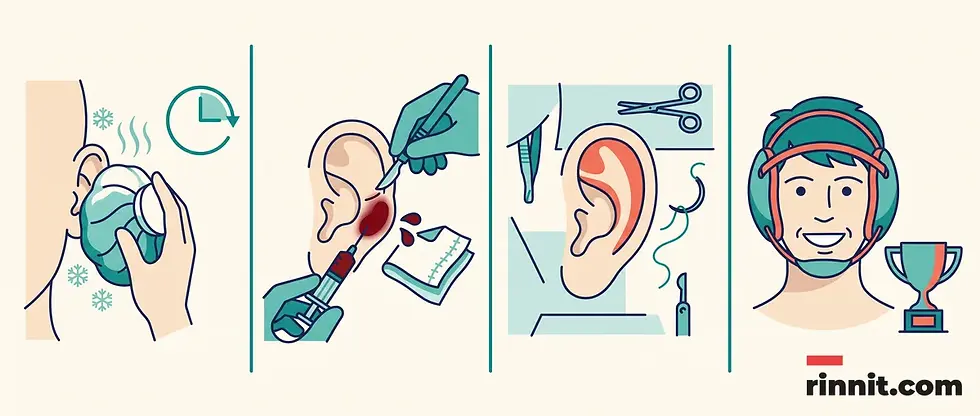
Why You Should Not Drain It Yourself
Some people attempt to drain their own cauliflower ear using a syringe. There are two problems with this approach:
Infection risk: your ear may become infected, leading to even more issues. [4]
It does not keep the ear compressed: simply draining the fluid does nothing to compress the ear, so the pocket created by the hematoma keeps filling up repeatedly. This is why so many people have recurring issues with cauliflower ear. [4]
If you get an injury that leads to cauliflower ear, seek medical care immediately. For best results, healthcare providers prefer to complete treatment within the first six hours. [4]
Recovery Timeline
Your recovery depends on the severity of your condition, how much time passed between the injury and treatment, and what type of treatment you received:
Treatment | Typical Recovery |
Incision and draining | About two weeks for most people |
Cosmetic surgery (otoplasty) | About four weeks of healing |
Your healthcare provider can tell you what to expect in your specific situation.
Outlook and Prognosis
Cauliflower ear will not go away on its own. If you undergo treatment quickly, you will likely recover without complications. [4] However, recurrence is common. [4] It happens when the pocket between your skin and cartilage fills up with fluid again.
Without treatment, the deformity usually becomes permanent in about seven to 10 days, and the edge of your ear may even flop over due to dying cartilage. [4]
Prevention
Yes, cauliflower ear can be prevented. Wear appropriate headgear while playing contact sports, and be sure the headgear fits properly. [4]
Living With Cauliflower Ear
How Do I Take Care of Myself?
Prompt treatment reduces your risk for permanent deformity. In the meantime, ice your ear as quickly as possible. Apply the compress for 15 minutes, wait 15 minutes, then ice it again. Continue this cycle until you see a healthcare provider. [4]
When Should I See My Healthcare Provider?
If you sustained an injury to your ear, see a healthcare provider as soon as possible. This may help you avoid permanent disfigurement or deformity. Call your primary care physician or head to your nearest emergency room. Even if your ear injury does not seem serious, you should still visit a healthcare provider. [4]
What Questions Should I Ask My Doctor?
Question | Why It Matters |
What type of treatment do I need? | Treatment differs by how much blood has pooled and how long ago the injury happened |
How soon do I need treatment? | The six-hour window matters for avoiding permanent change |
Will I have permanent ear damage or deformity? | Helps you understand your specific risk |
Conclusion
Cauliflower ear is a time-sensitive condition hiding behind a harmless-seeming ear bump. Blunt trauma cuts off the cartilage's blood supply, and within seven to 10 days the deformity usually becomes permanent. The good news is that prompt incision and draining, ideally within six hours, lets most people recover fully in about two weeks, and well-fitted headgear can prevent the whole problem for contact-sport athletes. Whether you wrestle, box, or simply bumped your ear, do not wait it out: see a provider, ice in the meantime, and protect the ear you were born with.
Understanding ear injuries starts with reliable information. At Rinnit, we create visual tools that turn complex medical topics into clear, shareable content. Explore our infographic templates to communicate health and sports-safety information more effectively.
FAQ
What is cauliflower ear?
Cauliflower ear is a condition that happens after blunt force trauma to the ear. The skin separates from the cartilage, blood pools in a hematoma, and the ear heals looking lumpy, folded, and deformed, like a cauliflower. [4]
What is another name for cauliflower ear?
It is also called wrestler's ear or an auricular hematoma. [4]
What causes cauliflower ear?
Blunt force trauma. The blood vessels supplying the cartilage tear, blood accumulates between the cartilage and the perichondrium, and the cartilage loses its nutrient supply and dies. [4]
What is the perichondrium?
The perichondrium is the connective tissue that surrounds your ear cartilage. [4]
What is a hematoma?
A hematoma is a pocket of collected blood. In cauliflower ear, it forms between the cartilage and the perichondrium after trauma. [4]
What happens to the cartilage after an ear injury?
Without its blood supply, the cartilage no longer receives the nutrients it needs, and tissue death (necrosis) occurs. New cartilage and scar tissue then form, typically lumpy, deformed, and asymmetrical. [4]
Why does the new cartilage grow back lumpy?
Experts are not exactly sure why the regrown cartilage becomes lumpy and deformed, but the end result is the cauliflower-like appearance. [4]
How painful is cauliflower ear?
The initial blow can be quite painful. Discomfort and swelling usually subside over the next few days, but pain may continue, especially if the ear becomes infected. [4]
Does cauliflower ear go away on its own?
No. Cauliflower ear will not resolve without treatment. Without it, the deformity usually becomes permanent in about seven to 10 days. [4]
How quickly do I need treatment?
Healthcare providers prefer to complete treatment within the first six hours after the injury. Prompt treatment greatly reduces the risk of permanent ear deformity. [4]
What happens if I wait too long to get treatment?
The deformity usually becomes permanent within seven to 10 days, and the edge of your ear may even flop over due to dying cartilage. [4]
How is cauliflower ear treated?
The main treatments are incision and draining, and otoplasty (ear reshaping surgery) for cases with permanent damage or deformity. [4]
What is incision and draining?
A procedure in which the provider opens the hematoma and drains the collected blood. Done promptly, it greatly reduces the risk of permanent deformity. [4]
How long does recovery take after draining?
Most people recover in about two weeks after incision and draining. [4]
How long does recovery take after ear reshaping surgery?
Healing after cosmetic otoplasty for cauliflower ear usually takes about four weeks. [4]
What is otoplasty?
Otoplasty is a cosmetic ear-reshaping surgery that can improve the appearance of an ear with permanent damage or deformity. [4]
Can I drain cauliflower ear on my own with a syringe?
It is not recommended. Draining it yourself carries an infection risk, and simply draining the fluid does nothing to compress the ear, so the hematoma pocket keeps refilling and the problem recurs. [4]
Why does cauliflower ear keep coming back?
The pocket between your skin and cartilage can fill up with fluid again after treatment. This is why so many people have recurring issues. [4]
Can cauliflower ear cause hearing loss?
Yes. Hearing loss is one of the main complications of cauliflower ear, along with ear deformity and infections. [4]
Can cauliflower ear cause infections?
Yes. If the ear becomes infected, you may develop fever, increased ear pain, increased swelling, and pus drainage. [4]
What are the symptoms of cauliflower ear?
Symptoms include a change in ear shape, blurred vision, discoloration, swelling or bruising of the outer ear, ear pain, ear bleeding, headaches, and tinnitus (ringing in the ears). [4]
What is tinnitus?
Tinnitus is ringing in the ears, and it can occur after ear trauma. [4]
Why would I have blurred vision after an ear injury?
Blurred vision can occur alongside ear trauma from blunt force impact. [4] A healthcare provider will evaluate you for related injuries.
Can cauliflower ear cause headaches?
Yes. Headaches are listed among the possible symptoms following an ear injury. [4]
How is cauliflower ear diagnosed?
A provider can diagnose it during a physical examination of your head and neck, plus checks for related blunt force trauma issues. [4]
What other checks happen during diagnosis?
The provider may check for a ruptured eardrum, perform a neurological evaluation of the brain, spinal cord, and nerves, evaluate the cranial nerves, and sometimes order a CT scan to check for head trauma. [4]
Is cauliflower ear contagious?
No. It is caused by physical trauma, not by anything that can spread from person to person.
Is cauliflower ear hereditary?
No. It results from injury, not genetics.
Can anyone get cauliflower ear?
Yes. It is most common among boxers, wrestlers, martial artists, and contact-sport athletes, but anyone who sustains an outer-ear injury can develop it. [4]
How common is cauliflower ear among martial artists?
Extremely common. One Finnish study reported that 96% of national-champion-level martial artists experienced at least one symptom of cauliflower ear. [4]
How common is it in the general population?
Experts are not sure how common it is among the general population. [4]
Can cauliflower ear be prevented?
Yes. Wearing appropriate, properly fitted headgear during contact sports can prevent it. [4]
What should I do right after injuring my ear?
Ice your ear as quickly as possible: apply a compress for 15 minutes, wait 15 minutes, then ice it again. Continue the cycle until you see a healthcare provider. [4]
Should I see a doctor for a minor ear injury?
Yes. Even if your ear injury does not seem serious, you should visit a healthcare provider, because untreated injuries can lead to permanent deformity. [4]
Is it safe to try to get cauliflower ear on purpose?
Combat athletes sometimes view it as a badge of honor [4], but it carries real risks including frequent ear infections and hearing loss. It is important to know the risks before making that choice.
Who should I contact after an ear injury?
Call your primary care physician or head to your nearest emergency room as soon as possible. [4]
What questions should I ask my doctor about cauliflower ear?
Ask what type of treatment you need, how soon you need it, and whether you will have permanent ear damage or deformity. [4]
Can I play sports again after treatment?
Once healed, athletes typically return to play, ideally wearing protective headgear to prevent recurrence. One emergency medicine review advises avoiding contact sports for at least 2 weeks after drainage [2], so ask your provider when it is safe for your specific case.
Related Reading
References
Manninen IK, Blomgren K, Elokiuru R, et al. Cauliflower ear among Finnish high-level male wrestlers and judokas is prevalent and symptomatic deformity. Scand J Med Sci Sports. 2019;29(12):1952-1956. PMID: 31359522. https://doi.org/10.1111/sms.13530
Long B, Mason J, Bridwell RE, et al. Managing auricular hematoma: an emergency medicine narrative review. J Emerg Med. 2025;69:62-75. PMID: 39904638. https://doi.org/10.1016/j.jemermed.2024.08.021
Özal N, Çetin Kara H, Çögen T, et al. Effect of external ear deformity on hearing in wrestlers. Am J Audiol. 2024;33(3):863-873. PMID: 38917152. https://doi.org/10.1044/2024_AJA-23-00277
Cleveland Clinic. Cauliflower Ear. Cleveland Clinic Health Library. Last updated August 9, 2024. https://my.clevelandclinic.org/health/diseases/23146-cauliflower-ear
Medical disclaimer
This article is for general informational purposes only and is not a substitute for professional medical advice, diagnosis, or treatment. Always seek the advice of a qualified healthcare provider with any questions you may have regarding a medical condition. Never disregard professional medical advice or delay seeking care because of something you have read here.



Comments