What Is Brain Freeze? Why Cold Foods Hurt and How to Stop It

Updated: 2 days ago
Medically reviewed by Dr. Baraa Alnahhal, MD · Last reviewed: October 2026
Quick Answer: What is brain freeze?
Brain freeze is a harmless headache caused by sudden extreme cold in the mouth or throat, which makes blood vessels in the head rapidly expand. It lasts only a few seconds to a few minutes [4] and needs no medicine. It can be stopped by drinking something warm or by pressing your tongue against the roof of your mouth. [4]
Key takeaways
Brain freeze is a brief, intense pain in the front of the head caused by extremely cold food, drinks, or air. [4]
The scientific name is sphenopalatine ganglioneuralgia, but most people call it an ice cream headache. [4]
It happens because blood vessels in the head expand quickly to warm the area after sensing cold. [4] [5]
It lasts only a few seconds to a few minutes [4] and goes away on its own — no medicine or rest is needed.
You can relieve it by drinking a warm or room-temperature liquid or pressing your tongue against the roof of your mouth. [4]
What the research says
About half of adults in one survey reported cold-stimulus headaches. In a questionnaire study of 618 people aged 17 to 63, the prevalence of headache attributed to ingestion or inhalation of a cold stimulus was 51.3% (317 of 618), with no difference between men and women. In 92.7% of cases the pain lasted under 30 seconds, and migraine was not linked to a higher risk of getting it (odds ratio 1.17, 95% CI 0.75–1.83) (Kraya et al., Cephalalgia, 2020) [2].
The pain is typically quick to start and quick to end. When researchers applied ice cream to the palate or throat, 46% of 50 students and 17% of 70 migraine patients developed a headache. Typically the pain began after about 12.5 seconds and lasted about 21 seconds, though a minority had a later-onset, longer headache (Bird et al., Headache, 1992) [1].
Children are affected too, and likely more often. A systematic review of 25 studies found that cold-stimulus headache is more prevalent in children than in adults and is not gender-specific, and that its triggers and features overlap with those in adults (Bonemazzi et al., Life (Basel), 2023) [3].
What Is Brain Freeze?

Brain freeze is a brief but intense pain in the front part of your head. [4] It occurs when you eat, drink, or breathe something extremely cold. The condition is commonly experienced after eating ice cream, but many cold items can trigger it.
A brain freeze is sometimes called an ice cream headache, a cold-induced headache, or a cold stimulus headache. The scientific term for it is sphenopalatine ganglioneuralgia [4] — a word almost as sudden and surprising as the headache itself.
Common Brain Freeze Triggers
Trigger | Description |
Freezing air | Breathing in very cold air, especially in winter |
Frozen or slushy drinks | Icy beverages consumed quickly |
Ice cream | Scoops eaten fast in warm weather |
Ice cubes | Sucking directly on ice |
Ice pops (popsicles) | Frozen treats eaten rapidly |
Who Gets Brain Freeze?
Anyone can get a brain freeze — it is a normal response to extreme cold, not a sign of illness. However, some groups may experience it more often.
Children may be more likely to get brain freeze because they may not have learned to slow down when eating something fun like an ice pop. [4]
Some earlier research suggested that sphenopalatine ganglioneuralgia is more common in people who get migraine headaches, but larger, more recent studies (see "What the research says" above) have not found a higher risk. [2]

What Causes Brain Freeze?
The cause comes down to how your body handles sudden temperature changes. When your body senses sudden, extreme cold in the mouth or throat, it tries to react and warm up.
Blood vessels throughout the head expand to let extra blood into the area for warmth. That quick change in blood vessel size is what causes the sudden, sharp pain. [4] [5]
Brain Freeze vs. Other Headaches
Unlike other headaches, a brain freeze comes and goes quickly. It usually lasts only a few seconds to a few minutes [4], and it goes away on its own without medicine or rest.
Other headaches often bring additional symptoms. A migraine can make you feel sick to your stomach (nausea). Some headaches make it hard to tolerate bright light or loud noise. [4] A brain freeze usually does not cause other symptoms. [2] [4]
Feature | Brain Freeze | Other Headaches (e.g., Migraine) |
Duration | A few seconds to a few minutes | Can last hours or days |
Speed | Comes and goes quickly | Often builds gradually |
Additional symptoms | Usually none | Nausea, light or sound sensitivity |
Treatment needed | None — resolves on its own | May need medicine or rest |
Trigger | Sudden extreme cold in mouth, throat, or head | Stress, hormones, diet, and more |
How to Stop a Brain Freeze
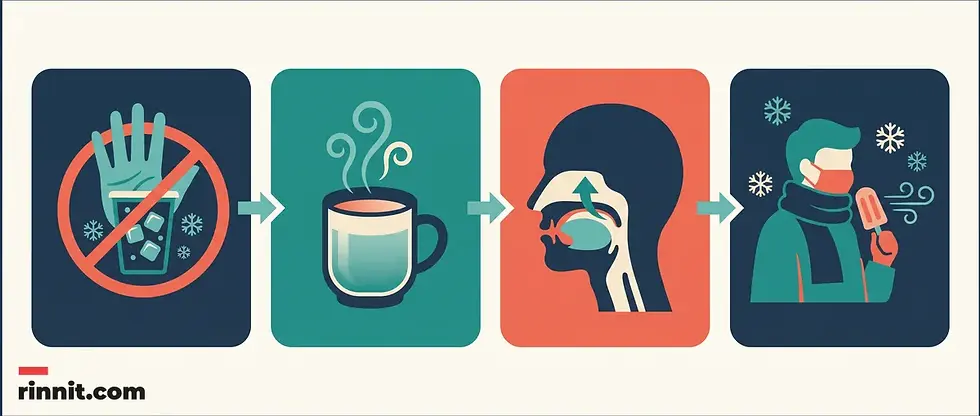
If you get an ice cream headache, the goal is to get the temperature of your mouth and throat back to normal. [4] Three simple steps work quickly.
Step | What to Do |
Stop the cold | Stop eating or drinking the cold item, or get out of the cold |
Sip something warm | Drink a warm or room-temperature liquid — not cold and not hot |
Press and warm | Press your tongue against the roof of your mouth to transfer warmth |
How to Prevent Brain Freeze
The only way to prevent brain freeze is to avoid sudden, extreme temperature changes in the mouth, throat, and head. Practical prevention steps include the following:
Avoid freezing food, drinks, and air when possible. Eat and drink very cold things slowly rather than gulping or rushing. [4] And use a barrier against cold air, such as a scarf or face mask, when outside in freezing weather.
Prevention Strategy | How It Helps |
Avoid freezing food, drinks, and air | Removes the sudden cold trigger entirely |
Eat and drink very cold things slowly | Gives your mouth time to adjust to the temperature |
Use a scarf or face mask | Shields your mouth and throat from freezing air |
Living With Brain Freeze
You don't need medical attention for a brain freeze. It is painful but not serious, and it goes away on its own quickly. [4]
However, if you get frequent headaches that last a while, talk to your healthcare provider. Frequent or long-lasting headaches may point to a different underlying cause that deserves professional evaluation.
Conclusion
Brain freeze is one of the most relatable little pains in medicine — startling, sharp, and completely harmless. Understanding why it happens, rapid blood vessel expansion in response to extreme cold, makes it easier to prevent and manage. The good news is that it resolves within a few seconds to a few minutes on its own, and simple tricks like sipping a warm drink or pressing your tongue against the roof of your mouth speed up relief. Eating cold treats slowly and protecting your mouth from freezing air keeps the fun without the freeze.
Want to explain health topics like this one visually? Infographics make complex concepts easy for readers of every age. Rinnit's infographic templates help you build clear, professional visuals for your own audience.
Frequently Asked Questions
What is brain freeze?
Brain freeze is a brief but intense pain in the front part of your head that occurs when you eat, drink, or breathe something extremely cold.
What is the scientific name for brain freeze?
The scientific term is sphenopalatine ganglioneuralgia. It is also commonly called an ice cream headache, a cold-induced headache, or a cold stimulus headache.
What causes a brain freeze?
When your body senses sudden, extreme cold in the mouth or throat, it tries to warm the area. Blood vessels throughout the head expand to let extra blood in, and that quick change in blood vessel size causes sudden pain.
Is brain freeze dangerous?
No. A brain freeze is painful but not serious. It goes away on its own quickly and does not need medical attention.
How long does brain freeze last?
Brain freeze usually lasts only a few seconds to a few minutes, and it goes away on its own without medicine or rest.
Does brain freeze cause other symptoms?
Usually not. A brain freeze usually does not cause other symptoms. Other headaches, like migraines, can cause nausea or sensitivity to light and sound.
How is brain freeze different from a migraine?
A migraine can last hours or days and often brings nausea or sensitivity to bright light and loud noise. Brain freeze lasts a few seconds to a few minutes, usually has no other symptoms, and resolves without treatment.
Who is most likely to get brain freeze?
Anyone can get one. Children may be more likely because they often eat fun frozen treats quickly. Some earlier research suggested it is more common in people who get migraine headaches, but a larger study found no higher risk.
Can kids get brain freeze?
Yes. Children are actually more prone to brain freeze since they may not have learned to slow down when eating something fun like an ice pop.
What foods and drinks trigger brain freeze?
Frozen or slushy drinks, ice cream, ice cubes, and ice pops (popsicles) are common triggers, along with breathing in freezing air.
Does breathing cold air cause brain freeze?
Yes. Breathing freezing air is one of the recognized triggers, which is why wearing a scarf or face mask in winter can help prevent it.
How do you stop a brain freeze once it starts?
Stop eating or drinking the cold item, or get out of the cold. Then drink a warm or room-temperature liquid, or press your tongue against the roof of your mouth to transfer warmth.
Why does pressing your tongue to the roof of your mouth help?
Pressing your tongue to the roof transfers warmth from your tongue directly to the cooled area in your mouth, helping return the temperature to normal so the blood vessels can settle.
Should the relief drink be hot?
No. A warm or room-temperature liquid works best — it should not be cold and not hot.
How do you prevent brain freeze?
Avoid sudden, extreme temperature changes in your mouth, throat, and head. Eat and drink very cold things slowly, and use a barrier such as a scarf or face mask against freezing air.
Can I still eat ice cream if I get brain freeze?
Yes. You don't have to give up frozen treats — just eat and drink them slowly so your mouth can adjust to the temperature.
Does brain freeze require medicine?
No. It goes away on its own without medicine or rest.
When should I see a doctor about headaches?
You don't need medical attention for a brain freeze. But if you get frequent headaches that last a while, talk to your healthcare provider.
Is brain freeze a sign of a health problem?
No. It is a normal response to extreme cold and is not considered a medical condition or warning sign.
Can brain freeze happen in summer and winter?
Yes. In summer it typically comes from frozen treats and cold drinks; in winter it can come from breathing freezing air.
What part of the head does brain freeze affect?
Brain freeze causes pain in the front part of the head.
Does brain freeze mean I have migraines?
No. Some earlier research suggested a link, but a larger study found no higher risk of brain freeze in people with migraine, so getting brain freeze alone does not mean you have migraines.
Related Reading
References
Bird N, MacGregor EA, Wilkinson MI. Ice cream headache — site, duration, and relationship to migraine. Headache. 1992;32(1):35-38. PMID: 1555929. https://doi.org/10.1111/j.1526-4610.1992.hed3201035.x
Kraya T, Schulz-Ehlbeck M, Burow P, et al. Prevalence and characteristics of headache attributed to ingestion or inhalation of a cold stimulus (HICS): a cross-sectional study. Cephalalgia. 2020;40(3):299-306. PMID: 31645112. https://doi.org/10.1177/0333102419884938
Bonemazzi I, Pelizza MF, Berti G, et al. Cold-stimulus headache in children and adolescents. Life (Basel). 2023;13(4):973. PMID: 37109502. https://doi.org/10.3390/life13040973
Richardson MW. What Causes Brain Freeze? BrainFacts.org. July 19, 2019. https://www.brainfacts.org/thinking-sensing-and-behaving/diet-and-lifestyle/2019/what-causes-brain-freeze-071819
National Headache Foundation. Scientists Study Brain Freeze to Better Understand Headache. National Headache Foundation. May 15, 2012. https://headaches.org/2012/05/15/scientists-study-brain-freeze-to-better-understand-headache/
Medical disclaimer
This article is for general informational purposes only and does not constitute medical advice. Always consult a qualified healthcare professional for diagnosis and treatment decisions.



Comments