What Is Asphyxiation? A Plain-Language Guide to Oxygen Deprivation — What Causes It, What It Feels Like, and the Emergency Steps That Save Lives

Updated: 2 days ago
Medically reviewed by Dr. Baraa Alnahhal, MD. Last reviewed October 13, 2026. This content is for educational purposes and is not medical advice.
Quick Answer
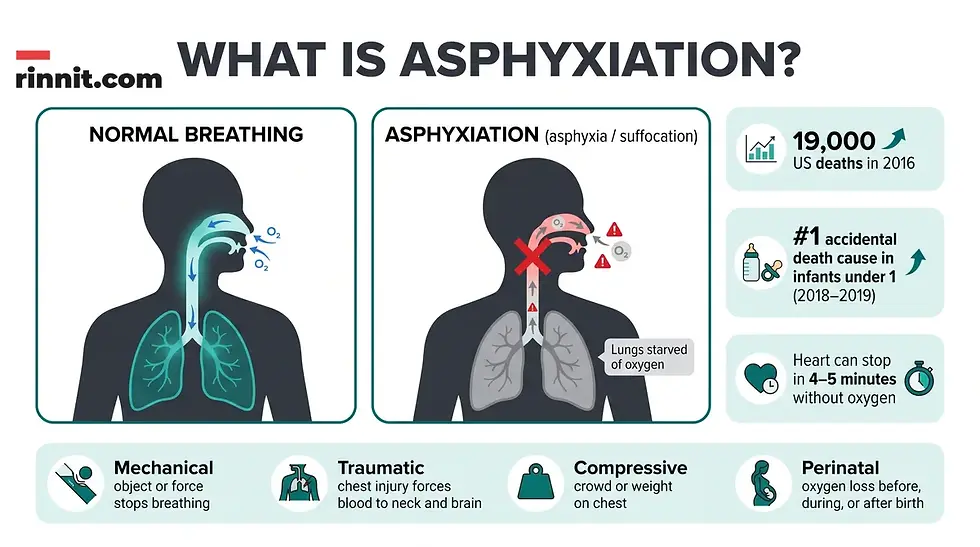
Asphyxiation, also called asphyxia or suffocation, is a condition in which the body does not get enough oxygen, which can cause loss of consciousness and death [1]. Causes include a blocked airway, anaphylaxis, asthma, drowning, opioid overdose and carbon monoxide [1]. Infants are at high risk [1] [3]. Treatment is immediate and targets the cause, including CPR and the Heimlich maneuver [1].
What the research says
Abdominal thrusts do not always clear a blocked airway. In a retrospective analysis of 1,947 U.S. emergency medical services cases of foreign body airway obstruction, abdominal thrusts removed the obstruction 46.6% of the time (41.5% on the first attempt), and the success rate was higher in children aged 15 or younger (60.2%). Successful cases had a lower proportion of impaired consciousness and cardiac arrest than unsuccessful ones, and the authors call for further studies to identify the most effective maneuvers (Suga et al., Journal of Nippon Medical School, 2024) [6].
Survival after naloxone for opioid overdose is high. A systematic review and meta-analysis of 44 studies published from 2003 to 2018 found survival after naloxone administration of 98.3% (95% CI 97.5-98.8) in programs serving people who use drugs, 95.0% (95% CI 91.4-97.1) in programs serving their family or other community members, and 92.4% (95% CI 88.9-94.8) in programs serving police. Five later studies (2018 to 2022) found similar results (Fischer et al., BMC Public Health, 2025) [7].
The evidence behind choking first aid is weaker than its reputation. A narrative review of first aid for choking in children found that guidelines around the world diverge and are generally grounded in low-quality evidence, derived mainly from case studies, and called for updated evidence on the effectiveness and safety of rescue maneuvers (Bieliński et al., Medicina, 2024) [8].
What is asphyxiation, exactly?
Asphyxiation (as-fik-see-ay-shen) is when your body doesn't get enough oxygen. It affects how you breathe. It may cause you to pass out, a state called unconsciousness, and it can also cause death [1].
You may also hear it called asphyxia or suffocation [1]. These are simply other names for the same problem.
Asphyxiation is very common. In 2016, nearly 19,000 people in the United States died from asphyxiation [1] [2]. From 2018 through 2019, asphyxiation was the leading cause of accidental death in children under one year old [1] [3].
What are the main kinds of asphyxiation?
There are many different kinds of asphyxiation. The table below explains each one:
Kind | What it is |
Mechanical asphyxia | An object or a physical force stops you from breathing. It also includes body positions that may prevent you from breathing. |
Traumatic asphyxia | A type of mechanical asphyxiation. A strong external force (trauma) to your thoracic cavity (the chamber in your body surrounded by your rib cage, muscles, tissue, and skin) forces blood from your heart back through your veins to your neck and brain. |
Compressive (compression) asphyxia | A type of mechanical asphyxiation. A strong external force presses on your chest or abdomen. Examples include a large crowd pushing against your body (like at a concert) or someone sitting or kneeling on your chest. |
Perinatal (birth) asphyxia | When a baby doesn't get enough oxygen right before, during, or right after birth. |
What does asphyxiation do inside the body?
When an object blocks the airway
If a foreign object is blocking your airway, your body retains carbon dioxide, a condition called hypercapnia. At the same time, oxygen can't reach the tissues in your body, which is called hypoxia [1].
Your body will try to start breathing again, and what happens may look frightening. Your eyes may bulge, your skin may change color, your hands may grab at your throat, and you may weakly cough [1].
Behind the scenes, your blood pressure and heart rate increase sharply: they spike. Your blood pH drops, and your body releases catecholamines, which are hormones that play an important role in the body's fight-or-flight response [1].
Eventually, your blood pressure drops and your heart slows down [1]. The blockage must be removed or treatment administered immediately. If it isn't, your heart will stop beating, a state called cardiac arrest, in four to five minutes [1].
When it comes from drowning
Drowning affects the body in two different ways, depending on what the vocal cords do:
Scenario | What happens |
About 10% of drownings | Your vocal cords suddenly stop working (a spasm called laryngospasm) when you first gasp water. You die from asphyxiation, but no water enters your lungs. |
The other 90% of cases | The muscles in your glottis (the space between your vocal cords) relax, and water enters your lungs. |
What the water does next depends on whether it is fresh or salty. Freshwater is absorbed quickly by your body; it dilutes the plasma in your blood and breaks down your red blood cells, a process called hemolysis [1]. Saltwater does the opposite: it draws fluids from your circulatory system into your lungs and decreases the amount of plasma in your blood [1].
What are the symptoms of asphyxiation?
Symptoms of asphyxiation include:
Symptom | What to notice |
Shortness of breath (dyspnea) | Struggling to catch air |
Quick or deep breathing (hyperventilation) | Breathing faster or deeper than normal |
Loss of consciousness | Passing out |
Coughing | Especially shallow, ineffective coughing |
Raspy or hoarse voice | A strained, rough voice |
Inability to speak | Cannot get words out |
Face or lip discoloration | Red, purple, blue, or gray coloring |
Difficulty or inability to swallow | Trouble getting food or liquid down |
Memory loss | Gaps in memory |
Involuntary urination or defecation | Loss of bladder or bowel control |
Dizziness | Feeling lightheaded or unsteady |
Headaches | Head pain |
What causes asphyxiation?
There are many different causes of asphyxiation:
Cause | How it cuts off oxygen |
Anaphylaxis | A severe allergic reaction, usually from food allergies. Other symptoms may include vomiting and swelling of your hands, feet, and face (lips). |
Asthma | A chronic (long-term) condition that affects your lungs. Triggers include exercise, pet dander (dried skin flakes), and tobacco smoke. |
Positional asphyxiation | Your body is in a position that blocks or obstructs your breathing. It most commonly occurs in newborn babies or infants who aren't strong enough to reposition their bodies. |
Chemical asphyxiation | You breathe in a substance that replaces the oxygen in your lungs, preventing oxygen from reaching the rest of your body. Chemicals include carbon monoxide, cyanide, hydrogen sulfide, and chemicals in household cleaning products. |
Opioid overdose | Opioids interact with nerve cells to reduce pain. Too many opioids slow your breathing down and can stop it entirely. |
Drowning | Asphyxiation from your head going under a liquid (submersion), usually water. |
Foreign object blockage (obstruction) | Foreign objects block your airways, often from improperly swallowing food or choking on vomit due to alcohol poisoning. |
Strangulation | A hand, rope, cord, or another object around your neck blocks your airway. |

How is asphyxiation recognized and diagnosed?
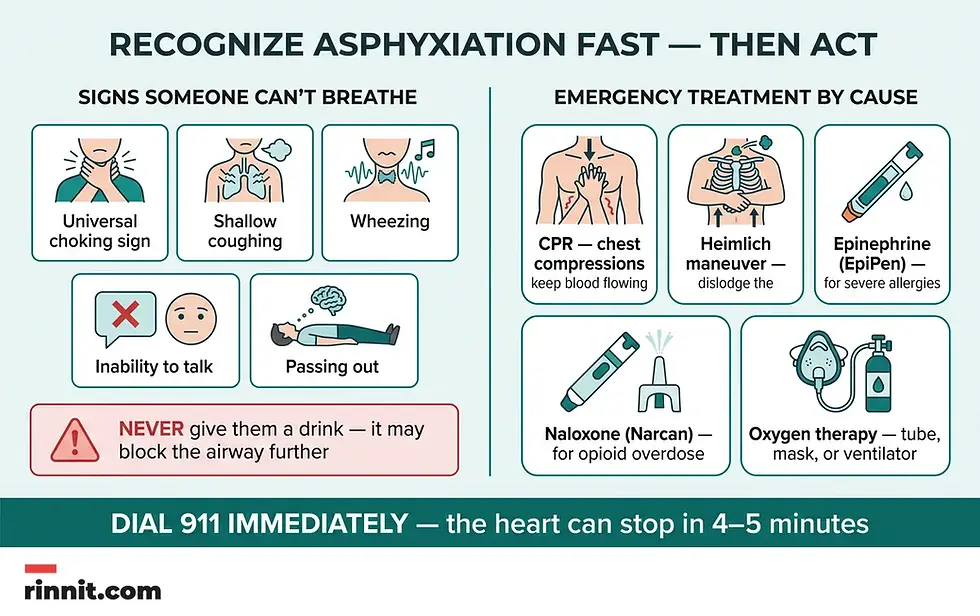
Asphyxiation is a medical emergency that requires immediate treatment [1]. If you're with a child or adult who suddenly can't breathe, ask them if they're choking. If they can't respond, look for these signs:
If a baby can't breathe, watch for changes in their behavior, including difficulty breathing, a weak cry, or a shallow cough [1].
One important rule: never give someone who can't breathe a drink. A drink may further obstruct the airway [1].
If a foreign object is partially obstructing the airway, a healthcare provider may order X-rays or a bronchoscopy, a procedure that looks directly inside the airways, to locate and remove the blockage [1].
How is asphyxiation treated?
Treatment depends on what's causing the breathing difficulty [1]:
Treatment | When it's used |
Cardiopulmonary resuscitation (CPR) | Chest compressions keep blood flowing to vital organs until the heartbeat returns. |
Heimlich maneuver | Abdominal thrusts help dislodge airway obstructions. |
Medications | An inhaler for asthma, epinephrine (EpiPen) for an allergic reaction, or naloxone (Narcan) for an opioid overdose. |
Mouth-to-mouth resuscitation | Helps stimulate breathing; can be applied to people who've drowned or overdosed on opioids. |
Oxygen therapy | A breathing tube, oxygen mask, nose tube, or ventilator delivers oxygen to your body. |
What is the outlook?
The outlook for people who immediately treat the cause of their asphyxiation is good [1]. If asphyxiation isn't treated immediately, long-term or permanent effects may include stroke, brain injury, or death [1].
How can asphyxiation be prevented?
The best way to prevent asphyxiation is to be careful, and to dial 911 immediately if you're with someone who can't breathe.
Situation | Prevention step |
Eating | Chew your food slowly and speak only after swallowing. Keep an eye on young children when they're eating; encourage small bites and no talking until food is swallowed. |
Food allergies | Carry an EpiPen with you at all times. Check the ingredients label of anything you eat. |
Swimming | Swim with at least one other person. If you can't swim, wear a life jacket. |
Asthma | Keep an inhaler with you at all times in case you have an asthma attack. |
At home | Install carbon monoxide detectors. Have a trained professional do yearly inspections of fuel-burning appliances: your furnace, water heater, and oven. |
What questions should I ask my healthcare provider?
What should I do if someone isn't breathing?
Do I have any long-term or permanent health effects from not being able to breathe?
Do I have any food allergies?
Should I see an allergist?
How can I prevent asphyxia in the future?
The bottom line
Asphyxiation is the common ending of many different emergencies: a blocked airway, a severe allergy, asthma, drowning, an overdose, chemical exposure, crushing pressure, or even a bad sleeping position in a newborn. What ties them all together is simple: the body runs out of oxygen, blood pressure and heart rate spike and then fall, and without help the heart can stop in four to five minutes [1].
The good news is that the first minutes are also where you have the most power: abdominal thrusts, CPR, an EpiPen, naloxone, and an immediate call to 911. Prevention is equally practical: slow eating and small bites for children, an EpiPen if you have food allergies, an inhaler if you have asthma, life jackets for non-swimmers, and carbon monoxide detectors in every home. When asphyxiation happens, immediate treatment makes the difference between a full recovery and permanent harm or death.
Take the next step: If someone near you suddenly can't breathe, ask if they're choking, watch for the universal sign of hands clutching the throat, and dial 911 right away. Take a CPR and choking-response course before you need one, and keep the right tools close: an EpiPen if food allergies run in your family, an inhaler if anyone has asthma, and carbon monoxide detectors on every level of your home. Ask your healthcare provider whether you should see an allergist, and never give a drink to someone struggling to breathe. The first minutes decide everything, and being ready makes you the person who can act in them.
Frequently Asked Questions
What is asphyxiation? Asphyxiation (asphyxia or suffocation) is when your body doesn't get enough oxygen. It affects how you breathe, may cause you to pass out (unconsciousness), and can cause death.
What are the symptoms? Symptoms include shortness of breath (dyspnea), quick or deep breathing (hyperventilation), coughing, a raspy or hoarse voice, inability to speak, face or lip discoloration (red, purple, blue, or gray), difficulty or inability to swallow, loss of consciousness, memory loss, involuntary urination or defecation, dizziness, and headaches.
What causes it? Causes include anaphylaxis (severe allergic reaction), asthma, positional asphyxiation, chemical asphyxiation (carbon monoxide, cyanide, hydrogen sulfide), opioid overdose, drowning, foreign object blockage, and strangulation.
What are the main kinds? Mechanical asphyxia (an object or physical force stops breathing, including certain body positions), traumatic asphyxia (chest trauma forcing blood back toward the neck and brain), compressive asphyxia (external pressure on the chest or abdomen, like a crowd crush), and perinatal asphyxia (oxygen loss before, during, or right after birth).
What happens inside the body when the airway is blocked? The body retains carbon dioxide (hypercapnia) while oxygen can't reach tissues (hypoxia). Blood pressure and heart rate spike, blood pH drops, and catecholamines, the fight-or-flight hormones, are released. Eventually blood pressure falls and the heart slows. Without treatment, cardiac arrest can occur in four to five minutes.
Does water always enter the lungs when someone drowns? No. In about 10% of drownings, the vocal cords spasm shut (laryngospasm) when the person first gasps water, and they die from asphyxiation with no water in the lungs. In the other 90%, water enters the lungs. Freshwater dilutes the blood plasma and breaks down red blood cells, while saltwater draws fluid into the lungs and lowers plasma.
How is it treated? Treatment depends on the cause and may include CPR, the Heimlich maneuver (abdominal thrusts), medications (an inhaler for asthma, epinephrine/EpiPen for allergic reaction, naloxone/Narcan for opioid overdose), mouth-to-mouth resuscitation, oxygen therapy, and, for partial blockages, X-rays or bronchoscopy to locate and remove the object.
What is the outlook? Good, if the cause is treated immediately. Without immediate treatment, long-term or permanent effects may include stroke, brain injury, or death.
How common is it? Very common. Nearly 19,000 people in the United States died from asphyxiation in 2016, and from 2018 through 2019 it was the leading cause of accidental death in children under one year old.
How can I prevent it? Chew food slowly and speak only after swallowing; watch young children while they eat; carry an EpiPen if you have food allergies; keep an inhaler if you have asthma; swim with at least one other person or wear a life jacket; install carbon monoxide detectors; and have fuel-burning appliances inspected yearly. If someone can't breathe, dial 911 immediately, and never give them a drink.
Related Reading
Anaphylaxis: Symptoms, Triggers, and Why Epinephrine Is the Only Emergency Treatment - How a food allergy becomes an oxygen emergency and why minutes matter.
References
Cleveland Clinic. Asphyxiation. Cleveland Clinic. Last updated February 13, 2023. https://my.clevelandclinic.org/health/diseases/24725-asphyxiation
Centers for Disease Control and Prevention. QuickStats: Percentage of Injury Deaths That Occurred in the Decedent's Home for the Five Most Common Causes of Injury Death - United States, 2016. MMWR Morb Mortal Wkly Rep. 2018;67(26):750. PMID 29975676. https://doi.org/10.15585/mmwr.mm6726a6
Garnett MF, et al. Urban-rural Differences in Unintentional Injury Death Rates Among Children Aged 0-17 Years: United States, 2018-2019. NCHS Data Brief. 2021;(421):1-8. PMID 34705627. https://pubmed.ncbi.nlm.nih.gov/34705627/
Borke J. Choking - adult or child over 1 year. MedlinePlus. Reviewed February 10, 2026. https://medlineplus.gov/ency/article/000049.htm
Richards D. Drowning. Merck Manual Professional Version. Last updated August 2026. https://www.merckmanuals.com/professional/injuries-poisoning/drowning/drowning
Suga R, et al. Effectiveness of the Abdominal Thrust Maneuver for Airway Obstruction Removal: Analysis of Data from the National Emergency Medical Services Information System. J Nippon Med Sch. 2024;91(3):270-276. PMID 38972739. https://doi.org/10.1272/jnms.JNMS.2024_91-305
Fischer LS, et al. Effectiveness of naloxone distribution in community settings to reduce opioid overdose deaths among people who use drugs: a systematic review and meta-analysis. BMC Public Health. 2025;25(1):1135. PMID 40133970. https://doi.org/10.1186/s12889-025-22210-8
Bieliński JR, et al. Do We Actually Help Choking Children? The Quality of Evidence on the Effectiveness and Safety of First Aid Rescue Manoeuvres: A Narrative Review. Medicina (Kaunas). 2024;60(11):1827. PMID 39597012. https://doi.org/10.3390/medicina60111827
Medical Disclaimer
This guide is for general information only and is not a substitute for professional medical advice, diagnosis, or treatment. Asphyxiation is a medical emergency: dial 911 immediately if someone cannot breathe. Never disregard professional medical advice or delay seeking it because of something you have read here.



Comments