What Is a Retractile Testicle? A Plain-Language Guide for Parents (What It Means, What Happens, and What Comes Next)

Updated: 2 days ago
Medically reviewed by Dr. Baraa Alnahhal, MD · Last reviewed: October 2026
Quick Answer
A retractile testicle is a testicle that moves between the scrotum and groin but can be guided back into place by hand [1], caused by an overactive cremaster muscle [1]. Unlike an undescended testicle, it has entered the scrotum [1]. No treatment is needed [2], and it usually settles by puberty [1] [2], but yearly exams check that it does not ascend [2].
What the research says
Surveillance, not surgery, is the evidence-based approach. A review of the literature on retractile testes, covering definitions, natural history, outcomes, and evidence for surgery, concluded that there is currently not enough evidence to warrant surgery and that a strategy of surveillance should be adopted. (Keys and Heloury, J Pediatr Urol, 2012) [3]
Follow-up matters because retractile testes are not always entirely typical. In a small study of 20 children (28 testes) with truly retractile testes, 21.4% had an open processus vaginalis (a small channel that normally closes) and 14.3% had epididymal anomalies, compared with 4% and 2% in 25 fetuses with testes in the scrotum. The authors concluded that retractile testis is not a normal variant. (Anderson et al., Int Braz J Urol, 2016) [4]
Even specialists can find it hard to tell similar conditions apart. In a survey of 62 urologists in Korea, 59.7% said they had difficulty distinguishing a retractile testis from a gliding testis, and the harder the diagnosis felt, the more often surgery was chosen. For infants with a retractile testis, 87.1% of urologists said they would follow up rather than operate. The authors called for a practical guideline to prevent unnecessary surgery. (Kim and Chung, J Korean Med Sci, 2022) [5]
What Is a Retractile Testicle?
A retractile testicle is a testicle that may move back and forth between the scrotum and the groin [1]. The scrotum is the bag of skin hanging behind the penis [1], and it is where a boy's testicles normally sit. When a retractile testicle is up in the groin, it can usually be gently guided by hand back into its proper position in the scrotum during a physical exam [1]. Once released, it will stay in the correct position at least for a while [1].
For most boys, the problem goes away on its own sometime before or during puberty [1]. At that point, the testicle moves to its correct location in the scrotum and stays there permanently [1].
Key fact: testicles form in the abdomen before birth. During the final months of development, they gradually travel down into the scrotum [1]. In a retractile testicle, this descent happened as it should. The testicle just does not stay in place [1].

Is a Retractile Testicle the Same as an Undescended Testicle?
No. The two conditions are often confused, but they are different. An undescended testicle, called cryptorchidism, is a testicle that never entered the scrotum at all [1]. A retractile testicle made the full journey down and then moves back and forth.
This distinction matters because the two conditions are handled differently, as the treatment section below explains.
Feature | Retractile testicle | Undescended testicle (cryptorchidism) |
Did it ever reach the scrotum? | Yes. It descended normally during fetal development [1]. | No. It never entered the scrotum. |
Can it be guided into place by hand? | Yes, and it stays there at least temporarily [1]. | No. It immediately retreats to its original location [2]. |
Does it move back and forth? | Yes, between the scrotum and the groin [1]. | No. |
Does it usually need treatment? | No. It is likely to descend on its own [2]. | Often it needs a doctor's evaluation and may need treatment. |
What Are the Symptoms of a Retractile Testicle?
A retractile testicle is mostly recognized by how it moves. Parents and doctors usually notice it through these signs:
Sign | What it looks like |
Hand-guided return | The testicle can be moved by hand from the groin into the scrotum and does not immediately retreat to the groin [1]. |
Spontaneous appearance | The testicle might suddenly appear in the scrotum on its own and remain there for a time [1]. |
Spontaneous disappearance | The testicle might then vanish again for a time, pulled back up toward the groin [1]. |
What Causes a Retractile Testicle?
An overactive muscle causes the condition [1]. The cremaster muscle is a thin pouch-like muscle in which a testicle rests [1]. When the cremaster muscle contracts, it pulls the testicle up toward the body [1].
The cremaster reflex that drives this muscle can be triggered by a few everyday things:
If this reflex is strong enough, it pulls the testicle out of the scrotum and up into the groin, producing a retractile testicle [1].

Are There Any Risk Factors?
There are no known risk factors for retractile testicles [1].
When Should You See a Doctor?
During regular well-baby checkups and annual childhood checkups, a healthcare professional examines a boy's testicles to determine if they are descended and appropriately developed [1].
If you believe your son has a retractile or ascending testicle, or you have any other concerns about how his testicles are developing, see his care professional. The care professional will tell you how often to schedule checkups to monitor changes in the condition [1].
What Is an Ascending Testicle, and Is It a Complication?
Retractile testicles are generally not associated with complications, aside from a greater risk of the testicle becoming an ascending testicle, also called an acquired undescended testicle [1]. This happens when the retractile testicle remains in the groin and is no longer movable [1].
In other words, the "wandering" testicle can eventually stop wandering and settle in the wrong place. This is why doctors keep a watchful eye on it at annual visits.
How Is a Retractile Testicle Diagnosed?
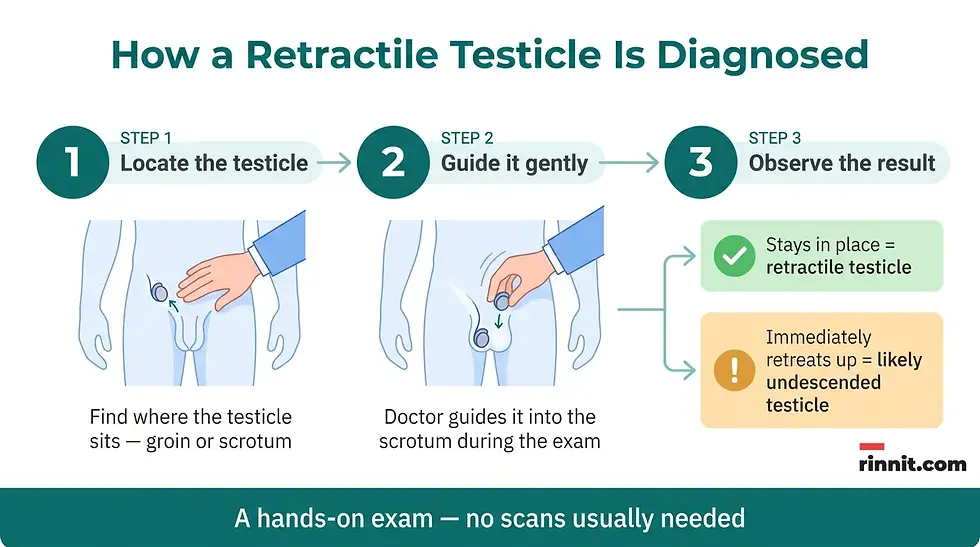
Diagnosis is done through a hands-on physical exam. If your son has a testicle that is not located in the scrotum, his doctor will determine its location in the groin. Once it is located, the doctor attempts to guide it gently into its proper position in the scrotum [2].
Your son may be lying down, sitting, or standing during this examination [2]. If he is a toddler, the doctor might have him sit with the soles of his feet touching and his knees to the sides [2]. These positions make it easier to find and manipulate the testicle [2].
What Is the Treatment for a Retractile Testicle?
Good news for parents: retractile testicles do not require surgery or other treatment [2]. A retractile testicle is likely to descend on its own before or during puberty [2].
Instead of treatment, the approach is watchful waiting through annual evaluations [2] [3]. A healthcare professional monitors any changes in the testicle's position each year to determine whether it:
Yearly checkup result | What it means |
Stays in the scrotum | The condition has resolved. |
Remains retractile | Annual monitoring continues. |
Becomes an ascending testicle | The testicle can no longer be guided down, so further medical care will be discussed with your doctor. |
How Can I Help My Son Cope Emotionally?
If your son has a retractile testicle, he might be sensitive about his appearance. To help him cope:
Explain simply. Tell him in simple terms what a retractile testicle is [2].
Reassure him. Remind him that there is nothing wrong with him [2].
Show it is handled. Explain that the position of the testicle is something you, your son, and his doctor will pay attention to, and fix if necessary [2].
Prepare him for teasing. Help him practice a response if he is teased or asked about the condition [2].
How Should You Prepare for Your Appointment?
A primary healthcare professional usually can diagnose a retractile testicle [2]. However, if there is any question about the diagnosis or a need for immediate treatment, you might be referred to a pediatric urologist, a doctor who specializes in urinary disorders and problems with male genitals in children [2].
Be prepared to answer the following questions on your child's behalf, or to help him answer them:
Doctor's question | Why it helps |
Were both testicles previously identified as descended in a well-baby or annual exam? | Shows whether the testicle was previously in place. |
When did you notice the absence of the testicle in the scrotum? | Helps establish the timeline. |
Have you observed this before? | Helps confirm a back-and-forth pattern. |
Has your child experienced any pain in his testicles or groin? | Checks for other problems. |
Has your son ever been treated for a hernia? | Gives the doctor a fuller picture of the groin area. |
Has your son experienced any trauma to his genitals or groin? | Checks whether an injury could explain changes. |
The Bottom Line
A retractile testicle sounds alarming, but it is one of the most manageable childhood conditions a parent can encounter. The testicle descended normally, an overactive muscle simply tugs it upward now and then, and in most boys the testicle settles into the scrotum for good before or during puberty, with no surgery or other treatment needed [2]. Yearly checkups are the main requirement, and they serve one purpose: to make sure the testicle does not become an ascending testicle that stops coming down. If you have noticed anything unusual, bring it up at the next well-child visit.
Take the next step. If you noticed a change in your child's testicle position, or you want a second look at anything your doctor found, book a well-child or pediatric visit and ask for a hands-on exam and a simple yearly monitoring plan. If the diagnosis is ever in doubt, ask whether a referral to a pediatric urologist makes sense. For more plain-language health guides, visit Rinnit.com.
Frequently Asked Questions
What is a retractile testicle?
A testicle that moves back and forth between the scrotum (the pouch of skin behind the penis) and the groin [1]. It can usually be guided back into place by hand during an exam and stays there at least for a while [1].
What causes a retractile testicle?
An overactive cremaster muscle, the thin pouch-like muscle a testicle rests in. When it contracts, it pulls the testicle up toward the body [1]. The reflex can be triggered by a cold environment, by emotions such as fear or laughter, or by rubbing a nerve on the inner thigh [1].
Is a retractile testicle the same as an undescended testicle?
No. An undescended testicle (cryptorchidism) never entered the scrotum [1]. A retractile testicle descended normally but does not stay in place [1].
Does a retractile testicle need surgery or treatment?
No. Retractile testicles do not require surgery or other treatment, and a retractile testicle is likely to descend on its own before or during puberty [2].
Are there any risk factors for retractile testicles?
There are no known risk factors for retractile testicles [1].
Can a retractile testicle cause complications?
Generally no. The main concern is a greater risk of the testicle becoming an ascending testicle, one that stays in the groin and can no longer be moved down [1].
How is a retractile testicle diagnosed?
Through a physical exam. The doctor locates the testicle in the groin and tries to guide it gently into the scrotum. If it moves relatively easily and does not immediately move up again, it is retractile [2]. If it immediately retreats, it is most likely undescended [2].
What should I watch for at home?
Whether the testicle appears in the scrotum on its own, whether it disappears again [1], and how often this happens. Tell your child's care professional about any changes or any pain, and keep annual checkups so the doctor can confirm the testicle stays in place over time [2].
At what age does a retractile testicle usually go away?
In most boys, a retractile testicle settles into the scrotum on its own by puberty. Your son's provider will check it at regular visits until then.
Does a retractile testicle affect fertility?
A retractile testicle is generally not linked to fertility problems or other complications on its own. The main concern is that it can become an ascending testicle, which may need treatment, so regular checkups matter.
Related Reading
What Are Undescended Testicles? Causes, Risks, and Treatment explains testicles that never reach the scrotum and why they need treatment.
Orchiopexy: Why It's Done, the Best Age, and What Recovery Looks Like explains the surgery that moves a testicle into the scrotum.
Testicular Torsion: Symptoms, Causes, Diagnosis and Treatment — What You Need to Know explains the emergency signs of a twisted testicle.
Inguinal Hernia in Babies and Children: Symptoms, Causes, and Surgical Repair explains groin bulges in children and when surgery is needed.
References
Mayo Clinic Staff. Retractile testicle - Symptoms and causes. Mayo Clinic. Published February 23, 2024. https://www.mayoclinic.org/diseases-conditions/retractile-testicle/symptoms-causes/syc-20377197
Mayo Clinic Staff. Retractile testicle - Diagnosis and treatment. Mayo Clinic. Published February 23, 2024. https://www.mayoclinic.org/diseases-conditions/retractile-testicle/diagnosis-treatment/drc-20377203
Keys C, et al. Retractile testes: a review of the current literature. J Pediatr Urol. 2012;8(1):2-6. PMID 21497555. https://doi.org/10.1016/j.jpurol.2011.03.016
Anderson KM, et al. Do retractile testes have anatomical anomalies? Int Braz J Urol. 2016;42(4):803-809. PMID 27564294. https://doi.org/10.1590/S1677-5538.IBJU.2015.0538
Kim JY, et al. Comprehension and Practice Patterns of Korean Urologists for Retractile and Gliding Testes. J Korean Med Sci. 2022;37(12):e98. PMID 35347906. https://doi.org/10.3346/jkms.2022.37.e98
Medical disclaimer
This article is for general informational purposes and is not a substitute for professional medical advice, diagnosis, or treatment. Always consult a qualified healthcare professional for your child's individual care. If your son has sudden testicular pain or swelling, seek medical care right away.



Comments