
Wernicke-Korsakoff Syndrome: Symptoms, Causes, and Recovery

Updated: 2 days ago
Medically reviewed by Dr. Baraa Alnahhal, MD · Last reviewed: October 2026
Quick Answer: What is Wernicke-Korsakoff syndrome and how is it treated?
Wernicke-Korsakoff syndrome is a brain and memory disorder caused by severe thiamine (vitamin B1) deficiency, most commonly from chronic alcohol use. It has two stages: sudden Wernicke encephalopathy and long-term Korsakoff syndrome. It needs immediate treatment with vitamin B1 and nutritional support; call your provider or 911 right away. It isn't curable, but prompt treatment helps. [1]
What the research says
IV thiamine often relieves symptoms. A systematic review of 27 studies on intravenous thiamine in Wernicke's encephalopathy (20 case reports plus 7 other studies covering 688 patients) found partial or complete resolution of symptoms in 18 of the 20 case reports (90%); the authors note that the evidence is limited and that the condition is underdiagnosed (Cantu-Weinstein et al., General Hospital Psychiatry, 2024) [2].
Weight-loss surgery is another trigger. A systematic review of 84 cases of Wernicke encephalopathy after bariatric surgery found that 79 (94%) were admitted within 6 months of surgery, frequent vomiting was a risk factor in 76 (90%), and recovery was incomplete in 41 (49%), with memory deficits and gait difficulties common (Aasheim, Annals of Surgery, 2008) [3].
It is not only an alcohol-related condition. A systematic review of 88 pediatric cases found eye movement disorders in 80%, mental status changes in 75%, and ataxia in 63%; 37% had received parenteral nutrition without thiamine before diagnosis, and full remission was achieved in 61% of cases (Oudman et al., Pediatric Reports, 2025) [4].
How Thiamine Deficiency Damages the Brain
Wernicke-Korsakoff syndrome happens because of a severe lack of thiamine (vitamin B1), an essential vitamin your body uses to convert food — sugar — into energy. When you have too little thiamine, your brain doesn't have enough energy to work properly and is damaged [1].
Stage | Type | Main characteristics |
|---|---|---|
Wernicke encephalopathy | Acute (sudden and severe) | Confusion, loss of coordination (ataxia), and visual changes or other eye problems |
Korsakoff syndrome | Chronic (long-term) | Severe memory loss and the inability to form new memories |
Common trigger | Systemic | Severe thiamine (vitamin B1) deficiency |
Urgency | Critical | Requires immediate emergency treatment |
Untreated, Wernicke encephalopathy develops into Korsakoff syndrome. Over time, WKS worsens and can be life-threatening [1].
Causes and Risk Factors
The most common cause of thiamine deficiency is chronic alcohol use. Long-term alcohol use irritates your stomach and digestive tract and interferes with your body's ability to absorb vitamins; an estimated 80% of people with alcohol addiction don't absorb or retain enough thiamine. Alcohol also makes it harder to store thiamine in the liver and to use it for other essential functions [1].
Other causes and risk factors include [1]:
Poor nutrition, eating disorders, and lack of access to medical care or healthy food
Weight loss (bariatric) surgery, such as gastric bypass
Chemotherapy and advanced-stage cancer
Bowel or stomach problems, such as inflammatory bowel disease
Long-term dialysis for kidney failure
Heart failure treated with diuretics for a prolonged period
HIV/AIDS, extremely high thyroid hormone levels (thyrotoxicosis), and certain genetic changes
Vomiting and extreme nausea in pregnancy (hyperemesis gravidarum)
Chronic infections and, rarely, head injury
Recognizing the Symptoms
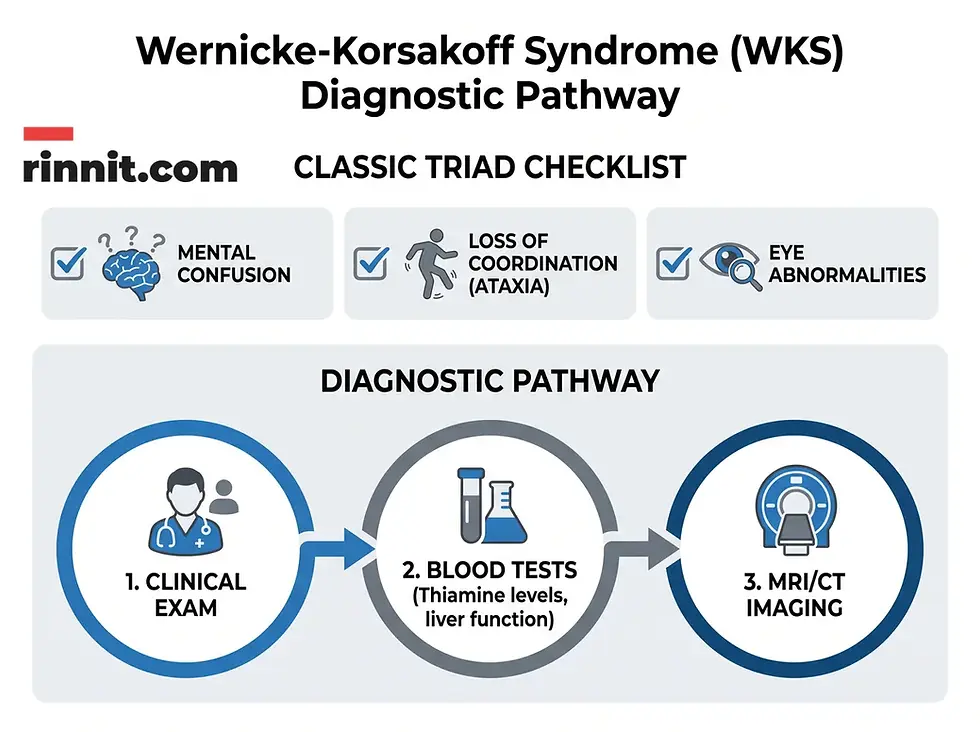
People with Wernicke encephalopathy commonly have three main symptoms: confusion, an inability to coordinate voluntary movements (ataxia), and visual changes and other eye problems. Some may also experience muscle loss [1]. Common signs include:
Balance problems, loss of coordination, and an unsteady gait
Confusion (delirium) and drowsiness
Abnormal eye movements (nystagmus), double vision, a drooping eyelid (ptosis), and eye muscle weakness or paralysis
Heart issues, including a rapid heartbeat or low blood pressure
Extreme loss of body heat (hypothermia)
As the condition progresses into Korsakoff syndrome, memory problems dominate: amnesia and the inability to form new memories, and confabulation — inventing information to fill memory gaps. Other symptoms include behavioral changes such as agitation or anger, delirium and disorientation, fatigue, poor attention, an unsteady gait, and hallucinations, especially in people withdrawing from alcohol. Confusion can make it hard for people to realize anything is wrong and seek treatment [1].

Diagnosis and Testing
Early detection is crucial. Providers diagnose WKS with a physical exam and by asking about symptoms and family history, checking for signs of alcohol use disorder, malnutrition, and thiamine deficiency. Diagnosis can be difficult when a person has severe mental confusion or memory loss [1].
Blood tests for blood sugar and thiamine levels, plus a blood alcohol test and liver function tests
Tests to rule out other causes, such as an arterial blood gas test, a complete blood count, and toxicology screening
Imaging and heart tests, including CT scan, MRI, and an electrocardiogram (EKG)
Treatment and Recovery
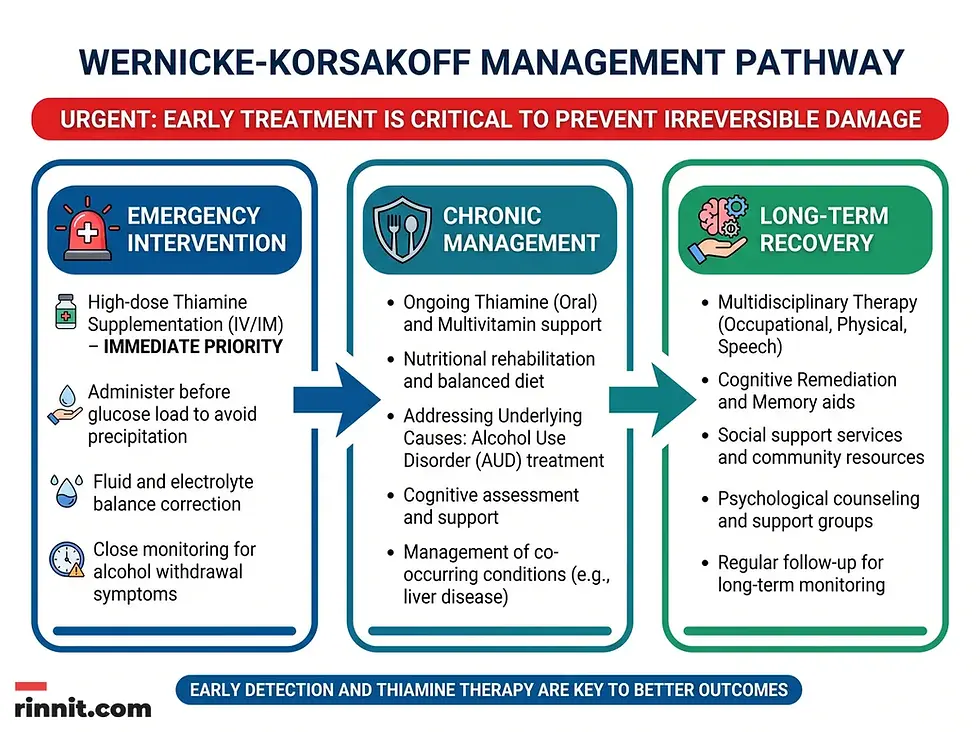
Wernicke-Korsakoff syndrome isn't curable, but immediate treatment can relieve symptoms. With treatment, Wernicke encephalopathy might not progress to Korsakoff syndrome, and in many cases treatment can slow or reverse symptoms such as confusion, eye problems, and poor muscle coordination. The outlook depends on the severity of symptoms and a timely diagnosis [1].
Treatment depends on symptoms and usually involves [1]:
Vitamin B1 (thiamine) by tablet or injection
IV fluids (rehydration)
Alcohol use disorder treatment
Nutritional support
Medications as needed for symptoms
Prevention and Self-Care
In many cases, stopping or limiting alcohol use is essential to reduce the risk of WKS. Proper nutrition and thiamine supplementation may also help, especially for people with alcohol addiction [1]. During recovery, stopping or limiting alcohol (following your provider's advice) and eating well can support your healing, and your provider can build a personalized care plan with you [1].
When to Seek Emergency Care
Seek care immediately if you or a loved one has symptoms of Wernicke-Korsakoff syndrome, or has lost consciousness. Call your healthcare provider or 911 for emergency treatment [1].
Frequently Asked Questions
Is Wernicke-Korsakoff syndrome the same as dementia?
No. WKS is a distinct brain and memory disorder caused by a severe lack of thiamine (vitamin B1). Its memory loss is the long-term stage, Korsakoff syndrome, that follows untreated Wernicke encephalopathy [1].
Can WKS be reversed?
WKS isn't curable, but immediate treatment can help. With treatment, Wernicke encephalopathy might not progress to Korsakoff syndrome, and treatment can slow or reverse symptoms such as confusion, eye problems, and poor coordination. Some symptoms may not improve even with treatment [1].
Does WKS only affect people who drink alcohol?
No. Alcohol use disorder is the most common cause, but WKS can also follow poor nutrition, eating disorders, chronic infections, weight loss (bariatric) surgery, long-term dialysis, advanced cancer or chemotherapy, and severe vomiting in pregnancy [1].
What is confabulation?
Confabulation is when a person with memory loss invents information to cover the gaps. It is a symptom in people with severe disease [1].
How common is the condition?
Cleveland Clinic reports that WKS occurs in up to 2% of people worldwide, and that about 50% of people who develop Wernicke encephalopathy go on to develop Korsakoff syndrome — about 80% among people with alcohol use disorder [1].
What happens if WKS is left untreated?
Untreated, it can worsen and become life-threatening, leading to disability and even death; severe cases can involve loss of consciousness (coma) [1].
Is thiamine the same as vitamin B1?
Yes. Thiamine is vitamin B1, an essential vitamin your body uses to convert food into energy [1].
Can WKS be prevented?
In many cases, stopping or limiting alcohol use is essential. Proper nutrition and thiamine supplementation (tablets or injection) may also help reduce risk, especially for people with alcohol addiction [1].
Are there long-term behavioral changes?
Yes. Korsakoff syndrome can cause behavioral changes such as agitation or anger, and hallucinations, especially in people withdrawing from alcohol [1].
Who is most at risk?
WKS affects more men than women, usually between ages 30 and 70. Most alcohol-related cases involve men over 40, while women and younger people are more likely to develop it from other causes. It is rarely reported in children [1].
References
Source currency note: The Cleveland Clinic page was last updated on April 4, 2022, and the three studies were checked against PubMed. This article reflects the most current information available from those sources.
Cleveland Clinic. Wernicke-Korsakoff syndrome: causes, symptoms & treatment. Cleveland Clinic. April 4, 2022. https://my.clevelandclinic.org/health/diseases/22687-wernicke-korsakoff-syndrome
Cantu-Weinstein A, Branning R, Alamir M, et al. Diagnosis and treatment of Wernicke's encephalopathy: a systematic literature review. General Hospital Psychiatry. 2024;87:48-59. PMID 38306946. https://doi.org/10.1016/j.genhosppsych.2024.01.005
Aasheim ET. Wernicke encephalopathy after bariatric surgery: a systematic review. Annals of Surgery. 2008;248(5):714-720. PMID 18948797. https://doi.org/10.1097/SLA.0b013e3181884308
Oudman E, Wijnia JW, Bidesie JR, et al. Pediatric Wernicke encephalopathy: a systematic review. Pediatric Reports. 2025;17(1):15. PMID 39997622. https://doi.org/10.3390/pediatric17010015
Medical disclaimer
Health information, not medical advice. This article is for general education and is not a substitute for professional diagnosis or treatment. Always consult a qualified healthcare provider about your own health, and seek emergency care for urgent symptoms.



Comments