Werner Syndrome (Adult Progeria): Symptoms, Causes, and Treatments

Updated: 3 days ago
Medically reviewed by Dr. Baraa Alnahhal, MD · Last reviewed: October 2026
Quick Answer
Werner syndrome, also called adult progeria, is a rare autosomal recessive genetic condition that causes premature aging [4], usually starting with slowed growth around age 13 and rapid aging in the 20s. [1] It brings early graying, hair loss and high risk of diseases like diabetes and cataracts. [1] Caused by WRN gene mutations, it has no cure; management treats symptoms. [1]
What the research says
Several specific cancers are far more common in Werner syndrome. A systematic review assembled 189 patients with Werner syndrome who had 248 neoplasms. Thyroid neoplasms, malignant melanoma, meningioma, soft tissue sarcomas, leukemia and pre-leukemic bone marrow conditions, and primary bone neoplasms made up about two-thirds of all reports. In patients living in Japan, risk compared with the general population ranged from 53.5-fold for skin melanoma (95% CI 24.5 to 101.6) to 8.9-fold for thyroid neoplasms (95% CI 4.9 to 15.0) (Lauper et al., PLoS One, 2013) [2].
Diagnosis rests on a short list of very common signs plus genetic testing. In a Japanese nationwide epidemiological survey, 6,921 questionnaires were sent to hospitals with more than 200 beds. The researchers revised the 26-year-old diagnostic criteria so that signs present in more than 90% of patients became cardinal signs, and they added genetic testing and calcification of the Achilles tendon as criteria (Takemoto et al., Geriatr Gerontol Int, 2013) [3].
What Is Werner Syndrome?
Werner syndrome is a rare genetic disorder that causes the body to age much faster than normal. Often called adult progeria, it differs from other progeroid syndromes because its onset is typically delayed until puberty. [1]
While a child with Werner syndrome may appear healthy, their growth rate often slows significantly around age 13. [1] By their 20s, they begin to develop physical characteristics and health conditions usually associated with much older individuals. This accelerated aging is not merely cosmetic. It involves systemic changes that can lead to life-threatening complications by the 40s or 50s. [1]

Signs and Symptoms
Symptoms of Werner syndrome become increasingly apparent as a person enters their 20s. These signs affect nearly every system in the body, from the skin and hair to internal organs.
Physical Characteristics
Growth stunting: a sudden halt in growth during the early teenage years. [1]
Hair changes: early graying and hair loss, including eyebrows and eyelashes. [1]
Skin alterations: thinning skin, loss of fat beneath the skin (subcutaneous fat), and smooth or hard patches similar to scleroderma. [1]
Voice changes: a voice that becomes high-pitched or hoarse. [1]
Facial features: a characteristic "pinched" facial expression. [1]
Early-Onset Health Conditions
Because the body is aging biologically at an accelerated rate, patients often develop chronic diseases decades earlier than their peers:
Type 2 diabetes: affects approximately 70% of patients by age 35. [1]
Vision problems: early cataracts and macular degeneration. [1]
Bone and muscle loss: osteoporosis and muscle wasting (atrophy). [1]
Cardiovascular disease: hardening of the arteries (atherosclerosis), chest pain (angina), and heart failure. [1]
Increased cancer risk: higher susceptibility to thyroid cancer, melanoma, and soft tissue sarcomas. [1]
Causes and Inheritance
Werner syndrome is a genetic disorder caused by mutations in the WRN gene. [1] This gene is responsible for producing a protein that helps maintain and repair DNA. When it is mutated, cells cannot repair themselves properly, leading to the rapid aging process.
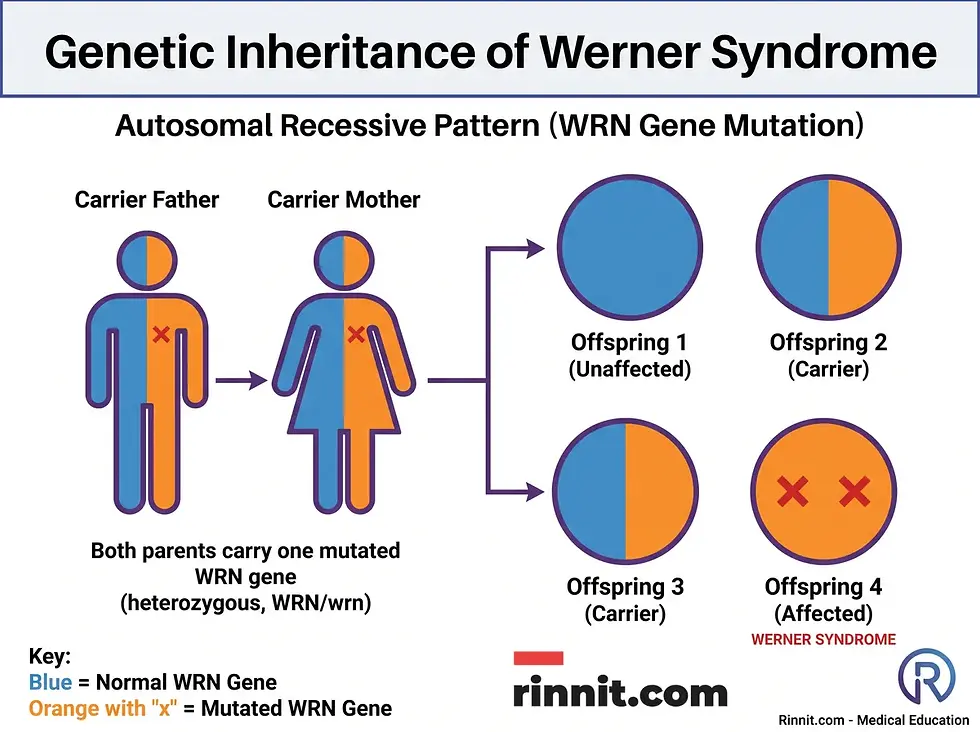
To learn how DNA changes like these arise and are passed on, see our guide to genetic mutations.
Diagnosis and Management
Healthcare providers may suspect Werner syndrome as early as age 15, but most patients are diagnosed in their 30s or 40s when symptoms become undeniable. [1]
Diagnostic Criteria
Treatment and Care
There is no cure for Werner syndrome, so treatment is focused on managing specific symptoms and preventing complications. [1] A coordinated team of specialists is usually required. [4]

Living with Werner Syndrome
While a diagnosis can be overwhelming, proactive management can significantly improve quality of life. Patients are encouraged to maintain healthy habits, such as a balanced diet, regular sleep, and stress management, to support their overall well-being. [1] Genetic counseling is also recommended for families affected by the condition.
Frequently Asked Questions
1. What is the difference between Werner syndrome and progeria?
Werner syndrome is often called "adult progeria" because symptoms start in the teens, whereas Hutchinson-Gilford progeria syndrome starts in early infancy.
2. How common is Werner syndrome?
Werner syndrome is extremely rare, with only about 800 cases reported in medical journals since its discovery in 1904.
3. Is Werner syndrome fatal?
The condition itself is not fatal, but it leads to life-threatening complications like heart disease and cancer, often by the 40s or 50s.
4. Can Werner syndrome be prevented?
No, it is a genetic condition. However, preimplantation genetic testing (PGT) can be an option for parents who know they are carriers.
5. Does Werner syndrome affect intelligence?
In most cases, Werner syndrome does not directly affect intellectual development or brain function.
6. Why is it more common in Japan?
Werner syndrome is more common in certain regions like Japan and Sardinia due to genetic "founder effects," where mutations were passed down through generations in isolated populations.
7. At what age do symptoms usually start?
Growth usually slows around age 13, and physical signs of aging become prominent in the 20s.
8. What was the first symptom ever noticed?
When Dr. Otto Werner first described the syndrome, he noted cataracts and hardened skin patches as the primary indicators.
9. Can surgery help with Werner syndrome?
Surgery can be used to treat specific complications, such as removing cataracts or tumors.
10. Does Werner syndrome affect fertility?
Yes. Many patients experience hypogonadism, which is impaired function of the ovaries or testes.
11. Are there any home remedies?
There are no home remedies to stop the aging process, but healthy lifestyle choices can help manage the secondary symptoms.
12. Should I get genetic testing?
If you have a family history of the condition or show multiple early-aging symptoms, talk with a doctor about genetic testing.
13. What cancers are most common in Werner syndrome?
Thyroid cancer, melanoma, osteosarcoma, and soft tissue sarcomas are among the most frequently seen.
14. How is the voice affected?
The voice often becomes high-pitched or hoarse due to changes in the vocal cords or surrounding tissues.
15. Is there a cure on the horizon?
Currently there is no cure, but researchers continue to study the WRN gene to better understand and potentially slow the aging process.
Related Reading
Trusted External Resources
References
Cleveland Clinic. Werner syndrome. Cleveland Clinic. Reviewed April 29, 2024. https://my.clevelandclinic.org/health/diseases/werner-syndrome
Lauper JM, Krause A, Vaughan TL, Monnat RJ. Spectrum and risk of neoplasia in Werner syndrome: a systematic review. PLoS One. 2013;8(4):e59709. PMID 23573208. https://doi.org/10.1371/journal.pone.0059709
Takemoto M, Mori S, Kuzuya M, et al. Diagnostic criteria for Werner syndrome based on Japanese nationwide epidemiological survey. Geriatr Gerontol Int. 2013;13(2):475-481. PMID 22817610. https://doi.org/10.1111/j.1447-0594.2012.00913.x
National Organization for Rare Disorders. Werner Syndrome. NORD Rare Disease Database. Accessed October 8, 2026. https://rarediseases.org/rare-diseases/werner-syndrome
Medical Disclaimer
This article is for informational purposes only and does not constitute medical advice. Always seek the advice of your physician or other qualified health provider with any questions you may have regarding a medical condition. Never disregard professional medical advice or delay in seeking it because of something you have read here.



Comments