Waterhouse-Friderichsen Syndrome: Symptoms, Causes, and Emergency Care

Updated: 2 days ago
Medically reviewed by Dr. Baraa Alnahhal, MD · Last reviewed: October 2026
TL;DR: Waterhouse-Friderichsen Syndrome (WFS) is a rare and critical medical emergency characterized by the rupture of blood vessels within the adrenal glands, leading to massive hemorrhage and acute adrenal failure. Often triggered by severe bacterial or viral infections—most notably Meningococcus [1]—the condition causes a rapid drop in cortisol production, known as an adrenal crisis. Without immediate intervention involving high-dose antibiotics and hormone replacement, WFS is fatal. Survivors typically require lifelong hormone supplementation [1] to manage the permanent loss of adrenal function.
Quick Answer: What is Waterhouse-Friderichsen syndrome?
Waterhouse-Friderichsen syndrome is a life-threatening complication of severe sepsis that causes bleeding into the adrenal glands, destroying their ability to make hormones like cortisol [1]. Symptoms include sudden fever, chills, a skin rash and septic shock [1]. Treatment must begin immediately with broad-spectrum antibiotics and steroid hormones, and most patients need lifelong hormone replacement [1].
What the research says
Corticosteroids modestly improve outcomes in sepsis overall. A Cochrane review of 61 trials (12,192 children and adults with sepsis) found that corticosteroids probably slightly reduce 28-day mortality (RR 0.91, 95% CI 0.84–0.99) and shorten ICU stay (mean difference −1.07 days), while increasing the risk of muscle weakness (RR 1.21, 95% CI 1.01–1.44) and hypernatremia (According to PubMed, Annane et al., Cochrane Database Syst Rev, 2019) [2].
The outlook remains serious even with treatment. A recent review describes Waterhouse-Friderichsen syndrome as a rare but potentially fatal disorder of bilateral adrenal hemorrhage, classically caused by meningococcal sepsis, that presents with shock, a petechial rash, and abdominal pain; management is fluid resuscitation and corticosteroid replacement, possibly with surgery, and the prognosis is poor despite treatment (According to PubMed, Rijal et al., Vitam Horm, 2023) [3].
Pathophysiology and Clinical Mechanism
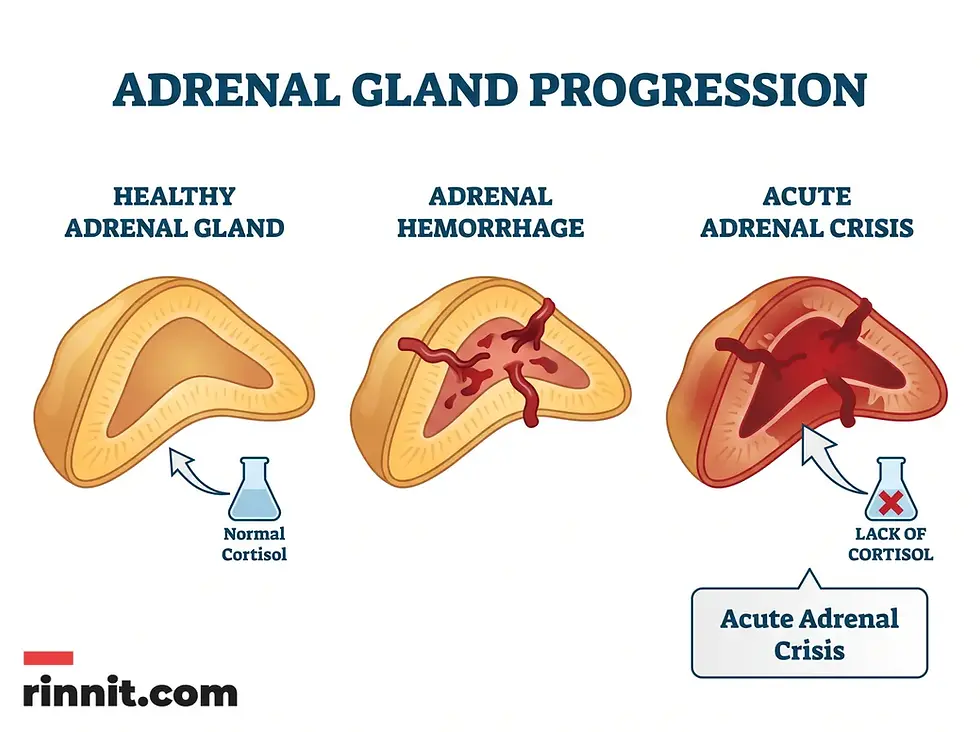
Waterhouse-Friderichsen Syndrome, also referred to as hemorrhagic adrenalitis [1], represents a catastrophic failure of the adrenal glands. These small, triangular organs located atop the kidneys are responsible for producing cortisol, a hormone essential for maintaining blood pressure and responding to stress. When a severe infection enters the bloodstream (sepsis), it can cause the small blood vessels within the adrenal glands to rupture. This results in an adrenal hemorrhage that quickly leads to an acute adrenal crisis [1].
The condition is most frequently associated with Neisseria meningitidis (meningococcus), although a wide range of other bacterial and viral pathogens can trigger the syndrome [1]. The sudden loss of cortisol and other adrenal hormones leads to a rapid decline in vascular stability, eventually progressing to septic shock and disseminated intravascular coagulation (DIC) [1]. While WFS can affect individuals of any age, it is clinically observed more frequently in children than in adults [1].
Clinical Feature | Description | Impact on Patient |
|---|---|---|
Adrenal Hemorrhage | Rupture of vessels within the adrenal glands. | Destroys hormone-producing tissue. |
Adrenal Crisis | Sudden, severe lack of cortisol production. | Leads to shock and systemic collapse. |
Sepsis Trigger | Systemic infection (bacterial or viral). | Initiates the inflammatory cascade. |
DIC | Disseminated Intravascular Coagulation. | Causes widespread clotting and bleeding. |
Recognizing Symptoms and Diagnostic Challenges
The onset of Waterhouse-Friderichsen Syndrome is typically sudden and aggressive. Initial symptoms often mimic a severe flu or general infection, including high fever, chills, intense headaches, and muscle pain localized in the lower back or abdomen [1]. As the condition progresses and the adrenal glands begin to fail, more specific signs emerge, such as a rapidly spreading skin rash, nausea, vomiting, and a sudden loss of consciousness (syncope) [1].
Diagnosing WFS is notoriously difficult because its clinical presentation closely resembles standard septic shock [1]. To differentiate the two, healthcare providers rely on a combination of physical exams and rapid diagnostic testing. Imaging tools like computed tomography (CT) scans or ultrasounds are critical for visualizing pools of blood within the adrenal glands [1]. Blood tests and lumbar punctures (spinal taps) are also performed to identify the specific pathogen responsible for the underlying infection [1].
Emergency Management and Treatment Protocols
Due to its high mortality rate, Waterhouse-Friderichsen Syndrome requires immediate hospitalization and intensive care. Treatment usually begins with the administration of broad-spectrum antibiotics even before the specific causative bacteria are identified. Clinicians must also closely monitor and stabilize the patient's electrolyte levels and fluid balance [1] to combat the effects of septic shock.
Once the immediate threat of sepsis is managed, the focus shifts to replacing the hormones the adrenal glands can no longer produce. This involves the administration of glucocorticoids (to reduce inflammation) and mineralocorticoids (to regulate salt and water levels) [1]. In severe cases, patients may require blood transfusions or angioembolization—a procedure used to block the arteries supplying the adrenal glands to stop active bleeding [1].

Long-Term Outlook and Recovery
Survival after a diagnosis of Waterhouse-Friderichsen Syndrome is possible with rapid treatment, but the recovery process is often lengthy. Most survivors experience significant physical and mental fatigue that can persist for several months following their discharge from the hospital [1]. Furthermore, because the adrenal hemorrhage often causes permanent tissue damage, the majority of patients must remain on hormone replacement therapy for the rest of their lives [1] to prevent future adrenal crises.
Long-term management involves regular follow-ups with an endocrinologist to ensure hormone levels remain balanced. Patients are also advised to carry medical identification indicating their condition, as they are at a higher risk of adrenal crisis during periods of illness or physical stress. With proper medication and monitoring, individuals can maintain a typical lifespan and quality of life.

Frequently Asked Questions
What is the main cause of Waterhouse-Friderichsen Syndrome?
The most common cause is a severe bacterial infection, particularly Meningococcus, which leads to sepsis and subsequent adrenal bleeding.
Is Waterhouse-Friderichsen Syndrome always fatal?
Without immediate medical treatment, the condition is fatal. However, rapid intervention with antibiotics and hormones significantly improves the chances of survival.
Who is most at risk for this condition?
While it can affect anyone, WFS is more commonly diagnosed in children than in adults.
What are the first signs of WFS?
Initial signs include sudden high fever, chills, severe headache, and muscle pain, often followed by a distinct skin rash.
How is the condition diagnosed?
Doctors use imaging like CT scans or ultrasounds to see bleeding in the adrenal glands, along with blood tests to identify the infection.
Will I need to take medicine forever if I survive?
Yes, most survivors require lifelong hormone replacement therapy because the adrenal glands are often permanently damaged.
Can viruses cause Waterhouse-Friderichsen Syndrome?
Yes, although less common than bacteria, viruses like Cytomegalovirus (CMV) and Ebola can trigger the syndrome.
What is an adrenal crisis?
An adrenal crisis is a life-threatening situation where the body suddenly stops producing cortisol, leading to low blood pressure and organ failure.
How long does recovery take?
While patients may start feeling better within two weeks of treatment, full recovery from the resulting fatigue can take several months.
Can this condition be prevented?
Staying up to date on vaccinations, especially for Meningococcus and Haemophilus influenzae, can reduce the risk of the infections that cause WFS.
References
Cleveland Clinic. Waterhouse-Friderichsen Syndrome: Causes & Treatments. Cleveland Clinic. Last updated 05/30/2023. https://my.clevelandclinic.org/health/diseases/25021-waterhouse-friderichsen-syndrome
Annane D, Bellissant E, Bollaert PE, et al. Corticosteroids for treating sepsis in children and adults. Cochrane Database Syst Rev. 2019;(12):CD002243. PMID 31808551. https://doi.org/10.1002/14651858.CD002243.pub4
Rijal R, Kandel K, Aryal BB, et al. Waterhouse-Friderichsen syndrome, septic adrenal apoplexy. Vitam Horm. 2023;124:449-461. PMID 38408808. https://doi.org/10.1016/bs.vh.2023.06.001
Medical disclaimer
This article is for educational purposes only and is not a substitute for professional medical advice, diagnosis, or treatment. Always seek the advice of your physician or other qualified health provider with any questions about a medical condition.



Comments