Visceral Hypersensitivity: Symptoms, Causes, and Management

Updated: 3 days ago
Medically reviewed by Dr. Baraa Alnahhal, MD · Last reviewed: October 2026
Editorial note: This article is provided for educational purposes only. It is not medical advice. Always consult a qualified healthcare professional about your individual health situation.
Quick Answer: What Is Visceral Hypersensitivity?
Visceral hypersensitivity is a condition in which the internal organs of the chest, abdomen or pelvis become overly sensitive to pressure or movement, so normal functions like gas moving through the intestines cause chronic discomfort. [1] It affects approximately 10% of the population and is twice as common in women [1]. Management targets underlying functional disorders and nervous system sensitivity.
What the research says
Brain-gut behavioral therapies can ease abdominal pain in IBS. A network meta-analysis of 42 randomized trials with 5,220 participants found that self-guided cognitive behavioral therapy (RR of pain not improving 0.71; 95% CI 0.54 to 0.95), face-to-face multicomponent behavioral therapy (RR 0.72; 95% CI 0.54 to 0.97) and gut-directed hypnotherapy (RR 0.77; 95% CI 0.61 to 0.96) were efficacious, although none was superior to another and no trial was at low risk of bias in every domain (Goodoory et al., Gastroenterology, 2024) [2].
Guidelines support both diet and gut-directed psychological treatment. The American College of Gastroenterology guideline recommends a limited trial of a low-FODMAP diet to improve global IBS symptoms and suggests gut-directed psychotherapy for global IBS symptoms. It also suggests a positive diagnostic strategy rather than a diagnosis of exclusion (Lacy et al., Am J Gastroenterol, 2021) [3].
Some medicines act directly on gut sensitivity. An American Gastroenterological Association expert review states that central neuromodulators such as antidepressants are used for bloating and abdominal distention by reducing visceral hypersensitivity, raising the sensation threshold and improving psychological comorbidities. It advises against using probiotics to treat bloating and distention (Moshiree et al., Gastroenterology, 2023) [4].
Understanding Visceral Hypersensitivity
Visceral hypersensitivity, also known as visceral hyperalgesia, refers to the experience of pain or discomfort within the internal (visceral) organs. [1] These organs include the heart, lungs, bladder, reproductive organs, and the digestive system. [1] For individuals with this condition, the threshold at which they feel pain is significantly lower than in the general population. [1]
In clinical settings, healthcare providers have measured this threshold by applying small amounts of internal pressure to specific organs. While most people do not feel discomfort during these tests, those with visceral hypersensitivity report pain. [1] This heightened sensitivity means that even the routine, healthy functioning of the body can be felt as an unpleasant or painful sensation.
Common Symptoms and Body Responses
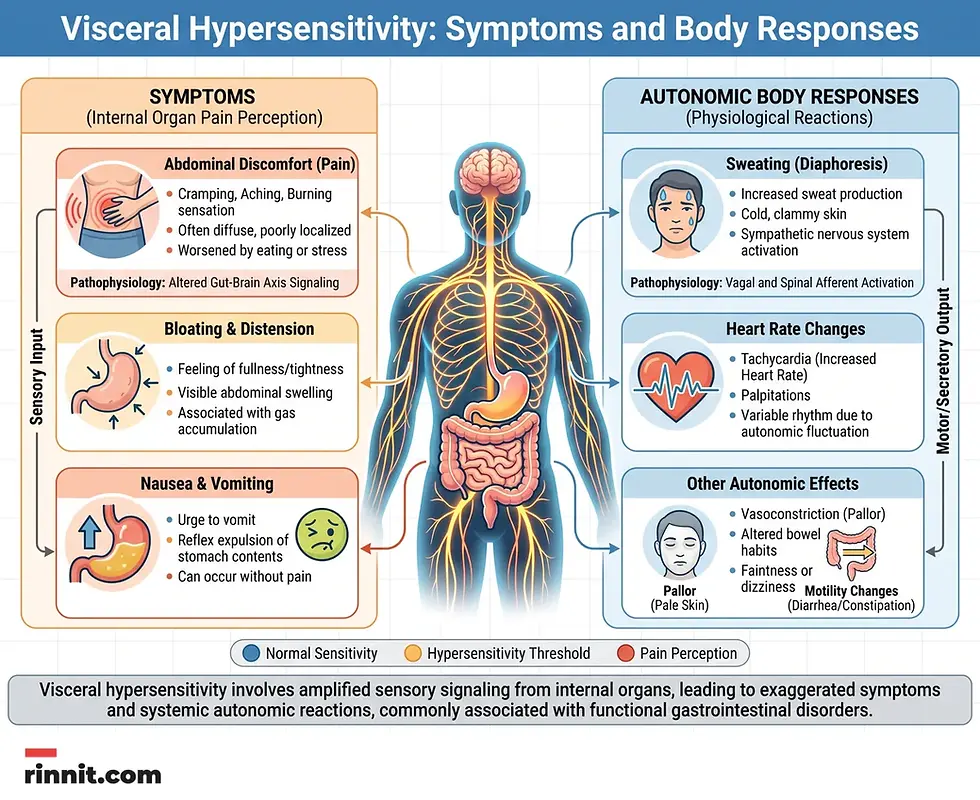
Visceral pain is distinct from somatic pain (pain from an injury like a cut or broken bone). It is often described as diffused, meaning it is difficult to pinpoint a precise location. [1] Even when the source of the pain is elsewhere, it frequently manifests in the gut, leading to symptoms like nausea or indigestion. [1]
Symptom Category | Common Signs and Indicators |
Gastrointestinal | Abdominal pain, bloating, indigestion, nausea, vomiting, diarrhea, or constipation. [1] |
Localized Discomfort | Chronic pain in the chest, abdomen, or pelvic cavity lasting more than three months. [1] |
Autonomic Responses | Sweating, pallor (paleness), changes in heart rate, blood pressure, or body temperature. [1] |
Referred Sensations | Burning sensations in different body parts or pain radiating to the arms or legs. [1] |
Associated Conditions
Visceral hypersensitivity rarely occurs in isolation. It is most frequently diagnosed alongside functional gastrointestinal disorders, where the organs appear healthy during testing but do not function normally. Approximately 40% of people with Irritable Bowel Syndrome (IBS) are also diagnosed with visceral hypersensitivity. [1]
Other conditions commonly overlapping with this syndrome include:
Potential Causes and Triggers
Researchers believe that the nervous system becomes overly sensitized due to repeated exposure to physical or emotional stress. [1] This "sensitization" causes the brain to perceive normal signals from the organs as painful threats.
Factor Type | Description of Influence |
Genetic Predisposition | Certain genes may make individuals more prone to enhanced pain perception. [1] |
Early Life Trauma | Childhood illness, infection, or emotional trauma can alter the brain's pain-regulation circuitry. [1] |
Psychological Factors | Anxiety and depression can frequently activate pain and stress pathways, leading to increased sensitivity. [1] |
Physical Stressors | Repeated internal pressure or chronic inflammation can lower the threshold for future pain signals. |

Management and Care Roadmap
Because visceral hypersensitivity is often tied to other functional disorders, management is highly individualized. The goal is to reduce the sensitivity of the nervous system and manage the triggers that cause discomfort.
Diagnosis: Providers use imaging like CT scans or MRIs to rule out organic causes (such as ulcers or inflammation). If no physical damage is found despite chronic pain, a functional disorder involving hypersensitivity is often considered.
Addressing Underlying Conditions: Treating IBS, anxiety, or interstitial cystitis often helps reduce the overall burden on the nervous system.
Stress Reduction: Managing mental and emotional stress is critical, as these factors can directly trigger or worsen visceral pain.
Long-term Monitoring: Patients work with specialists to track symptom patterns and adjust care plans based on their unique triggers, such as specific foods or bodily functions.

Conclusion
Visceral hypersensitivity is a complex condition where the body's internal alarm system becomes too sensitive. While it can make daily life uncomfortable, understanding that the pain is a result of a lowered threshold—rather than active organ damage—is a key step in management. By addressing both physical triggers and emotional stressors, individuals can work toward reducing their symptoms and improving their quality of life.
If you experience chronic abdominal or chest pain that has not been explained by standard medical tests, consult a healthcare provider or a gastroenterologist to discuss the possibility of visceral hypersensitivity.
Related reading: Abdominal Migraine: Symptoms, Triggers, Diagnosis, and Treatment in Children and Adults | Chest Pain: Symptoms, Causes & Treatment
Sources: Cleveland Clinic — Visceral Hypersensitivity | Goodoory et al., 2024 | Lacy et al., 2021 | Moshiree et al., 2023
Frequently Asked Questions
1. What exactly is visceral hypersensitivity?
Visceral hypersensitivity is a condition where your internal organs are more sensitive to pain, meaning normal functions can feel uncomfortable.
2. Is it the same as IBS?
No, but it is very common in people with IBS; about 40% of IBS patients have it.
3. What organs can be affected?
Any soft internal organ, including the heart, lungs, stomach, intestines, bladder, and uterus.
4. Why does it feel so diffused?
Visceral pain is naturally harder for the brain to locate precisely compared to a skin injury.
5. Can stress cause this?
Stress is a major factor; it can sensitize the nervous system and trigger pain episodes.
6. Is it common?
Visceral hypersensitivity is estimated to affect at least 10% of the general population.
7. Why is it more common in women?
Research shows it is twice as common in women, though the exact hormonal or genetic reasons are still being studied.
8. Can it be cured?
While it may not have a simple "cure," it can be managed effectively through lifestyle changes and treating underlying conditions.
9. What are autonomic responses?
Autonomic responses are involuntary body reactions to pain, such as sweating, paleness, or heart rate changes.
10. Does it run in families?
There is evidence that a predisposition to functional pain disorders can be inherited.
11. What is referred pain?
Referred pain is when pain from an internal organ is felt in a different part of the body, like the arms or legs.
12. How is it diagnosed?
Doctors usually rule out other diseases first through imaging and then evaluate symptom patterns.
13. Can diet help?
For those with GI-related hypersensitivity, managing diet to reduce gas and bloating can lower pain triggers.
14. What is the difference between visceral and somatic pain?
Somatic pain comes from skin or muscles and is easy to locate; visceral pain comes from internal organs and is vague.
15. When should I see a doctor?
You should seek medical advice if you have chronic pain lasting more than three months that interferes with your daily life.
References
Cleveland Clinic. Visceral Hypersensitivity. Cleveland Clinic. May 11, 2022. https://my.clevelandclinic.org/health/diseases/22997-visceral-hypersensitivity
Goodoory VC, Khasawneh M, Thakur ER, et al. Effect of Brain-Gut Behavioral Treatments on Abdominal Pain in Irritable Bowel Syndrome: Systematic Review and Network Meta-Analysis. Gastroenterology. 2024;167(5):934-943.e5. PMID 38777133. https://doi.org/10.1053/j.gastro.2024.05.010
Lacy BE, Pimentel M, Brenner DM, et al. ACG Clinical Guideline: Management of Irritable Bowel Syndrome. Am J Gastroenterol. 2021;116(1):17-44. PMID 33315591. https://doi.org/10.14309/ajg.0000000000001036
Moshiree B, Drossman D, Shaukat A. AGA Clinical Practice Update on Evaluation and Management of Belching, Abdominal Bloating, and Distention: Expert Review. Gastroenterology. 2023;165(3):791-800.e3. PMID 37452811. https://doi.org/10.1053/j.gastro.2023.04.039
Medical disclaimer
The information provided in this article is for educational purposes only and should not be used as a substitute for professional medical advice, diagnosis, or treatment. Always seek the advice of your physician or other qualified health provider with any questions you may have regarding a medical condition. Never disregard professional medical advice or delay in seeking it because of something you have read here.



Comments