Vibrio vulnificus: Symptoms, Risks, and Emergency Care

Updated: 2 days ago
Medically reviewed by Dr. Baraa Alnahhal, MD · Last reviewed: October 2026
Quick Answer: What is Vibrio vulnificus?
Vibrio vulnificus is a salt-loving bacterium found in warm, brackish waters that causes a serious form of vibriosis, mostly between May and October. [1] [2] Symptoms such as fever, chills and painful blisters usually appear within 24 hours. [1] Because it can become fatal within days, anyone with symptoms after eating raw shellfish or exposing a wound to seawater needs immediate emergency care. [1]
What the research says
Vibrio vulnificus causes most seafood-related deaths in the United States. A review of the pathogen reports that it is responsible for over 95% of seafood-related deaths in the United States and carries the highest fatality rate of any food-borne pathogen. Infections disproportionately affect males (about 85% of cases) and people over 40, especially those with liver disease, diabetes, or immune disorders (Baker-Austin & Oliver, Environ Microbiol, 2018) [3].
Liver disease, kidney disease, and delayed surgery are linked to a higher risk of death. In a meta-analysis of eight studies of Vibrio vulnificus sepsis and soft tissue infections, liver disease (odds ratio 4.38, 95% CI 2.43 to 7.87), renal disease (OR 3.90, 95% CI 1.37 to 11.12), and septic shock (OR 2.82, 95% CI 1.84 to 4.31) were associated with higher mortality. Surgery delayed beyond 12 hours (OR 2.64, 95% CI 1.39 to 5.0) or 24 hours (OR 2.99, 95% CI 1.54 to 5.78) was also associated with higher mortality, while different antibiotic regimens did not change outcomes (Elnahla et al., Surg Infect, 2021) [4].
Florida data show how deadly these infections can be. From 1981 through 1992, 125 people with Vibrio vulnificus infections were reported to Florida health authorities, and 44 (35%) died. The report notes that the bacterium can cause serious illness and death in people with preexisting liver disease or compromised immune systems (CDC, MMWR, 1993) [5].
Understanding Vibrio vulnificus
Vibrio vulnificus is a specific species of halophilic (salt-loving) bacteria that thrives in warm, mildly salty waters, often where fresh river water meets the sea. [1] While many species of Vibrio bacteria exist, including those that cause cholera, Vibrio vulnificus is responsible for the most severe and life-threatening forms of vibriosis. [1] Although rare, with only 100 to 200 cases reported annually in the United States, its rapid incubation period means the bacteria can spread from the gut to the bloodstream and vital organs within just a few hours. [1]
Transmission and Exposure
There are two primary pathways for contracting a Vibrio vulnificus infection. The first is through the ingestion of raw or undercooked shellfish, particularly oysters [1] [2], which can lead to severe gastroenteritis and septicemia. The second pathway involves direct contact between seawater and an open wound or break in the skin, such as a recent tattoo, piercing, or surgical site. [1]
Symptoms and Clinical Presentation
Symptoms of a Vibrio vulnificus infection typically appear suddenly, usually within 24 hours of contact. [1] The infection progresses with alarming speed, so it is important to watch for both whole-body and local signs of distress.

Risk Factors and Complications
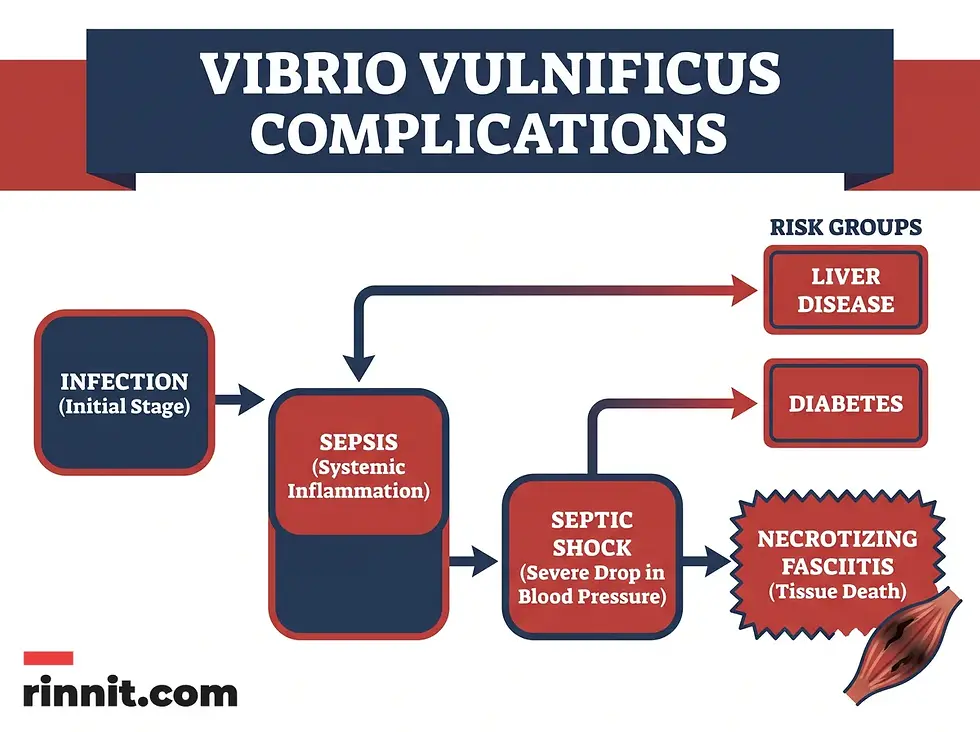
While anyone can contract the infection, certain people are at a significantly higher risk for severe complications and death. Men are statistically more likely to develop serious infections than women, and people over the age of 40 also face increased risks. [1] [3]
High-Risk Groups
Liver disease: Including cirrhosis and hemochromatosis (iron overload). [1]
Chronic conditions: Diabetes and chronic kidney (renal) failure. [1]
Immune status: Any condition that weakens or alters the immune system. [1]
Occupational exposure: Jobs or hobbies involving frequent contact with raw shellfish or warm seawater. [1]
Severe Complications
If left untreated, Vibrio vulnificus can cause devastating complications within days. These include internal bleeding (hemorrhage), thrombocytopenia (low platelet count), and septic shock. [1] One of the most severe outcomes is necrotizing fasciitis, a "flesh-eating" infection that destroys tissue and often requires surgery or amputation to prevent further spread.
Diagnosis and Emergency Management
Diagnosis is made through laboratory analysis of blood, stool, sputum, or tissue samples from a wound. [1] However, because the infection is so aggressive, healthcare providers often begin treatment before laboratory results are final. [1]
Treatment Roadmap
Immediate hospitalization is required for suspected cases. The treatment strategy focuses on eliminating the bacteria and managing the whole-body effects of the infection.
Treatment Type | Specific Interventions |
Antibiotics | Doxycycline plus a third-generation cephalosporin (such as ceftazidime), or a fluoroquinolone such as ciprofloxacin. [1] |
Wound Care | Surgical debridement (cleaning dead tissue) and blister drainage. [1] |
Systemic Support | IV fluids, oxygen therapy, and blood pressure medications (norepinephrine). [1] |
Surgical Intervention |

Prevention and Safety Guidelines
Prevention focuses on minimizing exposure to the bacteria through careful food handling and water safety practices.
Shellfish safety: Avoid eating raw or undercooked shellfish, especially oysters. Keep raw juices separate from other foods and wash your hands thoroughly after handling. [1]
Water safety: Avoid seawater or brackish water if you have any break in the skin. If contact is unavoidable, use waterproof coverings [1] and wash any exposed wounds thoroughly with fresh water and soap right after contact.
Protective gear: Wear gloves when handling raw seafood to provide an extra layer of protection against skin breaks. [1]
Frequently Asked Questions
1. Can I get Vibrio from a swimming pool?
It is very unlikely. Vibrio vulnificus lives in warm, salty, or brackish seawater, not in properly chlorinated pools.
2. Is Vibrio the same as "flesh-eating bacteria"?
Media reports sometimes use that name because Vibrio vulnificus can cause necrotizing fasciitis, a severe tissue-destroying infection. Other bacteria, such as group A Streptococcus, are actually the most common cause of necrotizing fasciitis in the United States.
3. Can I eat oysters in the winter?
The risk is lower because the bacteria thrive in warm water (May to October), but raw shellfish always carries some risk.
4. How quickly can Vibrio be fatal?
In severe cases, the infection can be fatal within just a few days if not treated immediately.
5. Does lemon juice kill Vibrio on raw oysters?
No. Neither lemon juice nor hot sauce kills the bacteria; only thorough cooking is effective.
6. What should I do if I get a cut at the beach?
Wash the wound thoroughly with clean water and soap immediately. Monitor for redness or swelling and seek medical help if symptoms appear.
7. Is Vibrio contagious from person to person?
No, you cannot catch a Vibrio vulnificus infection from another person.
8. Can antibiotics cure it?
Yes. Antibiotics such as doxycycline can cure the infection, especially when started early, which is why immediate emergency care matters.
9. Why are people with liver disease at higher risk?
Liver disease can affect the body's ability to handle iron and fight off certain types of bacteria like Vibrio.
10. Is it safe to swim with a new tattoo?
No. A new tattoo is an open wound and should not be exposed to seawater until it has fully healed.
11. How common is this infection?
Vibrio vulnificus infection is very rare, with only about 100 to 200 cases reported in the U.S. each year.
12. What is "brackish" water?
Brackish water is a mixture of fresh and salt water, typically found in estuaries and coastal marshes.
13. Can I recover fully?
Many people recover fully if they receive immediate medical treatment, although some need surgery, and serious infections can be fatal.
14. What is debridement?
Debridement is a surgical procedure to remove dead, damaged, or infected tissue to help a wound heal.
15. Should I go to the ER for a stomach ache after eating oysters?
If you have a fever, chills, or skin changes along with gastrointestinal symptoms, you should seek emergency care immediately.
Trusted External Resources
References
Cleveland Clinic. Vibrio Vulnificus. Cleveland Clinic. Last updated April 8, 2023. https://my.clevelandclinic.org/health/diseases/24884-vibrio-vulnificus
Centers for Disease Control and Prevention. About Vibrio Infection. CDC. Last reviewed May 14, 2024. https://www.cdc.gov/vibrio/about/index.html
Baker-Austin C, Oliver JD. Vibrio vulnificus: new insights into a deadly opportunistic pathogen. Environ Microbiol. 2018;20(2):423-430. PMID 29027375. https://doi.org/10.1111/1462-2920.13955
Elnahla A, Attia AS, Toraih E, et al. Prognostic factors of mortality in Vibrio vulnificus sepsis and soft tissue infections: meta-analysis. Surg Infect (Larchmt). 2021;22(9):928-939. PMID 33970025. https://doi.org/10.1089/sur.2020.243
Centers for Disease Control and Prevention. Vibrio vulnificus infections associated with raw oyster consumption, Florida, 1981-1992. MMWR Morb Mortal Wkly Rep. 1993;42(21):405-407. PMID 8497241. https://pubmed.ncbi.nlm.nih.gov/8497241/
Medical Disclaimer
This article is for informational purposes only and does not constitute medical advice. Always seek the advice of your physician or other qualified health provider with any questions you may have regarding a medical condition. Never disregard professional medical advice or delay in seeking it because of something you have read in this article.



Comments