Vertical Transmission: Understanding Mother-to-Child Infection

Updated: 2 days ago
Medically reviewed by Dr. Baraa Alnahhal, MD · Last reviewed: October 2026
Quick Answer: What is vertical transmission?
Vertical transmission is the passing of a germ such as a virus, bacterium or parasite from a pregnant or breastfeeding woman to her fetus or baby, across the placenta, during birth or through breastfeeding. [1] Examples include syphilis, rubella and HIV. [1] It can cause developmental delays, miscarriage or stillbirth. [1] Prevention relies on maternal screening, vaccination and treatment. [1]
What the research says
Congenital CMV is the most common congenital infection. A systematic review and meta-analysis of 77 studies covering 515,646 infants screened in the first 3 weeks of life found a pooled birth prevalence of 0.67% (95% CI 0.54% to 0.83%). The rate was about 3-fold higher in low- and middle-income countries (1.42%) than in high-income countries (0.48%) (Ssentongo et al., JAMA Netw Open, 2021) [2].
The placenta usually protects the fetus, but not always. A review explained that vertical transmission is rare because the placental barrier protects the developing fetus. When infections do cross it, they can cause fetal loss, stillbirth, prematurity, organ malformation, or neonatal disease (Parums, Med Sci Monit, 2024) [3].
Effects on development can extend beyond the classic TORCH germs. A narrative review found strong evidence that TORCH infections alter fetal neurodevelopment and contribute to motor and cognitive disabilities. It also found strong and moderate evidence, respectively, of a higher risk of motor and cognitive delays in children exposed in the womb to a range of non-TORCH pathogens, but little evidence of increased language or sensory disabilities (Devaraju et al., Neurosci Biobehav Rev, 2023) [4].
The Mechanisms of Vertical Transmission
Vertical transmission is a specific way an infection spreads: a germ moves from a mother to her child. It differs from horizontal transmission, in which a germ spreads from one person to another through coughing, sneezing, sex, or a shared item. [1] Many vertically transmitted diseases can also spread horizontally. [1] Even when a pregnant woman's symptoms are mild, the effects of an infection on a fetus or newborn can be serious. [1]
Primary Transmission Pathways
In utero (transplacental): the germ travels through the mother's bloodstream and crosses the placenta to infect the developing fetus. [1]
Intrapartum: the baby is infected during birth while passing through the birth canal. [1]
Postpartum: the baby is infected after birth, most commonly through breastfeeding, either through the milk itself or through blood from cracked nipples. [1]
Symptoms and Clinical Signs in Infants
A vertically transmitted infection can affect several organ systems and developmental milestones. Some babies have symptoms at birth, while others develop them later in childhood. [1]
System affected | Potential symptoms |
Sensory and neurological | Blindness or vision loss, hearing loss, seizures, and microcephaly (small head size). [1] |
Physical and developmental | Developmental delays, differences in motor skill development, facial differences, and small, widely spaced (notched) teeth. [1] |
Internal organs | Enlarged liver (hepatomegaly), enlarged spleen (splenomegaly), and heart disease. [1] |
Skin and eyes | Rashes, blisters, jaundice (yellowish skin and eyes), and pink eye (conjunctivitis). [1] |

Common Vertically Transmitted Infections (TORCH)
Medical professionals often use the acronym TORCH to group the most common infections that can spread from mother to child. If these infections are not managed, they can cause significant congenital (present-at-birth) conditions.
The TORCH Acronym
T: Toxoplasmosis and syphilis (Treponema pallidum).
O: Other infections, including COVID-19, chlamydia, gonorrhea, hepatitis viruses, HIV, Zika virus, Chagas disease, listeriosis, parvovirus B19, and varicella-zoster virus (chickenpox). [1]
R: Rubella.
C: Cytomegalovirus (CMV).
H: Herpes simplex virus (HSV).
How a Mother Can Acquire These Infections
A pregnant or breastfeeding woman can pick up these germs through oral, anal, or vaginal sex, respiratory droplets (coughing or sneezing), contact with cat feces, eating or drinking something contaminated with a parasite, the bite of a kissing bug, or, rarely, a blood transfusion. [1]

Diagnosis and Prenatal Screening
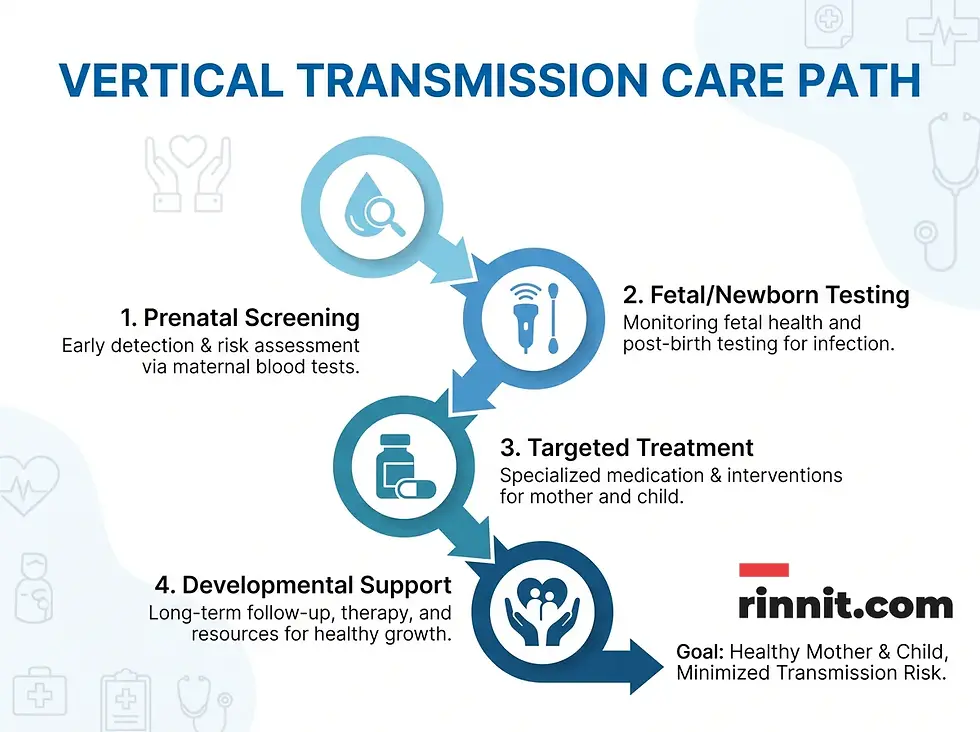
Early detection is the cornerstone of managing vertical transmission. Providers use several tests to monitor the health of both mother and fetus during pregnancy.
Diagnostic Procedures
Maternal blood tests: routine screening for certain infectious diseases in early pregnancy. [1]
Fetal testing: if a maternal infection is confirmed, providers may use amniocentesis (collecting fluid around the fetus), chorionic villus sampling (collecting placental tissue), or fetal blood sampling to see whether the fetus is infected. [1]
Newborn screening: blood tests, urine tests, or a cheek swab for a saliva test at birth if a TORCH infection is suspected. [1]
Management and Prevention Strategies
Vertical transmission can lead to serious problems such as miscarriage, stillbirth, or hydrops fetalis (severe fluid buildup in the fetus) [1], but many risks can be lowered with proactive care. Treatment depends on the infection and on when it is diagnosed. Medication can sometimes lessen the risk of health problems, but it may not completely prevent them and cannot reverse damage that has already happened. [1]
Treatment and Support
Treatment type | Application |
Medication | Antibiotics, antivirals, or antiparasitic drugs given before or after birth to reduce the risk of transmission or lessen the effects. [1] |
Developmental support | Speech and occupational therapy for children with hearing loss, sensory, or motor and developmental issues. [1] |
Preventive habits | Frequent handwashing, safe food habits, and avoiding crowded places or wearing a mask during high-risk seasons. [1] |
Ways to Lower the Risk
Wash your hands often with soap and water, and wear gloves for gardening or cleaning. [1]
Ask your provider about recommended vaccinations, which can protect against some of these infections. [1]
Practice safe sex, and ask partners to get tested for sexually transmitted infections or use condoms while pregnant. [1]
Avoid changing cat litter yourself, or wear disposable gloves and wash your hands afterward. [1]
Cook and freeze meat properly, wash or peel fruits and vegetables, avoid unpasteurized milk and untreated water, and skip raw or undercooked shellfish. [1]
Protect yourself from insect bites, and plan ahead with a travel medicine clinic before overseas travel. [1]
Long-Term Outlook
The outlook for a child affected by vertical transmission depends on the specific germ and when the infection happened. In general, the earlier in pregnancy a germ reaches the fetus, the higher the likelihood of pregnancy loss or of a baby being born with lifelong conditions. [1] With modern screening and treatment, many children can manage the effects of a congenital infection with ongoing medical and therapeutic support.
Frequently Asked Questions
1. What exactly is vertical transmission?
Vertical transmission is the spread of an infection from a pregnant or breastfeeding woman to her fetus or baby during pregnancy, birth, or breastfeeding.
2. What does TORCH stand for?
TORCH stands for Toxoplasmosis (and syphilis), Other infections, Rubella, Cytomegalovirus, and Herpes simplex virus.
3. Can I pass an infection through breast milk?
Yes. Some infections can spread through breast milk or through blood from cracked nipples.
4. Is vertical transmission the same as being contagious?
Not exactly. Being contagious usually refers to horizontal transmission, which is spread from person to person through coughing, sneezing, sex, or shared items. Vertical transmission is specifically from a pregnant or breastfeeding woman to her fetus or baby.
5. What are the signs of infection in a newborn?
Signs can include jaundice, rashes, a small head size, or enlarged organs such as the liver or spleen.
6. Can these infections be prevented?
Many can be prevented or their risk reduced through vaccinations, early screening, safe habits, and prescribed medication.
7. What is amniocentesis?
Amniocentesis is a test in which a provider uses a small needle to collect a sample of the fluid surrounding the fetus to check for infection or other conditions.
8. Can vertical transmission be fatal to a fetus?
Yes. Severe cases can lead to miscarriage, stillbirth, or a condition called hydrops fetalis, which is severe fluid buildup in the fetus.
9. How does a mother get these infections?
Through sex, respiratory droplets, contaminated food or water, contact with cat feces, or, less commonly, an insect bite or blood transfusion.
10. Are all symptoms visible at birth?
No. Some children do not show signs of a congenital infection until later in childhood.
11. What is microcephaly?
Microcephaly is a condition in which a baby's head is much smaller than expected, often because the brain has not developed normally.
12. Can antibiotics help?
Yes. If the infection is bacterial, such as syphilis, antibiotics can reduce the risk of passing it to the baby.
13. What is the "Other" in TORCH?
The "Other" in TORCH covers a wide range of infections, including HIV, hepatitis viruses, Zika virus, chlamydia, gonorrhea, and COVID-19.
14. Is jaundice always serious?
Newborn jaundice has several causes, but in the context of vertical transmission it can be a sign of an infection that needs evaluation.
15. When should I talk to my doctor?
Ask your pregnancy care provider about infectious disease screening early in pregnancy, and talk to them right away if you think you have been exposed to an infection or you get sick while pregnant.
Trusted External Resources
References
Cleveland Clinic. Vertical Transmission. Cleveland Clinic. Last updated April 8, 2025. https://my.clevelandclinic.org/health/diseases/vertical-transmission
Ssentongo P, Hehnly C, Birungi P, et al. Congenital cytomegalovirus infection burden and epidemiologic risk factors in countries with universal screening: a systematic review and meta-analysis. JAMA Netw Open. 2021;4(8):e2120736. PMID 34424308. https://doi.org/10.1001/jamanetworkopen.2021.20736
Parums DV. A review of emerging viral pathogens and current concerns for vertical transmission of infection. Med Sci Monit. 2024;30:e947335. PMID 39578400. https://doi.org/10.12659/MSM.947335
Devaraju M, Li A, Ha S, et al. Beyond TORCH: a narrative review of the impact of antenatal and perinatal infections on the risk of disability. Neurosci Biobehav Rev. 2023;153:105390. PMID 37708918. https://doi.org/10.1016/j.neubiorev.2023.105390
Medical Disclaimer
This article is for informational purposes only and does not constitute medical advice. Always seek the advice of your physician or other qualified health provider with any questions you may have regarding a medical condition. Never disregard professional medical advice or delay in seeking it because of something you have read in this article.



Comments