Vertebral Artery: Anatomy, Function, and Health

Updated: 3 days ago
Medically reviewed by Dr. Baraa Alnahhal, MD · Last reviewed: October 2026
The vertebral arteries are a pair of major neck arteries that run through the cervical spine to carry blood to the brain and spinal cord, providing about 20% of the blood flow to the brain while the carotid arteries supply the other 80%. [1] They join at the base of the skull to form the basilar artery, supporting areas that control balance, movement, speech and vision. [1] A heart-healthy lifestyle helps lower the risk of vertebral artery stenosis and stroke.
Quick Answer: What is the vertebral artery?
The vertebral artery is a major neck artery that runs from the subclavian artery through the cervical vertebrae into the skull, where it joins its partner to form the basilar artery. [1] It supplies 20% of the blood flow to the brain. [1] Narrowing, a tear or compression can reduce flow and lead to TIA or stroke.
What the research says
In cervical artery dissection, anticoagulation cut stroke but raised bleeding. A meta-analysis of 11 studies (5,039 patients) found that anticoagulation, compared with antiplatelet therapy, was associated with a lower risk of ischemic stroke (RR 0.63, 95% CI 0.43-0.94) but a higher risk of major bleeding (RR 2.25, 95% CI 1.07-4.72), with similar death and symptomatic intracranial hemorrhage rates (Yaghi et al., Stroke, 2024) [3].
Stenting added to medical therapy has not clearly beaten medical therapy alone. A Cochrane review of 4 randomized trials (429 people with symptomatic vertebral artery stenosis) found no clear difference between endovascular treatment plus medical therapy and medical therapy alone in 30-day death or stroke (RR 2.02, 95% CI 0.73-5.55) or in stroke or TIA during follow-up (RR 0.65, 95% CI 0.39-1.06), with low-certainty evidence (Zhang et al., Cochrane Database Syst Rev, 2026) [4].
Drug-coated balloons are an early alternative to bare-metal stents. A preliminary meta-analysis of 4 small studies (329 patients with symptomatic vertebral artery origin stenosis) found less imaging-confirmed restenosis with drug-coated balloons than with bare-metal stents (RR 0.45, 95% CI 0.27-0.73), but the authors say the findings should not guide routine treatment choice yet (Liu et al., BMC Neurol, 2026) [5].
Overview of the Vertebral Artery
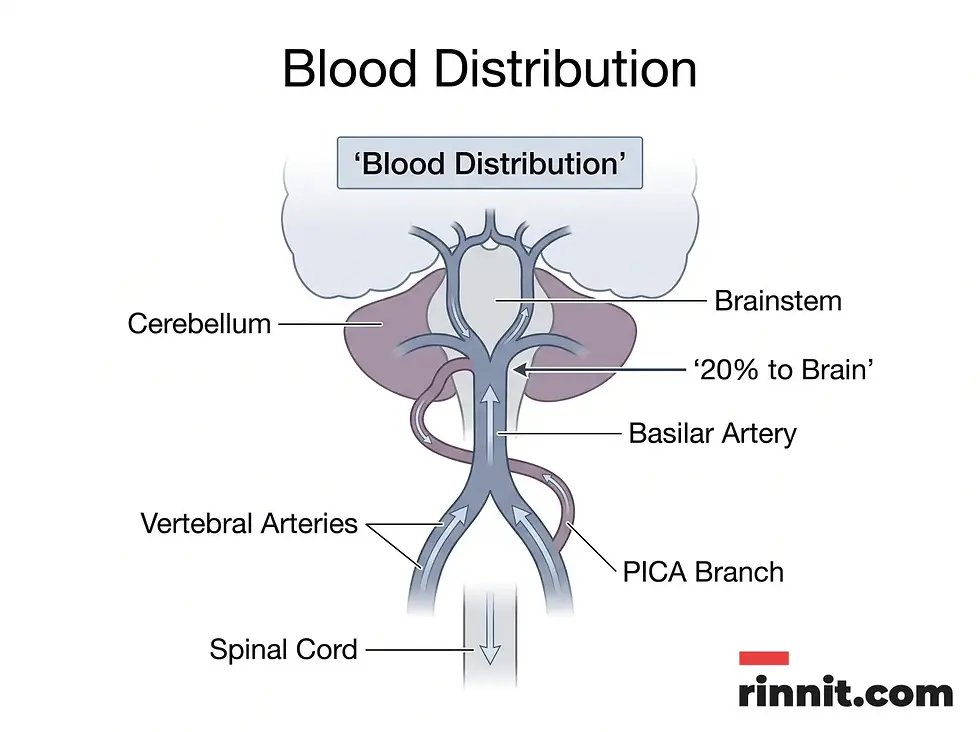
You have a left and a right vertebral artery, and both run through the spinal column in the neck to supply blood to the brain and spine. [1] They are part of the circulatory system and carry blood to the brain and spinal cord, which belong to the nervous system. The name refers to the arteries' position along the vertebrae, the bones of the spine. The two arteries join at the base of the skull to form the basilar artery, and together they are called the vertebrobasilar system. [1]
Anatomical Structure and Pathway
The vertebral arteries start at the subclavian arteries, which sit below the collarbone and arise from the aorta. The right subclavian artery arises from the brachiocephalic artery, which comes off the aorta, while the left subclavian arises directly from the aorta. [1] The vertebral arteries then run separately along the left and right sides of the neck's spinal column, and the suboccipital muscles at the base of the skull cover them. [1] They are divided into four segments:
Segment | Name | Description |
V1 | Pre-foraminal | Arises from the subclavian artery and runs behind the carotid artery. [1] |
V2 | Foraminal | Travels alongside vertebral veins and nerves, entering the transverse foramen at C6 and exiting at C2. [1] |
V3 | Extradural (extraspinal) | Curves and twists across the top of the C1 vertebra (the atlas) until it enters the skull. [1] |
V4 | Intradural (intracranial) | Enters the skull, where the right and left arteries join to form the basilar artery. |

Physiological Function
The vertebral arteries carry oxygen-rich blood to the brain and spinal cord. They provide 20% of the blood flow to the brain, and the carotid arteries supply the other 80%. [1] They have many small branches. The largest is the posterior inferior cerebellar artery (PICA), one of three main arteries that supply the cerebellum. [1] The cerebellum plays a key role in balance, movement, speech and vision. [1]
Clinical Conditions and Disorders
Fat and cholesterol deposits (plaque) can build up in the vertebral arteries and narrow them, which is atherosclerosis. When this happens in the vertebral arteries it is called vertebral artery stenosis, and too much plaque can cause blockages. [1] Other conditions can affect these arteries too.
Condition | Description | Potential Complications |
Atherosclerosis | Plaque buildup in the artery walls. | Narrowing of the arteries and reduced blood flow. |
Vertebral Artery Stenosis | Narrowing of the vertebral artery from plaque. | Blood clots, TIA (ministroke), stroke and vertebrobasilar insufficiency. [1] |
Artery Dissection | Narrowing, blood clots and stroke. | |
Bowhunter's Syndrome | Rotational vertebral artery stenosis, a rare condition usually caused when a bony growth compresses the artery. [1] | Restricted blood flow to the brain. |
Vertebral Artery Dissection
A dissection happens when a tear in the artery wall lets blood enter and separate its layers, which can narrow or block the vessel [2] and lead to clots and stroke. It is a rare cause of stroke overall, but it is one of the more common causes of stroke in people younger than 45. [2] Dissections are often set off by minor neck trauma or sudden or excessive neck movement, such as cervical manipulation, sports injuries, coughing or vomiting, and some happen spontaneously, particularly in people with connective tissue disorders or fibromuscular dysplasia. [2] Typical symptoms are sudden, severe neck pain or headache, sometimes followed by signs of posterior-circulation stroke such as dizziness, vertigo, double vision or poor coordination. [2]
Treatment focuses on preventing stroke, usually with anticoagulant or antiplatelet medicine, and people are admitted to hospital for monitoring. [2] Among people who survive an extracranial dissection, complete recovery occurs in roughly 80% to 90%, while intracranial dissections carry a worse outlook. [2]

When to Seek Medical Care
Call 911 right away if you have signs of stroke, especially sudden severe vertigo, imbalance, double vision or loss of vision, slurred speech, or weakness or paralysis; do not wait or drive yourself. [1] Also report unexplained falls. [1] A sudden, severe neck pain or headache after a neck injury or neck movement also deserves urgent evaluation.
Care and Maintenance Tips
You can lower your risk of vertebral artery stenosis with lifestyle changes. Many risk factors for arterial disease can be managed with steady habits and medical supervision:
Heart-healthy diet: eat foods low in fat, cholesterol and salt. [1]
Physical activity: be active most days of the week. [1]
Healthy weight: maintain a weight that is healthy for you.
Chronic condition management: work with your doctors to manage diabetes, high blood pressure and high cholesterol. [1]
Tobacco cessation: quit smoking. [1]

Conclusion
The vertebral arteries are a vital link between the heart and the brain and spine, supplying a fifth of the brain's blood flow. Knowing how they run through the neck, what can go wrong, and which warning signs need prompt attention helps you protect your neurological health. Regular check-ups and a heart-healthy lifestyle are your best defenses against arterial problems.
Frequently Asked Questions
What happens if a vertebral artery is blocked?
Plaque buildup in the vertebral arteries (vertebral artery stenosis) can lead to blood clots, a transient ischemic attack (TIA or ministroke), stroke and vertebrobasilar insufficiency. Call 911 right away for signs of stroke, especially sudden severe vertigo, imbalance, double vision or visual loss, or paralysis.
What are the symptoms of vertebral artery stenosis?
Warning signs include severe vertigo, imbalance, double vision or loss of vision, paralysis and unexplained falls. These can signal a stroke or TIA and need emergency care: call 911 right away.
What is Bowhunter's syndrome?
Also called rotational vertebral artery stenosis, it is a rare condition that is usually caused when a bony growth compresses a vertebral artery, restricting blood flow to the brain.
How is vertebral artery dissection diagnosed?
Doctors rely on advanced imaging such as CT angiography (CTA), MR angiography (MRA) and conventional angiography, and MRI can detect any associated stroke. Ultrasound can show abnormal blood flow but is not specific for dissection.
What is the vertebrobasilar system?
The vertebrobasilar system is the combination of the left and right vertebral arteries, which join at the base of the skull to form the basilar artery.
Is vertebral artery dissection serious?
Yes. A dissection is a tear in the artery wall that can lead to narrowing, blood clots and stroke, so it is potentially life-threatening. Most survivors of an extracranial dissection recover well, but it needs prompt medical care.
How does the vertebral artery differ from the carotid artery?
The vertebral arteries provide 20% of the blood flow to the brain, and the carotid arteries supply the other 80%.
Can exercise help protect the vertebral arteries?
Yes. Being physically active most days of the week is one of the lifestyle changes that can lower the risk of vertebral artery stenosis, along with a heart-healthy diet, a healthy weight, managing diabetes, high blood pressure and high cholesterol, and not smoking.
What is PICA?
PICA is the posterior inferior cerebellar artery, the largest branch of the vertebral artery and one of three main arteries that supply the cerebellum with blood.
What are the four segments of the vertebral artery?
V1 (pre-foraminal) arises from the subclavian artery, V2 (foraminal) runs through the transverse foramina from C6 to C2, V3 (extradural) curves across the top of the C1 vertebra, and V4 (intradural) enters the skull and joins its partner to form the basilar artery.
Related Reading
Vertebral Artery Dissection: Symptoms, Risks, and Recovery explains tears in the vertebral artery wall and their stroke risk.
Vertebrobasilar Insufficiency (VBI): Symptoms, Causes, and Care covers reduced blood flow to the back of the brain and its treatment.
Wallenberg Syndrome: Symptoms, Causes, and Clinical Management describes the brainstem stroke often linked to vertebral artery blockage.
Stroke: Symptoms, Causes, Diagnosis, and Treatment — A Complete Guide explains stroke warning signs and why fast emergency care matters.
References
Cleveland Clinic. Vertebral Artery. Cleveland Clinic. Last updated July 23, 2021. https://my.clevelandclinic.org/health/body/21689-vertebral-artery
Tavakoli SG, Britt TB, Agarwal S. Vertebral Artery Dissection. In: StatPearls [Internet]. Treasure Island (FL): StatPearls Publishing; updated April 6, 2025. PMID 28722857. https://www.ncbi.nlm.nih.gov/books/NBK441827/
Yaghi S, Shu L, Fletcher L, et al. Anticoagulation Versus Antiplatelets in Spontaneous Cervical Artery Dissection: A Systematic Review and Meta-Analysis. Stroke. 2024;55(7):1776-1786. PMID 38847098. https://doi.org/10.1161/STROKEAHA.124.047310
Zhang X, Cui S, Wang T, et al. Percutaneous transluminal angioplasty and stenting for vertebral artery stenosis. Cochrane Database Syst Rev. 2026;4(4):CD013692. PMID 41983456. https://doi.org/10.1002/14651858.CD013692.pub3
Liu T, Chen K, Zhong C, et al. Drug-coated balloon versus bare-metal stent for the treatment of symptomatic vertebral artery origin stenosis: a systematic review and meta-analysis. BMC Neurol. 2026;26(1):432. PMID 42121079. https://doi.org/10.1186/s12883-026-04968-5
Medical disclaimer
The information provided in this article is for educational purposes only and should not be used as a substitute for professional medical advice, diagnosis, or treatment. Always seek the advice of your physician or other qualified health provider with any questions you may have regarding a medical condition.



Comments