Vascular Parkinsonism: Understanding Lower-Body Movement Issues

Updated: 2 days ago
Medically reviewed by Dr. Baraa Alnahhal, MD · Last reviewed: October 2026
TL;DR: Vascular parkinsonism (VP) is a relatively rare condition where movement and balance problems arise from blood vessel damage in the brain, most often caused by strokes [1]. Unlike Parkinson’s disease, it primarily affects the lower body and typically does not cause resting tremors [1]. While no cure exists, the condition may not worsen if future strokes are prevented [1]. Management focuses on physical and occupational therapy alongside aggressive control of cardiovascular risk factors.
Quick Answer
Vascular parkinsonism is a brain condition caused by strokes or other blood vessel problems that produces parkinsonism-like symptoms, especially a shuffling gait and poor balance [1]. Unlike Parkinson's disease, it usually affects the lower body and responds less to levodopa [1]. Diagnosis uses neurological exams and brain imaging, and treatment centers on physical therapy and stroke prevention [1].
What the research says
Levodopa response is lower, but not absent. A systematic review of 12 studies found that the response to levodopa was lower in vascular parkinsonism than in idiopathic Parkinson’s disease, yet a subgroup of patients with good response could be identified using neuroimaging and olfactory testing (Del Toro-Pérez et al., Brain Sci, 2023) [2].
Brain imaging helps tell the two apart. A systematic review of dopaminergic imaging reported that vascular parkinsonism showed more diffuse and symmetric dopamine transporter reductions than idiopathic Parkinson’s disease, correlating with a poorer levodopa response (Ardila Jurado et al., Front Neurol, 2025) [3].
Other treatments are still unproven. The same 2023 review found the response to different therapeutic strategies in VP is modest, and that vitamin D, repetitive transcranial magnetic stimulation and photobiomodulation need further studies to demonstrate efficacy (Del Toro-Pérez et al., Brain Sci, 2023) [2].
What Is Vascular Parkinsonism?
Vascular parkinsonism (VP) is a clinical condition where symptoms of parkinsonism develop due to cerebrovascular disease, which refers to issues with the blood vessels in the brain [1]. The term “parkinsonism” serves as an umbrella category for brain conditions that cause slowed movements, muscle stiffness, and balance difficulties. VP is relatively rare, accounting for approximately 4.4% to 12% of all parkinsonism cases [1].
A defining characteristic of vascular parkinsonism is its localized impact. While Parkinson’s disease often affects the entire body, the movement symptoms of VP typically only affect the lower body, resulting in significant unsteadiness and walking difficulties [1].

Causes and Risk Factors
The primary cause of vascular parkinsonism is the occurrence of one or multiple strokes. These events disrupt blood flow to critical brain structures, leading to permanent damage. Not all strokes result in VP; the condition is more likely to develop if the stroke affects the basal ganglia or occurs in the small arteries (lacunar strokes) that supply the brain’s deep structures [1].
Primary Risk Factors
The risk factors for vascular parkinsonism are largely identical to those for general cerebrovascular and cardiovascular diseases. Managing these factors is the most effective way to prevent the onset or worsening of the condition.
Risk Factor | Impact on Vascular Health |
History of Stroke | Direct cause of brain tissue damage |
High Blood Pressure | Increases strain on brain blood vessels |
Diabetes | Damages blood vessel linings over time |
High Cholesterol | Leads to plaque buildup (atherosclerosis) |
Smoking | Significantly increases stroke and vascular risk |
Recognizing Symptoms of VP
The symptoms of vascular parkinsonism are distinct from other forms of the disorder. The most prominent signs involve a shuffling or “freezing” gait, where the individual has difficulty initiating steps or maintaining a steady walking pattern. Balance problems are also a major clinical feature [1].
Key Clinical Differences
Unlike Parkinson’s disease, vascular parkinsonism typically does not cause tremors while the person is at rest [1]. Furthermore, VP is usually not as responsive to levodopa, which is the standard medication used to treat other parkinsonism types [1]. Other potential features include dementia, rapid mood changes (spontaneous laughter or crying), and difficulty with basic functions like speaking, swallowing, or bladder control [1].

Diagnosis and Imaging
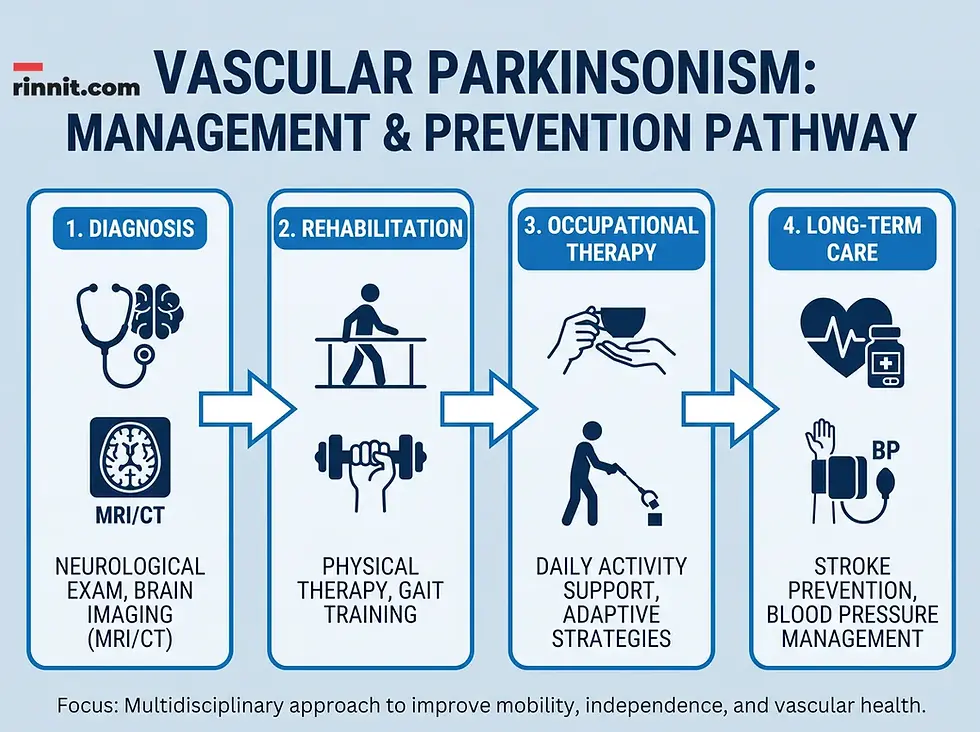
Diagnosing vascular parkinsonism typically requires the expertise of a neurologist. The process begins with a comprehensive physical and neurological examination to assess movement patterns and reflexes. A detailed medical history is also essential, particularly regarding past strokes or cardiovascular health [1].
Confirming the Diagnosis
Imaging tests are crucial for confirming the presence of cerebrovascular damage. These tests allow doctors to see brain lesions or evidence of past strokes that explain the movement symptoms [1]:
MRI: The most effective tool for identifying brain damage and lesions.
CT Scan: Provides a rapid overview of brain structures.
Cerebral Angiogram: Visualizes the blood vessels within the brain to identify blockages or narrowing.
Management and Long-Term Care
Because the brain damage caused by strokes is typically permanent, there is currently no cure for vascular parkinsonism [1]. Treatment strategies focus on managing current symptoms and preventing further neurological decline.
Therapeutic Approaches
Physical and occupational therapy are the cornerstones of VP management. Therapists work with patients to improve their walking patterns, strengthen balance, and adapt daily activities to accommodate mobility changes. Because standard Parkinson’s medications are less effective for VP, these non-pharmacological therapies are vital.
The Importance of Stroke Prevention
A critical component of long-term care is the prevention of additional strokes. Further vascular events can significantly worsen the condition and lead to a decline in overall health. Healthcare teams develop comprehensive plans to aggressively manage blood pressure, cholesterol, and diabetes while encouraging lifestyle changes like smoking cessation.
Prognosis and Outlook
Vascular parkinsonism is a lifelong condition [1]. However, unlike Parkinson’s disease, which is progressive, VP may stabilize if the underlying vascular health is maintained. The outlook for an individual depends heavily on their ability to prevent future strokes [1] and their commitment to physical therapy.
While parkinsonism generally reduces life expectancy compared to the general population, aggressive management of stroke risk factors can protect overall health and maintain quality of life for many years.
Conclusion
Vascular parkinsonism is a challenging condition that highlights the deep connection between brain health and the circulatory system. By understanding that strokes are the primary cause, patients and their families can focus on the most critical aspect of care: stroke prevention. Through dedicated physical therapy to maintain mobility and aggressive management of cardiovascular risk factors, individuals with VP can work toward stabilizing their condition. Early diagnosis by a neurologist and a proactive approach to vascular health are the best tools for navigating life with this disorder.
Clinical Urgency: If you or a loved one shows signs of a stroke—such as sudden facial drooping, arm weakness, or speech difficulty—call 911 or go to the emergency room immediately. Preventing further strokes is the most vital step in managing vascular parkinsonism.
Related reading: High Blood Pressure · High Blood Cholesterol · Parkinson’s Disease Medications
Frequently Asked Questions
How is vascular parkinsonism different from Parkinson’s disease?
Vascular parkinsonism is caused by strokes and primarily affects the lower body without typically causing resting tremors. Parkinson’s disease is a degenerative condition that affects the whole body and often includes tremors.
Can vascular parkinsonism be cured?
No. The brain damage from strokes is permanent. However, the condition can be managed and may not worsen if future strokes are prevented.
Does levodopa work for vascular parkinsonism?
Levodopa, the primary medication for Parkinson’s disease, is typically less effective in the vascular form of parkinsonism, although a subset of patients may respond well.
What is a shuffling gait?
A shuffling gait is a walking pattern where the feet barely leave the ground, often involving short, rapid steps and difficulty maintaining balance.
Is vascular parkinsonism progressive?
Not necessarily. Unlike Parkinson’s disease, which worsens over time, VP can stabilize if the patient prevents further strokes and manages their vascular health.
What are the risk factors for VP?
The main risk factors include a history of stroke, high blood pressure, high cholesterol, diabetes, and smoking.
What kind of doctor treats vascular parkinsonism?
A neurologist, specifically one who specializes in movement disorders or stroke care, typically manages the diagnosis and treatment of VP.
Can physical therapy help?
Yes. Physical therapy is one of the most effective ways to manage the movement and balance issues associated with vascular parkinsonism.
What is the “pseudobulbar affect”?
The pseudobulbar affect is a condition sometimes seen in VP where a person experiences sudden, uncontrollable outbursts of laughter or crying that do not match their actual mood.
How common is vascular parkinsonism?
Vascular parkinsonism is relatively rare, representing between 4.4% and 12% of all parkinsonism cases.
References
Cleveland Clinic. Vascular Parkinsonism: What It Is, Symptoms & Treatment. Cleveland Clinic. Last updated 08/01/2025. https://my.clevelandclinic.org/health/diseases/vascular-parkinsonism
Del Toro-Pérez C, Guevara-Sánchez E, Martínez-Sánchez P. Treatment of vascular parkinsonism: a systematic review. Brain Sci. 2023;13(3):489. PMID 36979299. https://doi.org/10.3390/brainsci13030489
Ardila Jurado E, Zünd-Hofer L, Brugger F, et al. The role of presynaptic dopaminergic imaging in acquired neurological conditions affecting basal ganglia: a systematic review. Front Neurol. 2025;16:1660747. PMID 41262975. https://doi.org/10.3389/fneur.2025.1660747
Medical disclaimer
This article is for educational purposes only and is not a substitute for professional medical advice, diagnosis, or treatment. Always seek the advice of your physician or other qualified health provider with any questions about a medical condition.



Comments