Vanishing Twin Syndrome: Understanding Symptoms, Causes, and Outcomes

Updated: 3 days ago
Medically reviewed by Dr. Baraa Alnahhal, MD · Last reviewed: October 2026
Editorial note: This article is provided for educational purposes only. It is not medical advice. Always consult a qualified healthcare professional for diagnosis and treatment of any condition.
Important: Seek immediate medical attention if you have sudden and severe pelvic pain, a high fever or heavy vaginal bleeding during pregnancy. These symptoms need urgent evaluation to rule out infection or other complications.
Quick Answer
Vanishing twin syndrome (VTS) is a condition in which one embryo in a twin or triplet pregnancy stops growing, most often in the first trimester, and its tissue is usually absorbed. It is usually found on ultrasound. The cause is unknown. In the first trimester it usually does not affect the surviving fetus, and emotional support matters for the parents. [1]
What the research says
VTS is common, but its effect on the surviving baby is debated. A review reports that VTS affects 15% to 35% of twin pregnancies. Risk factors include more embryos transferred in IVF, more gestational sacs and older maternal age. Studies disagree on whether it raises the risk of preterm birth or small babies, but small placentas are more common (Batsry & Yinon, Best Practice & Research Clinical Obstetrics & Gynaecology, 2022 [2]).
One large cohort found higher risks. In an Israeli study of 278 pregnancies with VTS, 1,801 dichorionic twin pregnancies and 252,994 singleton pregnancies, VTS was an independent risk factor for several adverse outcomes compared with singletons, including growth restriction (adjusted odds ratio 2.7), very low birth weight (6.9) and perinatal death (2.4) (Evron et al., Fertility and Sterility, 2015 [3]).
A study of IVF pregnancies found no such differences. Among 905 fresh IVF live births, including 73 with a vanishing twin, VTS was not linked to preterm delivery, growth restriction or other obstetric outcomes compared with IVF singletons. It was linked to more small placentas (adjusted odds ratio 2.15; 95% CI 1.08-4.28) (Harris et al., Obstetrics & Gynecology, 2020 [4]).
Key takeaways
Vanishing twin syndrome is a type of miscarriage in a multiple pregnancy: one embryo stops developing and is usually absorbed [1].
Many cases cause no symptoms, but some people have mild cramping or light spotting, and it is often found on ultrasound [1].
When it happens early it usually does not affect the surviving fetus, though studies on complications are mixed, so closer monitoring and emotional support can help [1] [2].
What is vanishing twin syndrome?
Vanishing twin syndrome (VTS) is a type of miscarriage that can occur in a multiple pregnancy (twins, triplets or more). It happens when an embryo that was seen on an early ultrasound no longer appears on a later one. The embryo stops growing, and its tissue is typically partly or fully absorbed by the body or the surviving embryo or embryos [1].
VTS most often happens in the first trimester, but it can also happen later in pregnancy. Finding out can bring a mix of relief for the surviving baby and grief for the one lost, which is why medical and emotional care are both important [1].
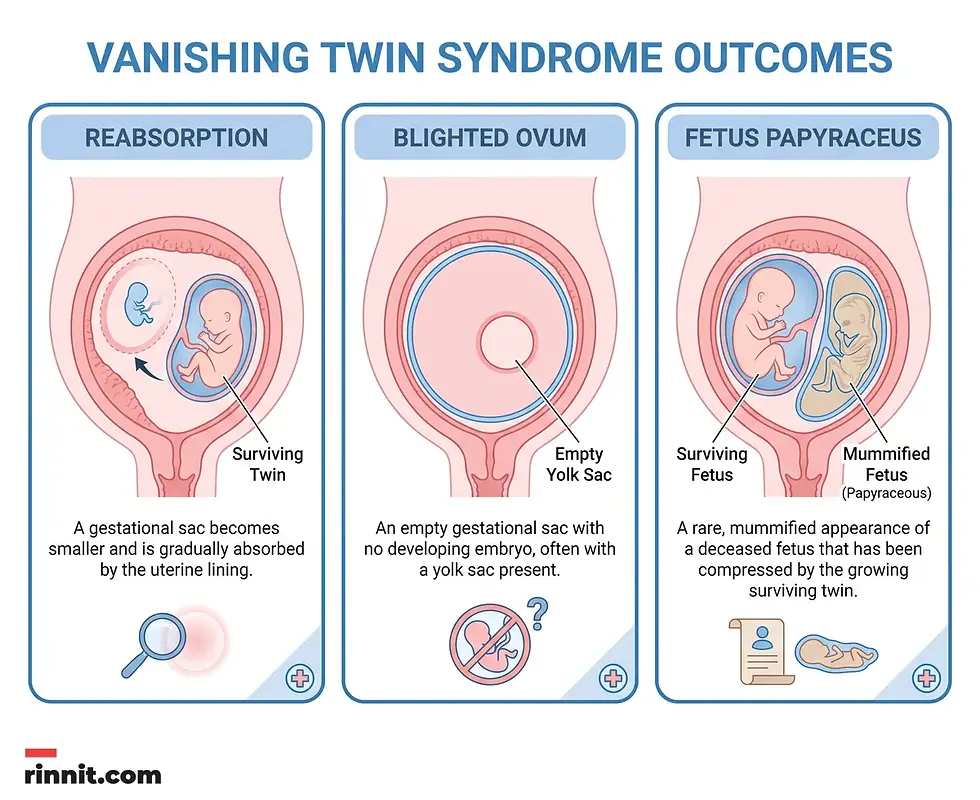
What are the possible outcomes of a vanishing twin?
The outcome depends on the timing and how the body responds. The most common result is reabsorption, which usually does not affect the pregnancy [1].
Outcome | Description | Frequency and notes |
Reabsorption | The mother's body or the surviving embryo absorbs the tissue. | The most common outcome; usually does not affect the pregnancy. |
Blighted ovum | A fertilized egg implants in the uterus but does not grow into an embryo. | Occurs very early in development. |
Fetus papyraceous | One fetus dies early and is squeezed between the membranes and the uterine wall, eventually looking like parchment paper. | Very rare. |
Source: Cleveland Clinic [1].
What are the symptoms of vanishing twin syndrome?
Most cases cause no symptoms, because the body often absorbs the embryo silently. Some people notice signs in the first trimester that look like early pregnancy complications [1]:
Light vaginal bleeding: spotting or light discharge.
Mild cramping: discomfort similar to period cramps.
Pelvic pain: dull or localized pain in the lower abdomen.
These signs also happen in many healthy pregnancies, so many people never know they had a vanishing twin, and VTS is often found only on a routine ultrasound [1].
What causes vanishing twin syndrome?
Researchers do not know the exact cause. They believe it could stem from problems with the chromosomes of the vanishing embryo, with the placenta, or with implantation [1]. You cannot prevent it, and these issues are not your fault or something you can control [1].

Who is at higher risk?
Risk factor | Details |
Multiple embryos | A higher chance when pregnant with three or more embryos. |
Maternal age | A higher chance at age 35 or older. |
Health conditions | Long-term conditions such as diabetes or lupus. |
Past pregnancy history | Intrauterine growth restriction (IUGR) in past pregnancies. |
Subchorionic hematoma | Blood between the placenta and the wall of the uterus. |
Source: Cleveland Clinic [1].
How is vanishing twin syndrome diagnosed?
Ultrasound: the most common way, when an embryo seen earlier is no longer visible [1].
hCG monitoring: a slower rise in the pregnancy hormone hCG than is typical for twins can be a sign [1].
Placental examination: sometimes tissue from the vanished twin is found in the placenta after delivery. Before ultrasound, this was the only way to confirm VTS [1].
Some people lose an embryo before the first ultrasound, so neither they nor their provider knows there was a twin. VTS is also more often caught in IVF pregnancies, because ultrasounds start earlier [1].
How is it managed, and what support is available?
There is no treatment that can stop or reverse VTS. Care focuses on protecting the surviving fetus and supporting the emotional well-being of the parents [1].

If VTS happens in the first trimester, it usually does not affect the surviving fetus. If it happens later, your provider may monitor you more closely and may classify the pregnancy as high-risk [1]. Studies are mixed on whether VTS raises the risk of preterm birth or slower growth in the surviving baby [1] [2].
Grief while still being pregnant can be confusing. Talking to your partner, friends or a therapist or grief counselor can help, and asking your provider what to expect for the rest of your pregnancy can ease anxiety [1].
Bottom line: what every reader should remember
Vanishing twin syndrome combines the hope of a continuing pregnancy with the grief of a loss. It cannot be prevented, and it is not your fault. When it happens early it usually does not affect the surviving fetus, and with monitoring and emotional support many pregnancies continue to a healthy delivery [1].
Take action today: Talk to your obstetrician or a maternal-fetal medicine specialist about your ultrasound results and ask for a personalized monitoring plan for the rest of your pregnancy [1].
Frequently Asked Questions
1. Is vanishing twin syndrome common?
Vanishing twin syndrome is estimated to occur in 15% to 35% of twin pregnancies and in about half of pregnancies with three or more embryos. The true number is not known because many people lose an embryo before their first ultrasound [1] [2].
2. Can I prevent vanishing twin syndrome?
No. It cannot be prevented or treated. It is thought to stem from chromosome, placenta or implantation problems that you cannot control [1].
3. Does a vanishing twin hurt the surviving twin?
If it happens in the first trimester, it usually does not affect the surviving fetus [1]. Studies are mixed on whether it raises the risk of problems such as preterm birth or slower growth, so your provider may monitor your pregnancy more closely [1] [2].
4. How is it diagnosed?
Usually on ultrasound, when an embryo seen earlier is no longer there. Providers may also check hCG levels, which may rise more slowly than expected for twins [1].
5. What happens to the tissue of the twin that vanishes?
The vanished twin's tissue is typically absorbed by your body, the surviving embryo or both [1].
6. Are there symptoms of VTS?
Most cases cause no symptoms, but some people notice light vaginal bleeding, mild cramping or pelvic pain in the first trimester [1].
7. Is VTS more common in IVF?
VTS is more often detected in IVF pregnancies because ultrasounds happen earlier in pregnancy [1].
8. What is fetus papyraceous?
A very rare outcome in which a fetus that has died early in pregnancy is squeezed between the membranes and the uterine wall and becomes mummified, looking like parchment paper [1].
9. Does VTS mean I have a high-risk pregnancy?
If it happens in the first trimester, usually not. If it happens later in pregnancy, your provider may monitor you more closely and may classify the pregnancy as high-risk [1].
10. Can VTS be caused by stress or something I did?
No. Researchers do not know the exact cause, but they believe chromosome, placenta or implantation problems are involved. It is not your fault [1].
11. Will I still have a normal delivery?
Many pregnancies continue to a healthy delivery of the surviving baby. Because studies are mixed on risks such as preterm birth and slower growth, your provider may suggest closer monitoring [1] [2].
12. Should I see a counselor?
Many people find it helpful to talk to a partner, friends, a therapist or a grief counselor. You can feel grief while still being pregnant, which can be confusing [1].
13. Can hCG levels tell me if I have VTS?
A slower rise in hCG than expected for twins can be a sign, but VTS is usually diagnosed on ultrasound [1].
14. Is reabsorption dangerous?
Reabsorption is the most common outcome and usually does not affect the pregnancy [1].
15. What if VTS happens after the first trimester?
Your provider may monitor you more closely, for example with more frequent check-ups and ultrasounds, and may classify the pregnancy as high-risk [1].
References
Cleveland Clinic. Vanishing Twin Syndrome: Causes, Symptoms & Diagnosis. Cleveland Clinic. Last updated May 7, 2026. https://my.clevelandclinic.org/health/diseases/23023-vanishing-twin-syndrome
Batsry L, Yinon Y. The vanishing twin: diagnosis and implications. Best Practice & Research Clinical Obstetrics & Gynaecology. 2022;84:66-75. PMID: 35450773. https://doi.org/10.1016/j.bpobgyn.2022.03.009
Evron E, Sheiner E, Friger M, et al. Vanishing twin syndrome: is it associated with adverse perinatal outcome? Fertility and Sterility. 2015;103(5):1209-1214. PMID: 25772775. https://doi.org/10.1016/j.fertnstert.2015.02.009
Harris AL, Sacha CR, Basnet KM, et al. Vanishing twins conceived through fresh in vitro fertilization: obstetric outcomes and placental pathology. Obstetrics & Gynecology. 2020;135(6):1426-1433. PMID: 32459435. https://doi.org/10.1097/AOG.0000000000003888



Comments