Vaginal Hematoma: Symptoms, Causes, and Recovery Guide

Updated: 3 days ago
Medically reviewed by Dr. Baraa Alnahhal, MD · Last reviewed: October 2026
Editorial note: This article is provided for educational purposes only. It is not medical advice. Always consult a qualified healthcare professional about your individual health situation.
Quick Answer
A vaginal hematoma is a localized collection of blood outside the blood vessels, usually caused by genital injury and most commonly linked to vaginal childbirth. [1] Symptoms include swelling, severe pain and deep discoloration. [1] Small hematomas are managed with rest and cold compresses, but rapid swelling, intense pain or difficulty urinating need prompt care and may require surgical drainage.
What the research says
Hematoma after birth is rare, and specific delivery factors raise the risk. Among 147,045 deliveries at one tertiary center, 57 women (0.04%) developed a postpartum vaginal or vulvar hematoma. Episiotomy (odds ratio 35.9), second-degree laceration (10.3) and vacuum delivery (5.0) each independently raised the risk, while epidural analgesia was protective (0.33). In this study, 26.3% of women with a hematoma needed surgery. (Atar et al., Pregnancy (Hoboken), 2026) [2]
In a small older series, larger hematomas managed without surgery fared worse. In a review of 32 vulvar and vaginal hematomas at three Florida hospitals, women managed conservatively had more later operations, more complications needing antibiotics or transfusion, and longer hospital stays than women treated surgically. The risk was higher when the product of the hematoma’s two diameters was 15 or greater. (Benrubi et al., South Med J, 1987) [3]
When to Call Your Care Team
Swelling that is growing quickly, or severe pain in the genital area
Difficulty or pain when urinating, or intense pressure in the vagina or rectum
Dizziness, faintness or other signs of shock (such as low blood pressure) — seek immediate medical attention
Fever, increasing pain or foul-smelling drainage, which may point to an infection
What Is a Vaginal Hematoma?
A vaginal hematoma occurs when a blood vessel in the vaginal or vulvar tissues ruptures, causing blood to spill into the surrounding tissue. [1] Unlike a standard bruise, a hematoma involves damage to larger vessels, leading to significant swelling and intense pressure.
Although they can be alarming in appearance, vaginal hematomas are relatively rare, occurring in approximately 1 in 300 to 1 in 1,000 deliveries. [1] They can range from small, self-resolving spots to large collections that require clinical monitoring. [1]
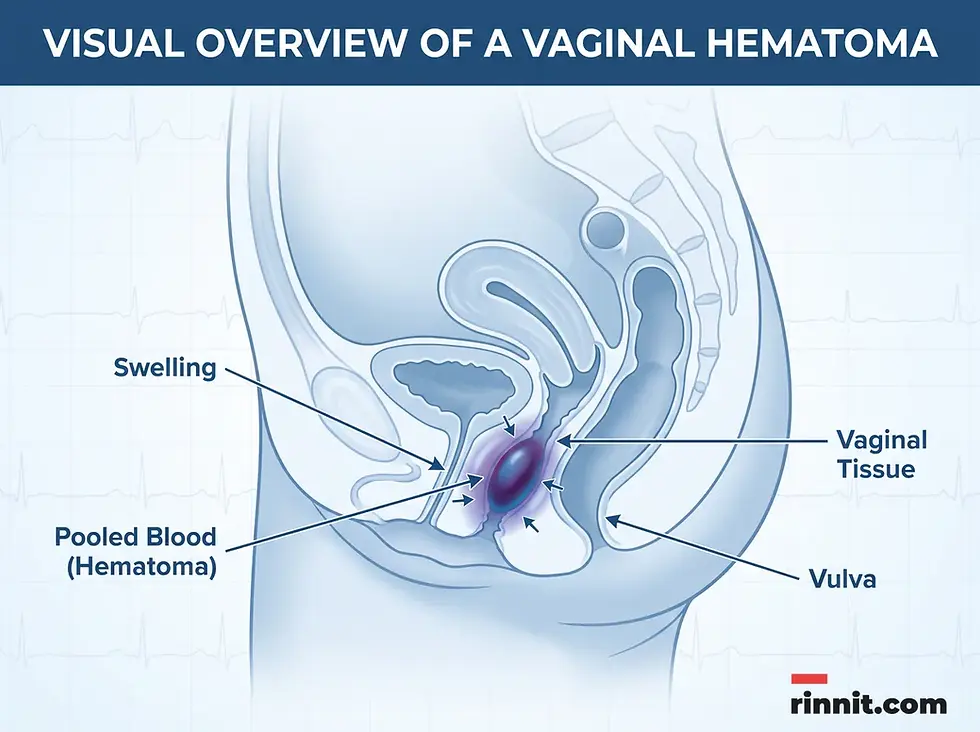
Symptoms and Identification
The symptoms of a vaginal hematoma often depend on its size and the depth of the affected blood vessel. Common signs include:
Significant swelling: The affected area becomes visibly puffy or firm. [1]
Deep discoloration: The skin may appear dark blue, purple, or red, eventually fading to yellow as it heals. [1]
Intense pain: Pressure from the pooled blood often causes mild to severe discomfort. [1]
Physical obstruction: Large hematomas may press against the urethra, making it difficult to urinate. [1]
Common Causes and Risk Factors
Most vaginal hematomas are caused by the intense pressure and stretching associated with childbirth. [1] However, any trauma to the pelvic region can lead to a hematoma. [1]
Primary Causes Include
Vaginal childbirth: Especially during a long second stage of labor, or when medical tools like forceps are required. [1]
Physical trauma: Falls, car accidents, or “straddle” injuries from activities like cycling, gymnastics, or horseback riding. [1]
Surgical complications: Vulvar or vaginal surgeries.
Sexual activity: Intense intercourse or sexual assault. [1]
Risk Factors
Factors that increase the likelihood of a hematoma during delivery include fetal macrosomia (a large baby), having an episiotomy, or the use of assistive delivery instruments. [1]

Management and Treatment
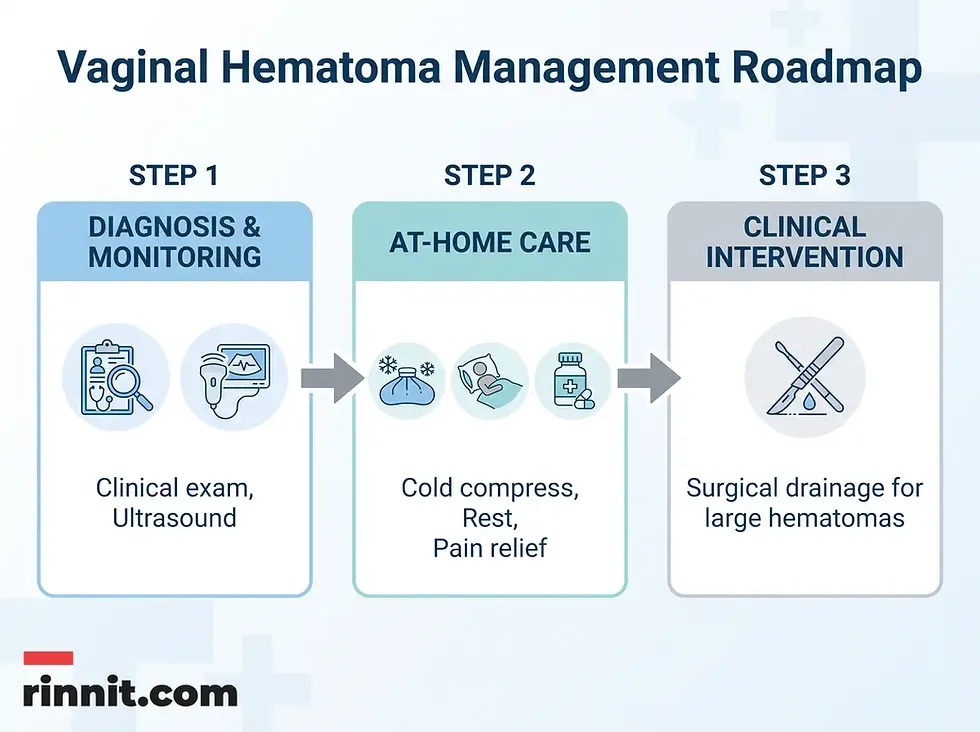
Treatment for a vaginal hematoma is determined by its size and whether it is actively growing.
At-Home Care for Small Hematomas
Small, stable hematomas typically resolve on their own within three weeks. [1] Recommended care includes:
Medical and Surgical Intervention
If a hematoma is larger than 10 centimeters, growing rapidly, or causing extreme pain, a healthcare provider may recommend surgery. [1]
Treatment Type | Description |
Observation | Monitoring the size to ensure it does not expand or show signs of infection. |
Incision and Drainage | A small cut is made to remove the pooled blood, often under local anesthesia. [1] |
Surgical Repair | Closing the broken blood vessel to stop active bleeding and stitching the area. |
Potential Complications
While rare, complications can occur if a hematoma is left untreated or becomes infected. These include:
Frequently Asked Questions
1. How long does it take for a vaginal hematoma to go away?
Most small hematomas heal within one to three weeks. Larger ones that require drainage may see initial relief within days, though full skin healing takes longer.
2. Is a vaginal hematoma a medical emergency?
A small, stable hematoma is usually not an emergency, but a rapidly growing one or one accompanied by signs of shock (dizziness, low blood pressure) requires immediate medical attention.
3. Can a vaginal hematoma cause an infection?
Yes, pooled blood can potentially become infected, leading to increased pain, fever, or foul-smelling drainage.
4. How is a vaginal hematoma diagnosed?
Healthcare providers typically diagnose them through a physical exam. In some cases, an ultrasound, CT scan, or MRI may be used to assess the depth and size.
5. Does a vaginal hematoma always need to be drained?
No. Providers generally only recommend drainage for hematomas that are larger than 10 cm, growing, or causing severe pain.
6. Can you get a vaginal hematoma without being pregnant?
Yes. Trauma from falls, accidents, or straddle-style sports (like horseback riding) can cause vaginal hematomas in anyone.
7. Is a hematoma different from a bruise?
Yes. A hematoma involves damage to larger blood vessels and results in a more significant collection of blood and swelling than a typical bruise.
8. Can a vaginal hematoma affect urination?
Large hematomas can put pressure on the urethra, making it difficult or painful to urinate.
9. What does a healing hematoma look like?
As the blood is reabsorbed, the dark purple or blue color will typically fade to a yellow or greenish tint before disappearing.
10. Can I treat a vaginal hematoma with heat?
No. Cold compresses are recommended initially to constrict blood vessels and reduce swelling. Consult your doctor before using heat.
11. Can intense exercise cause a hematoma?
Straddle-style exercises or those involving significant pelvic impact can potentially cause an injury leading to a hematoma.
12. Are vaginal hematomas common during delivery?
Vaginal hematomas are relatively rare, occurring in less than 1% of all vaginal deliveries.
13. What are the signs of a large hematoma?
Rapidly increasing swelling, a feeling of intense pressure in the vagina or rectum, and severe pain are common signs.
14. Can a vaginal hematoma return?
Recurrence is unlikely unless there is a new injury or a complication with the healing process.
15. Is it safe to have sex with a vaginal hematoma?
You should wait until the hematoma is fully healed and you have been cleared by your healthcare provider to avoid further injury or infection.
References
Cleveland Clinic. Vaginal hematoma. Cleveland Clinic. March 17, 2025. https://my.clevelandclinic.org/health/diseases/vaginal-hematoma
Atar I, Tako E, Gabbai D, et al. Clinical predictors of postpartum vaginal and vulvar hematomas and the need for surgical treatment. Pregnancy (Hoboken). 2026;2(4):e70316. PMID 42597019. https://doi.org/10.1002/pmf2.70316
Benrubi G, Neuman C, Nuss RC, et al. Vulvar and vaginal hematomas: a retrospective study of conservative versus operative management. South Med J. 1987;80(8):991-994. PMID 3616729. https://doi.org/10.1097/00007611-198708000-00014



Comments