Urge Incontinence: A Comprehensive Guide to Symptoms, Causes, and Care

Updated: 2 days ago
Medically reviewed by Dr. Baraa Alnahhal, MD · Last reviewed: October 2026
Quick Answer
Urge incontinence is a sudden, urgent need to urinate that cannot be delayed, followed by involuntary leakage, most often due to an overactive bladder. [1] Symptoms include urinating more than eight times while awake and waking at night to urinate. [1] It affects roughly 40% of females and 30% of males at some point. [1] Pelvic floor therapy and bladder retraining come first. [1]
What the research says
Bladder training was more likely than anticholinergic drugs to cure or improve overactive bladder, though the evidence is low-certainty. In a Cochrane review of 15 randomized trials (2,007 adults, 89.3% women), bladder training beat anticholinergics on cure or improvement in the early phase (risk ratio 1.37, 95% CI 1.10 to 1.70; 4 studies, 258 participants) and had fewer adverse events (risk ratio 0.03, 95% CI 0.01 to 0.17; 3 studies, 187 participants; very low-certainty evidence). (Funada et al., Cochrane Database Syst Rev, 2023) [2]
For refractory urgency incontinence, sacral nerve stimulation and Botox cut leaks by a similar amount. In the ROSETTA trial economic evaluation of 386 women with 6 or more urgency incontinence episodes on a 3-day diary, the mean reduction at 2 years was 3.00 episodes a day with sacral neuromodulation (95% CI 2.62 to 3.38) and 3.12 with 200 units of onabotulinumtoxinA (95% CI 2.76 to 3.48; p=0.66). Two-year costs were $35,680 versus $7,460 (2018 U.S. dollars). (Harvie et al., J Urol, 2020) [3]
What Is Urge Incontinence?
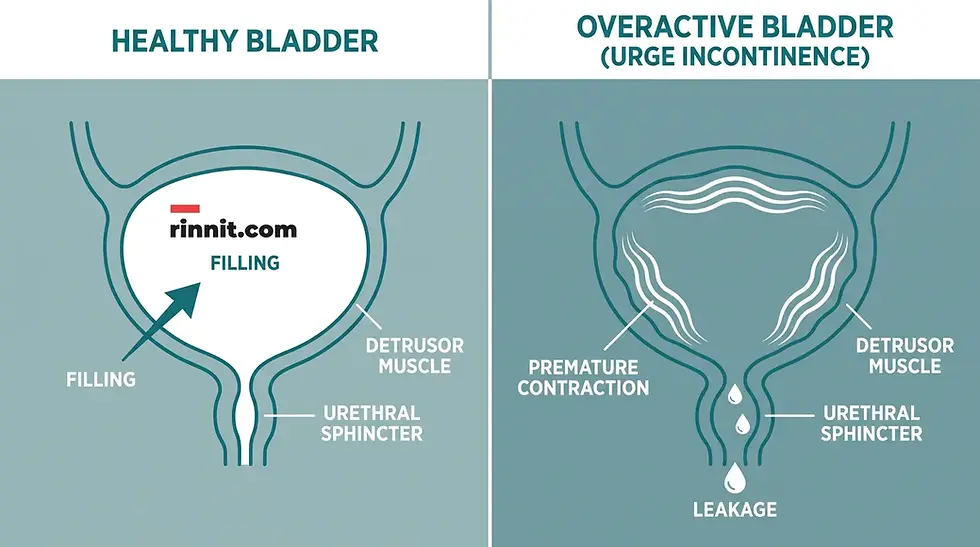
Urge incontinence is a specific type of urinary leakage defined by a sudden, intense urge to urinate that cannot be delayed. People with this condition often leak urine before they can reach a restroom. [1] It is frequently associated with an overactive bladder (OAB), which causes the bladder muscles to squeeze, or contract, even when the bladder is not full. [1]
Unlike other forms of incontinence, urge incontinence is characterized by how often and how urgently you need to go. Many people urinate more than eight times during their waking hours and wake up multiple times at night to use the bathroom. [1] It becomes more common with age, but medical professionals emphasize that it is not a normal consequence of growing older — it is a treatable medical condition. [1]
Recognizing the Symptoms
The hallmark symptom of urge incontinence is a sudden, uncontrollable urge to urinate, immediately followed by involuntary leakage. [1] It often comes with a cluster of related symptoms that affect daily life:
Frequent urination: Needing to urinate more than eight times while awake. [1]
Nocturia: Waking up more than twice during the night to urinate. [1]
Leakage patterns: Leaking urine before reaching the bathroom or just after urinating. [1]
Bedwetting: Involuntary urination during sleep, also known as enuresis. [1]
Beyond the physical symptoms, urge incontinence can affect mental well-being. The fear of having an accident in public can lead people to avoid outings where restrooms are not easy to find, which can increase the risk of stress, anxiety, and depression. [1]
What Causes Urge Incontinence?
The most frequent cause of urge incontinence is an overactive bladder. [1] In a healthy system, the bladder muscles stay relaxed while the bladder fills and contract only when it is time to urinate. In urge incontinence, these muscles contract too early, creating a false sense of urgency. The contraction also signals the urethral sphincter to relax, allowing urine to leak out. [1]
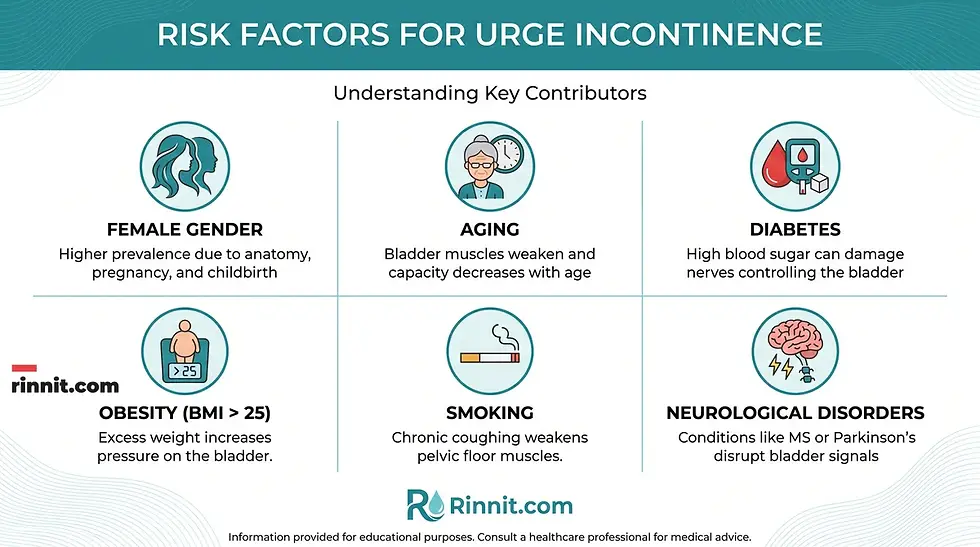
Several factors can raise the risk of developing urge incontinence:
Gender and age: Females are twice as likely as males to have urge incontinence, and the risk increases with age. [1]
Medical conditions: Diabetes, urinary tract infections (UTIs), and neurological disorders such as Alzheimer’s disease, Parkinson’s disease, and multiple sclerosis (MS). [1]
Lifestyle and physical factors: Smoking, a body mass index (BMI) greater than 25 (overweight or obesity), and a history of pelvic surgery or pelvic radiation therapy. [1]
Medications: Certain drugs, including diuretics, antidepressants, and blood pressure medications, may make symptoms worse. [1]
Diagnosis and Clinical Testing
To diagnose urge incontinence, a healthcare provider typically begins with a detailed medical history and a physical exam. [1] This may include a pelvic exam for females or a digital rectal exam for males to assess the pelvic organs and the prostate. [1]
Providers often recommend keeping a bladder diary for two to three days. In it, you record what you drink, how often you use the bathroom, and the circumstances around any leakage. [1] Additional tests may include:
Urinalysis: To rule out infection or blood in the urine. [1]
Ultrasound: To look at the bladder, kidneys, and other abdominal organs. [1]
Cystoscopy: A procedure to examine the inside of the urinary system. [1]
Urodynamic testing: Specialized tests that measure how well the bladder holds and releases urine. [1]
Treatment and Management Options
Urge incontinence rarely disappears on its own, but it can be managed effectively. [1] The choice of treatment depends on how severe the symptoms are and how much they affect your quality of life.
First-Line Therapies
Initial management usually focuses on non-invasive techniques. Pelvic floor physical therapy, which includes Kegel exercises, helps strengthen the muscles that support the urinary system. [1] Bladder retraining is another common approach, in which you learn to gradually increase the time between bathroom visits. [1] [2] Lifestyle adjustments, such as managing fluid intake and maintaining a healthy weight, are also essential parts of early care. [1]

Advanced Medical Treatments
If lifestyle changes do not bring enough relief, a healthcare provider may recommend more advanced options. These include Botox (botulinum toxin) injections into the bladder muscle to reduce overactivity [1] [3], or nerve stimulation therapies that help regulate the signals between the brain and the bladder. [1] [3]
The Bottom Line
Urge incontinence is a challenging but manageable condition that affects many people. By understanding the symptoms and getting a professional diagnosis, you can reach a range of effective treatments — from simple exercises to advanced medical therapies — to regain control and improve your quality of life.
Take the Next Step
Sudden urges, frequent trips to the bathroom, or leaks before you reach it are worth bringing to a healthcare provider. Urge incontinence is treatable and is not a normal part of aging. Keeping a bladder diary for two to three days is a simple way to prepare for your visit.
Frequently Asked Questions
Is urge incontinence just a normal part of getting older?
No. While it becomes more common with age, it is a treatable medical condition and not an inevitable part of aging.
How is urge incontinence different from stress incontinence?
Urge incontinence is caused by a sudden, intense need to go, while stress incontinence involves leakage due to physical pressure, such as coughing or laughing.
Can I have both urge and stress incontinence?
Yes. This is known as mixed incontinence, and it is common, especially among females.
How often do people with urge incontinence urinate?
Many people with urge incontinence urinate more than eight times a day while they are awake.
What is a bladder diary?
A bladder diary is a record, kept for two to three days, of what you drink, how often you urinate, and when you experience leakage.
Are Kegel exercises effective for urge incontinence?
Yes, they are a common first-line approach. Kegel exercises help strengthen the pelvic floor muscles that support the urinary system.
Can medications cause urge incontinence?
Yes. Certain antidepressants, diuretics, and blood pressure medicines can be risk factors and may worsen symptoms.
Is urge incontinence more common in women?
Yes. Females are twice as likely as males to have urge incontinence.
What is nocturia?
Nocturia is the need to wake up more than twice during the night to urinate.
Can smoking affect my bladder?
Yes. Smoking is a recognized risk factor for urge incontinence.
What is Botox used for in bladder treatment?
Botox (botulinum toxin) is injected into the bladder muscle to help it relax and reduce the urge to urinate.
Can a UTI cause urge incontinence?
Yes. Urinary tract infections (UTIs) are a common risk factor and can trigger symptoms.
Does being overweight affect incontinence?
Yes. A body mass index (BMI) greater than 25 is a known risk factor for urge incontinence.
What is urodynamic testing?
Urodynamic testing is a set of tests that measure how well your urinary system holds and releases urine.
Should I see a doctor for sudden leakage?
Yes, especially if it develops after a medical procedure, an injury, or starting a new medication.
Related Reading
Kegel Exercises for Men: Benefits and How to Do Them explains how men can strengthen their pelvic floor muscles.
References
Cleveland Clinic. Urge incontinence. Cleveland Clinic. Last updated September 11, 2024. Accessed October 14, 2026. https://my.clevelandclinic.org/health/diseases/22161-urge-incontinence
Funada S, Yoshioka T, Luo Y, et al. Bladder training for treating overactive bladder in adults. Cochrane Database Syst Rev. 2023;10(10):CD013571. PMID 37811598. https://doi.org/10.1002/14651858.CD013571.pub2
Harvie HS, Amundsen CL, Neuwahl SJ, et al. Cost-effectiveness of sacral neuromodulation versus onabotulinumtoxinA for refractory urgency urinary incontinence: results of the ROSETTA randomized trial. J Urol. 2020;203(5):969-977. PMID 31738113. https://doi.org/10.1097/JU.0000000000000656
Disclaimer: This guide is for general information only and is not a substitute for professional medical advice, diagnosis, or treatment. Always seek the advice of a physician or other qualified health provider with any questions about a medical condition. Never disregard professional medical advice or delay seeking it because of something you have read here.



Comments