Understanding Tubular Breasts: Characteristics and Cosmetic Options

Updated: 2 days ago
Medically reviewed by Dr. Baraa Alnahhal, MD · Last reviewed: October 2026
Editorial note: This article is provided for educational purposes only. It is not medical advice. Always consult a qualified healthcare provider regarding any developmental concerns or surgical procedures.
Quick Answer: What are tubular breasts?
Tubular breasts, also called tuberous breasts, are a common but often undiagnosed condition in which the breasts have a narrow, tube-like or triangular shape because connective tissue does not form correctly during puberty [1]. Features include large areolas and a wide gap between the breasts [1]. The condition is harmless but may limit milk supply [1], and treatment is cosmetic surgery.
What the research says
The shape comes from constricting connective tissue. A review of 42 studies on the anatomy and tissue makeup of tuberous breasts found a constricting fibrous ring made of longitudinally arranged collagen and elastic fibers, and noted that the condition has been described only sparsely in the literature (Lozito et al., Plastic and Reconstructive Surgery – Global Open, 2022) [2].
There is no single best operation. A scoping review of 27 surgical studies (from 2,210 records screened) found many described techniques but no consensus on the optimal treatment, and concluded that the approach should match each patient's features and preferences (van Durme et al., JPRAS Open, 2024) [3].
Most patients are satisfied long term, though re-operations are common. In 82 operated patients followed for an average of 7.4 years (40 completed the BREAST-Q questionnaire), surgery provided long-term satisfaction for most. Re-operations were more frequent after breast augmentation and in severe deformity, but did not appear to lower satisfaction over time (Faure et al., Annales de Chirurgie Plastique Esthétique, 2021) [4].
The Nature of Tubular Breasts
Tubular breasts, medically referred to as breast hypoplasia or tuberous breasts [1], are a developmental condition where the breasts do not achieve a full, round shape during puberty. Instead, the tissue grows in a narrow or elongated fashion, often appearing oval or triangular [1]. This irregular growth is not a sign of an underlying disease and is entirely harmless to physical health. However, the unique appearance of the breasts can have a significant emotional impact, potentially leading to low self-esteem or body image concerns [1].
The condition becomes apparent only after puberty begins [1] and breast development starts. While the exact prevalence is unknown, many cases remain undiagnosed [1] unless an individual seeks a professional evaluation for cosmetic reasons. It is important to distinguish this developmental condition from tubular breast carcinoma, which is a specific type of invasive cancer unrelated to the shape of the breasts [1].
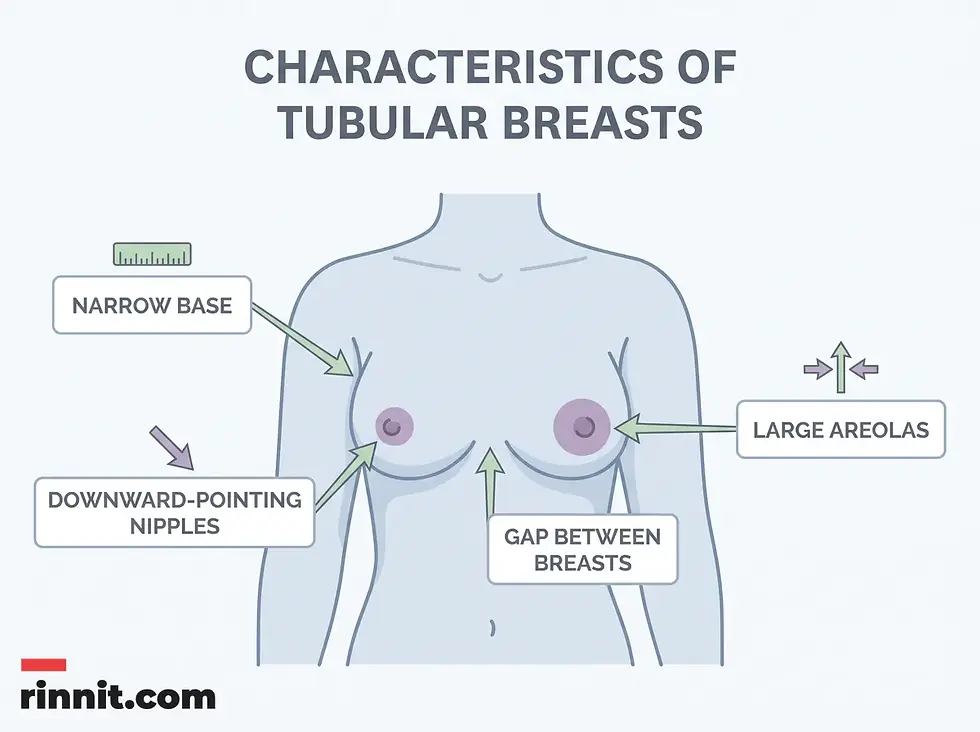
Characteristic feature | Description |
Breast shape | Narrow, elongated, oval, or triangular rather than round [1]. |
Areola size | Typically larger than average areolas [1]. |
Nipple orientation | Nipples that point downward [1]. |
Inter-breast gap | A gap larger than 1.5 inches between the breasts [1]. |
Base width | A narrow base where the breast attaches to the chest [1]. |
Asymmetry | Significant differences in size or shape between the two breasts [1]. |
Causes and Potential Complications
The primary cause of tubular breasts is the failure of connective tissue to form as expected during the pubertal growth phase [1]. Researchers are still investigating the exact triggers, but theories suggest a possible hormone imbalance or genetic changes that occur during fetal development. Unlike typical breast growth, which may be rapid, development in those with tubular breasts is often slow and incomplete, leaving the tissue only partially formed [1].
While the condition is not dangerous, it can lead to practical complications, most notably during breastfeeding. Because the breast tissue is not fully developed, the milk supply may be lower than normal [1], making it difficult to exclusively breastfeed a child. Beyond physical considerations, the psychological impact of having asymmetrical or irregularly shaped breasts is a common reason individuals seek medical consultation.
Complication category | Impact and details |
Breastfeeding | Potential for lower-than-average milk supply [1]. |
Emotional health | Possible low self-esteem, anxiety, or body dysmorphia. |
Symmetry and fit | Physical discomfort or difficulty finding well-fitting clothing. |
Management and Cosmetic Reshaping
Because tubular breasts are harmless, medical treatment is not required [1]. However, many individuals choose to undergo cosmetic procedures to achieve a more traditional round shape and improve symmetry. A plastic surgeon can recommend a personalized treatment plan based on the individual's anatomy and aesthetic goals. These procedures often involve adding volume and redistributing existing tissue to create a fuller appearance.
Surgical options are diverse and can be tailored to the patient's preferences. Common techniques include breast augmentation using silicone or saline implants, fat transfer (where fat is moved from another part of the body to the breasts), or a combination of both [1]. As with any surgery, there are risks such as scarring, infection, and bruising [1], which should be discussed thoroughly during a consultation with a qualified professional.

Common Reshaping Techniques
Tissue redistribution: Rearranging the existing breast tissue [1] to create a rounder base.
Breast augmentation: Using implants to provide volume and projection.
Fat transfer: A natural alternative using the patient's own fat cells to enhance shape.
Breast lift: Adjusting the position of the nipple and areola for a more centered look.
Conclusion
Tubular breasts are a unique variation in breast development that, while physically harmless, can significantly affect an individual's self-image. Understanding that this is a common developmental occurrence—rather than a sign of illness—is crucial for emotional well-being. Whether choosing to embrace their natural shape or opting for cosmetic enhancement, individuals have various pathways to feeling comfortable and confident in their bodies.
Your next step: If the shape or symmetry of your breasts is causing you emotional distress or impacting your self-esteem, consider consulting with a plastic surgeon or a mental health professional. Exploring your options in a supportive environment can help you make an informed decision that aligns with your personal goals and well-being.
Related reading: Natural Breast Augmentation: The Fat Transfer Method
Sources: Cleveland Clinic — Tubular Breasts
Frequently Asked Questions
1. What are tubular breasts?
Tubular breasts are breasts that develop into a narrow, tube-like, or triangular shape rather than a round one during puberty.
2. Is this condition dangerous?
No, tubular breasts are entirely harmless and are not a sign of any underlying health problem.
3. What causes the breasts to grow this way?
The tubular shape is caused by connective tissue not forming correctly during puberty, potentially due to hormonal or genetic factors.
4. Can tubular breasts be prevented?
Currently, there is no known way to prevent this developmental variation.
5. Is it the same as tubular breast cancer?
No. Tubular breast carcinoma is a type of cancer named for the shape of its cells; it is unrelated to the physical shape of the breast.
6. Can I breastfeed if I have tubular breasts?
You may be able to, but some individuals experience a lower milk supply due to incomplete tissue development.
7. How is the condition diagnosed?
A healthcare provider can diagnose it through a simple physical examination.
8. When do tubular breasts become apparent?
The characteristics typically emerge during puberty as the breasts begin to develop.
9. What is breast hypoplasia?
Breast hypoplasia is another medical term for tubular or tuberous breasts.
10. Do I need surgery?
Surgery is entirely optional and is only pursued for cosmetic reasons or to improve self-esteem.
11. What surgical options are available?
Options include breast implants, fat transfer, tissue redistribution, and breast lifts.
12. Are there non-surgical ways to change the shape?
There are no non-surgical treatments to permanently change the shape, though certain bra types can provide temporary enhancement.
13. What are the best bras for this shape?
Wireless bras, bandeau bras, bralettes, and padded bras are often cited as being comfortable and form-fitting.
14. Is it common to have a gap between the breasts?
Yes, a gap larger than 1.5 inches is a hallmark characteristic of tubular breasts.
15. Can tubular breasts affect only one side?
Yes, the condition can affect one breast (asymmetry) or both.
References
Cleveland Clinic. Tubular breasts. Cleveland Clinic. Last reviewed October 25, 2023. https://my.clevelandclinic.org/health/diseases/tubular-breasts
Lozito A, Vinci V, Talerico E, et al. Review of tuberous breast deformity: developments over the last 20 years. Plast Reconstr Surg Glob Open. 2022;10(5):e4355. PMID 35702542. https://doi.org/10.1097/GOX.0000000000004355
van Durme J, Cooreman A, Paternoster J, et al. The different surgical strategies for treating tuberous breast deformity: a scoping review. JPRAS Open. 2024;42:315-328. PMID 39555168. https://doi.org/10.1016/j.jpra.2024.07.011
Faure A, Mosca MV, Régas I, et al. Tuberous breast deformity correction: long-term satisfaction assessment with BREAST-Q questionnaire [article in French]. Ann Chir Plast Esthet. 2021;66(6):466-475. PMID 34563409. https://doi.org/10.1016/j.anplas.2021.08.003
Medical disclaimer
This content is for informational purposes only and does not constitute medical advice. Always seek the guidance of a qualified healthcare provider regarding any developmental concerns or surgical procedures.



Comments