
Understanding the Somogyi Effect: Why Morning Blood Sugar Can Spike

Updated: 3 days ago
Medically reviewed by Dr. Baraa Alnahhal, MD · Last reviewed: October 17, 2026
Quick Answer: What is the Somogyi effect?
The Somogyi effect is the theory that an overnight low blood sugar episode triggers a surge of hormones such as adrenaline and glucagon, which make the liver release stored glucose and raise blood sugar by morning. [1] Unlike the dawn phenomenon, it is caused by a night-time low. [1] Management involves adjusting insulin, the evening meal or exercise timing. [1]
Important safety note
Do not change your insulin dose on your own because of a high morning reading. If an overnight low is the cause, taking more insulin can make it worse. Seek urgent medical help for severe low blood sugar, such as confusion, seizures, or being unable to eat or drink.

What the research says
A large CGM study found no support for the Somogyi effect in type 2 diabetes. Researchers reviewed retrospective CGM data from 2,600 people with type 2 diabetes on stable insulin (4,705 valid nights). Morning fasting glucose was actually lower after nights with hypoglycemia, and only 27 nights showed fasting glucose above 7 mmol/L after a night-time low under 3.0 mmol/L (Huang et al., Int J Endocrinol, 2022) [2].
Under experimental conditions, rebound hyperglycemia can happen in type 1 diabetes. In five people with type 1 diabetes, low blood sugar led to marked rebound hyperglycemia (188 ± 26 mg/dL at 12 hours) even when waning insulin was prevented, and it did not occur when both insulin waning and glucose counterregulation were prevented, pointing to an excessive rise in glucose production (Bolli et al., N Engl J Med, 1984) [3].
The dawn phenomenon is the more common cause of morning highs. A review concluded that the dawn phenomenon is more common than the Somogyi effect, that checking glucose between 3 a.m. and 5 a.m. on several nights or using CGM helps tell them apart, and that good overall insulin control is the best prevention for both (Rybicka et al., Endokrynol Pol, 2011) [4].
What Is the Somogyi Effect?
The Somogyi effect is named after Dr. Michael Somogyi, who described it in the 1930s. [1] It is one of several possible reasons people with diabetes can have high blood sugar in the morning. [1] Also called “rebound hyperglycemia,” it is said to happen when the body overreacts to an overnight drop in blood sugar. [1] It was once thought to be a leading cause of morning highs, but CGM-based research has shown it to be less common than previously believed, so some researchers see it as more of a theory than a universal fact.
It is important to tell it apart from other causes of morning high blood sugar, such as the dawn phenomenon or too little medication. The Somogyi effect is a direct response to a low blood sugar episode, whereas the dawn phenomenon comes from hormone surges that happen in the early morning whatever the overnight glucose level. [1]
The Biological Mechanism
The theory centers on a “rescue” mechanism. If blood sugar drops too low during sleep, often because of injected insulin, the body senses a threat and releases hormones including adrenaline, corticosteroids, growth hormone, and glucagon. These signal the liver to turn stored energy into glucose and release it into the blood in large amounts. [1]
In a person without diabetes, the pancreas would release insulin to counter this surge and keep glucose in a healthy range. In people with diabetes who cannot make enough insulin, the surge goes unchecked, so blood sugar stays high when they wake up. [1]
Comparison | Somogyi effect | Dawn phenomenon |
Trigger | Overnight low blood sugar (hypoglycemia) | Natural early-morning hormone surge |
Hormones involved | Adrenaline, glucagon, cortisol, growth hormone | Cortisol and growth hormone |
Frequency | Less common and disputed | Much more common |
Primary cause | Over-reaction to a glucose drop | Normal circadian rhythm response |
Recognizing Symptoms and Triggers
The most obvious sign is a high glucose reading on a meter or CGM right after waking. [1] Depending on how high it is, you might also have increased thirst, frequent urination, headaches, or irritability. [1] The best clues often lie in what happens during the night, not just in the morning number.
Overnight lows can be subtle and easy to miss while asleep. [1] They may cause restless or irritable sleep, nightmares, or waking up unusually tired or confused. Waking with pajamas or sheets damp from sweat (night sweats) is one common clue.
Common signs that may point to this pattern:
Diagnosis and Monitoring
Because the Somogyi effect is uncommon and its existence is debated, it is hard to detect. The most useful tool is continuous glucose monitoring (CGM) [1], which shows the whole night and lets providers see whether a drop comes before the morning rise.
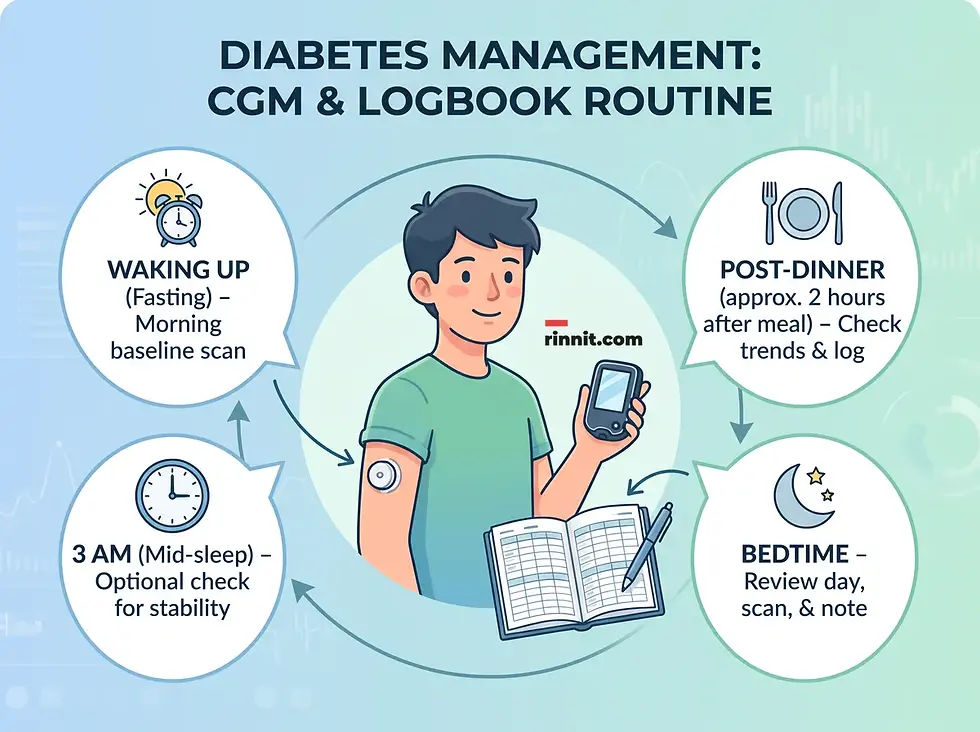
Without a CGM, a provider may recommend manual checks at set times: about two hours after the evening meal, before bed, in the middle of the night (around 2:00 or 3:00 AM), and right after waking. Keeping a detailed log of evening meals, exercise, and insulin doses also helps reveal patterns.
Treatment and Prevention
Management is personal, because everyone responds differently to insulin, food, and exercise. Once a pattern of overnight lows is confirmed, a provider will suggest changes to the diabetes plan. This often means fine-tuning insulin doses to prevent the first drop or changing the timing of long-acting insulin.
Diet can help too. Adjusting the evening meal, for example with more protein or complex carbohydrates, can steady glucose overnight. Some people benefit from an insulin pump for its precision [1], and moving evening exercise earlier may prevent late-night drops.
Management strategy | Action taken | Intended result |
Medication adjustment | Fine-tuning insulin or oral medicine doses | Prevents the initial overnight low |
Dietary changes | Adjusting the make-up of the evening meal | Steadies glucose during sleep |
Insulin pump | Using precise insulin delivery technology | Better control of basal rates |
Exercise timing | Moving workouts earlier in the day | Avoids late-night glucose drops |
Conclusion
The Somogyi effect is a debated explanation for high morning blood sugar. Whatever the cause, the important step is to find out what is actually happening overnight, using CGM or timed checks, and to adjust treatment with your care team rather than on your own.
Next Steps
If your morning blood sugar is often high, or you suspect overnight lows, talk with your healthcare provider or diabetes specialist. Bring your glucose log and ask whether CGM or a 3 AM check could help.
Trusted resources: Cleveland Clinic: Somogyi Effect.
Frequently Asked Questions
Is the Somogyi effect a proven fact?
The Somogyi effect is considered a theory. Some evidence supports it under experimental conditions, but studies using modern monitoring technology have disputed how often it actually happens.
Why is it called the Somogyi effect?
The Somogyi effect was named after Dr. Michael Somogyi, who first wrote about the idea in the 1930s.
Can people without diabetes have the Somogyi effect?
No. In people without diabetes, the body makes enough insulin to handle hormone surges and keep blood sugar in a normal range.
How does the Somogyi effect differ from the dawn phenomenon?
The Somogyi effect is a response to low blood sugar at night, while the dawn phenomenon is a natural result of hormones released in the early morning.
What are the signs of an overnight low?
Night sweats, nightmares, restless sleep, and waking up confused or very tired.
Is the Somogyi effect dangerous?
The Somogyi effect can be, because the pattern involves overnight low blood sugar, which can be dangerous, as well as high morning readings.
How can I tell if I have the Somogyi effect?
The best way is to use a continuous glucose monitor (CGM) to track your glucose while you sleep, and to review the results with your provider.
What should I do if my morning blood sugar is always high?
Talk to your healthcare provider. They will likely ask you to track your glucose overnight to find the cause.
Can changing my dinner help?
Changing your dinner may. Adjusting the amount of protein, fat, or carbohydrates in your evening meal can help steady glucose overnight, but plan changes with your care team.
Does exercise affect the Somogyi effect?
Late-evening exercise can lower blood sugar later in the night, which may set the stage for an overnight low.
What are “rescue” hormones?
Rescue hormones are hormones such as adrenaline and glucagon that the body releases to raise blood sugar when it gets too low.
Can an insulin pump help?
Insulin pumps allow more precise insulin delivery, which can help prevent overnight lows for some people.
What are the long-term risks of high morning blood sugar?
Persistently high glucose can lead to complications such as heart disease, kidney problems (nephropathy), and nerve damage (neuropathy).
Should I take more insulin if my morning blood sugar is high?
No, not on your own. If the high comes from an overnight low, extra insulin could make the low worse. Always ask your provider first.
How do I treat a low if I wake up during the night?
Follow your care plan. A common approach is about 15 grams of fast-acting carbohydrate, such as glucose tablets or half a cup of fruit juice, then rechecking in 15 minutes.
References
Cleveland Clinic. Somogyi Effect. Cleveland Clinic. January 31, 2023. https://my.clevelandclinic.org/health/diseases/11443-somogyi-effect
Huang Y, Lou X, Huang W, et al. Confirmation of the absence of Somogyi effect in patients with type 2 diabetes by retrospective continuous glucose monitoring systems. Int J Endocrinol. 2022;2022:6599379. PMID 36237834. https://doi.org/10.1155/2022/6599379
Bolli GB, Gottesman IS, Campbell PJ, et al. Glucose counterregulation and waning of insulin in the Somogyi phenomenon (posthypoglycemic hyperglycemia). N Engl J Med. 1984;311(19):1214-1219. PMID 6387483. https://doi.org/10.1056/NEJM198411083111904
Rybicka M, Krysiak R, Okopień B. The dawn phenomenon and the Somogyi effect: two phenomena of morning hyperglycaemia. Endokrynol Pol. 2011;62(3):276-284. PMID 21717414. https://pubmed.ncbi.nlm.nih.gov/21717414/
Medical Disclaimer
This article is for informational purposes only and does not constitute medical advice. Always seek the advice of your physician or other qualified health provider with any questions you may have regarding a medical condition. Never disregard professional medical advice or delay in seeking it because of something you have read in this article. Do not change your medication, diet, or exercise routine without talking to your provider. If you have severe symptoms of low blood sugar, seek immediate medical attention.



Comments