Understanding the Role of a Psychiatric Mental Health Nurse Practitioner (PMHNP)

Updated: 2 days ago
Medically reviewed by Dr. Baraa Alnahhal, MD | Last reviewed: October 17, 2026
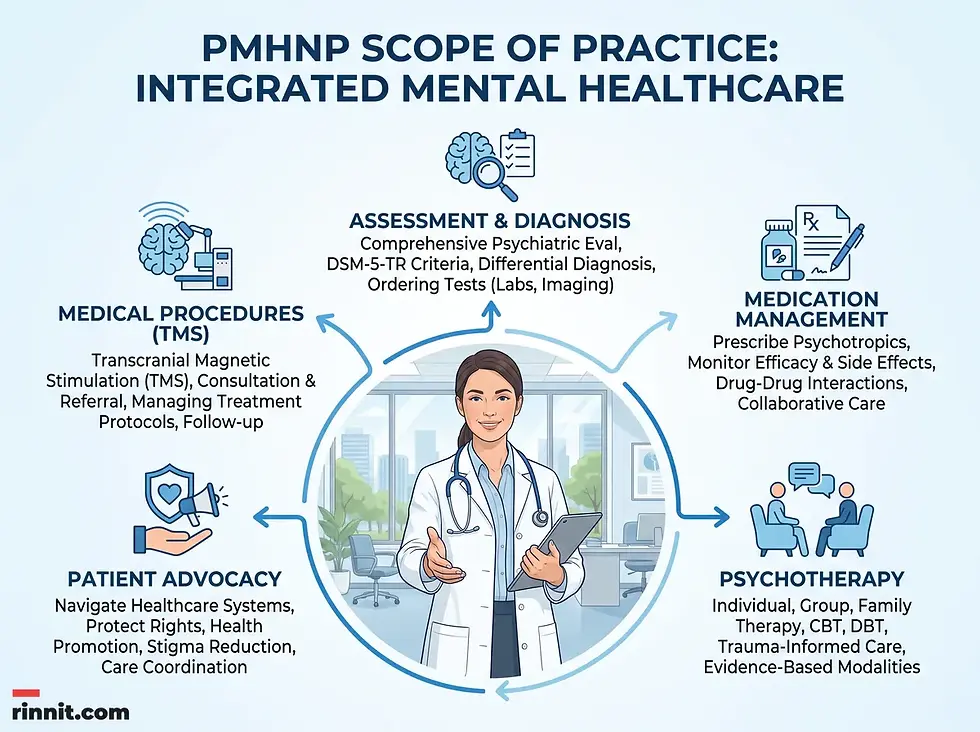
Quick Answer: What is a psychiatric mental health nurse practitioner (PMHNP)?
A psychiatric mental health nurse practitioner (PMHNP) is an advanced practice nurse who assesses, diagnoses and treats mental health and substance use disorders. [1] PMHNPs provide psychotherapy and medication management for adults, children and families in settings such as hospitals and private practices, often collaborating with other providers to build individualized recovery plans. [1]
What the research says
PMHNPs are a fast-growing part of the mental health workforce and treat patients similar to those seen by psychiatrists. In a study of US Medicare claims from 2011 to 2019, the number of PMHNPs treating beneficiaries grew 162% while the number of psychiatrists fell 6%; PMHNPs’ share of mental health prescriber visits rose from 12.5% to 29.8%, exceeding 50% in rural regions with full scope of practice, and the two groups treated roughly comparable patients with similar services and prescriptions (Cai et al., Health Affairs, 2022). [2]
Cognitive behavioral therapy, one of the psychotherapies PMHNPs provide, has moderate effects on anxiety-related disorders compared with placebo. A meta-analysis of 41 placebo-controlled randomized trials (2,843 patients) found a moderate effect on target disorder symptoms (Hedges’ g = 0.56) and higher response rates than placebo (odds ratio 2.97), with the largest effects in obsessive-compulsive disorder, generalized anxiety disorder, and acute stress disorder (Carpenter et al., Depression and Anxiety, 2018). [3]
Transcranial magnetic stimulation (TMS), a procedure some PMHNPs perform, can help people whose depression has not responded to medication. A systematic review and meta-analysis of 18 sham-controlled studies in treatment-resistant depression found that patients receiving repetitive TMS were more than 3 times as likely to respond (RR 3.38, 95% CI 2.24–5.10) and more than 5 times as likely to reach remission (RR 5.07, 95% CI 2.50–10.30) than those receiving sham treatment; how long the benefits last remains unclear (Gaynes et al., Journal of Clinical Psychiatry, 2014). [4]
The Scope of Practice for PMHNPs
A PMHNP serves as a vital link in the mental health care system, offering specialized care for individuals facing psychological challenges and substance use disorders. These providers maintain a safe and confidential environment while using evidence-based interventions to support patient recovery. [1] Their expertise allows them to work with individuals, families, groups, and communities to foster positive health outcomes. [1]
The duties of a PMHNP are extensive and vary depending on their clinical setting. They are trained to diagnose common psychiatric illnesses and manage mental health crises. [1] Beyond diagnosis, they provide various forms of psychotherapy, such as talk therapy and cognitive behavioral therapy (CBT). [1] They also advocate for their patients and families, coordinating services from multiple providers for people with complex psychiatric needs. [1]
Core Responsibility | Description of Clinical Action |
Assessment & Diagnosis | Evaluating mental health status and identifying specific psychiatric disorders. |
Medication Management | Prescribing and monitoring pharmacological treatments for mental health conditions. |
Psychotherapy | Delivering individual, group, and family therapy sessions to improve coping skills. |
Medical Procedures | Performing specialized treatments such as Transcranial Magnetic Stimulation (TMS). |
Education & Advocacy | Teaching patients about their diagnosis and advocating for their care needs. |
Conditions Treated by PMHNPs
PMHNPs are equipped to manage a diverse range of mental health disorders. Their training covers both psychiatric conditions and substance use disorders, including cases where both occur together, known as a dual diagnosis. [1] By maximizing a patient’s strengths and preventing further disability, PMHNPs help individuals gain, regain, or improve the skills needed for daily living. [1]
Common conditions managed by PMHNPs include:
Mood and Anxiety Disorders: Such as depression, bipolar disorder, panic disorder, and anxiety disorders. [1]
Developmental and Behavioral Issues: Including Attention-Deficit/Hyperactivity Disorder (ADHD) and Obsessive-Compulsive Disorder (OCD). [1]
Complex Psychiatric Conditions: Such as schizophrenia, personality disorders, and dementia. [1]
Trauma and Stress-Related Disorders: Specifically Post-Traumatic Stress Disorder (PTSD). [1]
Eating Disorders: Including anorexia nervosa and bulimia. [1]
Professional Settings and Collaboration
PMHNPs practice in a wide array of environments where mental health support is needed. This versatility allows them to serve patients in traditional clinical settings, such as hospitals and primary care clinics, as well as in community-focused locations like domestic violence shelters and correctional facilities. [1] They often work alongside primary care providers and other specialists [1] to take a holistic approach to patient recovery.
Practice Setting Type | Examples of Facilities |
Clinical Facilities | Hospitals, inpatient psychiatric facilities, private psychiatric practices, primary healthcare clinics. |
Community & Social Services | Community mental health centers, domestic violence shelters. |
Educational & Public Agencies | Colleges and universities, public health agencies, government agencies. |
Residential & Specialized Care | Residential substance abuse facilities, home health agencies, state psychiatric facilities, correctional facilities. |

The Path to Becoming a PMHNP
The journey to becoming a psychiatric nurse practitioner involves rigorous education and clinical training. Candidates must first become a Registered Nurse (RN) by earning an associate (ADN) or bachelor’s (BSN) degree in nursing and passing the national licensure exam (NCLEX). [1] After that, they can gain some nursing experience or go directly into a Master of Science in Nursing (MSN) program with a psychiatric mental health track. [1] Nurse practitioners who already hold an NP degree can instead complete a PMHNP certificate program. [1] Board certification as a Psychiatric-Mental Health Nurse Practitioner (PMHNP-BC) is available through the American Nurses Credentialing Center. [1]

PMHNP vs. Psychiatrist
PMHNPs and psychiatrists have similar roles and responsibilities: both provide therapy, prescribe medication, and manage the mental health of their patients. [1] Their educational paths, however, differ significantly. A psychiatrist is a medical doctor (MD or DO) who attends medical school for at least four years and then completes specialty training in psychiatry. A PMHNP is a nurse practitioner who attends nursing school and completes an advanced nursing program with a psychiatric specialty, using the nursing process to inform their practice. [1] Both roles are essential to mental health care.
Prescribing Authority
In all 50 U.S. states, PMHNPs have some level of prescribing privileges. [1] Cleveland Clinic’s July 2024 review reported that in 21 states they could prescribe without a collaborating physician, while in the remaining states they prescribe at the discretion of a psychiatrist or other physician. [1] Scope-of-practice laws change over time and differ between countries, so check the current rules where you practice or seek care.
Frequently Asked Questions
Can a psychiatric nurse practitioner prescribe medication?
Yes. In the United States, PMHNPs have some level of prescribing privileges in every state, though whether they need a collaborating physician depends on state law.
What is the main difference between a PMHNP and a psychiatrist?
The primary difference lies in their education: psychiatrists are medical doctors, while PMHNPs are nurse practitioners with advanced nursing education and a psychiatric specialty.
Do psychiatric nurse practitioners provide therapy?
Yes, they are trained to provide various forms of psychotherapy, including individual, group, and family sessions, as well as cognitive behavioral therapy.
What age groups do PMHNPs treat?
PMHNPs provide mental health care to adults, children, and families.
Where do psychiatric nurse practitioners usually work?
Psychiatric nurse practitioners work in diverse settings including hospitals, private practices, community mental health centers, colleges and universities, and correctional facilities.
Can a PMHNP diagnose mental health conditions?
Yes, they are qualified to assess, diagnose, and treat a wide range of psychiatric and substance use disorders.
What is PMHNP-BC certification?
PMHNP-BC certification is a board certification offered by the American Nurses Credentialing Center for nurse practitioners specializing in psychiatric-mental health.
Do PMHNPs treat substance use disorders?
Yes, they care for people with substance use disorders and those with co-occurring psychiatric conditions (dual diagnosis).
Can a PMHNP perform medical procedures?
Yes, some perform procedures such as Transcranial Magnetic Stimulation (TMS), depending on their training and setting.
How long does it take to become a PMHNP?
The timeline varies. It includes several years to earn a nursing degree, time to gain nursing experience, and then a nurse practitioner program whose length varies.
Do PMHNPs work independently?
Independence depends on the laws where they practice. In some U.S. states PMHNPs can prescribe without a collaborating physician, while in others they work under a collaborative arrangement.
What conditions do they commonly treat?
PMHNPs treat conditions such as depression, anxiety, ADHD, bipolar disorder, PTSD, and schizophrenia.
Are PMHNPs the same as psychiatric nurses?
No. A PMHNP is an advanced practice nurse with a graduate degree and a broader scope of practice than a registered psychiatric nurse.
Do they help with crisis intervention?
Yes, PMHNPs are trained to diagnose and treat common psychiatric issues and manage mental health crises. In an emergency, contact your local emergency services.
Can a PMHNP refer me to a specialist?
Yes, they monitor general health issues and refer people to specialized medical treatment when needed.
Conclusion and Next Steps
Psychiatric Mental Health Nurse Practitioners play a crucial role in providing accessible and comprehensive mental health care. By combining advanced clinical training with a patient-centered nursing approach, they help individuals navigate the complexities of mental illness and substance use. If you or a loved one are seeking mental health support, consulting a PMHNP can be an important step toward long-term recovery and wellness.
Call to action: Reach out to a healthcare provider today to discuss your mental health needs and learn how a Psychiatric Mental Health Nurse Practitioner can support your journey to wellness. If you or someone you know is in crisis or at risk of harm, contact your local emergency services or crisis line right away.
Sources
Cleveland Clinic. PMHNP (Psychiatric Nurse Practitioner). Cleveland Clinic. Last updated July 19, 2024. https://my.clevelandclinic.org/health/articles/psychiatric-nurse-practitioner-pmhnp
Cai A, Mehrotra A, Germack HD, Busch AB, Huskamp HA, Barnett ML. Trends in mental health care delivery by psychiatrists and nurse practitioners in Medicare, 2011-19. Health Aff (Millwood). 2022;41(9):1222-1230. PMID: 36067437. DOI: 10.1377/hlthaff.2022.00289
Carpenter JK, Andrews LA, Witcraft SM, Powers MB, Smits JAJ, Hofmann SG. Cognitive behavioral therapy for anxiety and related disorders: a meta-analysis of randomized placebo-controlled trials. Depress Anxiety. 2018;35(6):502-514. PMID: 29451967. DOI: 10.1002/da.22728
Gaynes BN, Lloyd SW, Lux L, et al. Repetitive transcranial magnetic stimulation for treatment-resistant depression: a systematic review and meta-analysis. J Clin Psychiatry. 2014;75(5):477-489. PMID: 24922485. DOI: 10.4088/JCP.13r08815
Medical disclaimer
The information provided in this article is for educational purposes only and is not intended as medical advice. Always seek the advice of your physician or other qualified health provider with any questions you may have regarding a medical condition.



Comments