Understanding Road Rash: Severity, Treatment, and Prevention

Updated: 2 days ago
Medically reviewed by Dr. Baraa Alnahhal, MD · Last reviewed: October 2026
Road rash is a friction burn caused by skin sliding across a paved surface such as asphalt or concrete. [1] Injuries range from minor superficial scrapes to deep, full-thickness burns that damage the tissue beneath the skin. [1] Minor cases can often be treated at home with cleaning and bandaging, but deeper or larger road rash needs professional care to prevent infection, scarring and serious complications. [1]
Quick Answer
Road rash is a type of friction burn that happens when skin rubs against pavement, cement or concrete, injuring it through both scraping force and heat. [1] Severity is graded by depth, from superficial outer-skin damage to full thickness and, in severe cases, muscle and bone damage. [1] Treatment starts with cleaning and covering the wound, while deeper burns may need grafting. [1]
What the research says
A small burn area does not mean a minor injury. In a registry review of 143 cycling-related friction burn admissions to specialist burn services in Australia and New Zealand (2009 to 2021), 89% of patients had a burn covering less than 5% of the body, yet 71% needed a procedure in theatre such as debridement and/or skin grafting (Tracy et al., Injury, 2023) [2].
Protective clothing lowers the risk of abrasions. Among 951 motorized two-wheeler riders, wearing both a motorcycle jacket and gloves was linked to a lower risk of upper-limb soft tissue injury (relative risk 0.28, 95% CI 0.12 to 0.69), and wearing both trousers and boots lowered lower-limb risk (relative risk 0.60, 95% CI 0.40 to 0.91); the benefit was mainly fewer abrasions and lacerations, not fewer fractures (Wu et al., Traffic Injury Prevention, 2019) [3].
What is road rash, and how do friction burns on pavement happen?
Road rash happens when you fall onto a paved surface and your momentum drags you along it. This can occur while running, or while riding a bicycle, motorcycle, moped, skateboard, rollerblades or scooter. [1] The longer the distance you slide and the faster you are moving, the worse the burn will be. [1]
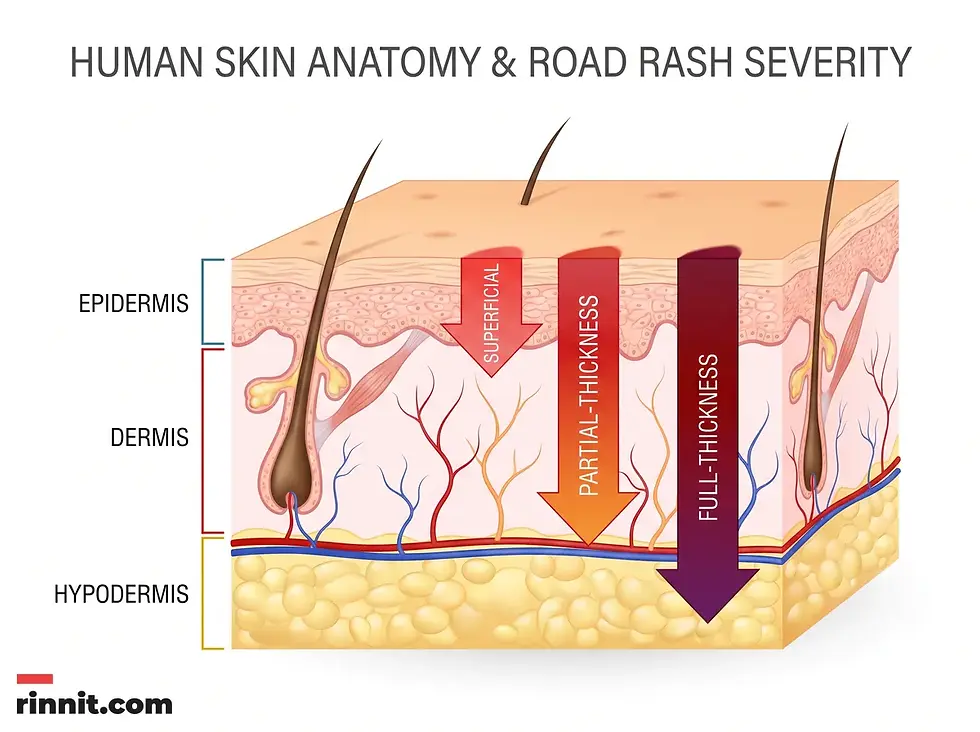
Unlike an ordinary scrape, road rash often forces gravel, dirt and asphalt deep into the wound, along with germs. That makes it prone to infection and can lead to "traumatic tattooing," in which foreign particles remain visible under the skin after the wound heals. [1] Knowing how deep the injury goes is the key to choosing the right level of care.
Severity Level | Tissues Affected | Typical Appearance |
Superficial | Epidermis (outermost layer) | Red or pinkish skin; painful |
Partial thickness | Epidermis and dermis | Blisters; darker red or reddish-brown; very painful |
Full thickness | Epidermis, dermis and fat layer | Charred, pale or gray skin; the center may not hurt |
Deeper tissue | Muscle and bone | Very severe damage that needs urgent specialist care |
What are the symptoms of road rash?
Superficial and partial-thickness road rash is very painful [1] because the nerve endings are still working. Full-thickness burns may not hurt in the center because the nerves are damaged, although the surrounding tissue stays painful.
Skin color changes: red or pinkish skin in people with lighter skin; a reddish tinge in darker skin, which may look lighter while it heals. [1] Full-thickness burns can look charred, or pale, ashy or gray. [1]
Blisters: fluid-filled blisters can form and often break open on their own. [1]
Embedded debris: gravel, grit or dirt lodged in the damaged skin. [1]
Pain: intense in shallow burns, but sometimes absent at the center of the deepest burns.
What complications and systemic risks can road rash cause?
Minor road rash is manageable, but severe cases can strain the whole body. Large partial-thickness and full-thickness burns can cause serious complications. [1]
Infection: forced-in dirt and germs make infection a main concern. [1]
Traumatic tattooing: permanent discoloration from debris that was not fully removed. [1]
Scarring: deeper burns that take longer to heal are more likely to scar. [1]
Shock: fluid loss from the burn, blood loss from related injuries, or both. [1]
Hypothermia: severe skin damage disrupts how the body regulates its temperature. [1]
Organ failure: waste products from broken-down tissue can strain the kidneys. [1]

How is road rash treated and managed?
Road rash treatment depends on the depth of the burn, how much of the body it covers, any other injuries and your health history. Superficial road rash needs minimal or no treatment and can be cared for at home:
Run cold water over the burn for a few minutes right after it happens. [1]
Make sure there is no grit or dirt left in the damaged skin. [1] Rinse gently rather than scrubbing hard.
Cover it with a sterile bandage or clean cloth that is not too tight. [1]
Use over-the-counter pain relief such as acetaminophen, or ibuprofen or naproxen for pain and inflammation. [1]
Small partial-thickness burns can also be self-treated if you can cover them with your hand. [1] Burns larger than your hand need professional care, and full-thickness burns always do. [1] Professional care can include:
Pain management: prescription pain medicine when needed. [1]
Cleaning and debridement: removing dirt, grit and dead tissue to avoid infection. [1]
Bandaging: dressings stand in for the skin's barrier against germs. [1]
Surgery: deeper burns often heal too slowly alone, and procedures such as skin grafting may be needed. [1]
Get emergency care if the burn may be partial thickness or deeper and is on your head, face, ears, hands, feet or groin, is larger than your hand, shows signs of infection (color changes, foul smell, oozing, pus or fever), or causes severe pain. [1] Also get care if a self-treated burn has not started healing after a couple of days. [1]

What is the outlook for road rash, and how does it heal?
The shallower the burn, the faster the recovery. Superficial burns usually heal within a couple of days, while deeper burns can take weeks or longer. [1] Road rash often comes with other injuries, such as broken bones or cuts, and these can strongly affect the outlook [1], so your healthcare provider is the best source of advice for your case.
How can you prevent road rash?
Road rash can be prevented by wearing abrasion-resistant gear, using helmets and elbow and knee pads, and riding at safe speeds while staying aware of your surroundings. [1]
Wear the right clothing: abrasion-resistant gear made for motorcyclists is the best protection for high-risk riding.
Use other safety gear: helmets, elbow pads and knee pads for skateboarding, rollerblading and similar activities. [1]
Ride and move safely: travel at speeds that suit the conditions, give the road your full attention and stay aware of your surroundings. [1]
Conclusion
Road rash is very treatable, and shallow, small burns can be cared for at home. Deeper or larger burns, burns in sensitive areas and any burn with embedded debris or signs of infection need timely medical care to limit scarring, traumatic tattooing and complications. The right gear and safe habits prevent many of these injuries.
Next step: If your road rash is larger than your hand, looks charred or gray, has debris you cannot remove, or shows signs of infection, see a healthcare provider promptly.
Frequently Asked Questions
What is road rash?
Road rash is a friction burn caused by skin rubbing against a paved surface. It combines physical scraping of the skin with heat damage.
How do I know if my road rash is serious?
Get medical care if the burn may be partial thickness or deeper and is larger than your hand, if over-the-counter pain medicine is not enough, if a lot of debris is stuck in the wound, or if it is not healing after a couple of days. Go to the emergency room for burns on the head, face, ears, hands, feet or groin, or if there are signs of infection.
Can road rash cause permanent tattoos?
Yes. If dirt, gravel or asphalt is not thoroughly removed, it can stay trapped under the skin as the wound heals. This is called traumatic tattooing.
Should I cover road rash or let it breathe?
Cover it with a sterile bandage or clean cloth that is not too tight. A covering protects the damaged skin from germs and further irritation.
Why doesn't deep road rash hurt as much as a scrape?
Full-thickness burns can destroy the nerve endings in the damaged skin, so the center of the burn may feel numb even though the surrounding tissue is painful.
Is road rash prone to infection?
Yes. The force of the fall can push dirt, debris and germs deep into the skin, which makes infection easy. Redness, swelling, pus, a foul smell or fever are warning signs.
How long does road rash take to heal?
Superficial burns should heal within a couple of days. Deeper burns can take weeks or longer and may need surgery to heal.
Can road rash cause organ failure?
In severe cases with large partial-thickness or full-thickness burns, waste products from broken-down tissue can strain the kidneys and lead to organ failure. Fluid loss can also cause shock.
What is debridement?
Debridement is the medical cleaning of a wound to remove dirt, debris and dead tissue so it can heal and to lower the risk of infection.
Do I need a tetanus shot after road rash?
Road rash is a dirty wound, so ask your healthcare provider whether your tetanus vaccination is up to date or whether you need a booster.
References
Cleveland Clinic. Road Rash. Cleveland Clinic. Last updated February 26, 2025. https://my.clevelandclinic.org/health/diseases/road-rash
Tracy LM, Gabbe BJ, Beck B. Friction burns in cyclists: an under-recognised problem. Injury. 2023;54(4):1119-1124. PMID 36813664. https://doi.org/10.1016/j.injury.2023.02.029
Wu D, Hours M, Ndiaye A, et al. Effectiveness of protective clothing for motorized 2-wheeler riders. Traffic Injury Prevention. 2019;20(2):196-203. PMID 30901230. https://doi.org/10.1080/15389588.2018.1545090
Medical disclaimer
The information provided in this article is for educational purposes only and should not be used as a substitute for professional medical advice, diagnosis, or treatment. Always seek the advice of your physician or other qualified health provider with any questions you may have regarding a medical condition.



Comments