Understanding Rhinitis Medicamentosa: Causes, Symptoms, and Recovery

Updated: 2 days ago
Medically reviewed by Dr. Baraa Alnahhal, MD · Last reviewed: October 2026
Rhinitis medicamentosa, commonly known as rebound congestion, is a condition where nasal passages become chronically blocked due to the overuse of decongestant sprays. [1] It is a reversible condition [1] that requires a gradual weaning process and alternative treatments to restore healthy nasal function.
Quick Answer
Rhinitis medicamentosa is a type of non-allergic rhinitis caused by using nasal decongestant sprays longer than recommended, typically more than three consecutive days. It creates a rebound effect in which nasal tissues become more inflamed and congested than before. Recovery involves gradually reducing the sprays under medical guidance, often with steroid or saline alternatives. [1]
What the research says
Surgery can still help people with rhinitis medicamentosa. In a retrospective case-control study of 36 adults with RM (at least daily decongestant use for 4 weeks or more) and 116 without, mean Nasal Obstruction Symptom Evaluation (NOSE) scores fell by 9.8 in the RM group and 8.6 in the non-RM group after functional nasal surgery (both p<0.0001, with no significant difference between groups), and 86.1% of RM patients maintained long-term decongestant cessation (Di Ponio et al., The Laryngoscope, 2025) [2].
Overuse affects quality of life well beyond a stuffy nose. In a qualitative study of interviews with 20 people with RM, sleep disorders, a feeling of suffocation, side effects and the psychological effects of nasal congestion significantly impaired quality of life, and all of Griffiths' addiction components appeared in participants' accounts, leading the authors to suggest RM may fit a substance-related or behavioral addiction framework (Lakatos et al., Journal of Behavioral Addictions, 2025) [3].
What is rhinitis medicamentosa (rebound congestion)?
Rhinitis medicamentosa (RM) is a specific form of nasal obstruction that occurs as a direct result of overusing over-the-counter nasal decongestant sprays. [1] While these medications provide rapid, short-term relief for symptoms of the common cold or allergies, their mechanism of action can lead to a paradoxical increase in congestion if used excessively.
The condition is frequently referred to as "rebound congestion" because the very symptom the patient is trying to treat returns with greater intensity once the medication wears off. This often leads to a vicious cycle where the individual uses the spray more frequently to achieve the same level of relief, eventually causing structural and inflammatory changes within the nasal passages.
Feature | Description |
Primary Cause | Overuse of topical nasal decongestant sprays |
Common Name | Rebound Congestion |
Key Ingredients | Oxymetazoline, Phenylephrine |
Safe Usage Limit | Maximum of three consecutive days |
Prevalence | Approximately 10% of the population |
How do decongestant sprays cause rebound congestion in rhinitis medicamentosa?
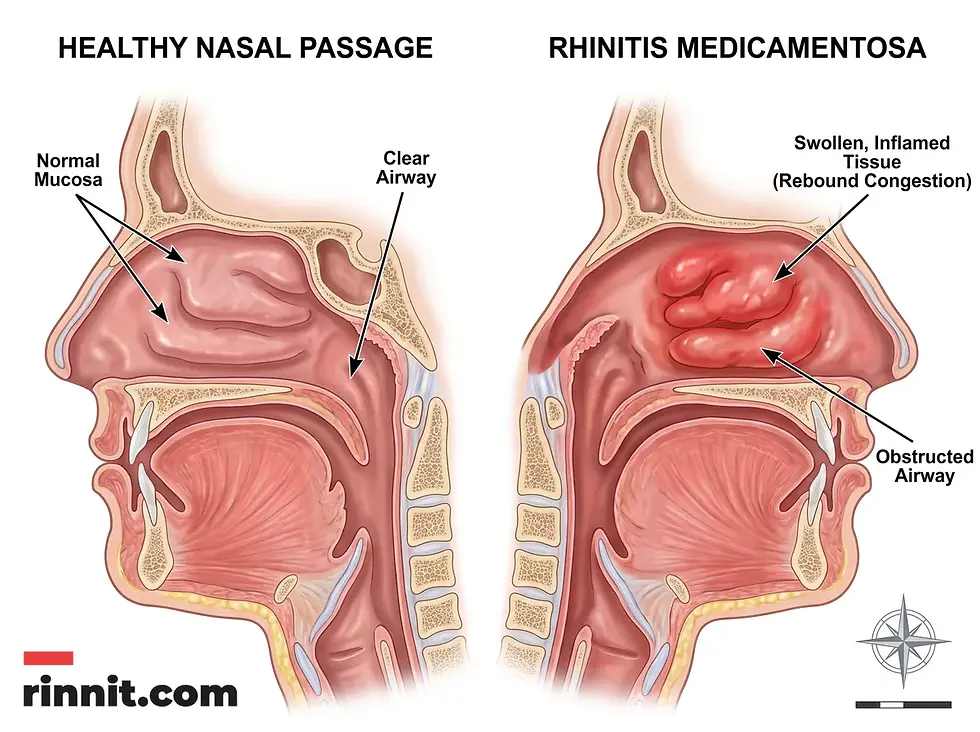
Rhinitis medicamentosa is caused by how decongestant nasal sprays interact with the nasal cavity when they are used for more than a few days. These sprays work by constricting the blood vessels in the nose, which reduces swelling and allows for easier breathing. [1] However, when used for more than a few days, this constant constriction deprives the nasal tissues of nutrient-rich blood [1] and oxygen.
In response to this deprivation, the body triggers an inflammatory rebound. The blood vessels dilate significantly, leading to increased swelling and a more severe feeling of blockage. Over time, the nasal tissue may suffer damage, and the medication becomes less effective, requiring higher doses or more frequent applications to maintain open airways. [1]
What are the symptoms of rhinitis medicamentosa?
Unlike other forms of rhinitis—such as allergic rhinitis or the common cold—rhinitis medicamentosa is unique in its localized impact. It typically does not involve the itchy eyes, sore throat, or ear pressure often associated with upper respiratory issues. [1] Instead, the focus is entirely on the nasal passages.
Common clinical signs include:
A persistent, heavy feeling of nasal blockage.
Difficulty breathing through the nose that worsens as the spray wears off.
The need to use nasal sprays more frequently than the label recommends.
A sensation of suffocation or severe headaches when the medication is not used. [1]
Congestion that does not respond to traditional allergy treatments.
What are the risk factors for rhinitis medicamentosa and how common is it?
Anyone who uses topical nasal decongestants is at risk for rhinitis medicamentosa, but certain populations are more vulnerable. Individuals with chronic nasal conditions, such as a deviated septum or perennial allergies, may reach for these sprays more often to find relief. [1] Research indicates that approximately 10 out of every 100 people deal with some form of rebound congestion. [1]
The primary risk factor is a lack of awareness regarding the three-day usage limit. Many patients do not read the full package instructions [1] and continue using the sprays until a cycle of dependency is established.
Risk Factor | Impact on RM Development |
Duration of Use | Using sprays for more than 3 days significantly increases risk. |
Underlying Conditions | Allergies or deviated septums lead to more frequent spray use. |
Awareness | Failure to read package warnings regarding rebound effects. |
Frequency | Increasing the number of sprays per day accelerates tissue damage. |
How is rhinitis medicamentosa diagnosed?
Diagnosing rhinitis medicamentosa is primarily a clinical process. Healthcare providers focus on the patient's history of medication use rather than complex laboratory tests. [1] It is vital for patients to be completely honest about how often and for how long they have been using over-the-counter sprays. [1]
The diagnostic steps usually include:
Medical History: A detailed review of nasal spray brands and usage frequency.
Physical Examination: Visual inspection of the nasal passages [1] to check for inflammation, redness, or tissue damage.
Ruling Out Other Causes: Checking for signs of sinus infections, polyps, or other obstructions that might mimic rebound congestion.

How is rhinitis medicamentosa managed and treated?
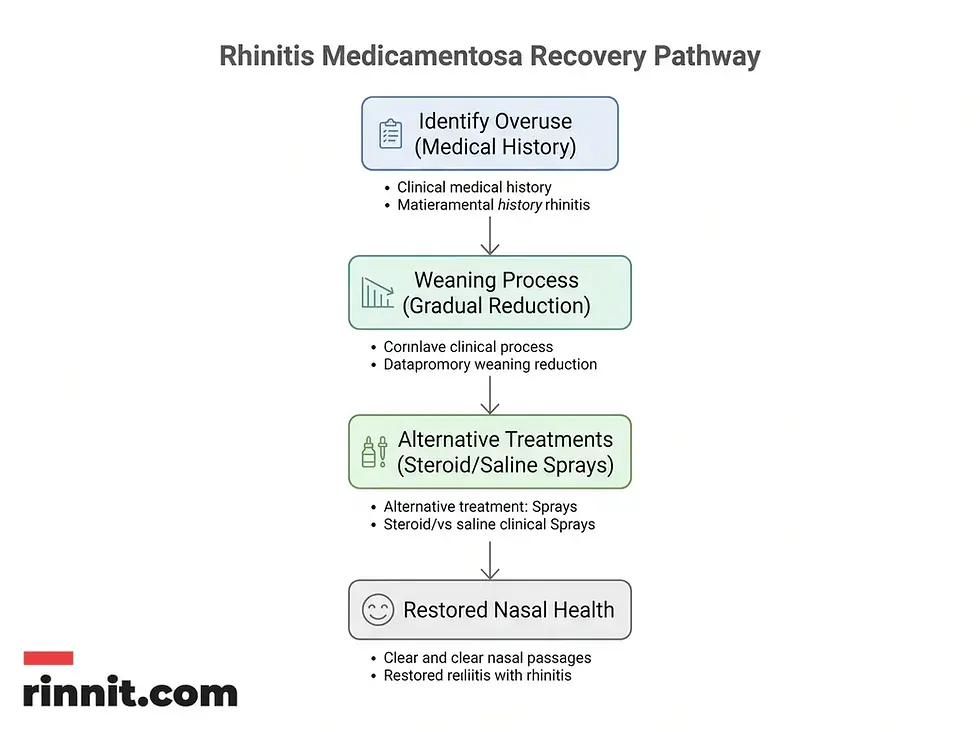
The most critical step in treating rhinitis medicamentosa is ending the reliance on decongestant sprays. However, stopping "cold turkey" can lead to severe, uncomfortable symptoms. [1] Healthcare providers typically recommend a gradual weaning process [1] to allow the nasal tissues to recover naturally.
Weaning and Alternative Medications
Providers often suggest reducing the use of the decongestant in one nostril at a time or gradually increasing the time between doses. During this period, other treatments may be used to manage the resulting congestion:
Intranasal Steroid Sprays: Medications like fluticasone (Flonase®) help reduce long-term inflammation [1] without the risk of rebound.
Saline Sprays: Non-medicated saltwater sprays can clear mucus [1] and soothe irritated tissues.
Oral Decongestants: While these do not cause rebound congestion, they must still be used only as directed to avoid other side effects. [1]
Surgical Intervention
In rare cases where the nasal tissue has been severely damaged by long-term overuse, surgery may be necessary to restore the airway. [1] This is typically a last resort after conservative weaning methods have failed.
Conclusion and Next Steps
Rhinitis medicamentosa is a challenging but entirely reversible condition. The key to recovery is patience and a commitment to weaning off the offending medications. By switching to safer alternatives like saline or steroid sprays, most individuals can restore their nasal health within a few weeks. If you find yourself unable to breathe without a decongestant spray, consult a healthcare provider to begin a structured recovery plan and prevent long-term tissue damage.
Frequently Asked Questions
What is the three-day rule for nasal sprays?
Most medical professionals recommend using topical decongestant sprays for no more than three consecutive days to avoid the risk of rebound congestion.
How long does it take to recover from rhinitis medicamentosa?
Recovery time varies, but most people see significant improvement within a few days to several weeks after they stop overusing the sprays.
Can I use saline sprays instead?
Yes. Saline sprays are non-medicated and do not contain the chemicals that cause rebound congestion, making them a safe alternative for clearing nasal passages.
Is rhinitis medicamentosa a form of addiction?
While not a traditional addiction, it is a physical dependency where the nasal tissues require the drug to function normally due to the rebound effect.
What happens if I stop using the spray abruptly?
Stopping "cold turkey" can cause a severe increase in congestion, headaches, and a feeling of suffocation. A gradual weaning process is usually recommended.
Are oral decongestants safer?
Oral decongestants do not cause rhinitis medicamentosa, but they can have other side effects like increased heart rate or blood pressure. They should still be used only as directed.
Can a deviated septum make RM worse?
Yes, because a deviated septum already restricts airflow, individuals may be more likely to overuse sprays to compensate, leading to a faster onset of RM.
Which tissues are affected in the nose?
The condition primarily affects the blood vessels and the mucous membrane lining the nasal cavity, leading to chronic inflammation and potential tissue damage.
Should I see a specialist?
If you are unable to wean off sprays on your own, an Ear, Nose, and Throat (ENT) specialist can provide a structured plan and check for permanent damage.
References
Cleveland Clinic. Rhinitis Medicamentosa. Cleveland Clinic. February 16, 2026. https://my.clevelandclinic.org/health/diseases/23393-rhinitis-medicamentosa
Di Ponio AP, Samad MN, Pellizzari R, et al. Outcomes after functional nasal surgery in patients with versus without rhinitis medicamentosa. The Laryngoscope. 2025;135(3):1015-1020. PMID 39387236. https://doi.org/10.1002/lary.31839
Lakatos L, Koltai BG, Ferencz V, et al. Does nose spray addiction exist? A qualitative analysis of addiction components in rhinitis medicamentosa. Journal of Behavioral Addictions. 2025;14(1):548-560. PMID 39932504. https://doi.org/10.1556/2006.2024.00078
Medical disclaimer
The information provided in this article is for educational purposes only and should not be used as a substitute for professional medical advice, diagnosis, or treatment. Always seek the advice of your physician or other qualified health provider with any questions you may have regarding a medical condition.



Comments