Understanding Retropharyngeal Abscess: Causes, Symptoms, and Treatment

Updated: 2 days ago
Medically reviewed by Dr. Baraa Alnahhal, MD · Last reviewed: October 2026
A retropharyngeal abscess is a serious collection of pus in the back of the throat, primarily affecting children aged 2 to 4. [1] It often follows upper respiratory infections and requires immediate medical intervention to prevent airway blockage. [1] Treatment typically involves hospitalization for IV antibiotics and surgical drainage. [1]
Quick Answer
A retropharyngeal abscess is a medical emergency in which pus collects deep in the back of the throat, usually when bacteria infect lymph nodes there, often after a sinus or ear infection in children. [1] Symptoms include severe pain, difficulty swallowing and noisy breathing. [1] Because it can block the airway, immediate hospitalization for antibiotics and possible surgery is essential. [1]
What the research says
Retropharyngeal abscess in US children has become more common, especially under age 5 and in boys. Across four study years of a national hospital database (6,233 retropharyngeal abscess discharges), the incidence rose from 2.98 per 100,000 children under 20 years old in 2003 to 4.10 per 100,000 in 2012, and it was highest in children under 5 years old and in boys (Woods et al., Journal of the Pediatric Infectious Diseases Society, 2016 [2]).
Adding steroids to antibiotics was linked to fewer drainage procedures in children. A systematic review and meta-analysis of five retrospective studies (2,560 children with retropharyngeal or parapharyngeal abscess) found a significantly lower surgical drainage rate with corticosteroids (odds ratio 0.28, 95% CI 0.23 to 0.34) and a shorter hospital stay, with no steroid adverse reactions reported (Wang et al., European Archives of Oto-Rhino-Laryngology, 2025 [3]).
In adults with deep neck infections, CT is the most used test and surgical drainage the most common treatment. A systematic review of 60 studies of adults with deep neck space infections, a group that includes retropharyngeal abscess, found CT was used to diagnose 78% of patients and open surgical drainage was used in a mean of 81% of cases, while the authors noted that few methodologically rigorous studies exist (Sheikh et al., Clinical Otolaryngology, 2023 [4]).
What is a retropharyngeal abscess and where in the throat does it form?
A retropharyngeal abscess is a pocket of pus that forms in the space deep at the back of the throat. [1] This condition primarily occurs when the lymph nodes located in this region become infected and inflamed. [1] While these lymph nodes are naturally larger in young children, they tend to shrink as a person ages, which is why the condition is most frequently diagnosed in children between the ages of 2 and 4. [1]
The throat anatomy in this region is critical because it sits near the airway. When an infection spreads from the upper respiratory tract, such as from the sinuses or ears, it can settle in these deep lymph nodes. [1] In adults, the condition is less common and typically results from a physical injury, such as a puncture from a sharp object or a complication following a medical procedure like dental work or an endoscopy.
Feature | Retropharyngeal Abscess | Peritonsillar Abscess |
|---|---|---|
Primary Location | Back of the throat (deep space) | Near the tonsils |
Typical Age Group | Children aged 2–4 | Older children and adults |
Common Cause | Upper respiratory infections | Complication of tonsillitis |
Emergency Risk | High (airway obstruction) | Moderate to high |

What are the symptoms and warning signs of a retropharyngeal abscess?
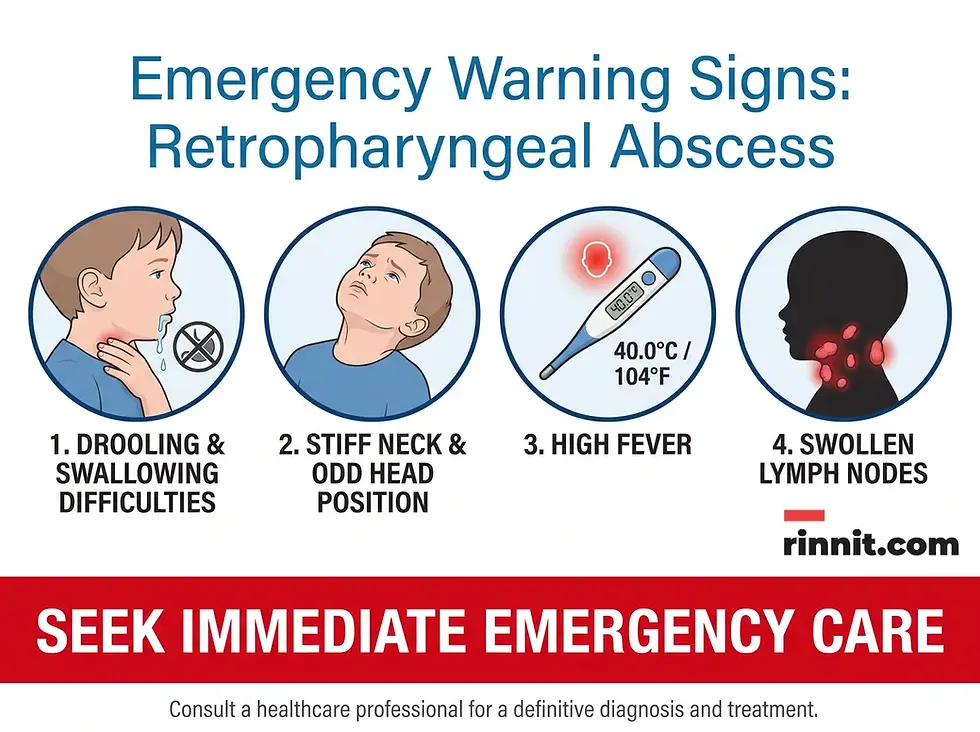
The most prominent sign of a retropharyngeal abscess is significant difficulty or pain when swallowing. Because the infection is located deep in the throat, it can cause the surrounding tissues to swell, leading to a variety of physical and behavioral changes. Children, in particular, may appear highly irritable or anxious and may drool excessively because they cannot swallow their saliva. [1]
Parents should also look for noisy breathing or a child positioning their head in an unusual way, which is often an instinctive attempt to keep the airway open. [1] Other common symptoms include a severe sore throat, fever, stiff neck, and swollen lymph nodes in the neck area. [1] In some cases, a severe headache or persistent coughing may also be present. [1]
What causes a retropharyngeal abscess and who is at risk?
The development of an abscess is usually a secondary event following a primary infection. In children, the most frequent triggers are common upper respiratory issues like strep throat, tonsillitis, or ear infections. [1] The bacteria responsible for these illnesses travel to the retropharyngeal lymph nodes, where they cause inflammation and the eventual collection of pus.
In adults, the causes are generally more traumatic. A puncture wound from a fish bone or other sharp food item can introduce bacteria directly into the deep tissues of the throat. [1] Furthermore, medical interventions such as intubation or dental surgery can occasionally lead to the formation of an abscess. [1] Over the last two decades, cases have seen a slight increase, possibly due to higher rates of tonsillitis or the prevalence of antibiotic-resistant bacteria like MRSA.
What are the possible complications and emergency risks of a retropharyngeal abscess?
A retropharyngeal abscess is considered a medical emergency primarily due to its location. If left untreated, the abscess can expand until it physically blocks the airway, making breathing impossible. [1] The infection also has the potential to spread to the blood, leading to septic shock, or to nearby organs such as the lungs, causing aspiration pneumonia. [1]
Other serious complications include the formation of blood clots in the major veins of the neck and inflammation in the chest cavity (mediastinitis). Because these risks are life-threatening, medical professionals emphasize that home treatment should never be attempted. [1] Prompt clinical evaluation is the only way to ensure the infection does not spread to the organs or blood.
How is a retropharyngeal abscess diagnosed?
When a retropharyngeal abscess is suspected, a healthcare provider, often an ear, nose, and throat (ENT) specialist, will perform a thorough physical examination. [1] To confirm the diagnosis and determine the exact size and location of the pus collection, imaging tests are required. A CT scan or an X-ray of the neck is typically the most effective way to visualize the abscess.
Blood tests are also a standard part of the diagnostic process. A complete blood count (CBC) can reveal high levels of white blood cells, which is a clear indicator of a severe infection. Additionally, a bacteria culture test may be performed to identify the specific strain of bacteria involved, allowing doctors to choose the most effective antibiotic treatment. [1]
How is a retropharyngeal abscess treated medically and surgically?
Treatment for a retropharyngeal abscess almost always requires a hospital stay. [1] The primary goal is to clear the infection and ensure the airway remains open. In many cases, surgical drainage is necessary. [1] During this procedure, a surgeon makes a small incision, either through the mouth or the neck, to allow the pus to escape while the patient is under general anesthesia.
Antibiotic therapy is the cornerstone of medical management. Initially, broad-spectrum antibiotics are administered through an IV to fight a wide range of bacteria. [1] Once the specific bacteria are identified through testing, the medication may be adjusted. [1] In some instances, corticosteroids are used to help reduce tissue inflammation, and IV fluids are provided to prevent dehydration. [1]
Treatment Component | Method | Purpose |
|---|---|---|
IV Antibiotics | Hospital administration | Kill bacteria and clear infection |
Surgical Drainage | Incision under anesthesia | Remove pus collection |
Oxygen Support | Mask or ventilation | Maintain open airway |
Corticosteroids | Medication | Reduce tissue swelling |

Conclusion and Next Steps
While a retropharyngeal abscess is a life-threatening condition, the outlook is excellent when medical care is sought promptly. Most patients recover fully once the infection is treated and the abscess is drained. However, it is vital to complete the full course of oral antibiotics even after being discharged from the hospital to prevent the infection from returning.
If you or your child experience severe throat pain, difficulty breathing, or an inability to swallow, seek emergency medical attention immediately. Early intervention is the most effective way to prevent serious complications and ensure a swift recovery.
Frequently Asked Questions
Can a retropharyngeal abscess be treated at home?
No. This is a medical emergency that requires hospitalization for IV antibiotics and potential surgical drainage to prevent airway blockage. [1]
Is a retropharyngeal abscess fatal?
A retropharyngeal abscess can be fatal if the airway becomes blocked or if the infection spreads to the blood or other organs, but it is highly curable with prompt medical treatment. [1]
What is the difference between this and a peritonsillar abscess?
A retropharyngeal abscess is deep in the back of the throat and more common in toddlers, while a peritonsillar abscess is near the tonsils and more common in older children and adults. [1]
How is the abscess drained?
A surgeon makes a small cut through the mouth or neck to drain the pus while the patient is under general anesthesia.
Will the abscess come back?
Recurrence happens in about 1% to 5% of cases. [1] Taking all prescribed antibiotics is the best way to reduce this risk.
What tests are used for diagnosis?
Doctors typically use a physical exam, blood tests (CBC), and imaging like a CT scan or X-ray to confirm the presence of the abscess. [1]
Are adults at risk for this condition?
Yes, though it is less common than in children. Adults usually develop it after an injury, such as swallowing a sharp object like a fish bone.
How long is the recovery?
With prompt treatment, the infection is typically cleared quickly, though oral antibiotics must be continued at home for the full duration prescribed.
Can MRSA cause a retropharyngeal abscess?
Yes, the rise in antibiotic-resistant bacteria like MRSA is one reason why cases have increased over the last 20 years.
References
Cleveland Clinic. Retropharyngeal Abscess. Cleveland Clinic. February 11, 2026. https://my.clevelandclinic.org/health/diseases/24026-retropharyngeal-abscess
Woods CR, Cash ED, Smith AM, et al. Retropharyngeal and parapharyngeal abscesses among children and adolescents in the United States: epidemiology and management trends, 2003-2012. Journal of the Pediatric Infectious Diseases Society. 2016;5(3):259-268. PMID 26407249. https://doi.org/10.1093/jpids/piv010
Wang X, Chen YC, Teng YS, et al. Corticosteroids in pediatric retropharyngeal and parapharyngeal abscesses: a systematic review. European Archives of Oto-Rhino-Laryngology. 2025;282(8):3825-3833. PMID 40053088. https://doi.org/10.1007/s00405-025-09265-4
Sheikh Z, Yu B, Heywood E, et al. The assessment and management of deep neck space infections in adults: a systematic review and qualitative evidence synthesis. Clinical Otolaryngology. 2023;48(4):540-562. PMID 37147934. https://doi.org/10.1111/coa.14064
Medical disclaimer
The information provided in this article is for educational purposes only and should not be used as a substitute for professional medical advice, diagnosis, or treatment. Always seek the advice of your physician or other qualified health provider with any questions you may have regarding a medical condition.



Comments