Understanding Redundant Prepuce: Risks and Correction

Updated: 2 days ago
Medically reviewed by Dr. Baraa Alnahhal, MD · Last reviewed: October 2026
Redundant prepuce refers to an excess amount of foreskin that completely covers the head of the penis when it is not erect. [1] This condition can lead to hygiene issues, infections, and long-term health risks if the skin cannot be fully withdrawn. While it sometimes occurs after an incomplete initial circumcision, it is highly correctable through a procedure known as circumcision revision. [1] It is best not to wait too long to correct it, particularly in children. [1]
Quick Answer
Redundant prepuce is a condition in which excess foreskin covers the head of the penis, often identified after an incomplete circumcision. If the extra skin cannot be fully retracted, it may cause smegma buildup, inflammation and a higher risk of urinary tract or sexually transmitted infections. The primary treatment is a circumcision revision, most often performed by a urologist. [1]
What the research says
Redundant foreskin is the most common reason for a revision, and results are usually good. In a review of 56 children who had a circumcision revision (aged 6 weeks to 11 years), redundant foreskin was the most common indication, the sleeve technique was used in 55 cases, all had a satisfactory cosmetic outcome, and one child needed a return to the operating room for bleeding (Brisson et al., Journal of Pediatric Surgery, 2002 [2]).
Foreskin status is linked to urinary tract infection risk in young infants. In a meta-analysis of 18 studies, 2.4% of febrile circumcised male infants under 3 months of age had a urinary tract infection, compared with 20.1% of uncircumcised infants (Shaikh et al., The Pediatric Infectious Disease Journal, 2008 [3]).
Childhood circumcision is linked to lower penile cancer risk, though the picture is nuanced. A meta-analysis of 8 studies found that circumcision in childhood or adolescence was associated with lower odds of invasive penile cancer (odds ratio 0.33, 95% CI 0.13 to 0.83; 3 studies), but the protective effect no longer held in two studies restricted to boys with no history of phimosis (Larke et al., Cancer Causes & Control, 2011 [4]).
What is a redundant prepuce?
Redundant prepuce is characterized by a surplus of foreskin that remains over the glans, or head, of the penis during its non-erect state. [1] While the presence of a foreskin is a natural anatomical feature, the term "redundant" applies when the volume of skin is excessive to the point of potentially interfering with hygiene or health. In many cases, this condition is identified following an initial circumcision where an insufficient amount of tissue was removed.
The condition creates a unique anatomical situation where the penis appears neither fully circumcised nor uncircumcised. [1] It is important to note that children do not "grow into" a longer-than-usual foreskin; rather, the anatomical disproportion typically persists or worsens without medical intervention. [1] For this reason, specialists often recommend addressing the issue early to avoid secondary complications. [1]
Feature | Description |
Primary Indicator | Excess skin covering the glans in a flaccid state. |
Secondary Indicator | Inability to fully withdraw or retract the foreskin. |
Common Origin | Incomplete initial circumcision (not enough foreskin removed). |
Specialist | Urologist (doctor who specializes in male reproductive organs). |
What health risks are linked to a redundant prepuce?
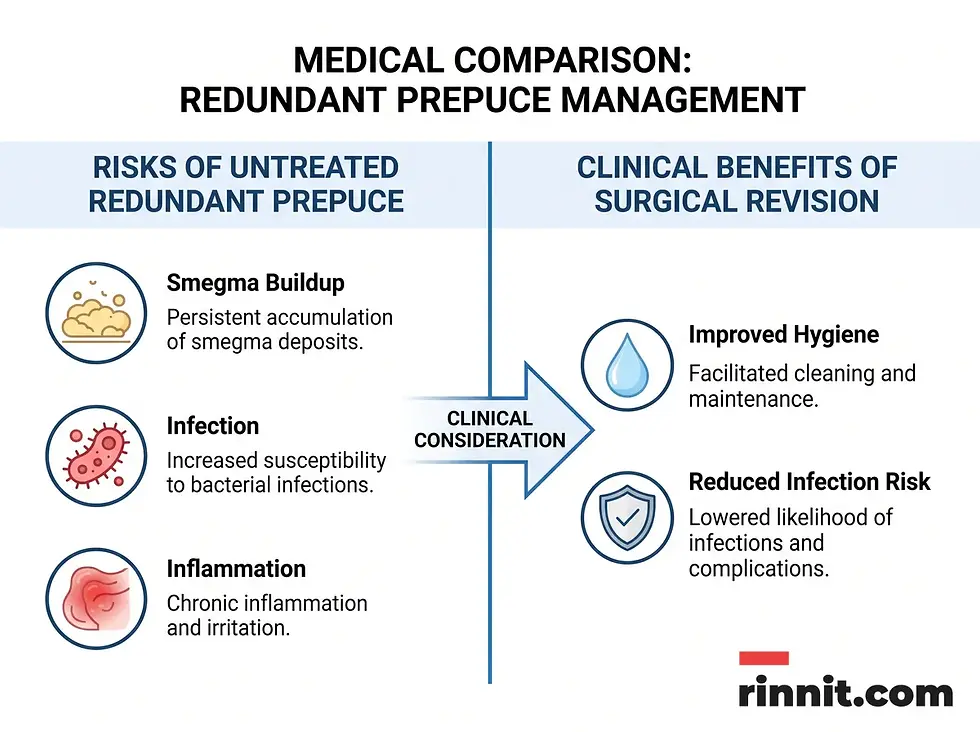
When the foreskin is redundant and difficult to retract, it creates an environment where moisture and biological materials can accumulate. This lack of accessibility for proper cleaning can lead to several distinct health challenges. Smegma, a natural lubricating substance, can build up and become a source of irritation or infection if not regularly removed.
Problems that can occur include:
Inflammation: Persistent irritation of the head of the penis and the inner foreskin. [1]
Infections: Urinary tract infections (UTIs) and sexually transmitted infections (STIs). [1]
Penile Cancer: Penile cancer is among the problems that can occur in uncircumcised males, which is one reason a second circumcision may be considered.

How is a redundant prepuce corrected with circumcision revision?
The standard treatment for redundant prepuce is a surgical procedure known as circumcision revision, or sometimes a "second circumcision." It is uncommon but sometimes necessary, and it is usually performed in a hospital setting, most often by a urologist, and general anesthesia is usually needed. [1] The goal is to remove the excess tissue and restore a healthy, functional anatomical state. The decision for revision is best made by the parents or the patient after a conversation with the surgeon. [1]
The most common method used by urologists is the sleeve surgical technique. [1] In this approach, the urologist removes the excess foreskin from its pulled-back position, ensuring that the remaining skin allows for proper hygiene and reduces the risk of future infections. The choice of technique may vary based on the patient's age and the specific reason for the revision. [1]
What is recovery like after redundant prepuce correction surgery?
Post-operative care is vital for ensuring successful healing after a circumcision revision. Surgeons typically use absorbable stitches that dissolve on their own, eliminating the need for a follow-up procedure to remove them. [1] The stitch line is covered with antibiotic ointment and a sterile dressing, which is generally left in place for 24 to 48 hours. [1]
Key elements of the recovery process include:
Ointment Application: Antibiotic ointment is used for the first 7 to 10 days to prevent the stitches from sticking to diapers or underwear. [1]
Hygiene Management: Careful monitoring of the surgical site to ensure it remains clean during the initial healing phase.
Prognosis: Circumcision revision is usually very successful, with patients experiencing improved hygiene and a reduction in infection risks.

Conclusion and Next Steps
Redundant prepuce is a manageable condition that, when addressed early, carries a very good prognosis. By undergoing a circumcision revision, individuals can address the hygiene challenges and infection risks associated with excess foreskin. If you or your child exhibit signs of redundant prepuce or have concerns following an initial circumcision, consulting a urologist is the first step toward a lasting solution.
Frequently Asked Questions
What causes redundant prepuce after circumcision?
Redundant prepuce often occurs when an insufficient amount of foreskin is removed during the initial circumcision procedure. This results in an unusual appearance where the penis is not fully circumcised, and the excess skin may still cover the glans. [1]
Can a child grow out of redundant prepuce?
No. Children do not "grow into" a longer-than-usual foreskin. If there is excess skin after a first circumcision, the problem typically persists or worsens over time, which is why it is best not to wait too long to correct it. [1]
What is a circumcision revision?
A circumcision revision, also known as a second circumcision, is a surgical procedure most often performed by a urologist to remove excess foreskin. It is used to correct a redundant prepuce and reduce associated health risks.
Is general anesthesia required for circumcision revision?
General anesthesia is usually needed, and the procedure is most often performed in a hospital to ensure it is safe and comfortable for the patient.
What are the risks of not treating redundant prepuce?
Untreated redundant prepuce can lead to a buildup of smegma, inflammation, and infections, including urinary tract and sexually transmitted infections. Penile cancer is also among the problems that can occur in uncircumcised males. [1]
What is the sleeve surgical technique?
The sleeve surgical technique is the most commonly used method for correcting redundant prepuce. [1] The urologist removes the excess foreskin from its pulled-back position.
Does redundant prepuce affect adults?
Yes. While often identified in childhood, redundant prepuce can affect males of any age. A man who is older may choose revision surgery to improve appearance or to lower the risk of problems such as infections.
Who should perform the revision surgery?
Circumcision revision is most often performed by a urologist, a medical doctor who specializes in treating the male reproductive organs and urinary system.
How should I clean a redundant foreskin?
Gently pull back the extra skin only as far as it moves easily, rinse with warm water and dry the area. Never force the skin back, and get medical care right away if it gets stuck behind the head of the penis.
Related Reading
References
Cleveland Clinic. Redundant Prepuce. Cleveland Clinic. December 8, 2020. https://my.clevelandclinic.org/health/diseases/16315-redundant-prepuce
Brisson PA, et al. Revision of circumcision in children: report of 56 cases. Journal of Pediatric Surgery. 2002;37(9):1343-1346. PMID 12194129. https://doi.org/10.1053/jpsu.2002.35005
Shaikh N, et al. Prevalence of urinary tract infection in childhood: a meta-analysis. The Pediatric Infectious Disease Journal. 2008;27(4):302-308. PMID 18316994. https://doi.org/10.1097/INF.0b013e31815e4122
Larke NL, et al. Male circumcision and penile cancer: a systematic review and meta-analysis. Cancer Causes & Control. 2011;22(8):1097-1110. PMID 21695385. https://doi.org/10.1007/s10552-011-9785-9
Medical disclaimer
The information provided in this article is for educational purposes only and should not be used as a substitute for professional medical advice, diagnosis, or treatment. Always seek the advice of your physician or other qualified health provider with any questions you may have regarding a medical condition.



Comments