Understanding Pseudobulbar Affect (PBA): Symptoms and Care

Updated: 2 days ago
Medically reviewed by Dr. Baraa Alnahhal, MD · Last reviewed: October 2026
Quick Answer: What Is Pseudobulbar Affect (PBA)?
Pseudobulbar affect (PBA) is a neurological condition that causes sudden, involuntary outbursts of laughing or crying that do not match inner feelings. It is thought to result from disrupted brain pathways controlling emotional expression, usually after brain injury or with conditions such as ALS or multiple sclerosis. It can cause embarrassment but is manageable with medication and coping strategies. [1]
What the research says
PBA is common in several neurodegenerative diseases. A meta-analysis estimated pooled PBA prevalence at 38.5% in ALS (95% CI 31 to 45%), 23.3% in multiple sclerosis, 16.4% in Alzheimer's disease, and 16.5% in Parkinson's disease, with high heterogeneity between studies for all but ALS (Nabizadeh et al., J Clin Neurosci, 2022).
Evidence for drug treatment after brain injury is limited but encouraging. A systematic review of pharmacotherapy for PBA after traumatic brain injury found two uncontrolled studies of dextromethorphan/quinidine (87 patients followed for 3 months and 23 for 12 months) reporting reduced symptoms and a positive safety profile, although both lacked a control group and had high dropout (Hicks et al., Neuropsychol Rev, 2020).
PBA is easily missed. An overview notes that PBA can be hard to tell apart from mood disorders, which contributes to a high rate of misdiagnosis, and that lack of recognition leads to ineffective or insufficient treatment and reduced quality of life (Goldin, J Psychosoc Nurs Ment Health Serv, 2020).
Research summaries are based on article abstracts retrieved from PubMed.
What Is Pseudobulbar Affect?
Pseudobulbar affect (PBA) is a neurological condition that disrupts how the brain expresses emotion. It causes sudden, unpredictable episodes of laughing or crying that can be intense and hard to restrain. These outbursts do not match your internal emotional state, so a person might cry uncontrollably while feeling fine, or laugh in a sad situation. Episodes can also be more intense and last longer than expected even when they seem to fit the trigger. [1]
PBA is best classified as a neuropsychiatric syndrome rather than a mental illness, because it results from damaged neurological circuitry. Researchers estimate that 2 million to 7 million people in the United States have PBA, and it affects both children and adults who have an underlying neurological condition. Because it can be embarrassing and cause anxiety, many people with PBA withdraw from others and become isolated. [1]
Aspect | Description |
Other Names | Emotional lability, pathological laughing and crying, involuntary emotional expression disorder, emotional incontinence. |
Core Symptom | Involuntary laughing or crying that does not match the inner mood. |
Brain Impact | Disruption of pathways that regulate emotional expression, likely involving the cerebellum. |
Prevalence | An estimated 2 million to 7 million people in the U.S. |

What are the symptoms of pseudobulbar affect (PBA) and how is it different?
The main symptom of pseudobulbar affect is crying or laughing that does not match your mood or its intensity, so it helps to separate mood from affect. Mood is your inner feeling, such as sadness or happiness. Affect is the visible display of emotion, such as laughing or crying. The main symptom of PBA is an affect, most often crying or laughing, that does not match your mood or its intensity. The episodes can be unpredictable, sudden, and involuntary, out of proportion to the trigger, or happen for no apparent reason. Involuntary outbursts of anger or frustration may also occur. [1]
Because PBA usually occurs alongside another neurological condition, people will also have symptoms of that underlying condition.
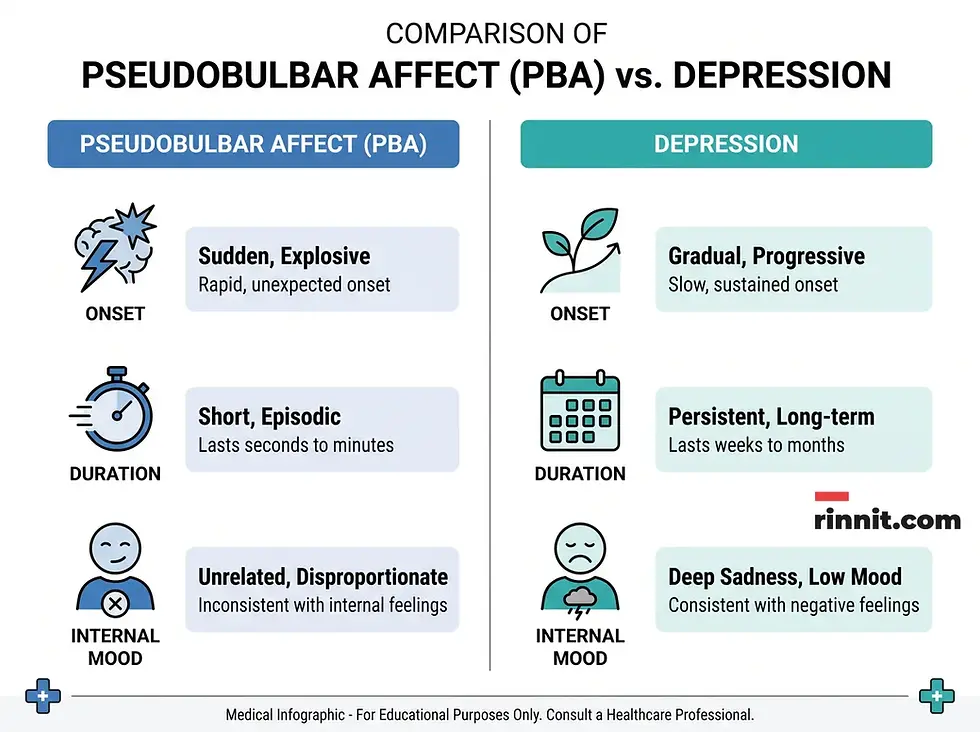
Condition | Typical Duration | Onset | Internal Sadness |
PBA | Short outbursts. | Explosive and sudden. | Usually absent or unrelated. |
Depression | Persistent and long-lasting. | Gradual or sustained. | Deep and longstanding. |
People with depression have a persistent low mood but do not tend to have frequent crying episodes, and when they do, the episodes last much longer than in PBA. Depression also brings other symptoms, such as sleep disturbances or eating changes, which do not occur in PBA. Some people can have both conditions. [1]
What causes pseudobulbar affect and which conditions are linked to it?
Researchers do not know the exact cause of PBA. They think it results from disruption of the brain pathways that regulate emotional expression, likely along a cerebro-ponto-cerebellar pathway. The cerebellum plays a key role in monitoring emotional responses and making sure they fit the social situation, and disrupting the nerve pathways that lead to it may cause a loss of control over emotional expression. Several neurotransmitters, including serotonin, norepinephrine, dopamine, glutamate, and acetylcholine, may also play a role. [1]
Several neurological conditions are associated with PBA:
Neurodegenerative diseases: Studies estimate that PBA affects up to 50% of people with ALS and up to 46% of people with multiple sclerosis. It is also associated with Alzheimer's disease and other dementias and with Parkinson's disease.
Brain injury: Up to 48% of people with a traumatic brain injury are estimated to be affected.
Other conditions: Stroke, brain tumors, epilepsy, and Wilson's disease.
How is pseudobulbar affect diagnosed?
PBA can be hard to diagnose, and providers often mistake it for a mood disorder, especially depression or bipolar disorder. There is no definitive test, so the diagnosis rests on your symptoms, your medical history (especially neurological conditions), your mental health history, and a physical exam. [1]
How is pseudobulbar affect managed, and what coping strategies help?
Pseudobulbar affect has no cure, but medication and practical coping techniques can help people manage it. The goal of treatment is to reduce how often and how severe the episodes of laughing or crying are. All medications have possible side effects, so you will work with your provider to choose the best plan. [1]
Medical Treatment
Dextromethorphan/quinidine sulfate (Nuedexta): The FDA has approved this combination as the first drug specifically developed to treat PBA.
Antidepressants: Tricyclic antidepressants, SSRIs, and norepinephrine/serotonin reuptake inhibitors may help manage symptoms, typically at lower doses than are used to treat depression.
Coping Techniques
Breathing: Take slow, deep breaths until the episode passes.
Distraction: Think about or focus on something else during an episode.
Physical adjustments: Relax your shoulders and facial muscles, or change your body position if you can.
Education: Tell family, friends, and caregivers about your condition so they know what to expect.
Professional support: See a mental health professional if PBA is affecting your mental health.

What is the outlook for pseudobulbar affect?
PBA is usually chronic, because the conditions that cause it are often chronic. Left undiagnosed and untreated, it raises the risk of depression, anxiety, impaired social interaction, and lower quality of life. Getting a diagnosis and treatment can be difficult, so it is important to keep advocating for yourself. Neuropsychologists, neurologists, and psychiatrists are the providers who may know the most about the condition. If your treatment is not working or you have unpleasant side effects, talk to your provider about a new plan. [1]
Conclusion and Next Steps
Pseudobulbar affect can affect your social life and well-being, but you do not have to face it alone. PBA is a medical condition caused by damaged brain circuitry, not a personal weakness, and understanding that is an important first step for patients and families. If you or a loved one has uncontrolled emotional episodes, talk to a healthcare provider such as a neurologist or neuropsychologist. With the right combination of medication and coping strategies, many people are able to manage their symptoms and improve their daily lives. [1]
Frequently Asked Questions
Is PBA a mental illness?
No. PBA is best classified as a neuropsychiatric syndrome, meaning a brain condition accompanied by dysfunctional emotional expression, caused by damaged neurological circuitry.
How is PBA different from depression?
PBA episodes are explosive, short, and usually not linked to longstanding internal sadness, whereas depression involves a persistent low mood. Other depression symptoms, such as sleep disturbances or eating changes, do not occur in PBA.
What medication is approved for PBA?
Nuedexta, a combination of dextromethorphan and a very low dose of quinidine sulfate, is the first drug specifically developed and FDA-approved to treat PBA. Some antidepressants may also help.
Can brain injuries cause PBA?
Yes. Traumatic brain injury is one of the associated conditions, and studies estimate that PBA affects up to 48% of people with a traumatic brain injury.
Does PBA ever go away?
PBA is usually chronic, because the underlying conditions that cause it, such as multiple sclerosis or Alzheimer's disease, are often chronic. Medication can help manage the symptoms.
Can children have PBA?
Yes. PBA affects children and adults who have an underlying neurological condition.
What part of the brain is involved?
PBA likely affects regions along a cerebro-ponto-cerebellar pathway, including the cerebellum, which helps ensure emotional responses fit the social situation.
What should I do during an episode?
Taking slow, deep breaths, focusing on something else, relaxing your shoulders and face, or changing your body position can help an episode pass.
Why is PBA often misdiagnosed?
There is no definitive test, and because the main symptoms are laughing and crying, it is often mistaken for a mood disorder such as depression or bipolar disorder.
How many people have PBA?
Researchers estimate that 2 million to 7 million people in the United States have PBA. The range is wide because severity varies and the condition is often misdiagnosed.
References
Cleveland Clinic. Pseudobulbar affect (PBA). Cleveland Clinic. Last updated October 11, 2022. https://my.clevelandclinic.org/health/diseases/17928-pseudobulbar-affect-pba
Nabizadeh F, Nikfarjam M, Azami M, et al. Pseudobulbar affect in neurodegenerative diseases: a systematic review and meta-analysis. J Clin Neurosci. 2022;100:100-107. PMID: 35436682. DOI: https://doi.org/10.1016/j.jocn.2022.04.009
Hicks AJ, Clay FJ, Ponsford JL, et al. Pharmacotherapy for the pseudobulbar affect in individuals who have sustained a traumatic brain injury: a systematic review. Neuropsychol Rev. 2020;30(1):28-50. PMID: 31942705. DOI: https://doi.org/10.1007/s11065-020-09427-7
Goldin DS. Pseudobulbar affect: an overview. J Psychosoc Nurs Ment Health Serv. 2020;58(9):19-24. PMID: 32609863. DOI: https://doi.org/10.3928/02793695-20200624-08
Medical disclaimer
This article is for informational purposes only and is not a substitute for professional medical advice, diagnosis, or treatment. Always seek the advice of your physician or other qualified health provider with any questions you may have about a medical condition.



Comments