Understanding Prune Belly Syndrome: Symptoms, Causes, and Care

Updated: 3 days ago
Medically reviewed by Dr. Baraa Alnahhal, MD · Last reviewed: October 2026
Quick Answer: What Is Prune Belly Syndrome?
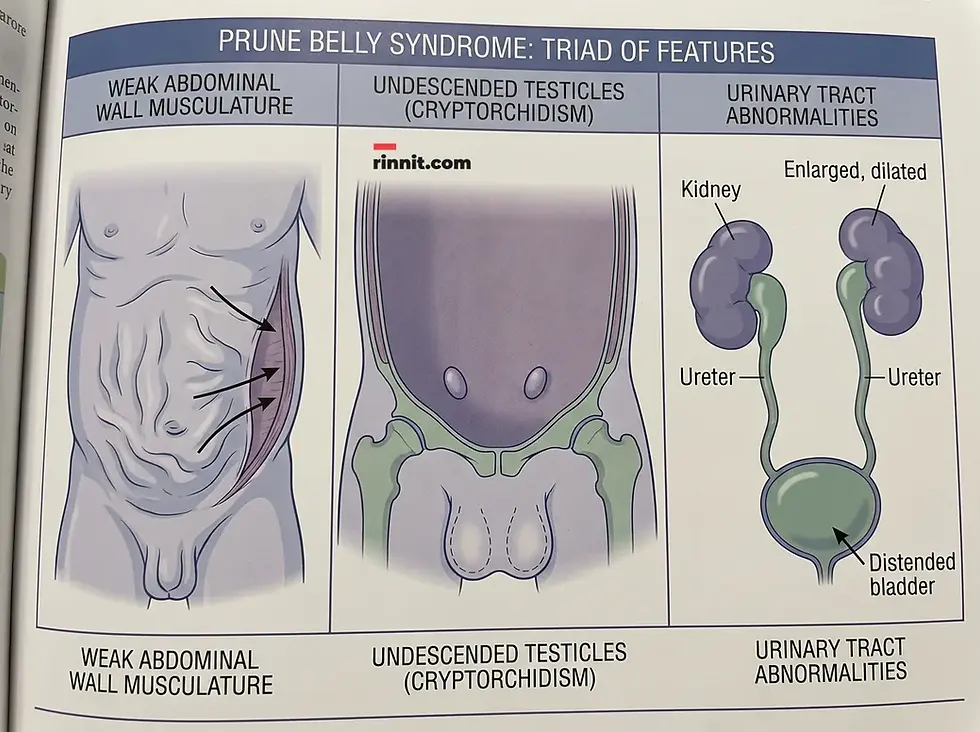
Prune belly syndrome, also called triad syndrome or Eagle-Barrett syndrome, is a rare congenital condition that mostly affects baby boys. Its three main features are weak or absent abdominal muscles that leave the belly skin wrinkled, undescended testicles and urinary system problems. Outcomes vary widely, and most people need lifelong monitoring of kidney and bladder function. [1]
What the research says
Kidney disease is a major long-term issue, and estimates vary widely. A scoping review of 25 studies found that the estimated prevalence of chronic kidney disease in prune belly syndrome ranged from 8% to 66% across 17 studies (441 patients). Age at kidney replacement therapy ranged from 4 to 21 years, and graft survival ranged from 22% to 87%, and the authors noted that the variability limits firm conclusions (Khondker et al., Pediatr Nephrol, 2024).
Urinary problems and surgery are common. In a 20-year single-center review of 64 patients (61 male, 3 female) followed for a median of 12.6 years, hydronephrosis occurred in 87.5%, vesicoureteral reflux in 73.4%, and recurrent UTIs in 76.6%. Orchidopexy was performed in 83.6% and abdominal wall reconstruction in 45.3%, chronic kidney disease developed in 48.4%, and 17.2% needed a kidney transplant (Chu et al., J Pediatr Urol, 2026).
Prenatal ultrasound alone often cannot confirm the diagnosis. A systematic review of fetal megacystis (an enlarged fetal bladder) found that prune belly syndrome accounted for about 4% of cases, with posterior urethral valves the most common cause (57%), and that ultrasound alone is often insufficient for a definitive diagnosis (Taghavi et al., J Pediatr Urol, 2017).
Research summaries are based on article abstracts retrieved from PubMed.
What Is Prune Belly Syndrome?
Prune belly syndrome is a rare congenital condition named for the wrinkled, prune-like look of a baby's abdomen. This is caused by weak or absent abdominal wall muscles. Beyond the visible changes in the abdomen, the syndrome is defined by a "triad" of features: undescended testicles in males and problems with how the urinary system (the kidneys and bladder) formed. It can also affect the heart, lungs, intestines, and skeletal system. [1]
The condition is rare, affecting about 1 in every 30,000 to 40,000 newborns. It mostly occurs in male babies, who make up about 95% of cases. [1]
Feature | Description |
Abdominal Muscles | Weak or absent, leading to wrinkled belly skin. |
Testicles | Do not descend from the abdomen into the scrotum. |
Urinary System | Structural problems with the kidneys, bladder, and ureters. |
What are the symptoms and causes of prune belly syndrome?
Prune belly syndrome has more than 50 recorded signs, and symptoms vary from baby to baby. The most prominent sign is a large, wrinkled abdomen, where loops of intestine may be visible through the thin skin. Infants often also have urinary tract problems, such as enlarged or blocked ureters, an enlarged kidney, an enlarged bladder, or vesicoureteral reflux (urine flowing backward up the urinary tract). Other possible problems include stomach and intestinal issues, heart structure problems, and musculoskeletal conditions such as scoliosis and clubfoot. [1]
Researchers do not know the exact cause but have several theories. One is that a bladder abnormality during fetal development lets urine build up and swell the bladder, ureters, and kidneys, and that the enlarging bladder causes the abdominal muscles to waste away (atrophy). Another is that the abdominal muscles do not develop completely. Because the syndrome has been seen in siblings, it may be genetic in some cases, and it also occurs in some children with trisomy 18 (Edwards syndrome) and trisomy 21 (Down syndrome). [1]

Possible Complications
Complications depend on which body systems are involved. The most common are: [1]
Constipation.
Bone deformities, such as dislocated hips or missing arms, fingers, or toes.
Urinary tract diseases and chronic kidney failure.
Underdeveloped lungs (pulmonary hypoplasia).
Infertility or cancer related to undescended testicles.
How is prune belly syndrome diagnosed?
A healthcare provider may find prune belly syndrome during a fetal ultrasound in pregnancy, which can also show a swollen bladder, an enlarged kidney, heart problems, underdeveloped lungs, or abnormal bones, muscles, stomach, or intestines. After birth, a provider can usually recognize the condition by examining the baby. [1]
To see how much the condition affects internal organs, the provider may request tests after birth:
Imaging studies: Ultrasound, X-ray, CT scan, or MRI.
Voiding cystourethrogram (VCUG): An X-ray test that shows how the bladder and urethra work during urination.
Blood tests: Used to confirm the condition and check kidney function.
How is prune belly syndrome managed and treated?
Treatment is tailored to each baby and usually involves a team of specialists, depending on which organs are affected. The team considers the baby's overall health and age, the extent of the medical problems, how well the baby can tolerate procedures, the outlook, and the parents' wishes. In the mildest cases, a baby may only need antibiotics to treat or prevent urinary tract symptoms. [1]
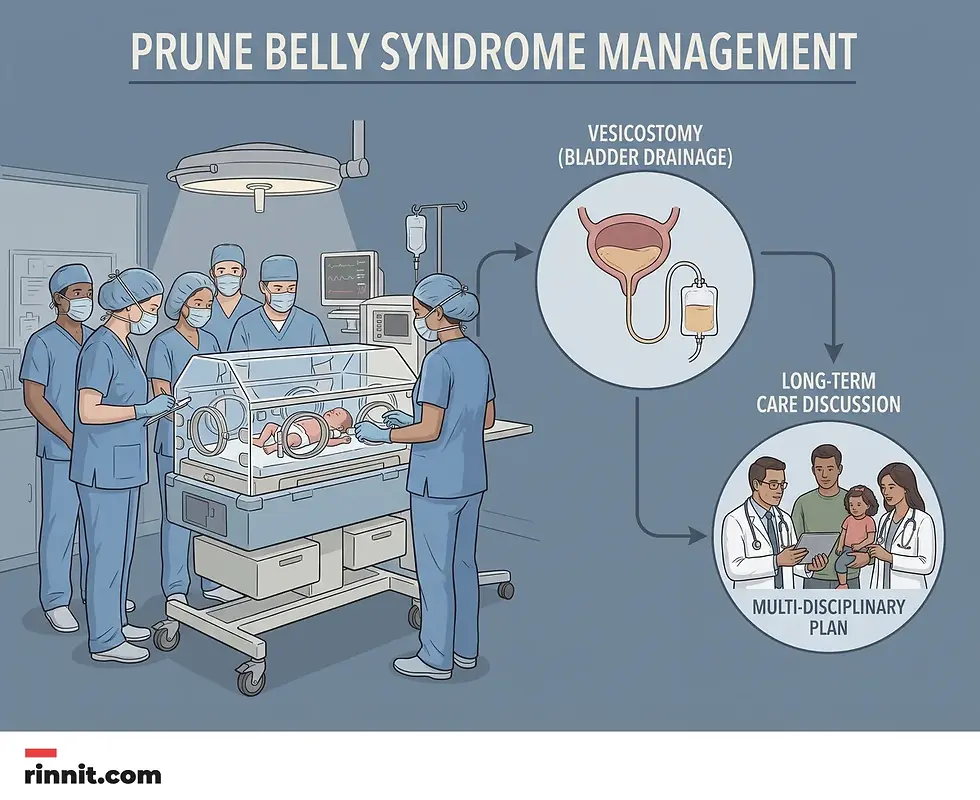
Most babies need several surgeries to repair the abdominal wall, genitals, bladder, and other urinary tract organs. Procedures may include: [1]
Vesicostomy: A small opening is made in the bladder through the abdomen so urine can drain.
Orchiopexy: A procedure that helps the testicles descend into the scrotum.
Cystoplasty: A more advanced procedure that involves complete bladder reconstruction.
Abdominal wall repair: Surgery to reconstruct the abdominal wall.
In some cases a child may also need a kidney transplant.
What is the outlook for prune belly syndrome?
The outlook depends on how severe the condition is. Sadly, 10% to 25% of infants are stillborn or die within the first few weeks of life from complications. About 40% of children have normal kidney function despite other mild urinary tract problems and can grow up to lead fairly normal lives. Some children have medical problems throughout life, and about 30% of those need a kidney transplant at some point. People with prune belly syndrome need lifelong follow-up to check the urinary system and reduce the chance of kidney damage. [1]
Conclusion and Next Steps
Prune belly syndrome is a complex condition that needs lifelong care and monitoring. A diagnosis can feel overwhelming for families, but with specialized care many children do well. Find a healthcare provider who is familiar with the condition, see them at least once a year, and call right away at the first sign of a urinary tract infection. It can also help to connect with other families, for example through the Prune Belly Syndrome Network. [1]
Frequently Asked Questions
Is prune belly syndrome genetic?
The exact cause is unknown, but it has been seen in siblings, which may mean it is genetic in some cases.
Can girls have prune belly syndrome?
Prune belly syndrome mostly affects boys, who make up about 95% of cases, so it is much less common in girls.
What is the life expectancy for children with this condition?
It depends on the severity. Between 10% and 25% of infants are stillborn or die within the first few weeks of life from complications, while others grow up and lead fairly normal lives.
Will my child need a kidney transplant?
Not necessarily. About 40% of children have normal kidney function despite other urinary tract problems. Among children who have medical problems throughout life, about 30% need a kidney transplant at some point.
What is another name for this syndrome?
Prune belly syndrome is also known as triad syndrome or Eagle-Barrett syndrome.
How common is prune belly syndrome?
Prune belly syndrome affects about 1 in every 30,000 to 40,000 newborn babies.
What are the main complications?
Common complications include constipation, bone deformities, urinary tract diseases, underdeveloped lungs, chronic kidney failure, and infertility or cancer related to undescended testicles.
Can it be diagnosed before birth?
Yes, it may be found on a fetal ultrasound, which can show signs such as a swollen bladder or an enlarged kidney.
What is a vesicostomy?
A vesicostomy is a surgical procedure that makes a small opening in the bladder through the abdomen so urine can drain.
Why are UTIs a major concern?
Urinary tract infections are especially harmful for people with prune belly syndrome, so call your child's healthcare provider at the first sign of one, such as fever, chills, burning with urination, or cloudy or bloody urine.
References
Cleveland Clinic. Prune belly syndrome. Cleveland Clinic. Last updated September 17, 2024. https://my.clevelandclinic.org/health/diseases/16231-prune-belly-syndrome
Khondker A, Ahmad I, Kim K, et al. Kidney function and transplants in prune belly syndrome: a scoping review. Pediatr Nephrol. 2024;39(4):1053-1063. PMID: 37968538. DOI: https://doi.org/10.1007/s00467-023-06209-0
Chu E, Press B, Weinstein C, et al. Clinical manifestations and management of prune-belly syndrome: a 20-year single center experience. J Pediatr Urol. 2026;22(3):105806. PMID: 41719823. DOI: https://doi.org/10.1016/j.jpurol.2026.105806
Taghavi K, Sharpe C, Stringer MD. Fetal megacystis: a systematic review. J Pediatr Urol. 2017;13(1):7-15. PMID: 27889224. DOI: https://doi.org/10.1016/j.jpurol.2016.09.003
Medical disclaimer
This article is for informational purposes only and is not a substitute for professional medical advice, diagnosis, or treatment. Always seek the advice of your physician or other qualified health provider with any questions you may have about a medical condition.



Comments