Understanding Presyncope: Causes, Symptoms, and Prevention Strategies

Updated: 2 days ago
Medically reviewed by Dr. Baraa Alnahhal, MD · Last reviewed: October 2026
Presyncope is the sensation of nearly fainting without losing consciousness. Typical symptoms are lightheadedness, weakness, sweating, and blurred vision. It is caused by reduced blood flow to the brain, often triggered by dehydration, anxiety, or heart problems. Treatment targets the underlying cause, and quick self-care such as sitting or lying down can help during an episode.
Quick Answer
Presyncope, also called near syncope, is a common condition in which you feel about to faint but stay conscious. Episodes usually last a few seconds to several minutes and are mainly caused by a temporary drop in blood flow to the brain. It can sometimes point to a serious heart or circulation problem, so medical evaluation is important. [1]
What the research says
About 1 in 10 emergency patients with syncope have a serious cause. A systematic review and meta-analysis of 31 studies evaluating 13 clinical decision rules noted that approximately 10% of emergency department patients with syncope have serious or life-threatening causes that may not be apparent at first assessment, and that most decision rules rest on low-quality evidence (Wakai et al., Acad Emerg Med, 2025).
Abnormal heart rhythm is the most common cause of missed serious outcomes. In 12 studies of 5,316 patients, 596 (11%) had a serious short-term outcome; the San Francisco Syncope Rule had a pooled sensitivity of 0.87 (95% CI 0.79–0.93) and specificity of 0.52 (0.43–0.62), and the most common reason for a false-negative result was cardiac arrhythmia (Saccilotto et al., CMAJ, 2011).
Clinical judgment remains essential. In an individual patient data meta-analysis of 3,681 patients, none of the three risk tools evaluated (OESIL, San Francisco Syncope Rule, EGSYS) performed better than clinical judgment at identifying serious outcomes (Costantino et al., Am J Med, 2014).
Research summaries are based on article abstracts retrieved from PubMed. These studies enrolled patients with syncope (fainting), which is closely related to presyncope.
What Is Presyncope?
Presyncope is the medical term for the sensation of being on the verge of fainting while remaining fully conscious. Healthcare providers often call it "near syncope," where syncope is the clinical term for a complete loss of consciousness, or fainting. An episode can last from a few seconds to several minutes, and although it may not lead to a fall, it is often unsettling and deserves attention. [1]
For most people, presyncope is a minor event. For a small percentage, it can be a warning sign of a more serious outcome. How serious it is depends largely on the underlying cause, which can range from simple dehydration to complex heart conditions.
Feature | Presyncope (Near Syncope) | Syncope (Fainting) |
Consciousness | Maintained throughout the episode | Complete, temporary loss of consciousness |
Duration | Seconds to a few minutes | Typically brief, followed by rapid recovery |
Primary sensation | Feeling like you are about to pass out | Actual loss of postural tone and consciousness |
What are the symptoms of presyncope?
Presyncope symptoms vary from person to person. Recognizing them early lets you act quickly to prevent a fall or a full loss of consciousness.
Presyncope can be unsettling, but you can take charge of it by finding the cause and getting treated. [1]
Common symptoms during an episode include:
Neurological and visual: Lightheadedness, blurred vision, or seeing black spots.
Physical weakness: A sudden feeling of weakness or instability.
Autonomic responses: Sweatiness, an upset stomach (nausea), and heart palpitations.
Localized discomfort: Pain in the abdomen or belly area.

What causes presyncope and who is at risk?
The basic cause of presyncope is a temporary lack of enough blood flow to the brain. If blood flow is cut off for even six to eight seconds, a person will usually lose consciousness. Presyncope happens when flow is reduced but not stopped completely. [1]
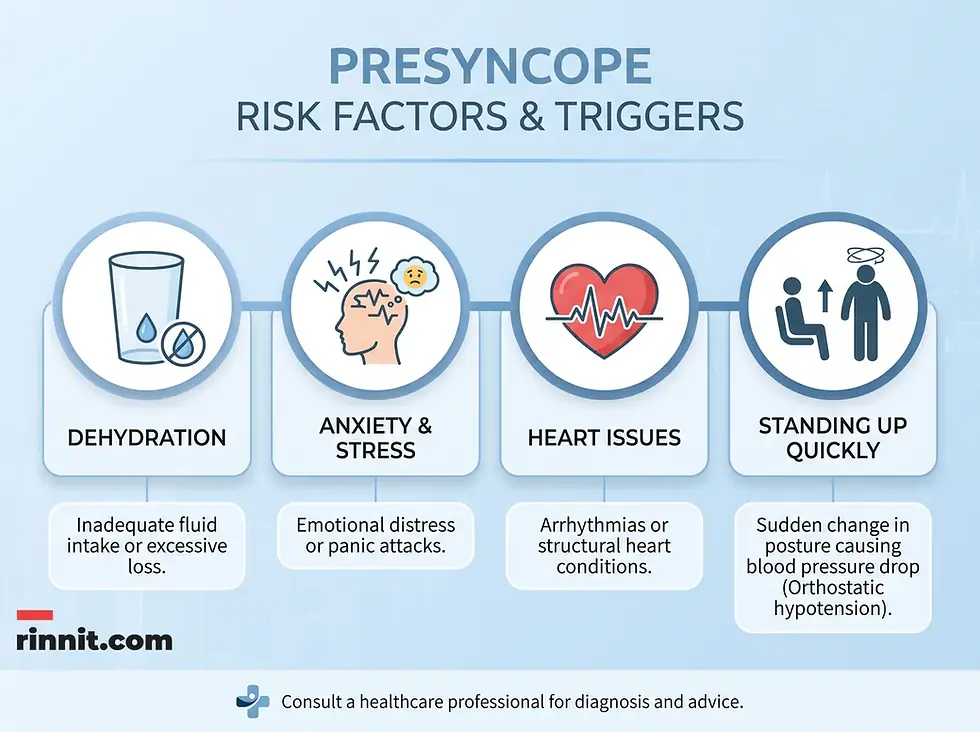
Category | Potential Causes |
Reflexive / triggers | Pain, anxiety, fear, or witnessing upsetting events |
Circulatory | Orthostatic hypotension (a drop in blood pressure when standing), dehydration, and postural orthostatic tachycardia syndrome (POTS) |
Cardiac issues | Arrhythmias, heart valve disease, heart attack, and heart failure |
Other medical | Anemia, sepsis, pulmonary embolism, and certain medications |
Several risk factors raise the chance of presyncope, including high blood pressure, diabetes, tobacco use, and a personal history of near-fainting. It is also reported more often in females. [1]
How is presyncope diagnosed?
Finding the root cause of presyncope takes a thorough evaluation by a healthcare provider. It usually begins with a detailed medical history and a physical exam. Providers often ask what you were doing before the episode and whether heart problems or fainting run in your family.
Specialized tests may be ordered to check heart health and circulation:
Cardiac monitoring: An electrocardiogram (EKG), Holter monitor, or Zio patch to track heart rhythm.
Stress and position testing: Exercise stress tests and tilt table tests to see how the body responds to exertion or a change in posture.
Imaging and blood work: An echocardiogram to view the heart, CT scans of the head, and blood tests for glucose and anemia (hematocrit). [1]
How can presyncope be managed and prevented?
Treatment is individualized and depends entirely on the cause found during diagnosis. For immediate relief during an episode, sit or lie down right away. Muscle-tensing techniques, such as clenching your fists or crossing your legs, can also help maintain blood pressure and prevent fainting.

Long-term management and prevention strategies include:
Hydration and nutrition: Drinking plenty of fluids, especially before vaccinations or blood donations, and eating smaller, more frequent meals.
Behavioral adjustments: Standing up slowly from a sitting or lying position and avoiding known triggers such as hot, crowded places.
Medical intervention: When a serious heart condition is the cause, treatment may include medications (such as blood thinners or antibiotics), pacemakers, or surgery to repair heart valves.
Conclusion and Next Steps
Presyncope is often a temporary and minor event, but it should not be ignored, especially if it happens often or comes with other concerning symptoms such as chest pain or shortness of breath. If you have an episode of near-fainting, follow up with a primary care provider to rule out serious underlying conditions. Call 911 or get emergency care right away if near-fainting comes with chest pain, shortness of breath, a racing or irregular heartbeat, or a sudden severe headache. By identifying triggers and following a professional management plan, most people can prevent future episodes and carry on with daily life safely.
Frequently Asked Questions
What is the difference between presyncope and syncope?
Presyncope is the feeling that you are about to faint while remaining conscious, whereas syncope is the actual loss of consciousness. [1]
Can dehydration cause me to feel like I'm going to faint?
Yes, dehydration is a common cause of orthostatic hypotension, which can lead to presyncope. [1]
Should I see a doctor after a single episode of near-fainting?
Yes, it is recommended to follow up with a healthcare provider to determine the cause and ensure there are no serious underlying issues. [1]
What should I do if I feel like I'm about to faint?
You should immediately sit or lie down, clench your fists, or cross your legs to help maintain blood flow to the brain. [1]
Are there certain medications that cause presyncope?
Yes, medications for high blood pressure and certain heart issues can sometimes cause near-fainting as a side effect. [1]
Is presyncope more common in certain groups?
Risk factors include high blood pressure, diabetes, tobacco use, and a history of the condition. It is also more common in females. [1]
What are the predictors of a serious outcome in presyncope?
Serious outcomes are more likely if there is heart failure, shortness of breath, low systolic blood pressure (below 90 mmHg), or abnormal EKG results. [1]
Can anxiety trigger an episode?
Yes, emotional triggers like anxiety, fear, or pain are known causes of presyncope. [1]
How long does a typical episode last?
An episode can last from a few seconds to a few minutes. [1]
Can standing up too fast cause presyncope?
Yes, standing up slowly is a recommended prevention strategy for those prone to orthostatic hypotension. [1]
References
Cleveland Clinic. Presyncope. Cleveland Clinic Health Library. Accessed October 11, 2026. https://my.clevelandclinic.org/health/diseases/presyncope
Wakai A, Sinert R, Zehtabchi S, et al. Risk-stratification tools for emergency department patients with syncope: A systematic review and meta-analysis of direct evidence for SAEM GRACE. Acad Emerg Med. 2025;32(1):72-86. PMID: 39496561. https://doi.org/10.1111/acem.15041
Saccilotto RT, Nickel CH, Bucher HC, et al. San Francisco Syncope Rule to predict short-term serious outcomes: a systematic review. CMAJ. 2011;183(15):E1116-E1126. PMID: 21948723. https://doi.org/10.1503/cmaj.101326
Costantino G, Casazza G, Reed M, et al. Syncope risk stratification tools vs clinical judgment: an individual patient data meta-analysis. Am J Med. 2014;127(11):1126.e13-1126.e25. PMID: 24862309. https://doi.org/10.1016/j.amjmed.2014.05.022
Medical disclaimer
This article is for informational purposes only and is not a substitute for professional medical advice, diagnosis, or treatment. Always seek the advice of your physician or other qualified health provider with any questions you may have about a medical condition.



Comments