Understanding Polidocanol Injection: Treatment for Varicose Veins

Updated: 2 days ago
Medically reviewed by Dr. Baraa Alnahhal, MD · Last reviewed: October 2026
Polidocanol is an injectable medication used to treat varicose veins by reducing their size. The treatment is delivered by injection into a vein in a clinical or hospital setting. Post-treatment care involves wearing compression stockings and avoiding certain activities for 2 to 3 days, and patients must be monitored for allergic reactions, blood clots, and rare cardiovascular events.
Quick Answer
Polidocanol is an injectable medication used mainly to treat varicose veins by making the targeted, enlarged veins shrink, improving their appearance and symptoms. It is given by healthcare professionals in a hospital or clinic, and afterward patients wear compression stockings and limit certain activities. It is generally well tolerated, but risks include blood clots and allergic reactions. [1]
What the research says
Polidocanol microfoam did not close veins better than physician-compounded foam in randomized trials. A systematic review and network meta-analysis of 6 randomized trials with 1,726 patients found no significant difference in occlusion between Varithena (polidocanol endovenous microfoam) and physician-compounded foam (risk ratio 1.12, 95% CI 0.93 to 1.35), with similar rates of adverse events. Surgery and endovenous laser ablation had higher occlusion rates than foam sclerotherapy (Chen et al., J Vasc Surg Venous Lymphat Disord, 2026).
Blood clots in the deep veins can follow treatment, and a short course of a blood thinner lowered them in one trial. In a randomized trial of 304 limbs in 257 patients treated with polidocanol microfoam, deep vein thrombosis occurred in 16.7% with compression alone and 14.7% with compression plus deep-vein flushing, versus 1.98% when 5 days of apixaban were added. This is why post-treatment monitoring matters, and any blood thinner decision belongs to your care team (Yang et al., J Vasc Surg Venous Lymphat Disord, 2023).
Research summaries are based on article abstracts retrieved from PubMed.
How does polidocanol injection work for varicose veins?
Polidocanol is a sclerosing agent that is injected directly into the affected vein. Once inside, it causes the lining of the blood vessel to become irritated and eventually collapse. Over time, the body naturally absorbs the treated vein, redirecting blood flow to healthier vessels. [1]
Because this treatment is highly localized, interactions with other medications are generally not expected. However, it is still vital for patients to provide their care team with a full list of current medications and supplements before the procedure. [1]

What should you consider before polidocanol injection treatment?
Before receiving polidocanol, a thorough review of the patient's medical history is required. Certain pre-existing conditions can influence the safety and effectiveness of the treatment. [1]
Health Factor | Clinical Significance |
Vessel Conditions | History of blood clots or recent surgery must be reported |
Allergy History | Previous reactions to polidocanol or preservatives are critical |
Pregnancy Status | Patients should report if they are pregnant or trying to conceive |
Breastfeeding | Important for the care team to know before administration |
Healthcare providers will use this information to determine if polidocanol is the most appropriate option for the patient's specific venous condition. [1]
What is recovery and aftercare like after polidocanol injection?
The success of polidocanol treatment depends heavily on the recovery steps taken immediately following the injection. [1]
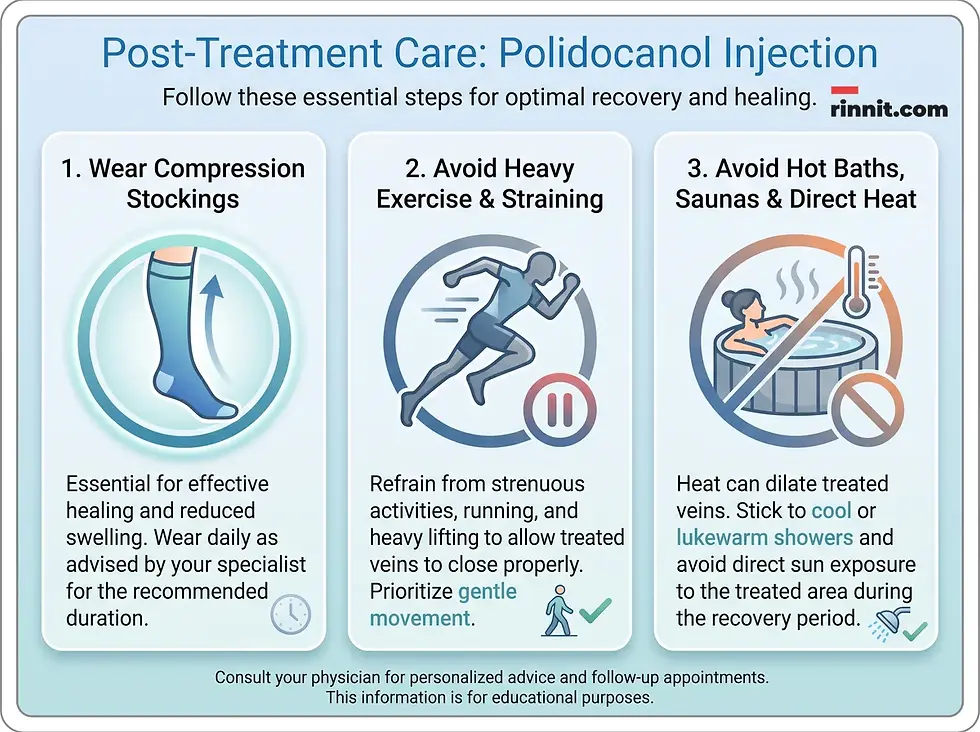
Compression Therapy: Patients must wear compression stockings or support hose on the treated leg. The specific size and duration of wear will be determined by the healthcare provider. [1]
Activity Monitoring: While light movement is often encouraged, patients should avoid heavy exercise, sunbathing, and long plane flights for 2 to 3 days. [1]
Environmental Restrictions: Hot baths and saunas should be avoided for the first few days to prevent unnecessary vein dilation. [1]
What are the side effects and safety warnings of polidocanol injection?
Polidocanol injection usually causes only minor irritation or bruising, but serious side effects such as blood clots, allergic reactions or cardiovascular and neurological symptoms must be reported immediately. [1]
Serious Symptoms to Watch For:
Signs of a blood clot, such as sudden pain, swelling, or warmth in the leg.
Allergic reactions, including skin rash, hives, or swelling of the face and throat.
Cardiovascular events, like chest tightness, shortness of breath, or cold/clammy skin.
Neurological symptoms, such as sudden numbness, confusion, or difficulty speaking. [1]

Conclusion
Polidocanol injection offers an effective, minimally invasive option for those seeking to manage varicose veins. By following a structured treatment plan and adhering to post-procedure recovery guidelines, patients can achieve significant improvements in their venous health. As with any medical procedure, clear communication with a healthcare provider and prompt reporting of any unusual symptoms are essential for a safe and successful outcome.
Frequently Asked Questions
What does polidocanol treat?
Polidocanol is used to treat varicose veins by reducing the size of the enlarged vessels.
How is polidocanol administered?
Polidocanol is injected directly into a vein by a healthcare professional in a clinic or hospital.
Do I need to wear compression stockings after the injection?
Yes, wearing compression stockings or support hose is a critical part of the recovery process.
What activities should I avoid after treatment?
Avoid heavy exercise, sunbathing, long plane flights, hot baths, and saunas for 2 to 3 days.
Is polidocanol safe during pregnancy?
You should inform your care team if you are pregnant or trying to get pregnant before receiving the treatment.
Are there any common drug interactions?
Interactions are generally not expected, but you should still provide a full list of your medications.
What are the common minor side effects?
Pain, redness, irritation, or bruising at the injection site are common but usually temporary.
Can polidocanol cause blood clots?
While rare, blood clots are a serious potential side effect that must be reported immediately.
Can I drive home after the procedure?
You should discuss your activity level and any immediate restrictions with your healthcare provider.
How long does it take to see results?
Results vary from person to person. Ask your care team what to expect and when to schedule follow-up.
References
Cleveland Clinic. Polidocanol Injection. Cleveland Clinic Health Library. Accessed October 11, 2026. https://my.clevelandclinic.org/health/drugs/20381-polidocanol-injection
Chen R, Soh CL, Salih M, et al. Comparison of polidocanol endovenous microfoam (Varithena) to physician-compounded foam in sclerotherapy treatment of truncal varicosities: a systematic review and network meta-analysis. J Vasc Surg Venous Lymphat Disord. 2026;14(4):102460. PMID: 41763540. https://doi.org/10.1016/j.jvsv.2026.102460
Yang J, Chung S, Srivatsa S. Prospective randomized trial of antithrombotic strategies following great saphenous vein ablation using injectable polidocanol endovenous microfoam (Varithena). J Vasc Surg Venous Lymphat Disord. 2023;11(3):488-497.e4. PMID: 36592692. https://doi.org/10.1016/j.jvsv.2022.12.008
Medical disclaimer
This article is for informational purposes only and is not a substitute for professional medical advice, diagnosis, or treatment. Always seek the advice of your physician or other qualified health provider with any questions you may have regarding a medical condition.


Comments