Understanding Plummer-Vinson Syndrome: The Triad of Anemia and Dysphagia

Updated: 2 days ago
Medically reviewed by Dr. Baraa Alnahhal, MD · Last reviewed: October 2026
Plummer-Vinson syndrome is a rare condition defined by iron-deficiency anemia, esophageal webs, and difficulty swallowing. While its exact cause is unknown, it is highly treatable through iron supplementation and esophageal dilation, though long-term cancer monitoring is essential. [1]
Quick Answer
Plummer-Vinson syndrome (PVS) is a rare clinical triad consisting of iron-deficiency anemia, the formation of thin tissue membranes in the esophagus (esophageal webs), and trouble swallowing (dysphagia). [1] It primarily affects middle-aged women and was historically more common before iron-rich diets became widespread. [1] Treatment focuses on restoring iron levels and, if necessary, physically widening the esophagus to restore normal swallowing function. [1]
What the research says
A single dilation relieves swallowing in most people, and cancer risk is real but modest. A 10-year single-center study of 153 adults with an esophageal web found 132 (86.3%) had Plummer-Vinson syndrome, and 85.6% of them were women, with a mean age of 43.5 years. One session of bougie dilation relieved dysphagia in 90.7%, and 9.3% needed repeat dilations. The overall risk of developing an upper gastrointestinal malignancy was 4.5% (Patil et al., J Gastroenterol Hepatol, 2021) [2].
Evidence is limited, but long-term surveillance is advised. A review notes that data on this condition come mostly from case reports and a few small cohort studies. Although most cases have a benign and indolent course, the risk of malignancy warrants long-term surveillance, and the authors stress a multidisciplinary approach to management (Lo et al., J Multidiscip Healthc, 2019) [3].
Research summaries are based on article abstracts retrieved from PubMed.
What is Plummer-Vinson Syndrome?
Plummer-Vinson syndrome, also known as sideropenic dysphagia or Paterson-Brown Kelly syndrome, is an extremely rare disorder characterized by three distinct clinical features. These include a significant deficiency in iron that leads to anemia, the development of atypical tissue webs that narrow the esophagus, and the resulting difficulty in moving food from the mouth to the stomach. [1]
Feature | Description |
Core Triad | Iron-deficiency anemia, esophageal webs, and dysphagia. [1] |
Alternative Names | Sideropenic dysphagia; Paterson-Brown Kelly syndrome. [1] |
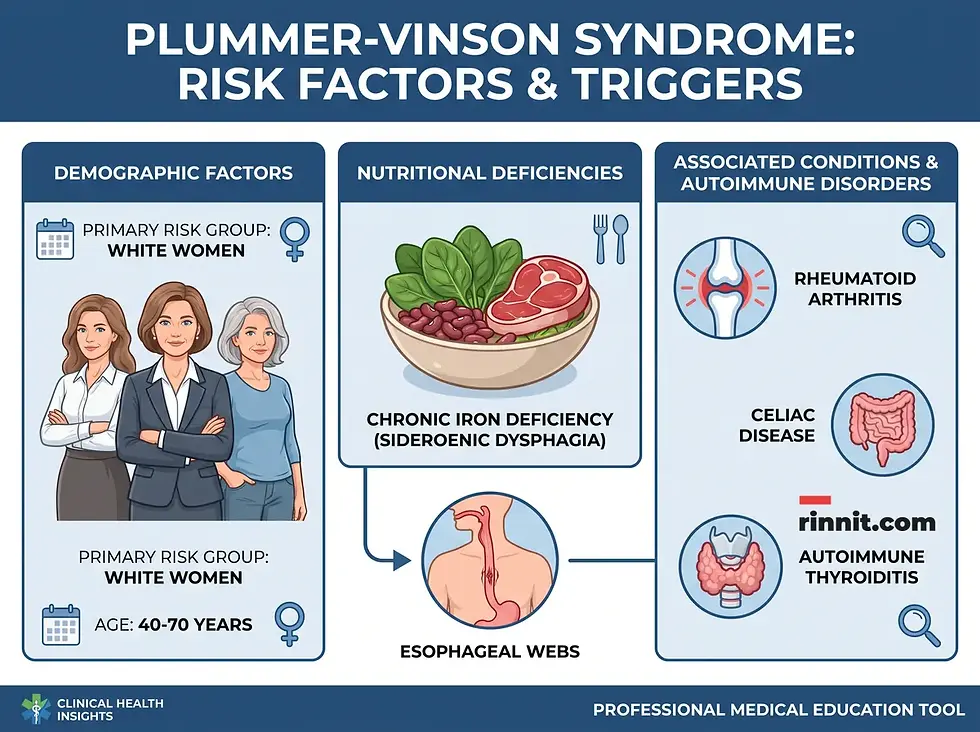
Primary Risk Group | White women, typically aged 40 to 70 years. [1] |
Key Complication | Increased risk of esophageal and hypopharyngeal cancer. [1] |

What are the symptoms of Plummer-Vinson syndrome?
The symptoms of Plummer-Vinson syndrome often overlap with general iron-deficiency anemia but include specific physical changes in the mouth and throat. Patients frequently report significant weakness, fatigue, and shortness of breath due to low hemoglobin levels. More specific indicators include a burning sensation or swelling of the tongue (glossitis), dry mouth, and cracked sores at the corners of the lips known as angular cheilitis. [1]
Physical signs may also manifest in the extremities and other organs. Some individuals develop brittle fingernails or notice lumps in an enlarged thyroid gland. [1] In certain cases, a healthcare provider may detect an enlarged spleen during a physical examination, further indicating the systemic nature of the disorder. [1]
What causes Plummer-Vinson syndrome and who is at risk?
The precise cause of Plummer-Vinson syndrome remains a subject of ongoing research, though several leading theories exist. Many experts believe that chronic nutritional deficiencies, particularly a lack of iron, trigger structural changes in the esophagus that lead to web formation. Others suggest a genetic predisposition or an autoimmune link, as the condition sometimes co-occurs with rheumatoid arthritis or celiac disease. [1]
How is Plummer-Vinson syndrome diagnosed?
Diagnosing Plummer-Vinson syndrome requires a combination of blood work to confirm anemia and imaging to visualize the esophagus. Blood tests, such as a complete blood count (CBC) and peripheral blood smear, are used to measure hemoglobin and iron levels. [1] These tests help determine if the red blood cells have sufficient iron to carry oxygen effectively throughout the body.
To identify the presence of esophageal webs and assess swallowing function, providers utilize specialized imaging procedures. An esophagram or videofluoroscopy allows doctors to watch the throat and food tube in real-time during the swallowing process. An upper endoscopy (EGD) may also be performed to directly view the esophageal lining and the atypical tissue webs. [1]
How is Plummer-Vinson syndrome treated and how do people recover?
The primary goal of treating Plummer-Vinson syndrome is to correct the underlying iron deficiency. In many cases, restoring iron levels through oral supplements or intravenous (IV) iron therapy is enough to reverse swallowing difficulties and resolve anemia symptoms. If iron replacement does not fully restore swallowing function, a procedure called esophageal dilation may be used to gently stretch the narrowed areas of the food tube. [1]
Management Strategies
Iron Supplementation: Rebuilding iron stores via capsules, tablets, or IV infusions. [1]
Esophageal Dilation: A noninvasive procedure to physically widen the esophagus if webs persist. [1]
Cancer Monitoring: Long-term surveillance is necessary because PVS is a risk factor for esophageal and throat cancers. [1] [3]
Dietary Adjustments: Ensuring a consistent intake of iron-rich foods to prevent recurrence.

What is the long-term outlook for Plummer-Vinson syndrome?
The overall prognosis for individuals with Plummer-Vinson syndrome is excellent, provided the iron deficiency is managed effectively. [1] Most patients see a rapid improvement in both their energy levels and their ability to swallow once treatment begins. While the increased risk of certain cancers requires ongoing medical monitoring, this does not mean that every patient will develop a malignancy. [1]
Frequently Asked Questions
What exactly are esophageal webs?
Esophageal webs are thin, atypical membranes of tissue that grow across the inside of the food tube, making it narrower and harder to swallow solid foods. [1]
Can Plummer-Vinson syndrome be prevented?
While there is no guaranteed way to prevent the condition, maintaining a diet rich in iron and seeking prompt treatment for anemia may reduce the overall risk. [1]
Who is most likely to get this syndrome?
The condition is most frequently diagnosed in white women between the ages of 40 and 70, though it can occasionally affect children. [1]
Does iron treatment always fix the swallowing problem?
For many people, correcting the iron deficiency is enough to stop the swallowing trouble, but some may still require a simple procedure to stretch the esophagus. [1]
Is Plummer-Vinson syndrome the same as cancer?
No, it is not cancer. However, it is considered a risk factor, meaning people with the syndrome have a higher chance of developing esophageal or throat cancer later in life. [1]
What should I do if I have trouble swallowing?
You should schedule an appointment with a healthcare provider if swallowing difficulties or symptoms of anemia, like constant fatigue, do not improve within two weeks. [1]
Are there other names for this condition?
Yes, it is also known as sideropenic dysphagia and, in the United Kingdom, it is often called Paterson-Brown Kelly syndrome. [1]
Is esophageal dilation a surgery?
No, it is a noninvasive procedure that does not require physical cuts or incisions; it simply involves stretching the esophagus to improve food passage. [1]
What foods are high in iron?
Iron-rich foods include red meats, beans, spinach, and fortified cereals, which are essential for maintaining healthy hemoglobin levels.
How rare is this condition today?
Plummer-Vinson syndrome is extremely rare in the modern era, largely due to better global access to iron-fortified foods and improved nutritional standards. [1] [2]
References
Cleveland Clinic. Plummer-Vinson Syndrome. Cleveland Clinic Health Library. Last updated January 7, 2025. https://my.clevelandclinic.org/health/diseases/plummer-vinson-syndrome
Patil M, Malipatel R, Devarbhavi H. Plummer-Vinson syndrome: a decade’s experience of 132 cases from a single center. J Gastroenterol Hepatol. 2021;36(1):181-185. PMID: 32525241. https://doi.org/10.1111/jgh.15139
Lo KB, Albano J, Sandhu N, et al. Plummer-Vinson syndrome: improving outcomes with a multidisciplinary approach. J Multidiscip Healthc. 2019;12:471-477. PMID: 31417270. https://doi.org/10.2147/JMDH.S180410
Medical disclaimer
This article is for informational purposes only and is not a substitute for professional medical advice, diagnosis, or treatment. Always seek the advice of your physician or other qualified health provider with any questions you may have about a medical condition.



Comments