Understanding PANDAS Syndrome: Symptoms, Causes, and Care

Updated: 2 days ago
Medically reviewed by Dr. Baraa Alnahhal, MD · Last reviewed: October 2026
PANDAS syndrome is a rare and debated group of symptoms, including sudden tics and obsessive-compulsive behavior, that appear in children after a streptococcal infection. It is thought to be an autoimmune reaction in which the immune system mistakenly attacks healthy brain cells, and it mostly affects children between ages 3 and 12. Care focuses on treating active infection with antibiotics and using behavioral therapies for the neurological and psychiatric symptoms [1].
Quick Answer: What is PANDAS?
PANDAS (Pediatric Autoimmune Neuropsychiatric Disorders Associated with Streptococcal Infections) is a condition in which a child develops abrupt neuropsychiatric symptoms, such as sudden OCD behaviors, tics and mood changes, after a strep infection. The diagnosis remains debated, and no single test confirms it. Care uses antibiotics for active infection and therapies such as CBT for symptoms. [1]
What the research says
Treatment evidence for PANDAS is thin. A systematic review found 12 research studies (of penicillin, azithromycin, IVIG, plasma exchange, tonsillectomy, CBT, NSAIDs, and corticosteroids) plus 65 case reports, and concluded that rigorous research on PANDAS treatment is scarce and published studies have a high risk of bias (Sigra et al., Neurosci Biobehav Rev, 2018).
Anti-inflammatory and antibiotic treatments are unproven for PANS. A systematic review of 4 randomized trials and 3 non-randomized studies (23 to 98 patients each) found very low certainty of benefit and moderate certainty of adverse effects from anti-inflammatory, antibacterial, or immunomodulating treatment in children with PANS (Johnson et al., PLoS One, 2021).
What Is PANDAS Syndrome?
PANDAS stands for Pediatric Autoimmune Neuropsychiatric Disorders Associated with Streptococcal Infections. It describes a child who suddenly and dramatically develops obsessive-compulsive disorder (OCD) or tics after a Group A streptococcal infection, such as strep throat or scarlet fever. It mainly affects children between 3 and 12 and often comes in waves that last days or weeks before easing [1].
Although widely discussed, the condition is still debated. Some providers find the diagnostic criteria vague or think the symptoms overlap too much with other pediatric conditions. Even so, specialists take the sudden changes parents describe seriously, rule out other causes, and offer targeted support.
What are the symptoms of PANDAS syndrome?
The hallmark is the "overnight" onset of symptoms. They are usually grouped into psychological and neurological changes, which vary from child to child.
Psychological and Behavioral Changes
A child may suddenly show intense obsessive-compulsive behavior or motor tics like those in Tourette syndrome. Other signs include sudden disinterest in food, severe separation anxiety, and dramatic mood swings such as unexplained rage or irritability. Parents may also see ADHD-like symptoms, including extreme fidgeting and trouble sleeping [1].
Neurological and Academic Effects
Neurological changes can affect schoolwork. They include a sudden decline in handwriting, poorer coordination, and sensitivity to light or sound. A child who did well in school may suddenly struggle to concentrate and learn.

The sudden onset, neurological, handwriting, and mood changes linked to PANDAS.
What causes PANDAS syndrome and who is at risk?
The exact cause is still being studied. The leading theory is an autoimmune disorder triggered by a strep infection [1].
Theory or factor | Description |
Autoimmune response | The immune system mistakenly attacks healthy brain cells while fighting a strep infection |
Sydenham chorea | Some experts think PANDAS may be a variant or related form of this condition |
Genetic predisposition | Certain gene changes related to immune function may raise a child’s risk |
Family history | A family history of rheumatic fever or autoimmune disease may be a risk factor |
How is PANDAS syndrome diagnosed?
Diagnosing PANDAS is often a process of exclusion, because no single lab test confirms it. Providers rely on a physical exam, the symptom history, and the child’s record of recent infections [1].
The proposed criteria are sudden onset of OCD or tics between age 3 and puberty, an episodic pattern of symptoms, and a confirmed past or current strep infection [1]. Providers may use blood tests to look for recent strep antibodies, or imaging to rule out other neurological conditions.

The proposed diagnostic path: symptom history, medical exam, and confirmation of strep infection.
How is PANDAS syndrome managed and treated?
No treatment is FDA-approved specifically for PANDAS. Providers focus on the underlying infection and on the neuropsychiatric symptoms [1].
Addressing infections:
If a child has an active Group A strep infection, antibiotics are prescribed to clear the bacteria. This is an important first step.
Behavioral and talk therapies:
Cognitive behavioral therapy (CBT) and exposure and response prevention (ERP) are widely used to help children manage OCD-like behaviors. For tics, habit reversal training offers practical tools for control [1].
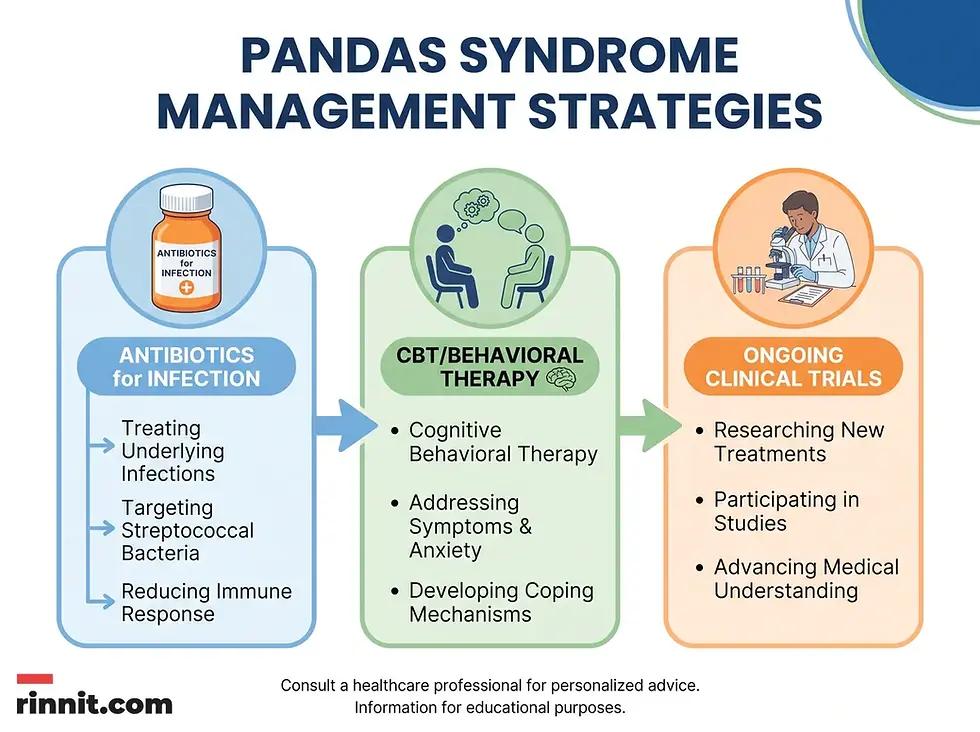
Management combines treating infection, behavioral therapy, and ongoing research.
What is the outlook for PANDAS syndrome and can it be prevented?
Without proper care, neuropsychiatric symptoms may worsen and could continue into adulthood. With medical care and behavioral support, many children have a clear drop in how often and how severe symptoms are [1].
PANDAS cannot be guaranteed to be prevented, but good hygiene is the best defense against the strep infections that trigger it. Encourage frequent handwashing, covering the mouth when coughing, and not sharing personal items [1].
What is the bottom line on PANDAS syndrome?
PANDAS is a complex, often distressing condition for children and families. Sudden behavior changes call for a caring and thorough medical evaluation. By working with pediatric neurologists and rheumatologists, parents can get an accurate diagnosis and a plan that fits their child. If your child has had sudden behavior changes after a sore throat, talk to a pediatric specialist about the possibility of PANDAS and your options.
Frequently Asked Questions
Is PANDAS a permanent condition?
Symptoms can be intense and come in episodes, and many children respond well to treatment. Without treatment, symptoms may last into adulthood.
Can a child have PANDAS without a sore throat?
Yes. Some strep infections cause no noticeable sore throat but can still trigger the immune response linked to PANDAS.
What is the difference between PANDAS and PANS?
PANDAS is specifically linked to strep infections, while PANS (Pediatric Acute-onset Neuropsychiatric Syndrome) can be triggered by other infections or environmental factors.
How quickly do PANDAS symptoms appear?
Onset is described as abrupt or "overnight," often reaching full intensity within a day or two.
Are there medications for PANDAS?
There are no PANDAS-specific drugs. Providers may use antibiotics for infections and psychiatric medicines to help manage OCD or anxiety.
Can PANDAS affect adults?
PANDAS is defined as a pediatric disorder that starts before puberty. However, untreated symptoms can continue into adult years.
Is PANDAS contagious?
No. The strep infection behind it is contagious, but the autoimmune reaction that causes PANDAS symptoms is not.
What specialists treat PANDAS?
Pediatric neurologists, rheumatologists, and developmental-behavioral pediatricians are the main specialists involved.
Does handwriting really change with PANDAS?
Yes. A sudden decline in handwriting (dysgraphia) is a recognized neurological symptom of the condition.
Can PANDAS be prevented?
Good hygiene that prevents strep infections is the most effective way to lower the risk.
Related Resources
Related reading on Rinnit:
References
Cleveland Clinic. PANDAS syndrome. Cleveland Clinic Health Library. Medically reviewed; last updated July 23, 2026. https://my.clevelandclinic.org/health/diseases/23553-pandas-syndrome
Sigra S, Hesselmark E, Bejerot S. Treatment of PANDAS and PANS: a systematic review. Neurosci Biobehav Rev. 2018;86:51-65. PMID: 29309797. DOI: 10.1016/j.neubiorev.2018.01.001
Johnson M, Ehlers S, Fernell E, et al. Anti-inflammatory, antibacterial and immunomodulatory treatment in children with symptoms corresponding to the research condition PANS (Pediatric Acute-onset Neuropsychiatric Syndrome): a systematic review. PLoS One. 2021;16(7):e0253844. PMID: 34197525. DOI: 10.1371/journal.pone.0253844
Medical disclaimer
This article is for informational purposes only and is not a substitute for professional medical advice, diagnosis, or treatment. Always seek the advice of your physician or other qualified health provider with any questions you may have about a medical condition.



Comments