Toe Walking: Symptoms, Causes, and Treatment

Updated: 2 days ago
Medically reviewed by Dr. Baraa Alnahhal, MD. Last reviewed October 17, 2026. This content is for educational purposes and is not medical advice.
Quick Answer
Toe walking is walking on the toes or balls of the feet instead of landing heel first. It is common in toddlers, and most children outgrow it; it is usually a habit but rarely signals a short Achilles tendon, cerebral palsy or autism. Seek advice if it continues after age 2. Habit toe walking usually needs no treatment.
What the research says
Toe walking is far more common when development is atypical. A review reports that toe walking at age 5.5 years affects 2% of normally developing children but 41% of children with a neuropsychiatric diagnosis or developmental delay, and that in most cases toe walking is idiopathic, with no discernible underlying cause (Ruzbarsky et al., Current Opinion in Pediatrics, 2016).
Casting and surgery are both studied, but firm conclusions are limited. A systematic review of 10 studies with 298 children found ankle dorsiflexion improved by 3.1° after casting versus 14.2° after surgery, with no significant differences in persistent toe walking or complications; the authors could not draw firm conclusions because the studies varied widely (van Bemmel et al., Musculoskeletal Surgery, 2014).
Good-quality trial evidence for treating habit toe walking is scarce. A Cochrane review found only 4 eligible studies with 104 participants; data could be extracted from just one (47 children, serial casting with or without botulinum toxin), and the certainty of the evidence was too low for conclusions (Caserta et al., Cochrane Database of Systematic Reviews, 2019).
Key Facts at a Glance
Category | Details |
Who it affects | Mostly young children learning to walk; can persist into childhood |
Main cause | A habit that develops when a child learns to walk |
Possible underlying causes | Short Achilles tendon, cerebral palsy, muscular dystrophy, autism spectrum disorder |
When to see a doctor | Still toe walking after age 2, or with tight muscles, stiff Achilles tendon, or poor coordination |
Typical treatment | Often none — most outgrow it; therapy, braces, casting, injections, or surgery when a physical problem is found |
What Is Toe Walking?
Toe walking is walking on the toes or the balls of the feet rather than with the heel striking the ground first. The term itself is the only symptom, because walking on the toes is easy to see. [1]
It is fairly common in children who are just beginning to walk. Most children outgrow it. Kids who continue toe walking beyond the toddler years often do so out of habit. As long as the child is growing and developing as expected, toe walking is not likely to be a cause for concern. [1]
Why Do Children Toe Walk?
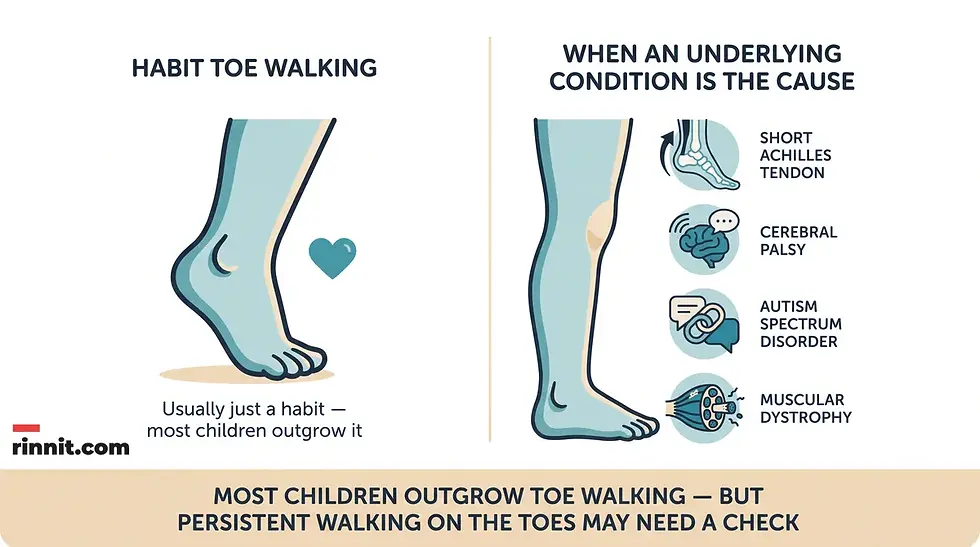
In most cases, toe walking is simply a habit that develops when a child learns to walk. This habit version is called idiopathic toe walking, and it sometimes runs in families. [1]
Rarely, toe walking is caused by an underlying condition. The main ones are a short Achilles tendon, cerebral palsy, muscular dystrophy, and autism spectrum disorder. The table below summarizes each cause.
Cause | What it is |
A short Achilles tendon | The tendon linking the lower leg muscles to the back of the heel bone is too short, so the heel cannot touch the ground |
Cerebral palsy | A group of conditions affecting movement and posture, caused by damage to the developing brain, most often before birth |
Muscular dystrophy | A genetic disease in which muscle fibers are unusually prone to damage and weaken over time |
Autism spectrum disorder | A condition that affects a child's ability to communicate and interact with others; toe walking has been linked to it |
A detail that matters: muscular dystrophy becomes more likely if your child first walked as expected and then started toe walking later. That change in pattern is a reason to ask for an evaluation. [1]
When should you see a doctor about toe walking?
Most toe walking is harmless and fades with time. Still, call your child's healthcare professional if your child is still toe walking after age 2. [1]
Make an appointment sooner if toe walking comes with any of these signs: tight leg muscles, stiffness in the Achilles tendon, or a lack of coordination. [1]

What Happens If Toe Walking Continues?
Constant toe walking can cause lasting changes to the structure of the foot. It also increases a child's risk of falling and can result in a social stigma. [1]
These possible complications are another reason not to wait if your child is still toe walking past age 2, or if any of the warning signs above are present.
How Is Toe Walking Diagnosed?
Toe walking can be observed directly during a physical exam. The healthcare professional watches how the child walks and may check for a short Achilles tendon or other physical findings. [2]
Sometimes further testing is added. The table below shows the diagnostic options.
Test | What it involves |
Physical exam | Watching the child walk and checking leg and foot movement |
Gait analysis | A closer study of how the child walks |
Electromyography (EMG) | A thin needle with an electrode is inserted into a leg muscle; the electrode measures electrical activity in the affected nerve or muscle |
Neurological exam or developmental testing | Considered if cerebral palsy or autism spectrum disorder is suspected |
If a neurological or developmental cause is suspected, the next step may be a neurological exam or testing for developmental delays. [2]
How Is Toe Walking Treated?
Treatment depends entirely on the cause.
Habit toe walking
If your child is toe walking out of habit, treatment is not needed. Your child is likely to outgrow the habit. The healthcare team might simply monitor your child's gait during office visits. [2]
When a physical problem is involved
If a physical problem is contributing to toe walking, several options are available. They range from gentle and reversible to more involved.
Treatment | How it works |
Physical therapy | Gentle stretching of the leg and foot muscles might improve the child's gait |
Leg braces or splints | Devices that sometimes help promote a regular gait |
Serial casting | A series of below-the-knee casts to progressively improve the ability to bring the toes toward the shin, tried if physical therapy or braces are not helpful |
OnabotulinumtoxinA (Botox) injections | Injections into the calf muscles sometimes used to help promote a regular gait |
Surgery | Lengthening the muscles or tendons at the back of the lower leg, considered if conservative treatments fail |
If the toe walking is related to cerebral palsy, autism spectrum disorder, or another problem, treatment will also include addressing the underlying condition. [2]

How should you prepare for a toe walking appointment?
You will probably first raise your concerns with a primary healthcare professional — a family doctor, nurse practitioner, physician assistant, or pediatrician. That professional might refer you to a neurologist, a doctor specializing in nerve function, or to orthopedic surgery. [2]
Before the appointment, write down a list of questions. Three useful starters are: What could be causing toe walking in my child? What tests are needed, if any? What treatments do you recommend? [2]
Your doctor will likely ask about your child's medical history and development, including whether there is a family history of muscular dystrophy or autism spectrum disorder, whether your child was born prematurely, and whether your child first walked flat-footed before starting to toe walk. A simple at-home check your doctor may mention: see if your child can walk on their heels if you ask. [2]
Conclusion and Next Steps
Toe walking is common, usually harmless, and usually outgrown. If your child is still walking on their toes after age 2, or shows tight leg muscles, a stiff Achilles tendon, or poor coordination, a conversation with a healthcare professional is the right next step. An exam is simple, and when a physical cause is found, effective treatments from physical therapy to surgery can help restore a regular, safer gait.
FAQ: Toe Walking
Is it normal for toddlers to walk on their toes? Yes. Walking on the toes or balls of the feet is fairly common in children just learning to walk. Most children outgrow it, and if the child is growing and developing as expected, it is usually not a concern.
When should I worry about my child's toe walking? See a healthcare professional if your child is still toe walking after age 2. Make an appointment sooner if your child also has tight leg muscles, stiffness in the Achilles tendon, or a lack of coordination.
What conditions can cause toe walking? Rarely, toe walking is caused by a short Achilles tendon, cerebral palsy, muscular dystrophy, or autism spectrum disorder. Most often it is just a habit, sometimes a family one.
How is toe walking diagnosed? Toe walking is usually spotted during a physical exam by watching the child walk. Tests such as gait analysis or an EMG, which measures nerve and muscle electrical activity, may be added, along with a neurological exam or developmental testing if cerebral palsy or autism is suspected.
Does toe walking need treatment? Habit toe walking usually needs no treatment, as most children outgrow it. When a physical problem is involved, options include physical therapy, leg braces or splints, serial casting, calf muscle injections, and surgery to lengthen the muscles or tendons.
Trusted External Resources
References
Mayo Clinic Staff. Toe walking in children - Symptoms & causes. Mayo Clinic. August 12, 2025. https://www.mayoclinic.org/diseases-conditions/toe-walking/symptoms-causes/syc-20378410
Mayo Clinic Staff. Toe walking in children - Diagnosis & treatment. Mayo Clinic. August 12, 2025. https://www.mayoclinic.org/diseases-conditions/toe-walking/diagnosis-treatment/drc-20378414
American Academy of Orthopaedic Surgeons. Toe Walking. OrthoInfo. Accessed October 14, 2026. https://www.orthoinfo.org/diseases--conditions/toe-walking
Cleveland Clinic. Toe Walking: Symptoms, Causes & Treatment. Cleveland Clinic. Last updated October 26, 2022. https://my.clevelandclinic.org/health/diseases/21017-toe-walking
Ruzbarsky JJ, Scher D, Dodwell E. Toe walking: causes, epidemiology, assessment, and treatment. Curr Opin Pediatr. 2016;28(1):40-6. PMID 26709689. https://doi.org/10.1097/MOP.0000000000000302
van Bemmel AF, van de Graaf VA, van den Bekerom MP, et al. Outcome after conservative and operative treatment of children with idiopathic toe walking: a systematic review of literature. Musculoskelet Surg. 2014;98(2):87-93. PMID 24415128. https://doi.org/10.1007/s12306-013-0309-5
Caserta AJ, Pacey V, Fahey M, et al. Interventions for idiopathic toe walking. Cochrane Database Syst Rev. 2019;10(10):CD012363. PMID 31587271. https://doi.org/10.1002/14651858.CD012363.pub2



Comments