Tangier Disease: Symptoms, Causes, Diagnosis, Treatment, and Outlook

Updated: 2 days ago
Medically reviewed by Dr. Baraa Alnahhal, MD · Last reviewed: October 2026
Quick Answer: What is Tangier disease?
Tangier disease is a rare genetic condition caused by a change in the ABCA1 gene, which helps cholesterol leave cells to form HDL. Cholesterol builds up in organs while blood HDL levels become very low. Signs include enlarged orange or yellow-grey tonsils, an enlarged spleen or liver and nerve problems. Diagnosis involves blood and genetic testing. [1]
What the research says
Tangier disease is very rare, and early heart disease is frequently seen. A review reports 35 cases in Japan and 109 outside Japan to date; with changes in both ABCA1 copies, HDL cholesterol is mostly below 5 mg/dL and apolipoprotein A-I is 10 mg/dL or less, and premature coronary artery disease is frequently observed even though LDL cholesterol tends to be low. No curative treatment exists, so early identification and preventing atherosclerosis are crucial (Koseki et al., Journal of Atherosclerosis and Thrombosis, 2021). [2]
Heart risk for people who carry just one changed ABCA1 copy is still being studied. In a Danish study of 41,961 people (109 carriers of four ABCA1 loss-of-function variants), carriers had lower HDL cholesterol (41 vs 58 mg/dL) but no higher risk of ischemic heart disease (odds ratio 0.93, 95% CI 0.53–1.62) (Frikke-Schmidt et al., JAMA, 2008). A later review notes that newer evidence suggests heterozygous ABCA1 carriers may also be at increased risk, and that patient registries could help clarify this (Hooper et al., Current Opinion in Lipidology, 2020). [3] [4]

What is Tangier disease?
Tangier disease affects the way the body transports cholesterol. HDL is often called “good cholesterol” because it helps carry excess LDL cholesterol out of the blood. When HDL is very low, plaque may build up more easily in the arteries. [1]
Extra cholesterol may also collect in tissues and organs. The tonsils, spleen, and liver are examples of areas that may become enlarged. Tangier disease is considered a lipoprotein metabolism disorder. [1]
The condition got its name from where it was discovered: in 1960, researchers identified the first case on Tangier Island in Chesapeake Bay. It has several other names, including hypoalphalipoproteinemia, familial alpha-lipoprotein deficiency, high-density lipoprotein deficiency type 1, and high-density lipoprotein deficiency of the Tangier type.
How does ABCA1 cause Tangier disease?
The ABCA1 gene tells the body how to make the ABCA1 protein. That protein helps cholesterol leave different cells. The cholesterol then normally joins with special proteins called apolipoproteins to form HDL particles. [1]
With Tangier disease, ABCA1 does not work as it should. Cholesterol has trouble leaving cells, so two related changes can occur: cholesterol builds up in organs and tissues, and the body cannot make enough HDL particles. [1]
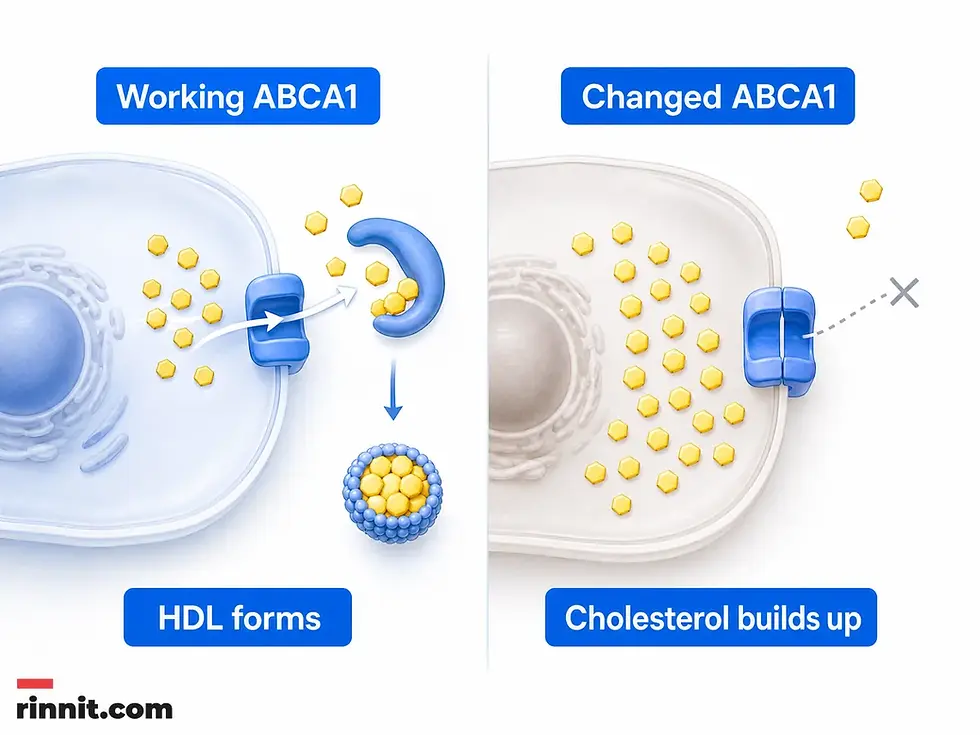
Normal cholesterol transport | Tangier disease pattern |
ABCA1 helps cholesterol leave cells. | A changed ABCA1 gene makes it harder for cholesterol to leave cells. |
Cholesterol joins apolipoproteins to form HDL particles. | The body cannot make enough HDL particles. |
HDL carries excess LDL cholesterol out of the blood. | Very low HDL may make plaque buildup in arteries more likely. |
How is Tangier disease inherited?
Tangier disease usually follows an autosomal recessive inheritance pattern. A person generally needs to inherit an abnormal copy of the ABCA1 gene from both biological parents to develop the condition. [1]
A person who inherits one abnormal copy is a carrier. Carriers do not develop the clinical symptoms, but their HDL cholesterol may be lower than normal. Because carriers can show a blood-level effect, some experts also describe Tangier disease as having an autosomal codominant pattern. [1]
Inheritance situation | What it means |
Two abnormal ABCA1 copies | A person may develop Tangier disease. |
One abnormal ABCA1 copy | A person is a carrier and usually does not develop clinical symptoms. |
Family planning | Genetic counseling may help explain the chance of a child having the condition. |
What are the symptoms of Tangier disease?
Symptoms vary depending on where cholesterol builds up. An important early warning sign is enlarged tonsils that may look bright orange or yellow-grey. This commonly appears by adolescence. [1]
Other possible symptoms include an enlarged spleen or liver, peripheral neuropathy, swollen lymph nodes, clouding of the cornea, high triglyceride levels, and a low platelet count. [1]
Peripheral neuropathy can affect nerve function. It may involve muscle weakness or loss of sensation in the arms and hands. [1]
Symptom or finding | What it may look like or involve |
Enlarged tonsils | Tonsils may look bright orange or yellow-grey; this may appear by adolescence. |
Enlarged spleen or liver | The spleen, liver, or both may become larger because of cholesterol buildup. |
Peripheral neuropathy | Muscle weakness or loss of sensation may occur in the arms and hands. |
Swollen lymph nodes | Lymph nodes may swell in the neck, armpits, or chest. |
Corneal opacity | The cornea may become cloudy. |
High triglycerides | Blood triglyceride levels may be high. |
Low platelets | The platelet count may be lower than normal. |
Can Tangier disease affect the heart?
Tangier disease raises the risk of coronary artery disease earlier than expected, typically in the 50s or 60s. The risk may be related to very low HDL, although the relationship continues to be studied. [1]
HDL helps move excess LDL cholesterol out of the blood. Without enough HDL to do this job, plaque may build up in the arteries. This plaque buildup is called atherosclerosis. [1]
Heart risk is one reason ongoing monitoring matters. Treatment plans may include medicines to manage blood pressure or cholesterol, avoiding tobacco, eating heart-healthy foods, and getting physical activity as a healthcare provider recommends.
How is Tangier disease diagnosed?
A healthcare provider may diagnose Tangier disease using a physical exam and blood tests. The provider may look for enlarged tonsils or spleen and review laboratory results that suggest very low HDL or reduced apolipoprotein A-I. [1]
Results that may suggest Tangier disease include HDL cholesterol below 25 mg/dL, commonly below 5 mg/dL, apolipoprotein A-I below 20 mg/dL, and genetic testing that identifies ABCA1 gene variants.
A low HDL result alone does not establish Tangier disease. Genetic testing and the broader clinical picture help clarify whether the condition is present.
Diagnostic element | What it may show |
Physical examination | Signs such as enlarged tonsils or an enlarged spleen. |
HDL cholesterol | A level below 25 mg/dL, commonly below 5 mg/dL, may suggest the condition. |
Apolipoprotein A-I | A level below 20 mg/dL may support the evaluation. |
Genetic testing | ABCA1 gene variants. |
What tests may be needed after diagnosis?
Additional tests can help show how Tangier disease is affecting the body. An ultrasound of the abdomen may check the spleen and liver. Nerve conduction studies and electromyography may check nerve and muscle function. Eye exams can look for corneal clouding. [1]
A carotid ultrasound or CT angiogram may be used to look for plaque in major arteries. The exact evaluation plan depends on the person’s symptoms and findings. [1]

Area checked | Possible evaluation |
Spleen and liver | Abdominal ultrasound. |
Nerves and muscles | Nerve conduction study and electromyography. |
Eyes | Eye examination for corneal clouding. |
Major arteries | Carotid ultrasound and CT angiogram for plaque. |
How is Tangier disease treated?
Tangier disease has no cure, so treatment focuses on managing symptoms and reducing the risk of plaque buildup in the arteries. Treatment focuses on managing symptoms and reducing the risk of plaque buildup in the arteries. [1]
Some people may need surgery to remove an affected area, such as the tonsils or spleen. Braces or orthotics may help when nerve problems affect movement. Gene therapy may help in the future, but it is not described as an established cure. [1]
Treatment or care focus | What it may involve |
Heart-risk management | Medicines to manage blood pressure or cholesterol levels, as prescribed. |
Lifestyle support | Avoiding tobacco, eating heart-healthy foods, and getting provider-recommended physical activity. |
Surgery | Removing an affected area, such as tonsils or spleen, for some people. |
Movement support | Braces or orthotics for nerve-related movement problems. |
Future approaches | Gene therapy may help in the future. |
What exercise is safe with an enlarged spleen?
If the spleen is enlarged, a healthcare provider can advise which exercises are safe. Contact sports may need to be avoided because an impact could cause the spleen to rupture. [1]
Do not choose an exercise plan based only on a general description of Tangier disease. Activity guidance should reflect the size of the spleen, other symptoms, and the provider’s recommendations.
Why are regular checkups important?
People with Tangier disease should see a healthcare provider regularly and follow the appointment schedule they receive. Routine checkups may include the nervous system, heart, and eyes. [1]
Regular monitoring gives the care team an opportunity to respond if symptoms worsen and to look for effects of the condition over time.
What is the outlook for Tangier disease?
Most people with Tangier disease have a good prognosis, but outlook depends on the features of the condition and their severity. A healthcare provider can explain long-term expectations, including any impact on life expectancy. [1]
Tangier disease is lifelong. Early diagnosis and continued checkups can help people manage the condition. [1]
Can Tangier disease be prevented?
Tangier disease is genetic and present from birth, so there is no way to prevent it. People who are planning to have children may wish to speak with a genetic counselor about the chances of a child having the condition. [1]
Although the inherited condition itself cannot be prevented, regular care can help identify and manage symptoms and heart-related risk.
How can people live with a rare condition like Tangier disease?
A very rare diagnosis can feel isolating, especially when few people have the same condition. Support groups and communities for people with other rare diseases may offer a place to share experiences and connect with someone who understands.
A healthcare provider may be able to point you toward support resources. Emotional support is part of living with a lifelong condition, even when the main medical focus is on cholesterol transport, symptoms, and heart monitoring.
What questions should you ask the care team about Tangier disease?
Question | Why it may help |
What findings suggest Tangier disease? | The condition has several possible signs and laboratory patterns. |
Should I have ABCA1 genetic testing? | Genetic testing may identify ABCA1 variants. |
What do my HDL and apolipoprotein A-I levels mean? | These blood results are part of the diagnostic evaluation. |
Do I need an ultrasound or other organ tests? | Additional tests may assess the spleen, liver, nerves, muscles, eyes, and arteries. |
What exercise is safe if my spleen is enlarged? | Contact sports may need to be avoided because of rupture risk. |
How often should my heart, nerves, and eyes be checked? | Regular monitoring is part of ongoing care. |
Would genetic counseling help my family? | Counseling may explain inheritance and family-planning questions. |
Conclusion: Tangier disease requires lifelong, coordinated care
Tangier disease is a rare inherited condition caused by a change in the ABCA1 gene. When cholesterol cannot leave cells normally, it can build up in tissues and organs, while HDL cholesterol becomes very low. [1]
Enlarged orange or yellow-grey tonsils, an enlarged spleen or liver, nerve problems, corneal clouding, high triglycerides, and low platelets are possible findings. Diagnosis may include a physical exam, blood tests, genetic testing, and checks of the heart, nerves, eyes, liver, spleen, and arteries. [1]
There is no cure, but symptom management, heart-risk reduction, regular checkups, safe activity planning, and support can help people live with this lifelong condition. [1]
Continue exploring clear health education: visit the health blog and health videos, and learn more about the publisher’s mission on the About page. [1]
Frequently Asked Questions
What is Tangier disease?
Tangier disease is an extremely rare inherited condition in which cholesterol builds up in parts of the body and HDL cholesterol is very low.
What causes Tangier disease?
A change in the ABCA1 gene causes Tangier disease. The altered gene can make it difficult for cholesterol to leave cells and can reduce the body’s ability to make HDL particles.
What are the earliest symptoms of Tangier disease?
Enlarged tonsils that look bright orange or yellow-grey are a common early warning sign and typically appear by adolescence.
Does Tangier disease affect the heart?
Tangier disease can raise the risk of coronary artery disease earlier than expected, often in the 50s or 60s. Very low HDL may make plaque buildup in arteries more likely.
How is Tangier disease diagnosed?
Evaluation may include a physical exam, HDL and apolipoprotein A-I blood levels, and genetic testing for ABCA1 variants. Additional tests may assess the heart, arteries, nerves, eyes, liver, and spleen.
Is there a cure for Tangier disease?
There is no cure. Treatment focuses on managing symptoms and reducing the risk of plaque buildup. Gene therapy may help in the future.
Can people with Tangier disease exercise?
Exercise recommendations depend on the person’s symptoms and whether the spleen is enlarged. A healthcare provider can advise which activities are safe. Contact sports may need to be avoided when the spleen is enlarged.
Is Tangier disease inherited?
Yes. It usually follows an autosomal recessive pattern. A person generally needs an abnormal ABCA1 gene copy from both biological parents to develop the condition.
What is the prognosis?
Most people have a good prognosis, but outlook depends on the condition’s features and severity. Tangier disease is lifelong, and early diagnosis with continued checkups can help manage it.
References
Cleveland Clinic. Tangier Disease: Symptoms, Causes & Treatment. Cleveland Clinic. Last updated August 7, 2025. https://my.clevelandclinic.org/health/diseases/23951-tangier-disease
Koseki M, Yamashita S, Ogura M, et al. Current diagnosis and management of Tangier disease. J Atheroscler Thromb. 2021;28(8):802-810. PMID 33994407. https://doi.org/10.5551/jat.RV17053
Hooper AJ, Hegele RA, Burnett JR. Tangier disease: update for 2020. Curr Opin Lipidol. 2020;31(2):80-84. PMID 32022754. https://doi.org/10.1097/MOL.0000000000000669
Frikke-Schmidt R, Nordestgaard BG, Stene MCA, et al. Association of loss-of-function mutations in the ABCA1 gene with high-density lipoprotein cholesterol levels and risk of ischemic heart disease. JAMA. 2008;299(21):2524-2532. PMID 18523221. https://doi.org/10.1001/jama.299.21.2524
National Library of Medicine. Tangier disease. MedlinePlus Genetics. Last updated October 30, 2023. https://medlineplus.gov/genetics/condition/tangier-disease/
Disclaimer
This article is for general educational purposes and is not a substitute for professional medical advice, diagnosis or treatment. Always seek the advice of a qualified health provider with any questions you may have regarding a medical condition.
Tangier disease is rare and can affect different organs, so readers should discuss symptoms, test results, exercise safety, family-planning questions, and treatment options with a qualified healthcare provider. This article is not a diagnosis or a personal treatment plan.



Comments