Sun Allergy: Symptoms, Causes, Prevention, Diagnosis, and Treatment Explained

Updated: 2 days ago
Medically reviewed by Dr. Baraa Alnahhal, MD · Last reviewed: October 2026
Quick Answer: What is a sun allergy?
A sun allergy is any condition in which sunlight or UV radiation causes an itchy rash on exposed skin, most commonly polymorphous light eruption. Causes include immune reactions, sun-sensitizing medicines and substances like fragrances. See a provider for an unusual rash after sun exposure. Most cases clear within a day or two out of the sun; severe cases need prescriptions.
What the research says
Polymorphic light eruption (PLE) is common, and it is more frequent farther from the equator. A systematic review and meta-analysis of population-based studies estimated that about 10% of people in the general population have PLE (95% CI 6%–15%; 19,287 people), and prevalence rose with distance from the equator (Burfield et al., J Eur Acad Dermatol Venereol, 2023) [3].
Medicines and topical drugs are leading triggers in photopatch testing. Of 223 patients photopatch tested over 12 years, 33.6% reacted. Among the 72 clinically relevant reactions, 45.8% were caused by topical drugs such as ketoprofen or promethazine and 9.8% by systemic drugs such as hydrochlorothiazide and fenofibrate, while classic UV filters in sunscreens caused 6 positive reactions overall (Codeço et al., Contact Dermatitis, 2023) [4].
A short phototherapy course can "harden" skin for the season. In a small, non-randomized retrospective study of 15 people with severe PLE, a one-month course of narrowband UVB twice a week sustained the hardening effect in 87.5% of treatments (Combalia et al., Actas Dermosifiliogr, 2017) [5].
What Is a Sun Allergy?
Sun allergy is a broad term. It describes several conditions that cause an itchy rash to form on the skin after being in sunlight or other sources of ultraviolet (UV) radiation. Polymorphous light eruption is the most common form of sun allergy. [1]
Some people have a hereditary type of sun allergy. Others develop symptoms only when triggered by another factor, such as taking a medication or touching certain plants. Other types of sun-related reactions occur for reasons that are unclear. [1]
Mild sun allergy may clear up without treatment. Severe rashes may be treated with steroid creams or pills. If you have a severe sun allergy, you may need to take preventive steps, such as wearing clothing that shields you from the sun. [1]
What Are the Symptoms of a Sun Allergy?
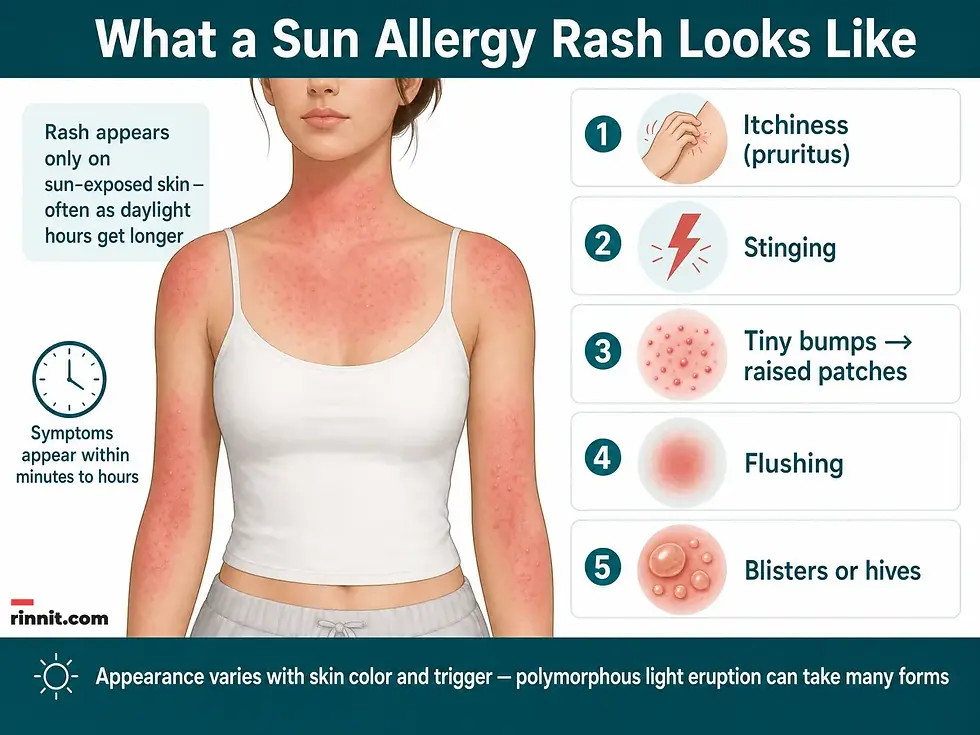
Symptoms usually occur only on skin that has been exposed to the sun or another source of UV light, and they show up within minutes to hours after exposure. [1] How the skin looks varies widely depending on your skin color and what is causing the symptoms. [1]
Symptom | What it looks or feels like |
|---|---|
Itchiness (pruritus) | An itchy rash, the hallmark of sun allergy. |
Stinging | A stinging sensation on the affected skin. |
Tiny bumps | Small bumps that may merge into raised patches. |
Flushing | A flush of redness across the exposed area. |
Blisters or hives | Fluid-filled blisters or hive-like welts, usually in more severe reactions. |
What is polymorphous light eruption?
Polymorphous light eruption is a rash that affects parts of the body exposed to more sunlight as daylight hours get longer, such as the front of the neck and chest. "Polymorphous" means the rash can take many forms, such as tiny bumps, raised areas, or blisters. [1]
When should you see a doctor?
See a health care provider if you have unusual, bothersome skin reactions after being in the sun. For severe or persistent symptoms, you may need to see a dermatologist, a doctor who specializes in diagnosing and treating skin disorders. [1]
What Causes a Sun Allergy?
Causes of sun allergy include immune system reactions to sunlight, and certain medications and chemicals that make the skin more sensitive to the sun. It is not clear why some people develop a sun allergy and others do not, and inherited traits may play a role. [1]
What are the risk factors?
Risk factor | How it works |
|---|---|
Contact with certain substances | Some symptoms are triggered when your skin is exposed to a substance and then to sunlight. Common substances include fragrances, disinfectants, and chemicals used in some sunscreens. [1] |
Taking certain medications | A number of medicines can make skin burn more quickly, including tetracycline antibiotics, sulfa-based drugs, and pain relievers such as ketoprofen. [1] |
Having another skin condition | Having dermatitis increases your risk of having a sun allergy. [1] |
Having a blood relative with a sun allergy | You are more likely to have a sun allergy if a sibling or parent has one. [1] |
How Can You Prevent a Sun Allergy?
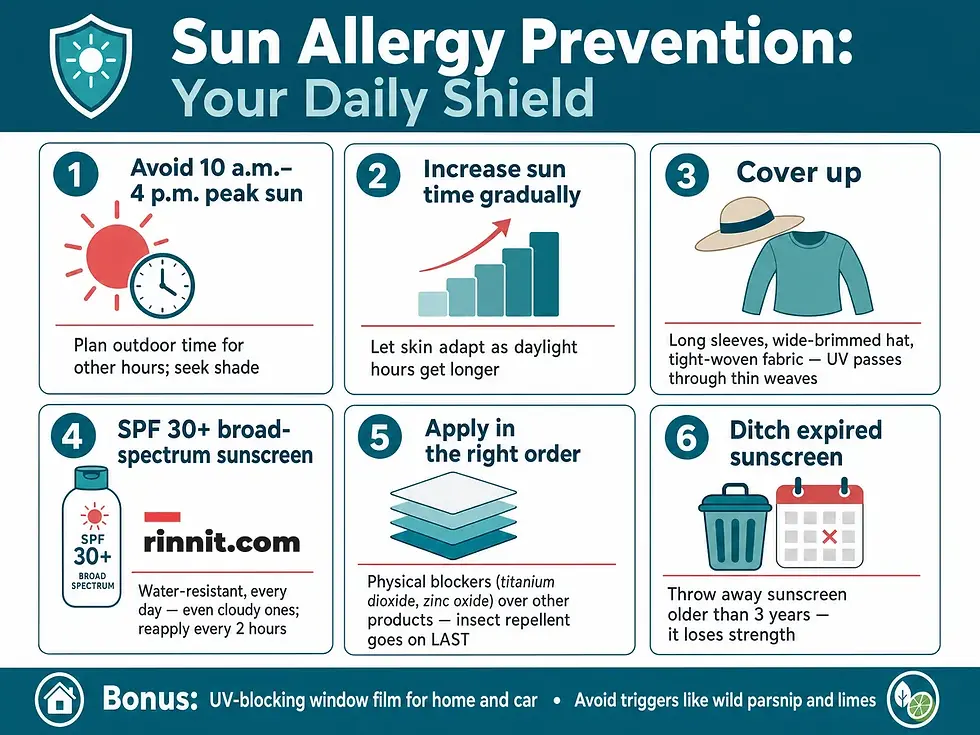
If you have a sun allergy or increased sensitivity to the sun, these steps can help prevent a reaction:
Prevention step | Details |
|---|---|
Avoid sun exposure between 10 a.m. and 4 p.m. | The sun's rays are strongest during these hours. Plan outdoor activities for other times. If you can't, limit your time in the sun and seek shade when possible. [1] |
Avoid sudden exposure to lots of sunlight | Many people have symptoms seasonally, when daylight hours get longer. Gradually increase the time you spend outdoors so your skin has time to adapt. [1] |
Wear sunglasses and protective clothing | Long-sleeved shirts and wide-brimmed hats protect your skin. Avoid thin or loosely woven fabrics, because UV rays can pass through them. [1] |
Apply sunscreen | Use a water-resistant, broad-spectrum sunscreen with an SPF of at least 30, even on cloudy days. Apply it generously and reapply every two hours, or more often if you are swimming or sweating. [1] |
Layer physical blockers correctly | If you use a product with physical blockers (titanium dioxide or zinc oxide), apply it over other products you are wearing, except insect repellent, which goes on last. Physical blockers give the most effective protection for sensitive skin. [1] |
Check sunscreen freshness | The FDA requires sunscreen to keep its original strength for at least three years. Check labels for storage directions and expiration dates, and throw away sunscreen that is expired or more than 3 years old. [1] |
Avoid known triggers | If you know a substance sets off your reaction, such as a medication or contact with wild parsnip or limes, avoid it. [1] |
Apply UV-blocking window film | Put UV-blocking film on the windows of your home and car. [1] |
How Is a Sun Allergy Diagnosed?
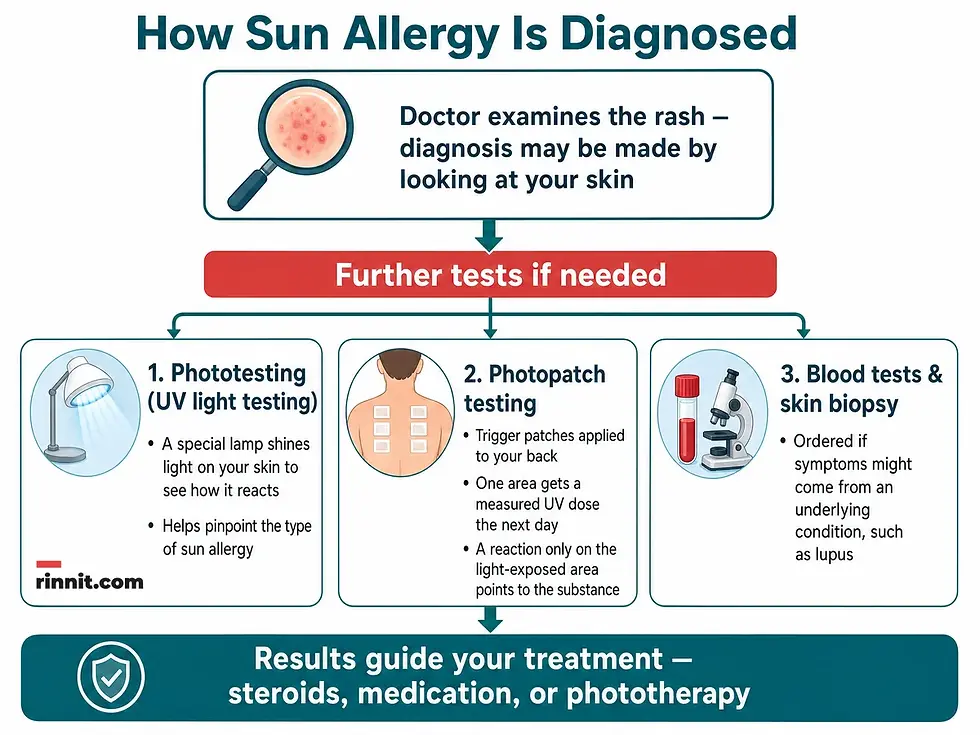
Your health care provider may diagnose sun allergy simply by looking at your skin. You might also need tests, such as:
Test | How it works |
|---|---|
Ultraviolet (UV) light testing (phototesting) | A special lamp is used to see how your skin reacts to light. This can help pinpoint which type of sun allergy you have. [2] |
Photopatch testing | Identical patches of common sun allergy triggers are applied to your skin, typically on the back. A day later, one of the areas receives a measured dose of UV rays from a sun lamp. If a reaction occurs only on the light-exposed area, it is likely linked to the substance being tested. [2] |
Blood tests and skin samples | Your provider may order these if your symptoms might be caused by an underlying condition such as lupus. A blood sample or a skin sample (biopsy) is examined in a laboratory. [2] |
How Is a Sun Allergy Treated?
Treatment depends on the type of sun allergy you have and your symptoms. For mild symptoms, you may only need to avoid the sun for a few days. [2]
What medications are used?
Creams containing corticosteroids are available in both nonprescription and prescription strengths. For a severe reaction, your health care provider may have you take prescription corticosteroid pills, such as prednisone, for a short time. The malaria medicine hydroxychloroquine (Plaquenil) may ease the symptoms of some types of sun allergy. [2]
What is phototherapy?
If you have a severe sun allergy, your provider may suggest gradually getting your skin used to sunlight each year as daylight hours get longer. In phototherapy, a special lamp shines ultraviolet light on areas of the body that are often exposed to the sun. It is generally done a few times a week over several weeks. [2]
What home remedies help?
Home remedy | How it helps |
|---|---|
Avoid sun exposure | Most sun allergy symptoms improve in less than a day or two if you keep the affected skin out of the sun. [2] |
Stop using medicines that make you sensitive to light | If you take medicines for other conditions, ask your provider whether you can stop them if they are making your skin more sensitive to the sun. [2] |
Apply moisturizers | Moisturizing lotions can help relieve irritation from dry, scaly skin. [2] |
How Should You Prepare for a Doctor's Appointment?
You will likely start with your primary care provider, or you may be referred to a dermatologist. When you book, ask whether you need to do anything in advance. For example, if you are having phototesting, you might need to stop certain medicines beforehand. [2]
What should you be ready to tell your doctor?
How long after sun exposure your symptoms began
What type of symptoms you had
Whether your symptoms have worsened or improved
Whether you have had these symptoms before
What medicines and supplements you take regularly
What will your doctor ask?
Which parts of your body are affected?
Exactly what does the affected skin look like?
How severe are your symptoms?
How long does your skin reaction last?
Do you have itching or pain?
Does your skin react only to direct sunlight, or also to sunlight shining through window glass?
Does anyone else in your family have skin reactions to sunlight or other allergic skin conditions?
What products do you use on your skin?
Conclusion
Sun allergy is not one disease but a family of reactions that turn sunlight, or any UV source, into an itchy and sometimes blistery rash on exposed skin. The most common form, polymorphous light eruption, tends to strike the sun-facing chest, neck, and arms just as the days grow longer, which is why a springtime rash deserves attention. Because the appearance varies with skin color and the specific trigger, and because some reactions can point to deeper conditions such as lupus, an unusual rash after sun exposure is worth a professional look rather than a guess.
The condition is very manageable. Most reactions calm down within a day or two simply by staying out of the sun. Prevention is a daily habit: avoid the 10 a.m. to 4 p.m. peak, cover up with tightly woven clothing and a wide-brimmed hat, and use a broad-spectrum SPF 30+ sunscreen, layered correctly with insect repellent last and replaced once it is three years old. When reactions are severe, prescription corticosteroids, hydroxychloroquine, and phototherapy can restore your comfort in the sun.
Next Steps
If you have noticed an itchy rash on sun-exposed skin within minutes to hours of going outside, book an appointment with your primary care provider or a dermatologist, and bring a list of your medicines, supplements, and skincare products. Before your next long day outdoors, run through the prevention checklist: plan activities outside peak hours, dress for coverage, apply SPF 30+ generously, and set a two-hour reapplication reminder. And if your sunscreen has been sitting in a drawer for more than three years, throw it away and start fresh.
Trusted resources: U.S. Food and Drug Administration: Sunscreen: How to Help Protect Your Skin from the Sun · American Academy of Dermatology: Sunscreen FAQs
Related reading on Rinnit: Polymorphous Light Eruption: Complete Guide to Symptoms, Causes, and Treatment · Lupus: Symptoms, Causes & Treatment Guide
Frequently Asked Questions
What is a sun allergy?
Sun allergy is a broad term for several conditions that cause an itchy rash on the skin after being in sunlight or other sources of ultraviolet (UV) radiation.
What is the most common form of sun allergy?
Polymorphous light eruption is the most common form of sun allergy.
What is polymorphous light eruption?
It is a rash that affects parts of the body exposed to more sunlight as daylight hours get longer, such as the front of the neck and chest. "Polymorphous" means the rash can take many forms, such as tiny bumps, raised areas, or blisters.
How quickly do sun allergy symptoms appear?
Symptoms show up within minutes to hours after sun exposure, and usually only on skin that was exposed to the sun or another UV source.
What does a sun allergy rash look like?
It varies with your skin color and the cause. Signs include itchiness, stinging, tiny bumps that may merge into raised patches, flushing of the exposed area, and blisters or hives.
Is a sun allergy the same as a sunburn?
No. A sun allergy is an itchy rash caused by an immune reaction, a medicine, or a chemical on the skin reacting with UV light, rather than simple skin damage from too much sun. Some medicines can, however, make skin burn more quickly.
What causes a sun allergy?
Immune system reactions to sunlight, and certain medicines and chemicals that make the skin more sensitive to the sun. It is not clear why some people develop it and others do not, and inherited traits may play a role.
Can sun allergy run in families?
Yes. You are more likely to have a sun allergy if a sibling or parent has one.
What medicines trigger a sun allergy?
A number of medicines can make skin burn more quickly, including tetracycline antibiotics, sulfa-based drugs, and pain relievers such as ketoprofen.
Can sunscreen cause a sun allergy?
Yes. Chemicals used in some sunscreens, along with fragrances and disinfectants, can trigger symptoms when your skin is exposed to the substance and then to sunlight. Contact with plants such as wild parsnip or limes can also set off a reaction.
Can another skin condition make it worse?
Yes. Having dermatitis increases your risk of having a sun allergy.
Why does my rash appear in spring?
Many people have symptoms seasonally, when daylight hours get longer and they are exposed to more sunlight. Polymorphous light eruption affects areas exposed to more sun as the days lengthen.
How do I know it is not lupus?
If your symptoms might be caused by an underlying condition such as lupus, your provider may order blood tests and a skin biopsy to examine in a laboratory.
Will a sun allergy go away on its own?
Most symptoms improve in less than a day or two if you keep the affected skin out of the sun, and mild sun allergy may clear up without treatment.
What is the best treatment for a sun allergy?
It depends on the type and your symptoms. For mild symptoms, avoid the sun for a few days. For more severe reactions, options include corticosteroid creams, short courses of corticosteroid pills such as prednisone, hydroxychloroquine, or phototherapy.
What is phototherapy for sun allergy?
A special lamp shines ultraviolet light on areas of the body that are often exposed to the sun, gradually getting your skin used to sunlight each year as daylight hours get longer. It is generally done a few times a week over several weeks.
What sunscreen should I use for a sun allergy?
A water-resistant, broad-spectrum sunscreen with an SPF of at least 30, even on cloudy days. Apply it generously and reapply every two hours, or more often if you are swimming or sweating. Products with physical blockers (titanium dioxide or zinc oxide) give the most effective protection for sensitive skin.
In what order should I apply sunscreen and insect repellent?
Apply a product with physical blockers over any other products you are wearing, except insect repellent. Insect repellent goes on last.
Does sunscreen expire?
The FDA requires sunscreen to keep its original strength for at least three years. Check the label for storage directions and expiration dates, and throw away sunscreen that is expired or more than 3 years old.
Can sunlight coming through windows cause a reaction?
It can in some people. That is why your doctor may ask whether your skin reacts only to direct sunlight or also to sunlight through window glass, and why UV-blocking film on home and car windows is a recommended precaution.
When should I see a doctor about a sun rash?
See a health care provider if you have unusual, bothersome skin reactions after being in the sun. For severe or persistent symptoms, you may need to see a dermatologist.
What is photopatch testing?
Identical patches of common sun allergy triggers are applied to your skin, typically on the back. A day later, one area receives a measured dose of UV rays from a sun lamp. A reaction only on the light-exposed area likely links to the substance being tested.
How can I prevent a sun allergy reaction?
Avoid sun exposure between 10 a.m. and 4 p.m., increase outdoor time gradually as days lengthen, wear sunglasses and tightly woven protective clothing, use SPF 30+ broad-spectrum sunscreen, avoid known triggers such as certain medicines, wild parsnip, and limes, and apply UV-blocking film to home and car windows.
References
Mayo Clinic Staff. Sun allergy: Symptoms and causes. Mayo Clinic. July 19, 2024. https://www.mayoclinic.org/diseases-conditions/sun-allergy/symptoms-causes/syc-20378077
Mayo Clinic Staff. Sun allergy: Diagnosis and treatment. Mayo Clinic. July 19, 2024. https://www.mayoclinic.org/diseases-conditions/sun-allergy/diagnosis-treatment/drc-20378082
Burfield L, Rutter KJ, Thompson B, et al. Systematic review of the prevalence and incidence of the photodermatoses with meta-analysis of the prevalence of polymorphic light eruption. J Eur Acad Dermatol Venereol. 2023;37(3):511-520. PMID 36433668. https://doi.org/10.1111/jdv.18772
Codeço C, Alves PB, Figueiredo AC, et al. Shedding a light on the importance of photopatch testing: a 12-year experience in a dermatology unit. Contact Dermatitis. 2023;88(6):438-445. PMID 36807918. https://doi.org/10.1111/cod.14297
Combalia A, Fernández-Sartorio C, Fustà X, et al. Successful short desensitization treatment protocol with narrowband UVB phototherapy (TL-01) in polymorphic light eruption. Actas Dermosifiliogr. 2017;108(8):752-757. PMID 28549611. https://doi.org/10.1016/j.ad.2017.04.004
Medical Disclaimer
This article is for informational purposes only and does not constitute medical advice. Unusual or persistent skin reactions after sun exposure should be evaluated by a qualified health care professional. Always seek the advice of your physician or other qualified health provider with any questions you may have regarding a medical condition.



Comments