Smith-Magenis Syndrome: Causes, Symptoms, and Management

Updated: 3 days ago
Medically reviewed by Dr. Baraa Alnahhal, MD · Last reviewed: October 2026
Quick Answer: What is Smith-Magenis syndrome?
Smith-Magenis syndrome is a rare genetic developmental disorder caused by a deletion on chromosome 17 that includes the RAI1 gene, or a harmful change in that gene, usually occurring by chance. [1] [2] It causes intellectual disability, distinctive facial features, behavioral challenges and disrupted sleep. [1] [2] Management includes educational support, therapies, sleep strategies and medicines, and early intervention improves development.
When to seek medical advice
Talk to your child's pediatrician if you notice developmental delays together with persistent, severe sleep problems, frequent outbursts, or self-injurious behavior. [1] A genetics evaluation can confirm or rule out the syndrome. [1] Get urgent medical care for a seizure that lasts longer than five minutes, a first-time seizure, or an injury from self-harming behavior.
What the research says
Most cases come from a deletion that includes RAI1. Smith-Magenis syndrome is caused by a 17p11.2 deletion in about 90% of people and by a pathogenic variant within RAI1 in about 10%. Most people have mild-to-moderate intellectual disability, and the behavioral picture includes significant sleep disturbance, repetitive behaviors, and self-injury (Rinaldi et al., Genes, 2022) [2].
RAI1 explains most features, but not all. In 31 patients (10 with an RAI1 mutation and the rest with 17p11.2 deletions), 21 of 30 syndrome features were due to loss of one working copy of RAI1. Heart anomalies, speech and motor delay, low muscle tone, short stature, and hearing loss were linked to deletions rather than to RAI1 mutations alone, which suggests other genes in the region contribute (Girirajan et al., Genetics in Medicine, 2006) [3].
Sleep problems trace back to an inverted melatonin rhythm. A clinical review explains that severe sleep disturbance is linked to melatonin being released during the day instead of at night. It describes a treatment approach of blocking daytime melatonin production while giving melatonin in the evening, an approach that should only be directed by a specialist (De Leersnyder, Handbook of Clinical Neurology, 2013).
What Is Smith-Magenis Syndrome?
Smith-Magenis syndrome is a complex developmental condition that affects many body systems. [1] It results from the loss or alteration of a specific segment of genetic material on chromosome 17. [1] It is rare, affecting roughly 1 in 15,000 to 1 in 25,000 people worldwide. [1] Physical, cognitive, and behavioral features usually become clearer as a child grows.
Most cases are not inherited from a parent. They arise from a spontaneous ("de novo") genetic change that occurs randomly when reproductive cells form or very early in development, so there is usually no family history of the syndrome. [1]
What genetic changes cause Smith-Magenis syndrome?
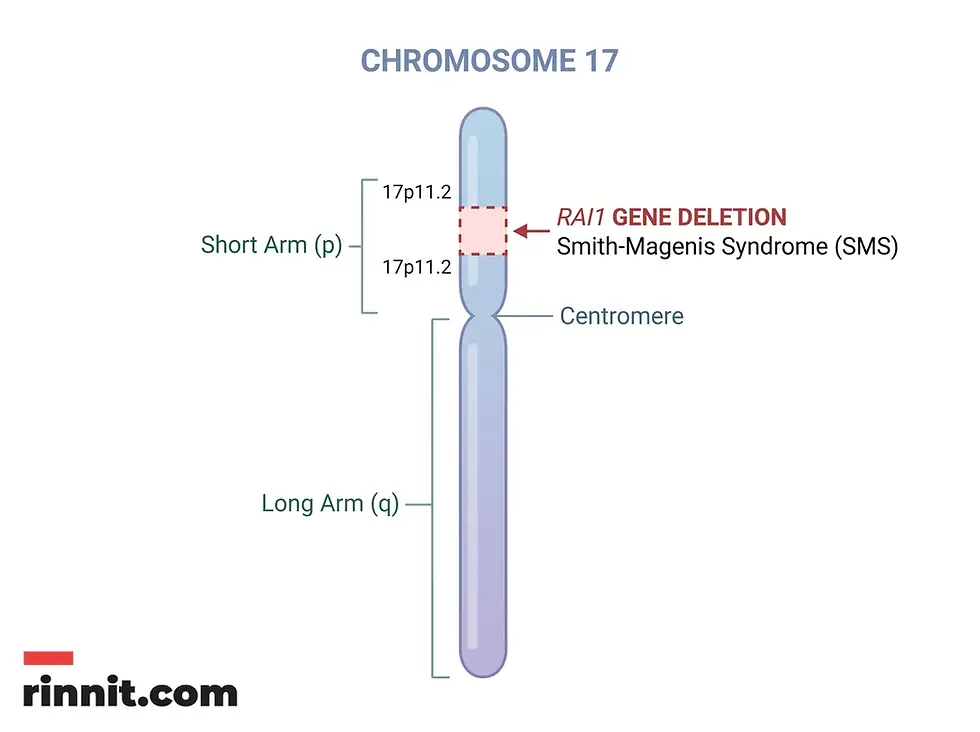
The main cause is loss of function of the retinoic acid induced 1 (RAI1) gene, located on the short arm of chromosome 17 (region 17p11.2). [1] [2] RAI1 helps control the activity of other genes and is important for the development and function of many organs and tissues, although its exact role is still being studied. [1] [2]
About 90% of people with the syndrome are missing a small piece of chromosome 17 that contains RAI1. [1] [2] The remaining 10% or so have a harmful change within the RAI1 gene that stops it from working properly. [1] [2] Because the deletion often removes other nearby genes too, features can vary from person to person. [2] [3]
Genetic feature | Approximate frequency | Mechanism |
|---|---|---|
Chromosomal deletion | About 90% | Loss of a segment of chromosome 17 (17p11.2) that includes RAI1 |
Gene variant | About 10% | A harmful change within the RAI1 gene |
Inheritance | Usually not inherited | Most cases arise spontaneously (de novo) around conception |
What are the symptoms of Smith-Magenis syndrome?
Symptoms vary widely in severity. Physical features can include short stature, scoliosis (curvature of the spine), and a hoarse or raspy voice. [1] Infants may have weak muscle tone (hypotonia), developmental delay, and feeding difficulties. [1] Less often, the syndrome affects the heart or kidneys, vision or hearing, or causes seizures.
Distinctive facial features usually become easier to recognize in middle childhood. [1] They include a broad, square-shaped face, full cheeks, deep-set eyes, a flat nasal bridge, and a prominent jaw. [1] Dental differences can also occur. [1] Speech and language are often delayed, and some children have difficulty with motor speech; see our guide to childhood apraxia of speech for more on that topic.
Sleep disturbances: A disrupted sleep-wake cycle is a hallmark. Many people have trouble falling asleep, wake often at night, and are very drowsy during the day. [1] This is linked to an abnormal pattern of melatonin release. [1] [4]
Behavioral traits: Children are often very affectionate and may hug themselves ("self-hugging"). [1] They can also have frequent tantrums, outbursts, and self-injurious behaviors such as head banging or hand biting. [1] Features of ADHD or autism spectrum disorder are common. [1]
How is Smith-Magenis syndrome diagnosed?
Diagnosis usually happens in childhood, when delays and physical traits become more apparent. [1] A healthcare provider will perform a physical examination, review the child's medical and developmental history, and talk with the family about sleep and behavior. Because the features overlap with other developmental disorders, genetic testing is needed to confirm the diagnosis. [1]
Genetic testing, usually a blood test, looks for the 17p11.2 deletion using chromosomal microarray or a related method. If no deletion is found but the features still suggest the syndrome, the RAI1 gene can be sequenced to look for a harmful variant. Early diagnosis helps families access support services and begin symptom management sooner. Genetic counseling is also recommended.
Diagnostic step | Purpose |
|---|---|
Physical exam | Assess growth, facial features, and muscle tone |
Medical and developmental history | Review milestones, sleep patterns, and behavior |
Genetic testing | Confirm a 17p11.2 deletion or an RAI1 variant |
How is Smith-Magenis syndrome managed and treated?
Smith-Magenis syndrome currently has no cure, so treatment focuses on managing symptoms and supporting development. [1] A multidisciplinary team is usually needed, which may include pediatricians, neurologists, geneticists, sleep specialists, speech-language pathologists, occupational and physical therapists, and behavioral specialists. Early intervention programs and individualized education plans help children reach their developmental and learning goals. [1]
Speech, physical, and occupational therapies address developmental delays and physical challenges, and behavioral therapy can help with outbursts and self-injury. [1] For sleep, a consistent routine and a sleep-friendly environment are the foundation. Because the melatonin rhythm is inverted, specialists may use melatonin at a carefully chosen time, sometimes combined with other measures, so dosing and timing should be directed by a physician. [1] [4] Medicines may also be used for co-existing conditions such as ADHD, anxiety, or seizures.

What is the outlook and long-term care for Smith-Magenis syndrome?
The long-term outlook depends on how severe the symptoms are and on the level of support a person receives. [1] Many people with the condition live into adulthood. [1] A 2023 scoping review of adults found that many childhood features persist, including intellectual disability, attention and autism-related traits, self-injurious and aggressive behavior, sleep-wake problems, and seizures, so ongoing care matters (Korteling et al., American Journal of Medical Genetics Part B, 2023) [5]. Some adults can live semi-independently with support, while others need lifelong care in a residential or group setting. [1]
Ongoing preventive care and symptom management are essential throughout life. [1] With appropriate support and a stable, structured environment, people with Smith-Magenis syndrome can lead healthy and fulfilling lives. Families are encouraged to work closely with their medical team and adjust the plan as needs change.

Conclusion
Smith-Magenis syndrome is a rare but well-characterized genetic condition. A missing segment of chromosome 17 or a change in the RAI1 gene disrupts development, behavior, and the body's sleep-wake rhythm. Although there is no cure, early diagnosis, coordinated therapies, sleep management, and strong family and school support can make a major difference in quality of life.
What are the next steps for families facing Smith-Magenis syndrome?
If you are concerned about your child's development, sleep, or behavior, speak with your pediatrician and ask whether a genetics referral is appropriate. If your family has received a diagnosis, ask your care team about early intervention services, sleep specialists, and genetic counseling, and consider connecting with a rare-disease family support organization.
Trusted resources: Cleveland Clinic: Smith-Magenis Syndrome, MedlinePlus Genetics: Smith-Magenis Syndrome, NORD: Smith-Magenis Syndrome
Frequently Asked Questions
What is the main cause of Smith-Magenis syndrome?
It is caused by a deletion that includes the RAI1 gene on chromosome 17 (17p11.2), or by a harmful variant within the RAI1 gene itself.
Is Smith-Magenis syndrome inherited?
In most cases, no. It usually arises spontaneously (de novo) and there is no family history. Rarely, a parent can carry the change, for example through germline mosaicism, so genetic counseling is recommended.
How common is this condition?
It affects an estimated 1 in 15,000 to 1 in 25,000 people worldwide.
What are the common facial features?
A broad, square-shaped face, full cheeks, deep-set eyes, a flat nasal bridge, and a prominent jaw. These usually become more noticeable in middle childhood.
Why do children with this syndrome have trouble sleeping?
Sleep problems are linked to an abnormal melatonin rhythm, in which the hormone is released during the day instead of at night. This causes difficulty falling and staying asleep and daytime sleepiness.
Can melatonin help with sleep problems?
It can help in some people when given at the right time, but because the rhythm is inverted, timing and dosing should be directed by a physician, ideally one with sleep experience.
What behavioral symptoms are common?
Affectionate behavior, self-hugging, tantrums, and sometimes aggression or self-injury such as head banging or hand biting. ADHD or autism features are also common.
Is there a cure for Smith-Magenis syndrome?
No. Treatment focuses on managing symptoms and supporting development with therapies, education, sleep management, and medicines when needed.
How is the condition diagnosed?
Diagnosis is confirmed with genetic testing, usually a blood test that looks for a 17p11.2 deletion or, if none is found, an RAI1 variant.
What is the RAI1 gene?
RAI1 is a gene on chromosome 17 that helps control the activity of other genes and is important for the development and function of many tissues.
Does Smith-Magenis syndrome affect life expectancy?
Outcomes depend on the severity of symptoms and any associated medical problems. Many people live into adulthood, and ongoing medical care is important.
What kinds of therapies are used?
Speech and language, physical, occupational, and behavioral therapies are commonly used, along with educational support and sleep management.
Can Smith-Magenis syndrome affect the heart or kidneys?
Sometimes. Heart and kidney differences have been reported, as have seizures, hearing loss, and vision problems, so regular monitoring is recommended.
What is "self-hugging" in this syndrome?
It is a characteristic behavior in which a person repeatedly wraps their arms around themselves in a squeezing or hugging motion.
Can people with Smith-Magenis syndrome live independently?
It varies. Some adults live semi-independently with support, while others need lifelong care in a residential or group setting.
References
Cleveland Clinic. Smith-Magenis Syndrome. Cleveland Clinic. November 22, 2022. https://my.clevelandclinic.org/health/diseases/24467-smith-magenis-syndrome
Rinaldi B, Villa R, Sironi A, et al. Smith-Magenis syndrome: clinical review, biological background and related disorders. Genes (Basel). 2022;13(2):335. PMID 35205380. https://doi.org/10.3390/genes13020335
Girirajan S, Vlangos CN, Szomju BB, et al. Genotype-phenotype correlation in Smith-Magenis syndrome: evidence that multiple genes in 17p11.2 contribute to the clinical spectrum. Genet Med. 2006;8(7):417-427. PMID 16845274. https://doi.org/10.1097/01.gim.0000228215.32110.89
De Leersnyder H. Smith-Magenis syndrome. Handb Clin Neurol. 2013;111:295-296. PMID 23622179. https://doi.org/10.1016/B978-0-444-52891-9.00034-8
Korteling D, Musch JLI, Zinkstok JR, et al. Psychiatric and neurological manifestations in adults with Smith-Magenis syndrome: a scoping review. Am J Med Genet B Neuropsychiatr Genet. 2024;195(2):e32956. PMID 37584268. https://doi.org/10.1002/ajmg.b.32956
Medical Disclaimer
This article is for informational purposes only and does not constitute medical advice. Always seek the advice of a qualified healthcare professional with any questions you may have regarding a developmental diagnosis or genetic testing.



Comments