Sinus Headache or Migraine: What Facial Pressure Really Means, and What Treatment Can — and Can't — Do

Updated: 2 days ago
Medically reviewed by Dr. Baraa Alnahhal, MD · Last reviewed: October 2026
Headaches with facial pressure around the eyes, cheeks, and forehead are often mistaken for sinus infections, but most turn out to be migraines or tension-type headaches. [2] True sinus headaches usually follow a cold, come with thick discolored mucus and a reduced sense of smell, and last days rather than hours. [1] Because the cause of head pain is hard to determine on your own, a provider's exam is key, and imaging such as CT or MRI is sometimes used. Treatment then targets migraines — with pain relievers, triptans, CGRP drugs, or other prescription options — rather than antibiotics. [1] [2]
Quick Answer
A sinus headache is pain, pressure and fullness in the cheeks, brow or forehead that worsens when you bend forward or lie down, sometimes with a stuffy nose or achy upper teeth. [1] Most people who seek care for sinus headaches actually have migraines, so treatment usually involves migraine medications rather than antibiotics. [1] [2] New or frequent facial-pressure headaches deserve evaluation.
What the research says
Most people who think they have a sinus headache actually have migraine. In a clinic study that screened 2,991 patients with a history of self-described or physician-diagnosed "sinus" headache, no previous migraine diagnosis and no evidence of infection, 88% met criteria for migraine (80%) or migrainous headache (8%); the most common sinus-area symptoms were sinus pressure (84%), sinus pain (82%) and nasal congestion (63%) (Schreiber et al., Arch Intern Med, 2004) [3].
Only a small share of self-diagnosed sinus headaches were caused by sinus disease. Among 100 adults who believed they had sinus headache, 52% had migraine with or without aura and 23% had probable migraine, while only 3% had a headache secondary to rhinosinusitis (Eross et al., Headache, 2007) [4].
Antibiotics add little even for true acute sinus infections. A Cochrane review of 15 trials with 3,057 adults found that without antibiotics 46% of people with acute rhinosinusitis were cured after 1 week and 64% after 14 days; antibiotics shortened time to cure for only 5 to 11 more people per 100 and caused more side effects (odds ratio 2.21; 95% CI 1.74–2.82), and the authors concluded there is no place for antibiotics in uncomplicated acute rhinosinusitis (Lemiengre et al., Cochrane Database Syst Rev, 2018) [5].
What Is a Sinus Headache?
A sinus headache is a headache that feels like an infection in the sinuses, the condition known as sinusitis. You may feel pressure around the eyes, cheeks, and forehead, and your head may throb. [1]
But this pain might actually be caused by a migraine. [1] That is the single most important fact to understand before reaching for antibiotics or sinus remedies.
The cause of headaches can be difficult to determine. [2] That is why providers ask detailed questions, perform an exam, and sometimes order imaging — because the treatment only works when it targets the real cause.
Key point: most people who assume they have sinus headaches actually have migraines or tension-type headaches. [2]
What are the symptoms of a sinus headache?
Signs and symptoms of sinus headaches may include the following features.
Symptom feature | What to expect |
Location | Pain, pressure, and fullness in the cheeks, brow, or forehead |
Position changes | Worsening pain when bending forward or lying down |
Nasal signs | Stuffy nose |
General | Fatigue |
Referred pain | Achy feeling in the upper teeth |
The position-related worsening is a hallmark. Migraine and sinus-headache pain both often get worse when you bend forward [1], which is one reason the two are so easy to confuse.
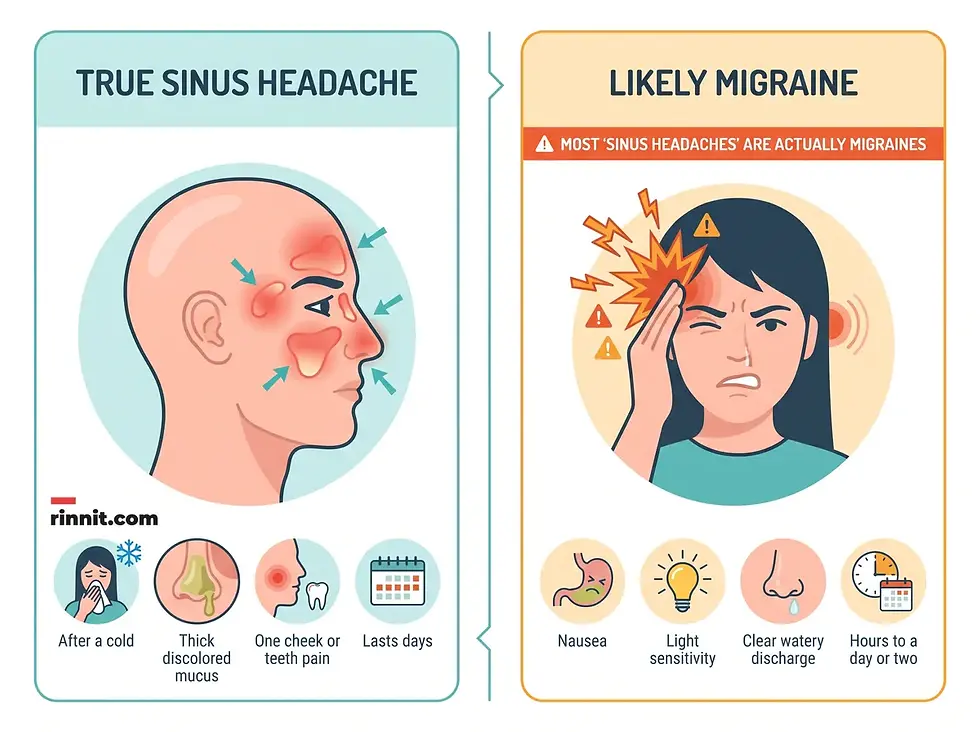
How can you tell sinusitis from a migraine?
Migraines and headaches from sinusitis are easy to confuse because their signs and symptoms overlap. [1] Both can include facial pressure and both worsen when you bend forward.
Migraine can also be accompanied by various nasal signs and symptoms — including congestion, facial pressure, and a clear, watery nasal discharge. [1] These nasal symptoms are due to involvement of the autonomic nervous system in a migraine attack. [1]
In fact, studies have shown that most people who see a health care provider for sinus headaches are found to have migraines instead. [1] [3] [4]
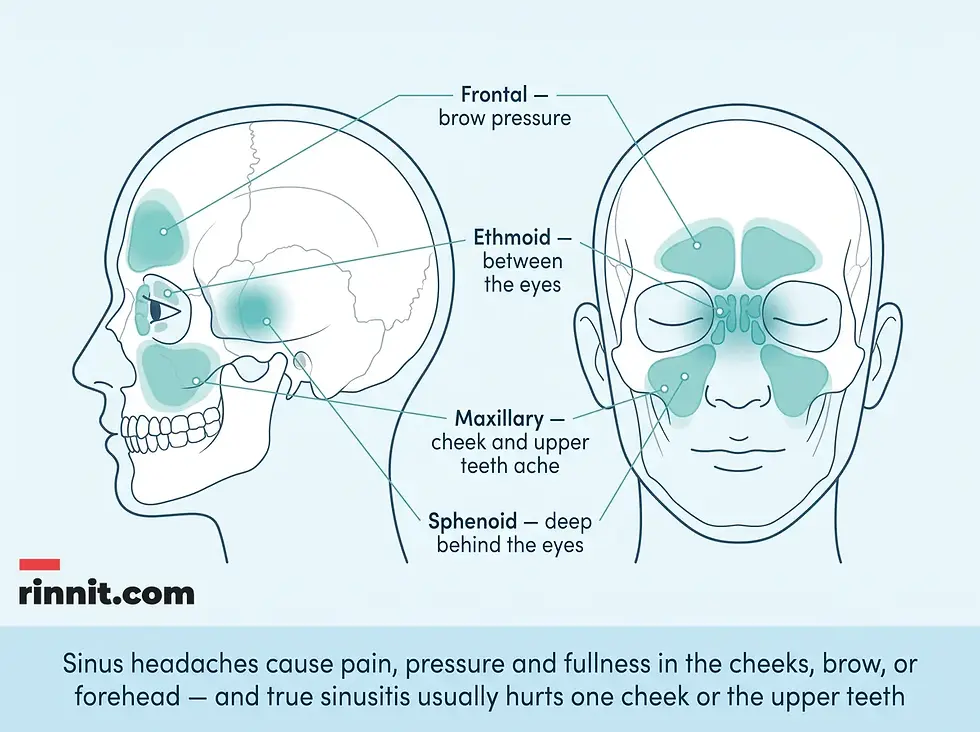
How true sinusitis usually behaves
Clue | Sinusitis pattern |
Timing | Usually occurs after a viral upper respiratory infection or cold |
Nasal discharge | Thick, discolored nasal mucus |
Sense of smell | Decreased sense of smell |
Pain location | Pain in one cheek or the upper teeth |
Duration | Often lasts days or longer |
How migraine usually behaves
Clue | Migraine pattern |
Nasal discharge | Clear, watery discharge possible (autonomic effect) |
Other features | Nausea or vomiting; aggravation by noise or bright light |
Duration | Most commonly lasts hours to a day or two |
Sinusitis, however, usually is not associated with nausea or vomiting, and it is not aggravated by noise or bright light — all common features of migraines. [1] The table below puts the two side by side.
Feature | More likely sinusitis | More likely migraine |
Onset | After a viral upper respiratory infection or cold | May occur without any infection |
Nasal mucus | Thick and discolored | Clear and watery, if present at all |
Sense of smell | Decreased | Usually normal |
Nausea or vomiting | Unusual | Common |
Light or noise sensitivity | Unusual | Common |
Pain location | One cheek or upper teeth | Often both sides, throbbing |
Typical duration | Days or longer | Hours to a day or two |
What causes sinus headaches?
Sinus headaches are usually associated with migraines or other forms of headaches. They produce pain and pressure in the face and sinuses and can cause nasal symptoms. [1]
Most of these headaches are not caused by sinus infections and generally should not be treated with antibiotics. [1] This is why getting the correct diagnosis matters — the wrong treatment wastes time and exposes you to medication side effects for no benefit.
What are the risk factors for sinus headaches?
Sinus headaches can affect anyone. [1] They may be more likely if you have any of the following.
Risk factor | What it means |
Previous history of migraines or headaches | Past patterns of head pain raise the odds the current pain is the same condition |
Family history of migraines or headaches | Headache disorders often run in families |
Hormonal changes associated with headaches | Estrogen fluctuations can trigger or worsen head pain |
When should you see a doctor for a sinus headache?
Consult your provider if any of the following apply. Get emergency care for a sudden, severe headache, a headache with fever and a stiff neck, confusion, vision changes, swelling or redness around the eye, or weakness or numbness.
Situation | Why it matters |
Headache symptoms occur more than 15 days a month [1] | This pattern signals chronic or recurrent headaches that need a treatment plan |
Frequent use of over-the-counter pain medicine | Relying on it often means the underlying problem is going untreated |
Severe headache that OTC pain medicine doesn't help | Strong pain with no relief needs medical evaluation |
Missing school or work due to frequent headaches | Headaches interfering with daily life deserve treatment, not endurance |
How are sinus headaches diagnosed?
Because the cause of headaches can be difficult to determine, your provider will question you about your headaches and do a physical exam. [2]
Your provider may perform imaging tests to help determine the cause of your headache. [2] These tests are the main way to confirm whether the sinuses, brain structures, or something else is involved.
Diagnostic test | How it works |
CT scan (computerized tomography) | A computer combines images from an X-ray unit that rotates around your body to create cross-sectional images of the brain and head, including the sinuses |
MRI (magnetic resonance imaging) | A magnetic field and radio waves create cross-sectional images of the structures within the brain |
What are the treatment options for sinus headaches?
Because most presumed sinus headaches turn out to be migraines or tension-type headaches, treatment usually targets those conditions. [2] Migraines and chronic or recurrent headaches may be treated with prescription medication taken every day to reduce or prevent headaches, or taken at the onset of a headache to keep it from getting worse. [2]
Treatment approach | How it works and key notes |
Over-the-counter pain relievers | Acetaminophen (Tylenol and others), naproxen sodium (Aleve), and ibuprofen (Advil, Motrin IB and others) may treat migraines and other headaches |
Triptans | Block pain pathways in the brain; available as tablets, nasal sprays, and injections (sumatriptan, rizatriptan, naratriptan, zolmitriptan, frovatriptan, eletriptan). A single-tablet combination of sumatriptan and naproxen sodium (Treximet) has proved more effective than either medication alone. Avoid if you have a history of heart disease or stroke, because they promote constriction of blood vessels [2] |
Ergots | Ergotamine and caffeine combination drugs (Migergot) are less effective than triptans and may worsen migraine nausea or lead to medication overuse headaches; they seem most effective when pain lasts more than 48 hours. Dihydroergotamine (D.H.E. 45, Migranal) is an ergot derivative that is more effective, has fewer side effects, and is less likely to cause medication-overuse headaches. Available as nasal spray and injection. Also avoid with a history of heart disease or stroke |
Lasmiditan (Reyvow) | A newer oral tablet approved for migraine with or without aura; it blocks pain pathways like a triptan but does not appear to constrict blood vessels |
CGRP antagonists | Oral calcitonin gene-related peptide receptor antagonists ubrogepant (Ubrelvy) and rimegepant (Nurtec ODT) are approved for acute migraine with or without aura in adults |
CGRP monoclonal antibodies | Erenumab-aooe (Aimovig), fremanezumab-vfrm (Ajovy), galcanezumab-gnlm (Emgality), and eptinezumab-jjmr (Vyepti) are FDA-approved migraine drugs given monthly or quarterly by injection |
Anti-nausea medications | Migraines often come with nausea, with or without vomiting. Medications such as chlorpromazine, metoclopramide (Reglan, Gimoti), and prochlorperazine (Compro, Procomp) are usually combined with other medications |
Glucocorticoids | Dexamethasone (Hemady) may be used with other medications to improve pain relief, but should not be used frequently due to the risk of steroid toxicity |
A word of caution: treating facial-pressure headaches with antibiotics is generally not the right path, because most are not caused by sinus infections at all. [1]
How can migraine prevention help prevent sinus headaches?
Whether or not you take preventive medications, lifestyle changes can help reduce the number and severity of headaches. One or more of these suggestions may be helpful for you.
Preventive step | How it helps |
Avoid triggers | If certain foods or odors have triggered your headaches in the past, avoid them. Your provider may recommend reducing caffeine and alcohol intake and avoiding tobacco. Establish a daily routine with regular sleep patterns and regular meals, and try to control stress |
Exercise regularly | Regular aerobic exercise reduces tension and can help prevent headaches — choose walking, swimming, or cycling if your provider agrees. Warm up slowly, because sudden, intense exercise can cause headaches. [1] Obesity is also thought to be a factor in headaches, and regular exercise helps maintain a healthy weight |
Reduce the effects of estrogen | If estrogen seems to trigger or worsen your headaches, you may want to avoid or reduce estrogen-containing medications such as birth control pills and hormone replacement therapy. Talk with your provider about appropriate alternatives or dosages |

Conclusion: Get the Right Diagnosis First
Facial pressure and head pain that feel like a sinus infection deserve careful attention — but the answer is rarely what people assume. Most presumed sinus headaches turn out to be migraines or tension-type headaches [2], and true sinus infections are not the usual culprit.
That makes the diagnosis step the most important one. With the right questions, an exam, and sometimes a CT scan or MRI, your provider can identify the true cause and match it to treatment that actually works — whether that is a triptan, a CGRP medication, a lifestyle routine, or something else entirely.
If facial pressure, tooth achiness, or sinus-area pain keeps bringing you headaches, schedule an evaluation with your healthcare provider today.
Frequently Asked Questions
What are the symptoms of a sinus headache?
A sinus headache causes pain, pressure, and fullness in the cheeks, brow, or forehead. It typically worsens when you bend forward or lie down and may come with a stuffy nose, fatigue, and an achy feeling in the upper teeth.
Is my sinus headache really a migraine?
Very often, yes. Studies have shown that most people who seek care for sinus headaches are actually found to have migraines, because migraine attacks can produce congestion, facial pressure, and clear nasal discharge through the autonomic nervous system.
What causes sinus headaches?
Sinus headaches are usually associated with migraines or other forms of headaches. Most are not caused by sinus infections, which is why they generally should not be treated with antibiotics.
How can I tell sinusitis from a migraine?
True sinusitis usually follows a cold, produces thick discolored mucus, reduces your sense of smell, causes pain in one cheek or upper teeth, and lasts days or longer. Migraine more often brings nausea, vomiting, or light and noise sensitivity and lasts hours to a day or two.
How long does a sinus headache last?
Headaches due to sinus disease often last days or longer, while migraines most commonly last hours to a day or two. Duration is one of the clearest clues to the true cause.
When should I see a doctor for a sinus headache?
See a provider if headaches occur more than 15 days a month, require frequent over-the-counter pain medicine, are severe and unrelieved by over-the-counter medicine, or cause you to miss school or work.
How are sinus headaches diagnosed?
Your provider will question you about your headaches and perform a physical exam. Imaging tests such as a CT scan or MRI may be performed to look at the sinuses, brain, and head structures and help determine the cause.
How are sinus headaches treated?
Because most turn out to be migraines or tension-type headaches, treatment usually targets those conditions: over-the-counter pain relievers, triptans, CGRP antagonists or monoclonal antibodies, ergots, anti-nausea medications, or glucocorticoids, chosen based on your history and health.
Can sinus headaches go away on their own?
Migraines and headache patterns often continue without a treatment plan. Daily preventive medication or medication taken at headache onset can reduce or prevent attacks, and lifestyle changes may also reduce their number and severity.
How can I prevent sinus headaches?
Work with your provider to avoid known triggers like certain foods, odors, caffeine, alcohol, and tobacco; keep regular sleep and meal routines; exercise regularly with a slow warm-up; and discuss reducing estrogen-containing medications if estrogen triggers your headaches.
Further Reading
For further authoritative guidance, consult:
American Academy of Otolaryngology — Head and Neck Surgery — sinus headache and facial pain information
National Institute of Neurological Disorders and Stroke — Headache Information Page — government resource on headache disorders and research
American Migraine Foundation — research-backed migraine education
References
Mayo Clinic. Sinus headaches - Symptoms & causes. Mayo Clinic. May 17, 2022. https://www.mayoclinic.org/diseases-conditions/sinus-headaches/symptoms-causes/syc-20377580
Mayo Clinic. Sinus headaches - Diagnosis & treatment. Mayo Clinic. May 17, 2022. https://www.mayoclinic.org/diseases-conditions/sinus-headaches/diagnosis-treatment/drc-20377584
Schreiber CP, Hutchinson S, Webster CJ, et al. Prevalence of migraine in patients with a history of self-reported or physician-diagnosed "sinus" headache. Arch Intern Med. 2004;164(16):1769-1772. PMID 15364670. https://doi.org/10.1001/archinte.164.16.1769
Eross E, Dodick D, Eross M. The Sinus, Allergy and Migraine Study (SAMS). Headache. 2007;47(2):213-224. PMID 17300361. https://doi.org/10.1111/j.1526-4610.2006.00688.x
Lemiengre MB, van Driel ML, Merenstein D, et al. Antibiotics for acute rhinosinusitis in adults. Cochrane Database Syst Rev. 2018;9(9):CD006089. PMID 30198548. https://doi.org/10.1002/14651858.CD006089.pub5
Medical disclaimer
The information provided in this article is for educational purposes only and should not be used as a substitute for professional medical advice, diagnosis, or treatment. Always seek the advice of your physician or other qualified health provider with any questions you may have regarding a medical condition.



Comments