Rippling Muscle Disease: Symptoms, Causes, and Management

Updated: 2 days ago
Medically reviewed by Dr. Baraa Alnahhal, MD · Last reviewed: October 2026
Quick Answer: What is rippling muscle disease?
Rippling muscle disease (RMD) is a rare neuromuscular disorder in which skeletal muscles become unusually sensitive to movement or pressure, causing mounding, stiffness and visible wave-like rippling. Most cases result from a CAV3 gene mutation that leaves muscle cells short of caveolin-3. Symptoms usually begin in late childhood or adolescence and are triggered by impact, stretching, exercise or cold. [1]

What the research says
Rippling muscle disease can start in childhood. A report of 7 children with RMD caused by caveolin-3 gene mutations described frequent falls, painful tiptoe walking, calf hypertrophy, and raised creatine kinase as early symptoms, with percussion- or pressure-induced contractions, painful muscle mounding, and rippling visible even in early childhood (Schara et al., J Child Neurol, 2002). [2]
An immune-mediated form exists and can respond to treating its cause. A case report described a patient with RMD and a thymoma whose anti-MURC/cavin-4 antibody levels fell sharply after tumor removal and immunotherapy, with complete disappearance of the rippling and full remission. The authors noted that this antibody had recently been found in 8 of 10 patients with immune-mediated RMD without thymoma (Svahn et al., Neurol Neuroimmunol Neuroinflamm, 2023). [3]
What Is Rippling Muscle Disease?
RMD mainly affects the skeletal muscles, the muscles you control to move. It tends to affect muscles near the center of the body (proximal muscles) the most, especially the thigh muscles (quadriceps). The hallmark is irritable, excitable muscle that reacts abnormally to physical stimuli. Symptoms most often begin in late childhood or adolescence, but they can begin at any age. [1]
What are the symptoms and warning signs of rippling muscle disease?
Two symptoms are always present in RMD: muscle mounding and repetitive muscle tensing. They typically happen after a sudden impact, such as bumping into something. About 60% of people with RMD also have visible muscle rippling, which usually happens when a muscle is stretched. [1]
Symptom | What It Looks or Feels Like | Usual Trigger |
|---|---|---|
Muscle mounding | The muscle bunches up into a visible lump. | Sudden impact or pressure on the muscle. |
Repetitive muscle tensing | Contractions that can last up to 30 seconds. | Sudden impact or physical contact. |
Muscle rippling | Wave-like contractions that can look like worms crawling under the skin, lasting about 5 to 20 seconds. [1] | Stretching the muscle. |
Muscle changes | Overgrowth (hypertrophy) of some muscles and an atypical walking pattern (gait). | Develops over time in some people. |
General discomfort | Fatigue, muscle stiffness, and muscle cramps. | More likely after strenuous exercise or cold exposure. |
RMD can be painful when repetitive contractions last a while, and cramping can also hurt. For general advice on cramps, see our guide to leg cramps. [1]
What causes rippling muscle disease, and how is it inherited?
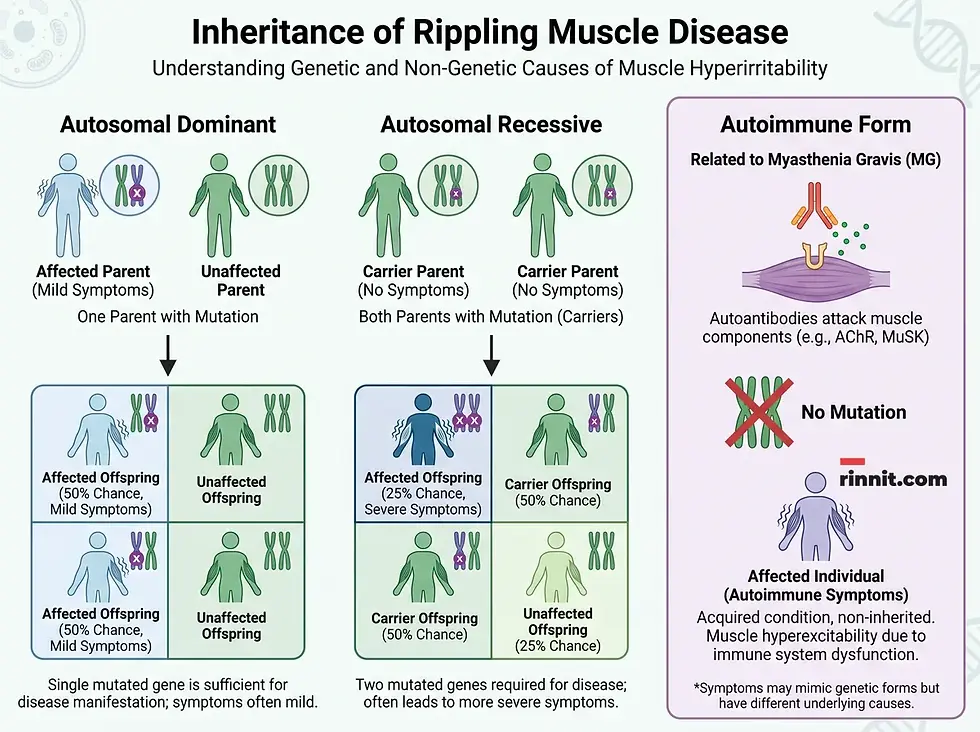
Most cases of RMD result from changes (mutations) in the CAV3 gene, which is passed down from a biological parent. This gene provides instructions for making caveolin-3, a protein in the membrane around muscle cells that may also help regulate calcium levels. In RMD, the mutation leads to a lack of caveolin-3. Researchers think this disrupts normal calcium control in muscle cells and causes abnormal contractions when the muscle is pressed or stretched. [1]
Autosomal dominant: Inheriting one altered CAV3 gene from one biological parent. This is the most common pattern. [1]
Autosomal recessive: Inheriting an altered CAV3 gene from both biological parents. This form typically causes more severe symptoms. [1]
New mutations: In rare cases RMD results from a new mutation that is not inherited, including in people with no family history. [1]
Autoimmune form: Cases of an autoimmune form have been reported alongside myasthenia gravis. People with this form do not have CAV3 mutations. [1]
Muscle conditions caused by CAV3 mutations are called caveolinopathies. Along with RMD, they include autosomal dominant limb-girdle muscular dystrophy, hypertrophic cardiomyopathy, isolated hyperCKemia (raised creatine kinase), and CAV3-related distal myopathy. These can sometimes share symptoms with RMD, such as wave-like muscle contractions. [1]
How is rippling muscle disease diagnosed and tested?
Because RMD is rare and shares symptoms with other conditions, providers may use several of the following. Not every test is always necessary. [1]
Medical history: Especially any family history of RMD or other caveolinopathies. [1]
Physical and neurological exams: To look at how the muscles respond to pressure and stretch. [1]
Creatine kinase (CK) blood test: CK is often raised in muscle disorders. [1]
Electromyography (EMG): Measures the electrical activity of muscles. [1]
Muscle biopsy: Examines a small tissue sample, including for caveolin-3. [1]
Antibody tests: To check whether RMD is autoimmune. [1]
Genetic testing: Looks for a CAV3 gene mutation. [1]
Your provider may refer you to a neurologist who specializes in neuromuscular disorders or to a geneticist. [1]
How is rippling muscle disease managed and treated?
Treatment depends on whether RMD is the genetic or the autoimmune form.
Genetic Form
Treatment mainly involves symptom management and a referral for genetic counseling. Certain medicines can help if cramps or contractions are severe. [1]
Autoimmune Form
Because most RMD is genetic, it cannot be prevented. If you are concerned about passing RMD or other genetic conditions to a biological child, genetic counseling can help. [1]
Conclusion
Rippling muscle disease is rare and can be disruptive, and sometimes painful, but it is not fatal on its own. Care from a neurologist or geneticist, treatment of severe cramps or contractions, and a clear understanding of your triggers can help you manage symptoms. Genetic testing and counseling help families understand the condition and plan ahead.
What are the next steps if you have rippling muscle disease?
If you or a family member notices muscle bunching after a bump, wave-like contractions after stretching, or ongoing stiffness, talk to a healthcare provider about a neurological evaluation. If your symptoms become more severe or more frequent, or if a biological family member has been diagnosed, ask whether you or other relatives are at risk and whether genetic counseling is right for you.
Frequently Asked Questions
Does rippling muscle disease affect the heart?
RMD itself does not affect the heart. However, it is related to hypertrophic cardiomyopathy because both involve mutations in the same gene. It is possible, but very rare, for CAV3 mutations to affect both heart and skeletal muscles. [1]
Is there a cure for rippling muscle disease?
There is no cure for the genetic form, and treatment focuses on managing symptoms. The autoimmune form is treated by targeting the immune system and, if a thymoma is present, may involve removing the thymus gland.
Why do my muscles ripple when I stretch?
Researchers think a shortage of caveolin-3 disturbs normal calcium control in muscle cells, so muscles contract abnormally when they are stretched or pressed. [1]
Is rippling muscle disease fatal?
RMD itself is not fatal. Related CAV3 conditions, such as severe autosomal dominant limb-girdle muscular dystrophy or hypertrophic cardiomyopathy, can be life-threatening. [1]
Can exercise make symptoms worse?
Yes. Symptoms such as stiffness, cramps, and fatigue are more likely after strenuous exercise or exposure to cold. [1]
What does rippling look like?
Wave-like contractions that can look like worms crawling under the skin. About 60% of people with RMD have visible rippling, usually when a muscle is stretched. [1]
Is RMD always painful?
Not always, but repetitive contractions that last a while can cause muscle pain, and cramping can be painful. [1]
At what age do symptoms usually start?
Most often in late childhood or adolescence, though symptoms can begin at any age. [1]
Can cold weather trigger symptoms?
Yes. Cold temperatures make stiffness, cramps, and contractions more likely. [1]
How rare is rippling muscle disease?
Rippling muscle disease is a rare neuromuscular disorder. [1]
What is muscle mounding?
Muscle mounding is when a muscle bunches up into a visible lump, typically after a sudden impact such as bumping into something. [1]
Do I need a muscle biopsy?
Not always. Providers choose from several tests. Genetic testing looks for a CAV3 mutation, and a muscle biopsy can help rule out other conditions. [1]
Can RMD be misdiagnosed?
RMD symptoms can overlap with other conditions, including other CAV3-related muscle disorders. That is why providers combine history, exams, blood tests, EMG, and genetic testing. [1]
Is the autoimmune form different from the genetic form?
Yes. The autoimmune form does not involve CAV3 mutations. It has been reported alongside myasthenia gravis and may be treated with immunosuppressive therapy. [1]
Should my children be tested if I have RMD?
If you have the genetic form, you could pass it on. Talk to your provider about genetic counseling and whether testing is right for your family. [1]
References
Cleveland Clinic. Rippling Muscle Disease. Cleveland Clinic. December 22, 2023. https://my.clevelandclinic.org/health/diseases/rippling-muscle-disease
Schara U, Vorgerd M, Popovic N, et al. Rippling muscle disease in childhood. J Child Neurol. 2002;17(7):483-490. PMID 12269726. https://doi.org/10.1177/088307380201700703
Svahn J, Coudert L, Streichenberger N, et al. Immune-mediated rippling muscle disease associated with thymoma and anti-MURC/cavin-4 autoantibodies. Neurol Neuroimmunol Neuroinflamm. 2023;10(1):e200068. PMID 36522170. https://doi.org/10.1212/NXI.0000000000200068
Medical Disclaimer
This article is for informational purposes only and does not constitute medical advice. Rippling muscle disease is a rare condition that requires professional diagnosis and management by a specialist. Always seek the advice of your physician or other qualified health provider with any questions you may have regarding a medical condition. Never disregard professional medical advice or delay in seeking it because of something you have read in this article.



Comments