Reye’s Syndrome: Symptoms, Causes, and Prevention Guide

Updated: 2 days ago
Medically reviewed by Dr. Baraa Alnahhal, MD · Last reviewed: October 2026
Quick Answer: What is Reye’s syndrome?
Reye's syndrome is a medical emergency in which the brain swells and the liver fills with fat and fails, letting toxins build up in the blood. [1] It usually follows a viral infection, and aspirin use during that illness is the strongest known link. [1] Persistent vomiting and unusual sleepiness after a viral illness need emergency care. Prevention is safest.

What the research says
Cases fell sharply after aspirin warnings were issued. In US national surveillance covering 1,207 cases in people under 18 (1981 to 1997), reported cases dropped from a peak of 555 in 1980 to no more than 36 a year since 1987. Salicylate was detectable in the blood of 82% of affected children, and the overall case fatality rate was 31%, highest in children under five (relative risk 1.8) and in those with an ammonia level above 45 µg/dL (relative risk 3.4) (Belay et al., N Engl J Med, 1999) [3].
The same pattern appeared in the UK. Among 445 cases reported in the British Isles between 1982 and 1990, “classic” Reye’s cases fell by 79% after the June 1986 aspirin warnings, compared with about 50% for the less typical cases, and the classic cases were more likely to have received aspirin (p < 0.0001) (Hardie et al., Arch Dis Child, 1996) [4].
Many “Reye-like” illnesses are really inherited metabolic disorders. In 187 French children diagnosed with fatty acid oxidation defects, 49% presented with Reye syndrome features, 73% had high ammonia, and 75% had low blood sugar, which is why doctors test for these disorders in any suspected case (Baruteau et al., J Inherit Metab Dis, 2013) [5].
What Is Reye’s Syndrome?
Reye’s syndrome is a rare condition that mainly affects children and teenagers, although it can occur at any age. Swelling in the brain and a buildup of fat in the liver develop quickly, and the liver can no longer clear ammonia from the blood. [1] Mayo Clinic describes a typical pattern in which blood sugar drops while ammonia and acid levels in the blood rise. [1]
The condition is not contagious. The viral infections that usually come before it, such as flu and chickenpox, are. Researchers believe the underlying problem is a disturbance in how the mitochondria (the energy producers) in liver cells work, but the exact cause of classic Reye’s syndrome is still unknown (Schrör, Paediatr Drugs, 2007) [6]. Because of widespread aspirin warnings, the illness is now very rare. [3]
What are the symptoms and warning signs of Reye's syndrome?
Symptoms usually start about 3 to 5 days after a viral infection begins [1] [6], and they differ a little by age.
Group | Common Signs |
|---|---|
Children under 2 | Diarrhea and rapid breathing are often the first signs. |
Older children and teens | Vomiting that does not stop, and being sleepy or sluggish. |
As it gets worse | Irritable, aggressive, or irrational behavior; confusion; seeing or hearing things that are not there; weakness or inability to move the arms and legs. |
Emergency signs | Seizures, extreme sluggishness, and a decreased level of consciousness. |
How Doctors Grade Severity
Doctors often describe the illness in five stages. They help the care team judge how far the brain is affected.
Stage | Key Signs |
|---|---|
Stage 1 | Persistent, severe vomiting; extreme tiredness; confusion. |
Stage 2 | Delirium, combativeness, rapid breathing, and a fast heartbeat. |
Stage 3 | Deepening drowsiness into a coma, with stiff, bent-arm posturing (decorticate posturing). |
Stage 4 | Deeper coma, wide pupils that do not react to light, and stiff, straight-arm posturing (decerebrate posturing). |
Stage 5 | Seizures, paralysis, absent reflexes, and respiratory arrest. |
When to get help: seek emergency care if your child has seizures or loses consciousness. [1] Contact your child’s doctor right away if, after the flu or chickenpox, your child vomits repeatedly, becomes unusually sleepy or sluggish, or has sudden behavior changes. [1]
What causes Reye's syndrome, and who is at risk?
The exact cause is not known. The factors below most often appear together.
Aspirin (salicylates): Using aspirin to treat a viral illness is the most commonly reported risk factor. [1] Aspirin can hide in unexpected products, so check every label.
Viral infections: Reye’s syndrome may follow influenza or chickenpox in particular [1], and it can also follow an upper respiratory infection such as a cold.
Metabolic disorders: The most common is MCAD deficiency, a fatty acid oxidation disorder. In children with one of these disorders, aspirin during a viral illness is more likely to trigger symptoms, and symptoms can occur even without aspirin. [1]
Toxins: Insecticides, herbicides, and paint thinner can cause symptoms that look like Reye’s syndrome, but they do not cause the condition itself. [1]
How is Reye's syndrome diagnosed?
Reye's syndrome has no single diagnostic test [2], so doctors combine several tests because its symptoms overlap with other illnesses. Doctors usually start with blood and urine tests, which can include checks for ammonia, blood sugar, and clotting, and for fatty acid oxidation and other metabolic disorders. [2] Because the symptoms overlap with other illnesses, more tests are often needed.
Blood and urine tests: Look for high ammonia, low blood sugar, and signs of liver trouble, and screen for metabolic disorders. [2]
Spinal tap (lumbar puncture): Helps rule out meningitis or encephalitis, which can cause similar symptoms. [2]
Head CT or MRI: Can show brain swelling and rule out other causes of confusion or drowsiness. [2]
Liver biopsy: Can show fat buildup in liver cells and rule out other liver conditions. [2]
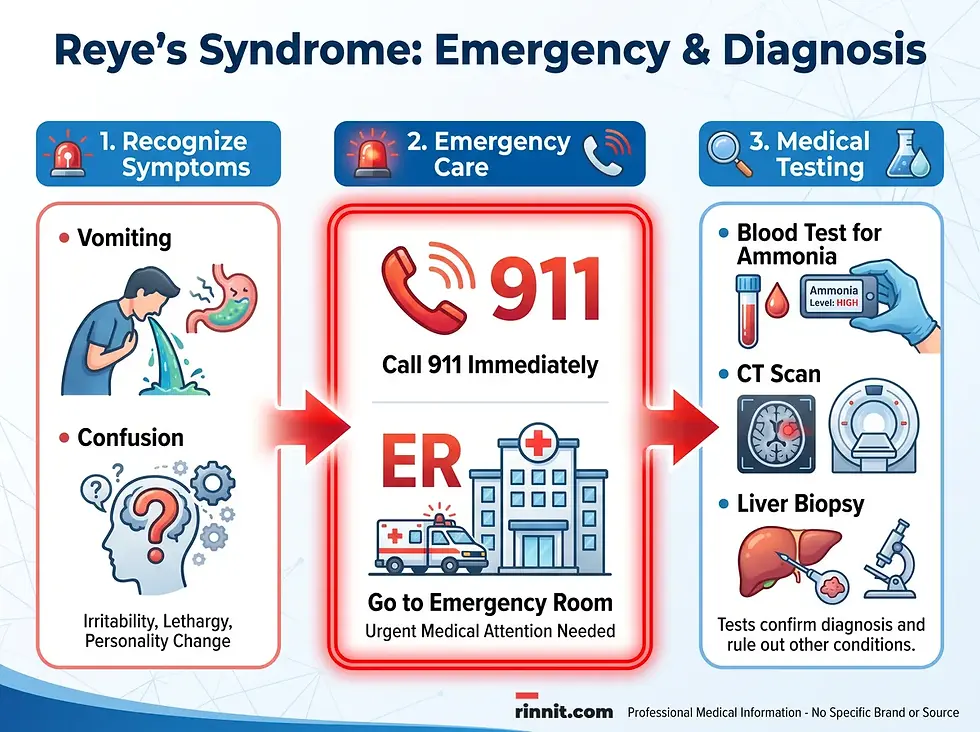
Because Reye’s syndrome is now so rare, any child suspected of having it should be checked carefully for treatable inherited metabolic disorders that can mimic it (Belay et al., N Engl J Med, 1999) [3].
How is Reye's syndrome treated and managed?
Treatment is given in the hospital, and serious cases are managed in the intensive care unit, where the team closely monitors blood pressure and other vital signs. [2] The aim is to support the body and protect the brain while the liver recovers.
IV fluids: Glucose (sugar) and an electrolyte solution are given through a vein. [2]
Diuretics: These medicines can lower pressure from fluid around the brain. [2]
Bleeding prevention: Liver problems can cause bleeding, which may be treated with vitamin K, plasma, and platelets. [2]
Cooling blankets: Help keep body temperature at a safe level. [2]
Breathing support: A ventilator can help if the child has trouble breathing. [2]
Ammonia control: In very high ammonia levels, intensive care teams may use dialysis. One published case describes a 4-year-old with an ammonia level above 500 µmol/L who recovered fully with this kind of treatment (Pribožič et al., Am J Case Rep, 2021) [7].
Most children and teenagers who have Reye’s syndrome survive, but varying degrees of lasting brain damage are possible. [1] Without proper diagnosis and treatment, the illness can cause death within a few days [1], which is why early care matters.
How does the "no aspirin" rule help prevent Reye's syndrome?
The most effective way to protect your child is to avoid aspirin. Mayo Clinic advises that children and teenagers should not be given aspirin, including medicines that contain it. [1] Age cutoffs on medicine labels vary (many use under 16, and some health authorities advise avoiding aspirin through age 18), so the safest approach is no aspirin for any child or teenager unless a doctor specifically prescribes it.
Read every label: This includes over-the-counter cold, flu, and stomach remedies and herbal products. Look for acetylsalicylic acid, acetylsalicylate, salicylic acid, and salicylate. [1]
Use safer alternatives: Infants’ or children’s acetaminophen or ibuprofen can treat fever and pain. Follow the age and weight directions on the label, and ask a doctor or pharmacist if you are unsure.
Ask before giving any new medicine: This is especially important for a child who is recovering from a virus, and for products containing bismuth subsalicylate.
Know the exceptions: Some children with long-term conditions, such as Kawasaki disease, need aspirin under specialist care. In these cases, keep vaccines current, including two doses of the chickenpox vaccine and a yearly flu vaccine. [1]
Tell every caregiver: Make sure babysitters, grandparents, and school staff know not to give your child aspirin.
Know your child’s risk: Some hospitals screen newborns for fatty acid oxidation disorders. If your child has one, avoiding aspirin is especially important. [1]

Conclusion
Reye’s syndrome is rare today, but its potential for permanent brain damage makes it one of the most serious pediatric emergencies. Following the “no aspirin” rule and knowing the early signs, repeated vomiting, unusual sleepiness, and sudden behavior changes after a virus, help children get life-saving care quickly.
What are the next steps for Reye's syndrome concerns?
Check your medicine cabinet today and set aside any products that contain aspirin or salicylates. Share the “no aspirin” rule with everyone who looks after your child. If your child shows warning signs after a viral illness, do not wait: seek emergency help right away.
Trusted resources: National Reye’s Syndrome Foundation, American Academy of Pediatrics, Centers for Disease Control and Prevention.
Frequently Asked Questions
What is the most common cause of Reye’s syndrome?
The exact cause is not known. Using aspirin during a viral illness such as flu or chickenpox is the most commonly reported link. Some children also have an underlying metabolic condition, such as medium-chain acyl-CoA dehydrogenase (MCAD) deficiency, that can lead to Reye-like symptoms even without aspirin.
Can adults get Reye’s syndrome?
Reye’s syndrome can occur at any age, but it is very rare in adults. It mainly affects children and teenagers after a viral infection.
Is Reye’s syndrome contagious?
No. The viruses that can trigger it, such as influenza and chickenpox, spread from person to person, but Reye’s syndrome itself does not.
How long after a virus does Reye’s syndrome start?
Symptoms usually begin about 3 to 5 days after a viral infection starts.
What is the survival rate for Reye’s syndrome?
Most children and teenagers who have Reye’s syndrome survive today, but lasting brain damage is possible. In older US national surveillance data (1981 to 1997), the case fatality rate was 31%, and it was highest in children under five.
Can a child recover fully from Reye’s syndrome?
Some children recover well, especially when the illness is recognized and treated early. Others have varying degrees of lasting brain damage, so quick medical care matters.
What other names for aspirin should I look for on labels?
Look for acetylsalicylic acid, acetylsalicylate, salicylic acid, and salicylate. Aspirin can also appear in unexpected products, such as some effervescent antacid tablets, so always check the label.
Does Pepto-Bismol contain aspirin?
Pepto-Bismol contains bismuth subsalicylate, which is a salicylate related to aspirin. Ask a doctor or pharmacist before giving it to a child or teenager who has a viral illness.
What can I give my child for fever instead of aspirin?
Infants’ or children’s acetaminophen or ibuprofen are safer alternatives. Follow the age and weight directions on the product label, and ask a doctor or pharmacist if you are unsure.
Is there a vaccine for Reye’s syndrome?
No vaccine exists for Reye’s syndrome itself. Chickenpox and yearly flu vaccines help prevent the two infections most often linked to it.
Can Reye’s syndrome cause seizures?
Yes. Swelling in the brain can cause seizures, convulsions, or loss of consciousness, and these need emergency treatment.
Should I call the doctor if my child vomits once after the flu?
A single episode of vomiting is common with the flu. Contact a doctor if your child vomits repeatedly, becomes unusually sleepy or sluggish, or has sudden behavior changes. Seek emergency help for seizures or loss of consciousness.
References
Mayo Clinic Staff. Reye’s syndrome: Symptoms and causes. Mayo Clinic. July 30, 2024. https://www.mayoclinic.org/diseases-conditions/reyes-syndrome/symptoms-causes/syc-20377255
Mayo Clinic Staff. Reye’s syndrome: Diagnosis and treatment. Mayo Clinic. July 30, 2024. https://www.mayoclinic.org/diseases-conditions/reyes-syndrome/diagnosis-treatment/drc-20377259
Belay ED, Bresee JS, Holman RC, et al. Reye’s syndrome in the United States from 1981 through 1997. N Engl J Med. 1999;340(18):1377–1382. PMID 10228187. https://doi.org/10.1056/NEJM199905063401801
Hardie RM, Newton LH, Bruce JC, et al. The changing clinical pattern of Reye’s syndrome 1982–1990. Arch Dis Child. 1996;74(5):400–405. PMID 8669954. https://doi.org/10.1136/adc.74.5.400
Baruteau J, Sachs P, Broué P, et al. Clinical and biological features at diagnosis in mitochondrial fatty acid beta-oxidation defects: a French pediatric study of 187 patients. J Inherit Metab Dis. 2013;36(5):795–803. PMID 23053472. https://doi.org/10.1007/s10545-012-9542-6
Schrör K. Aspirin and Reye syndrome: a review of the evidence. Paediatr Drugs. 2007;9(3):195–204. PMID 17523700. https://doi.org/10.2165/00148581-200709030-00008
Pribožič L, Žerjav Tanšek M, Herga P, et al. Reye syndrome with severe hyperammonemia and a good neurological outcome. Am J Case Rep. 2021;22:e932864. PMID 34629460. https://doi.org/10.12659/AJCR.932864
Medical Disclaimer
This article is for informational purposes only and does not constitute medical advice. Reye’s syndrome is a medical emergency. Always seek the advice of your physician or other qualified health provider with any questions you may have regarding a medical condition. Never disregard professional medical advice or delay in seeking it because of something you have read in this article.



Comments