Quadriceps (Quad Muscles): Anatomy, Function, Injuries and Care

Updated: 3 days ago
Medically reviewed by Dr. Baraa Alnahhal, MD · Last reviewed: October 2026
Quick Answer: What are the quadriceps muscles?
The quadriceps are a group of voluntary muscles on the front of the thigh, above the knee and below the hip. Their main role is to help straighten the knee, but they also help absorb force, flex the hip, support posture and balance, stabilize the kneecap and regulate walking. [1]
Core idea | Plain-language meaning |
Other name | Quadriceps femoris, or quads. |
Location | Front of the thigh, above the knee and below the hip. |
Main action | Helps straighten the knee. |
Other roles | Hip flexion, force absorption, posture, balance, kneecap movement and gait. |
Muscle type | Voluntary; you control how the muscles move and work. |
Tendon | The muscle heads merge into the quadriceps femoris tendon, which attaches to the kneecap. |
Common problems | Strains, contusions, cuts or lacerations, tendonitis and quad tendon tears. |
What the research says
Delay in seeking care is common in chronic quad tendon ruptures. A systematic review of 26 studies covering 44 patients who had surgery for chronic quadriceps tendon rupture (injuries of at least 6 weeks) found a mean of 17.2 months between injury and surgery. Falls were the most frequent mechanism (59%), and patient delay in seeking treatment accounted for 55% of delayed management in the cases that reported a reason. No re-ruptures were reported after repair or reconstruction (Touhey et al., J Knee Surg, 2025). [2]
Structured injury-prevention programs can lower injury rates. A systematic review and meta-analysis of nine randomized trials in 4,959 soccer players found that programs including balance training reduced ankle injuries by 36% per 1,000 hours of exposure compared with the team's usual warm-up (IRR 0.64, 95% CI 0.54–0.77). This study looked at ankle injuries in soccer rather than quad injuries specifically (Al Attar et al., J Physiother, 2022). [3]
Some medicines are linked to tendon complications. A systematic review and meta-analysis of 12 studies including 439,299 patients found Achilles tendinopathy or rupture after fluoroquinolone antibiotics in 0.17% of patients taking levofloxacin or ciprofloxacin and 1.40% of those taking ofloxacin. This study examined the Achilles tendon, not the quadriceps tendon (Sangiorgio et al., EFORT Open Rev, 2024). [4]

Where are the quadriceps located?
The quadriceps are on the front of the thigh, above the knee and below the hip. Quad tendons attach these muscles to the pelvis, hip bones, thigh bones (femurs) and kneecaps. [1]
The quadriceps are voluntary muscles. You control how they move, unlike muscles that work on their own. They are one of the major muscle groups of the leg. [1]
What do the quadriceps do?
The main job of the quadriceps is to straighten the knee. This helps you kick, run, jump and walk. [1]
The quads also absorb force when your heel hits the ground. They flex the hip, help with posture and balance, and move and steady the kneecap (patella). They also control your gait, the way you walk. [1]
Quadriceps role | What it supports |
Knee extension | Straightening the knee. |
Force absorption | Absorbing force when the heel contacts the ground. |
Hip flexion | Moving the thigh toward the front of the body. |
Posture and balance | Helping maintain an upright, stable position. |
Patella movement and stability | Moving and stabilizing the kneecap. |
Gait regulation | Supporting the way you walk. |
What are the five quadriceps muscles?
Cleveland Clinic describes five muscles in the quadriceps group. Experts once thought there were four, and many anatomy books still list four. A fifth muscle has since been identified. [1]
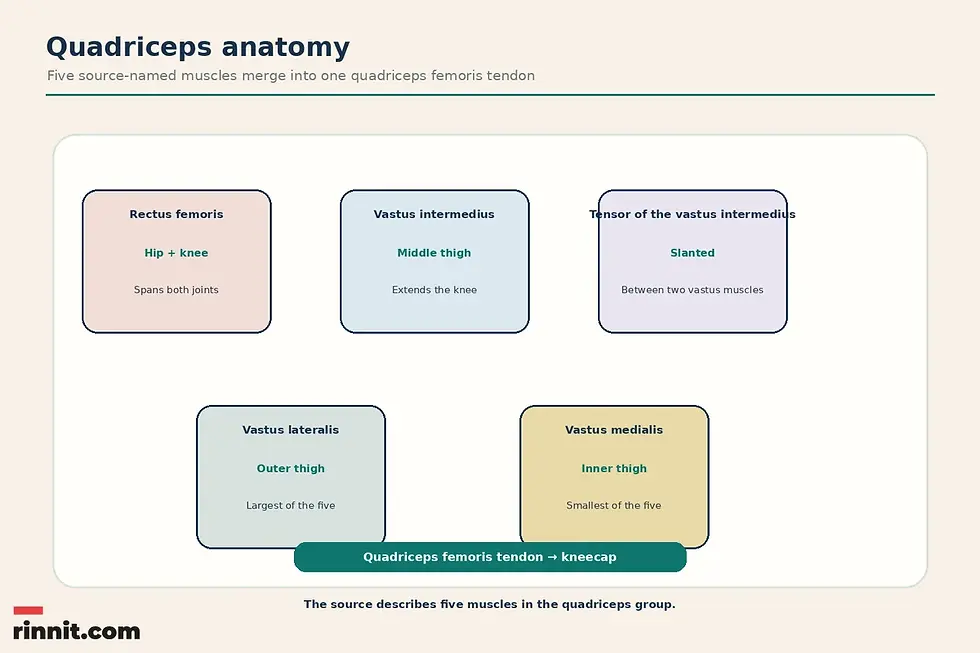
Muscle | Description |
Rectus femoris | Has two heads originating from the hip bone and pelvis and extends to the kneecap; the only quad muscle spanning both the hip and knee joints. |
Vastus intermedius | Lies in the middle of the thigh beneath the rectus femoris and primarily extends the knee. |
Tensor of the vastus intermedius | A slanted muscle between the vastus lateralis and vastus intermedius. |
Vastus lateralis | Runs along the outside of the thigh, connects the thigh bone to the kneecap and is the largest of the five. |
Vastus medialis | Runs along the inside of the thigh and connects the thigh bone to the kneecap; it is the smallest of the quad muscles. |
How do the quadriceps attach to the knee?
All five muscles merge into one shared tendon, the quadriceps femoris tendon. This tendon attaches the muscles to the kneecap. [1]
The quads also have many tiny, elastic muscle fibers that help the thigh muscles tighten (contract). The fibers are red and white, which gives the muscles a striped look. [1]
What is a quadriceps strain?
A quadriceps strain, or pulled quad, happens when muscle fibers are overstretched. It can range from mild to severe. [1]
In a severe injury, the quadriceps tendon can tear completely away from the kneecap. This is called a quad tendon tear. [1]
What other injuries affect the quads?
Besides strains and quad tendon tears, injuries include contusions, cuts or lacerations, and tendonitis. [1]
Injury | Description |
Strain | Overstretched quad muscle fibers; severity can range from mild to severe. |
Quad tendon tear | A severe injury in which the quad tendon completely tears away from the kneecap. |
Contusion | Usually follows a direct blow to the front of the thigh; may cause bruising or a hematoma, in which blood pools under the skin. |
Cut or laceration | An open wound that breaks the skin and may damage the quad muscles or tendon; possible causes include a fall, car accident or traumatic sports injury. |
Tendonitis | Inflammation of tendons connecting the quad muscles to the kneecap or hip; it can cause thigh pain and put extra pressure on the muscles. |
What symptoms can a quad injury cause?
A quad injury may cause a tearing or popping feeling, severe pain and swelling, bruising, cramping, tenderness and trouble walking. Some injuries cause a dent above the kneecap. Others make it impossible to straighten the knee or make the kneecap droop. [1]
Possible symptom | What it may mean |
Tearing or popping sensation | May occur with a quadriceps injury. |
Pain and swelling | Severe pain and swelling may occur. |
Bruising | May occur, including after a contusion. |
Indentation above the kneecap | May be noticeable after an injury. |
Inability to straighten the knee | May occur with a quadriceps injury. |
Cramping or tenderness | May occur. |
Drooping or sagging kneecap | May occur with a severe injury. |
Trouble walking | May occur and should be assessed in context. |
Thigh and knee symptoms can have many causes. See also our guide to knee pain.
Who is at risk of quad injuries?
Quad injuries are common in athletes who run, jump and kick. This includes sprinters and people who play soccer, football, rugby, basketball and softball. [1]
Other risk factors include being over 40, having a health condition that weakens tendons, or having had a quad injury before. Tired quads, weak quads or hamstrings, and corticosteroids or other medicines that can damage tendons also raise the risk. [1]
Risk factors do not establish that an injury is present. A healthcare professional should assess symptoms and function.
How can you keep your quads healthy?
Do not push through hip, leg or knee pain. Rest your quads between workouts or long periods of effort. Warm up and stretch the quad muscles before and after activity. These habits help, but they cannot guarantee you won't get hurt.
Habit | Practical meaning |
Do not push through pain | Stop and reassess activity if hip, leg or knee pain develops. |
Rest between exertion | Give the quadriceps time to rest between workouts or prolonged activity. |
Warm up and stretch | Properly warm up and stretch before and after physical activity. |

When should you contact a healthcare professional?
Contact a healthcare provider right away if you cannot move your leg or walk, have numbness in your hips, legs or knees, or have severe, sudden leg pain. Ongoing pain in the front of the thigh also needs prompt care.
Most mild to moderate quad injuries get better without surgery. A severe injury, such as a torn quad tendon, may need surgery. Get emergency care for severe or fast-worsening pain, not being able to bear weight, a large open wound, severe swelling or numbness, or other worrying symptoms after an injury. [1]
How can you prepare for a professional visit?
Note when symptoms started, what you were doing, whether you felt a pop or took a direct hit, and whether you can walk or straighten your knee. Bring a list of your medicines and health history, including past quad injuries and conditions that affect tendons.
This helps your provider assess you, but it cannot tell on its own whether you have a strain, bruise (contusion), tendonitis or a tendon tear.
Conclusion: Strong quads support everyday movement
The quadriceps are a muscle group at the front of the thigh. They straighten the knee and help with walking, running, jumping, kicking, hip flexion, posture, balance, kneecap stability and gait. [1]
Strains, bruises, cuts, tendonitis and quad tendon tears can affect these muscles or their tendon. Don't push through hip, leg or knee pain. Rest between workouts, and warm up and stretch properly. If you cannot move or walk, or have numbness or severe sudden leg pain, contact a healthcare provider right away. [1]
Use this guide to understand quad anatomy and prepare questions for a qualified healthcare professional. It is a starting point for informed care, not a diagnosis. [1]
Frequently Asked Questions
What are the quadriceps muscles?
The quadriceps, or quadriceps femoris, are a group of voluntary muscles at the front of the thigh.
What is the main function of the quadriceps?
The quadriceps' main function is helping straighten the knee. They also support kicking, running, jumping, walking, hip flexion, posture, balance, kneecap stability and gait.
How many quadriceps muscles are there?
Cleveland Clinic describes five: rectus femoris, vastus intermedius, tensor of the vastus intermedius, vastus lateralis and vastus medialis. Many anatomy references still describe four.
Which quad muscle crosses both the hip and knee?
The rectus femoris is the only quad muscle described as spanning both the hip and knee joints.
What is a quad strain?
A quad strain, or pulled quad, results from overstretched muscle fibers. It can range from mild to severe.
What is a quad tendon tear?
A quad tendon tear is a severe injury in which the quadriceps tendon completely tears away from the kneecap.
What are common symptoms of a quad injury?
Possible symptoms include a tearing or popping sensation, pain and swelling, bruising, tenderness, cramping, trouble walking, an indentation above the kneecap and inability to straighten the knee.
Who is more likely to injure a quad?
Risk is higher in athletes who run, jump or kick, people over 40, people with a prior quad injury, quad fatigue, weak quads or hamstrings, tendon-weakening conditions or corticosteroid use.
How can I reduce my risk of quad injury?
Do not push through hip, leg or knee pain, rest between workouts or prolonged exertion, and properly warm up and stretch before and after activity.
When should I seek care for a quad injury?
Contact a healthcare provider right away if you cannot move your leg or walk, have numbness in the hips, legs or knees, or have severe, sudden leg pain.
Related guides
References
Cleveland Clinic. Quadriceps (Quads): What Are They, Anatomy & Function. Cleveland Clinic. Updated March 23, 2025. https://my.clevelandclinic.org/health/body/22816-quad-muscles
Touhey DC, Beady ND, Tartibi S, et al. Chronic Quadriceps Tendon Rupture-Surgical Treatment and Outcomes: A Systematic Review. J Knee Surg. 2025;38(11):539-548. PMID 40345235. https://doi.org/10.1055/a-2585-5037
Al Attar WSA, Khaledi EH, Bakhsh JM, et al. Injury prevention programs that include balance training exercises reduce ankle injury rates among soccer players: a systematic review. J Physiother. 2022;68(3):165-173. PMID 35753965. https://doi.org/10.1016/j.jphys.2022.05.019
Sangiorgio A, Sirone M, Adravanti FM, et al. Achilles tendon complications of fluoroquinolone treatment: a molecule-stratified systematic review and meta-analysis. EFORT Open Rev. 2024;9(7):581-588. PMID 38949172. https://doi.org/10.1530/EOR-23-0181
Medical disclaimer
This article is for general educational purposes and is not a substitute for professional medical advice, diagnosis or treatment. Always seek the advice of a qualified healthcare professional with any questions about a medical condition or treatment.



Comments